

La Specola Florence reveals a side of the city that many visitors never discover. While Florence is famous for Renaissance painting, sculpture and architecture, this remarkable museum tells another story: the history of science, anatomy, zoology and the human desire to understand the natural world.
Located on Via Romana in the Oltrarno, only a short walk from Palazzo Pitti and the Boboli Gardens, La Specola combines historic natural-history collections with extraordinary anatomical wax models and centuries of scientific heritage. For visitors interested in medicine, biology or the history of science, it is one of the most unusual museums in Florence.
Opened: 1775
Historic name: Imperial and Royal Museum of Physics and Natural History
Founded under: Grand Duke Peter Leopold of Lorraine
Famous for: Anatomical wax models and natural-history collections
Location: Via Romana 17, Oltrarno
Nearby: Palazzo Pitti and Boboli Gardens
Suggested visit: Approximately 2 hours
Why Visit La Specola Florence?
La Specola offers something fundamentally different from Florence’s great art museums. Instead of concentrating on paintings and sculpture, it explores how generations of scholars observed, classified and attempted to understand nature and the human body.
The museum is particularly fascinating because scientific objects and historical context remain closely connected. Zoological specimens, anatomical models and scientific collections reveal how knowledge developed before photography, medical imaging and digital visualisation transformed the study of the natural world.
For visitors spending several days in Florence, La Specola provides a fascinating contrast to the Uffizi and Accademia. It also belongs naturally among the small museums in Florence worth discovering, particularly for travellers who enjoy places beyond the standard itinerary.
A Scientific Museum Born in the Age of Enlightenment
La Specola opened in 1775 as the Imperial and Royal Museum of Physics and Natural History under Grand Duke Peter Leopold of Lorraine. It became one of Europe’s pioneering institutions for presenting scientific collections to a wider public.
Its origins, however, reach further back. The Medici family collected not only paintings, sculptures and precious objects but also minerals, fossils, plants, animals and scientific curiosities. Such collections reflected the Renaissance and early modern fascination with observing and understanding the world.
After the end of the Medici dynasty, the Lorraine grand dukes developed these collections in a more systematic direction. Natural objects were increasingly classified, studied and displayed according to scientific principles. The museum became part of the Enlightenment idea that knowledge should be organised and made accessible.
Science, anatomy, philosophy, craftsmanship and nature were not regarded as completely separate fields. Together they formed part of a broader attempt to understand the physical world.
La Specola belongs to an important moment in European intellectual history. During the Enlightenment, private collections of curiosities increasingly developed into organised institutions devoted to observation, classification, research and education.
What Does the Name La Specola Mean?
The name Specola derives from the Italian word for an observatory. The building became associated with astronomical observation, reflecting the broad scientific ambitions of the institution rather than a narrow concentration on natural history.
This is important for understanding the museum. La Specola developed during a period when the boundaries between scientific disciplines were less rigid than they are today. Astronomy, physics, zoology, botany and anatomy could all belong to a wider culture of scientific investigation.
The name therefore preserves the memory of an institution intended not simply to store specimens but to participate actively in the study of nature.
From Medici Curiosity to Scientific Classification
The history of La Specola illustrates a profound change in the way Europeans collected objects. Renaissance princes often assembled unusual natural and artificial objects because they were rare, beautiful or astonishing. Such collections demonstrated curiosity, knowledge and power.
By the eighteenth century, scientists increasingly wanted to organise nature systematically. An animal specimen was no longer interesting merely because it looked exotic. Its anatomy, relationship to other species and place within systems of classification became equally important.
La Specola stands at the intersection of these traditions. The fascination with extraordinary objects remained, but Enlightenment science added a growing desire to compare, classify and explain them.
The Zoological Collections
Zoology forms an important part of La Specola Florence. Historic specimens document the enormous variety of animal life and reveal how natural-history museums became essential centres for scientific study before photography and modern field research transformed the biological sciences.
Preserved animals allowed researchers to compare species originating in distant parts of the world. For many European visitors, museums provided their first opportunity to examine creatures they could otherwise know only from drawings, written descriptions or travellers’ accounts.
Today, these collections have another dimension. They are not merely representations of animals but historical evidence of how scientists collected, preserved and presented nature during earlier centuries.
Natural History Before Photography
It is easy to underestimate the importance of physical museum collections from a modern perspective. Today, researchers can access high-resolution photographs, scientific databases, CT datasets and three-dimensional models almost instantly. Earlier scientists had none of these possibilities.
A carefully preserved specimen therefore represented information that could not easily be obtained in another way. Researchers could study proportions, anatomy, surfaces and structural differences directly, while specimens from different regions could be compared side by side.
Natural-history museums consequently functioned as research archives. Their objects were not simply exhibits for visitors but physical repositories of information about the biological world.
The Anatomical Waxes – The Great Treasure of La Specola
The most famous and perhaps most unforgettable part of La Specola is its collection of anatomical wax models. These extraordinary objects occupy a fascinating position between medicine, science and art.
The models were produced primarily during the eighteenth and nineteenth centuries for anatomical teaching and study. Access to human bodies for dissection was limited by practical and social constraints, while decomposition meant that anatomical preparations could be studied only for a limited period.
Wax offered an ingenious solution. A carefully constructed model could reproduce anatomical structures in three dimensions, preserve them permanently and allow the same preparation to be studied repeatedly. Muscles, organs, vessels, nerves and other structures could be presented layer by layer with extraordinary precision.

For modern visitors, the models can initially feel strange. Some are beautiful, some unsettling, and many combine both qualities. Their impact comes precisely from this tension between scientific accuracy and artistic craftsmanship.

Families should be aware that some models show the human body in considerable anatomical detail, including exposed muscles, organs and internal structures. The displays are historical and educational rather than sensational, but they may be intense for younger or sensitive children.
Look at the anatomical waxes not only as medical teaching models but also as handcrafted objects. Before photography, CT and MRI, anatomical modellers translated complex three-dimensional structures into durable teaching tools using observation, colour, sculpture and extraordinary manual skill.
How the Anatomical Models Were Made
Producing convincing anatomical wax models required close collaboration between scientific knowledge and artistic skill. Anatomists supplied the medical understanding, while specialised wax modellers reproduced structures with remarkable attention to shape, texture and colour.
Wax was particularly suitable because it could imitate soft tissues more convincingly than stone, wood or plaster. Pigments created different tissue colours, while modelling techniques allowed muscles, vessels and organs to appear surprisingly lifelike.
The process demanded more than copying visible anatomy. Structures also needed to remain understandable to students, which meant that scientific accuracy had to be combined with careful visual interpretation.
In this sense, the waxes belong unmistakably to Florence. They unite anatomical observation with a sculptural tradition in a city where artists had studied the human body for centuries.
Felice Fontana – The Scientific Mind Behind the Wax Collection
The anatomical waxes of La Specola were not created as isolated works of craftsmanship. Their development was closely connected with Felice Fontana, a physician, naturalist and experimental scientist who became one of the central figures in the creation of the museum.
Grand Duke Peter Leopold called Fontana to Florence during the eighteenth century and entrusted him with organising the scientific and natural-history collections. As the first director of the new museum, Fontana wanted anatomy to become easier to study, compare and teach. Permanent three-dimensional models offered an elegant solution to the practical limitations of dissection.
Fontana therefore worked closely with specialised wax modellers, transforming anatomical preparations into durable educational objects. His role helps explain why the collection combines scientific ambition with such exceptional artistic craftsmanship.
Giuseppe Ferrini and Clemente Susini – Masters of Florentine Wax Modelling
The production of anatomical waxes in Florence began in 1771, several years before La Specola officially opened. One of the early modellers was Giuseppe Ferrini, who worked under the scientific direction associated with Felice Fontana and helped establish the techniques used by the museum’s wax-modelling workshop.
Among the most celebrated figures of the Florentine tradition was Clemente Susini. His exceptional technical ability helped make the anatomical waxes produced in Florence famous far beyond Tuscany. Muscles, blood vessels, nerves and internal organs could be represented with an accuracy and visual clarity that made the models valuable teaching instruments.
The tradition continued well into the nineteenth century. La Specola therefore preserves not only individual anatomical models but the legacy of a specialised Florentine workshop in which scientific knowledge, observation and sculpture developed together over generations.
La Specola was more than a museum filled with finished objects. Its internal workshops produced and restored scientific instruments, created anatomical waxes, prepared zoological specimens and preserved botanical material. Science depended on highly skilled craftsmen as much as on scholars.
La Specola and Careggi – Two Anatomical Traditions
For visitors with a medical or scientific background, Florence offers an especially interesting comparison between different traditions of anatomical wax modelling.
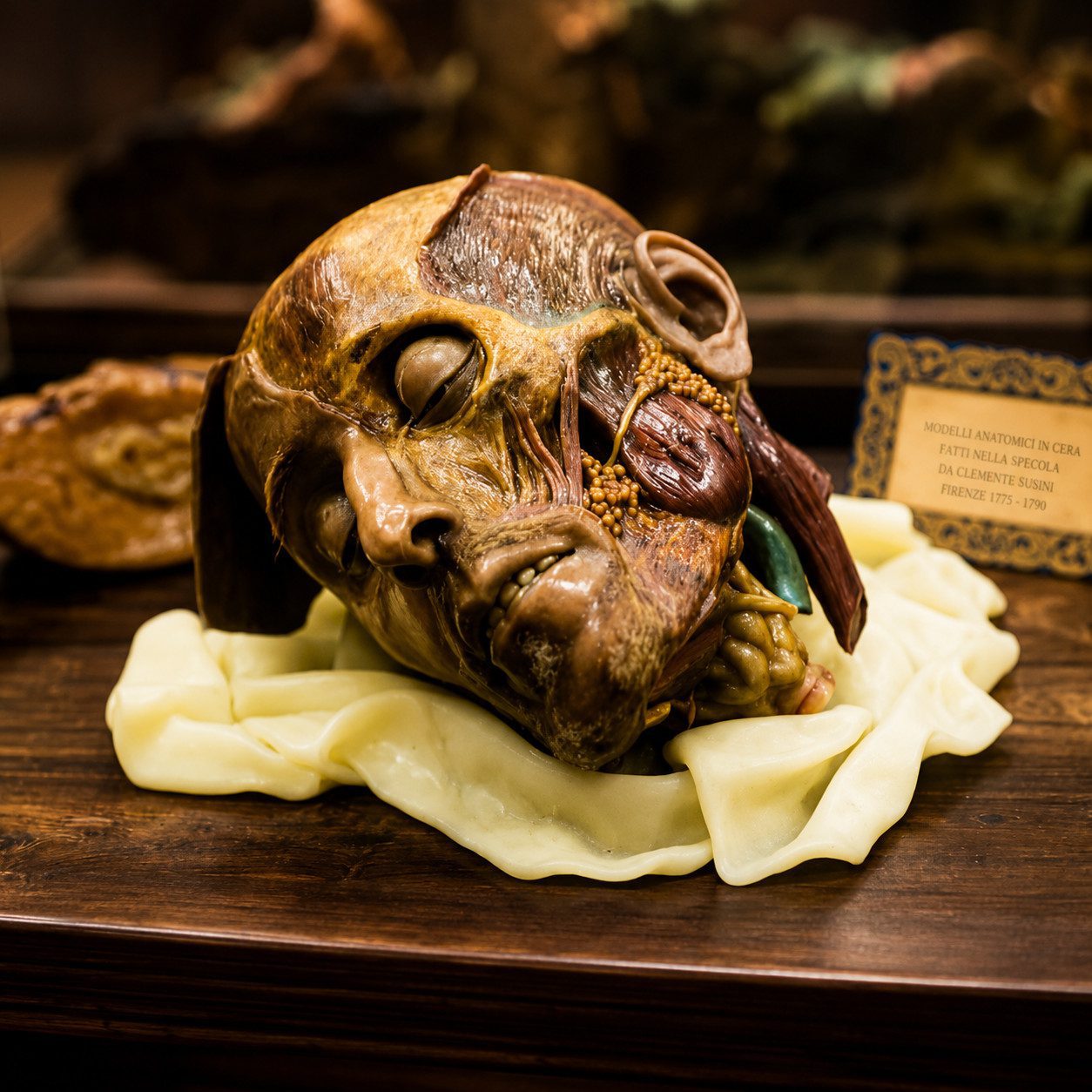
At La Specola, the celebrated anatomical wax collection is principally devoted to the systematic representation of human anatomy, although individual models also document anatomical variations and abnormalities. During the early history of the collection, pathological and obstetric models were produced as well, and some specialised material was later transferred to other Florentine medical institutions.
Historic collections associated with the Museo di Anatomia Patologica in Careggi place much greater emphasis on pathological anatomy. Anatomical and dermatological wax models document diseases, deformities and unusual pathological findings. The two traditions therefore complement one another: La Specola demonstrates the systematic visualisation of anatomy, while Careggi preserves a particularly important record of disease and pathological morphology.
The pathological models also document the limits of historical medicine. Some diseases could progress to stages rarely encountered today in countries with modern diagnostic and therapeutic possibilities. Physicians might have been able to observe and describe a disease accurately while having few effective ways to stop it.
These models consequently preserve more than morphology. They also record an era before modern pathology, surgery, oncology, antibiotics and diagnostic imaging fundamentally changed medical practice.

Access to the Careggi collections may be limited and should be checked separately. For physicians, medical historians and scientifically interested visitors, they reveal another highly specialised aspect of Florence’s medical heritage.
Why Wax Anatomy Was Revolutionary
Anatomical waxes solved several problems at once. They did not decompose, could be examined repeatedly and allowed important structures to remain visible for teaching. A carefully designed model could also present anatomical relationships more clearly than a temporary dissection.
This did not mean that wax models replaced cadaveric anatomy. Instead, they provided an additional educational tool that made anatomical knowledge easier to preserve and communicate.
Their historical importance becomes even clearer when compared with modern medicine. CT, MRI, ultrasound and three-dimensional visualisation now allow us to examine the body in ways eighteenth-century anatomists could scarcely have imagined. La Specola preserves an earlier solution to the same fundamental challenge: how can the complex structure of the human body be made visible and understandable?
A Florentine Tradition with a European Connection
Florence was not alone in developing this approach. A comparable and famous collection of anatomical wax models survives at the Josephinum in Vienna, the historic medical institution founded under Emperor Joseph II.
The connection reflects the political and intellectual world of eighteenth-century Europe. Enlightened rulers supported scientific education, medical reform and collections intended to organise and communicate knowledge. Anatomical waxes belonged perfectly to this environment because they combined scientific information, teaching and craftsmanship.
Seen in this wider context, La Specola is far more than a local curiosity. It forms part of a European history of anatomy, medicine and Enlightenment culture.
The Hall of Skeletons
Another remarkable part of La Specola is the Hall of Skeletons. Access arrangements can differ from the standard museum route, so visitors interested in this collection should check current information before their visit.
The hall contains an extensive osteological collection representing many animal species. Large articulated skeletons make the strongest immediate impression and allow visitors to compare the underlying structures of animals with dramatically different body forms.
The experience differs completely from Florence’s Renaissance galleries. Paintings and decorative surfaces disappear, leaving bones, proportions and biological structure. A skeleton reveals the architecture that supports movement and determines much of an animal’s physical form.
Historic skeleton collections were not assembled simply to impress visitors. Comparative anatomy allowed scientists to study similarities and differences between species, making osteological collections important tools for zoological research and teaching.
Comparative Anatomy and the Search for Order
The skeleton collections illustrate one of the central scientific ambitions of natural history: comparison. When skeletons of different species stand beside one another, structural similarities become easier to recognise.
Limbs adapted for walking, swimming or flying may look dramatically different externally, yet their underlying anatomical organisation can reveal relationships that are less obvious in the living animal. Comparative anatomy became an important method for understanding biological form and, eventually, evolutionary relationships.
The Hall of Skeletons is therefore more than a collection of impressive bones. It represents a method of scientific thinking based on observation and comparison.
Florence as a City of Science
La Specola becomes even more meaningful when placed within Florence’s broader scientific history. The city associated with Michelangelo and Botticelli was also home to Galileo Galilei and generations of mathematicians, physicians, astronomers and naturalists.
The Medici court supported scientific instruments and collecting alongside artistic patronage. Later rulers continued to develop institutions devoted to observation and education. Scientific culture therefore formed an important part of Florence’s intellectual identity.
Visitors interested in this aspect of the city can combine La Specola with the Museo Galileo. Together, the two museums reveal very different approaches to understanding nature: one through instruments, astronomy and experimentation, the other through specimens, anatomy and natural history.
La Specola and the History of Medicine
Medical visitors may find La Specola particularly rewarding because the anatomical waxes stand at a fascinating point in the history of visualisation. Medicine has always depended on finding ways to make structures and diseases visible.
Dissection exposed anatomy directly. Drawings translated observations onto paper. Wax modelling recreated structures in three dimensions. Later photography, microscopy, radiography, CT and MRI introduced entirely new methods of representing the body.
Viewed from this perspective, the anatomical waxes are part of a much longer history leading towards modern medical imaging. The technology changed completely, but the underlying objective remained remarkably similar: to see inside the human body, understand spatial relationships and communicate that knowledge to others.
The Museum Building
La Specola occupies a historic building on Via Romana in the Oltrarno. Its location places the museum within easy walking distance of Palazzo Pitti and the Boboli Gardens while keeping it slightly removed from Florence’s busiest tourist routes.
The building contributes to the atmosphere because the collections remain connected with the long institutional history of the site. Visitors are not entering a newly constructed science centre but a place where natural history has been collected, organised and studied for generations.
This continuity gives La Specola a character that modern interactive museums cannot easily reproduce.
A Quiet Detour from Palazzo Pitti
La Specola is particularly easy to include in an Oltrarno itinerary. Palazzo Pitti and the Boboli Gardens lie nearby, while the surrounding streets lead into one of Florence’s most attractive historic districts.
The contrast works beautifully. Palazzo Pitti represents dynastic power, court culture and enormous artistic wealth. La Specola turns attention towards science, anatomy and the classification of nature. Visitors can therefore experience two very different aspects of Florentine history within a relatively small area.
If you are visiting Palazzo Pitti or the Boboli Gardens, consider adding La Specola rather than crossing the river immediately afterwards. The museum offers a completely different experience and turns an Oltrarno visit into a journey through both Florence’s artistic and scientific history.
La Specola or Museo Galileo?
Both museums explore Florence’s scientific heritage, but they do so in very different ways. Museo Galileo focuses strongly on scientific instruments, astronomy, measurement and the intellectual world associated with Galileo and Medici science.
La Specola concentrates on natural history, zoology and anatomy. Its historic specimens and wax models make it particularly appealing to visitors interested in biology, medicine and the study of the human body.
If time allows, the museums complement rather than replace one another. Together they demonstrate how broad scientific culture became in Florence.
Who Will Enjoy La Specola Most?
La Specola appeals especially to visitors who enjoy museums outside the conventional tourist programme. Natural-history enthusiasts, physicians, biologists and anyone interested in the history of science will find obvious reasons to visit.
The museum can also fascinate artists and visitors interested in craftsmanship because the anatomical waxes demonstrate an extraordinary combination of observation and modelling. Their scientific purpose does not diminish their aesthetic and technical sophistication.
Families with children interested in animals and skeletons may also enjoy the museum, although the anatomical waxes can be intense for sensitive younger visitors.
Practical Information
Museum: La Specola – Natural History Museum of the University of Florence
Address: Via Romana 17, Florence
Area: Oltrarno
Suggested visit: Approximately 2 hours
Nearby: Palazzo Pitti and Boboli Gardens
Good to know: Access arrangements for special collections can vary. Check current museum information before visiting.
Highlights of La Specola Florence
- Anatomical wax models – extraordinary eighteenth- and nineteenth-century teaching models combining anatomy and craftsmanship.
- Felice Fontana – the scientist who played a central role in organising the museum and developing its anatomical teaching collections.
- Giuseppe Ferrini and Clemente Susini – important figures in the Florentine tradition of anatomical wax modelling.
- Zoological collections – historic specimens documenting centuries of natural-history research.
- Hall of Skeletons – an extensive osteological collection with impressive articulated animal skeletons, subject to current access arrangements.
- Scientific workshops – evidence of the close relationship between research, craftsmanship and scientific instrument making.
- Scientific heritage – the museum’s roots in Medici collecting and Enlightenment classification.
- Medical history – a rare opportunity to understand anatomical teaching before modern imaging and visualisation.
Why La Specola Is Worth Visiting
La Specola reveals a Florence that can easily remain hidden behind the fame of Michelangelo, Botticelli and Brunelleschi. Its collections belong to another great Florentine tradition: the desire to observe nature, understand the human body and organise knowledge about the physical world.
The anatomical waxes express this tradition particularly well. Created before photography, radiology and modern three-dimensional imaging, they transformed anatomical knowledge into permanent visual objects through an extraordinary combination of scientific observation and artistic craftsmanship.
The work of Felice Fontana, Giuseppe Ferrini, Clemente Susini and generations of specialised craftsmen adds another dimension to the museum. La Specola was not simply a place where scientific objects were displayed; it was an environment in which researchers, modellers and technicians actively produced knowledge and the tools needed to communicate it.
The museum also places Florence within the intellectual culture of Enlightenment Europe. Medici curiosity developed into more systematic scientific collecting under the Lorraine grand dukes, while institutions such as La Specola helped make knowledge accessible beyond a small circle of specialists.
For visitors who already know Florence’s great galleries and palaces, La Specola offers something increasingly valuable: a completely different way of understanding the city. Florence was not only a place where people tried to represent the world beautifully. It was also a place where they tried to understand how that world worked.
Interesting Facts About La Specola
- La Specola opened as a scientific museum in 1775.
- Its collections developed partly from earlier Medici collections of natural objects and scientific curiosities.
- The museum became associated with the Enlightenment ambition to classify and communicate scientific knowledge.
- The production of anatomical wax models in Florence began before the museum officially opened.
- Felice Fontana played a central role in the creation and scientific organisation of the anatomical collection.
- Giuseppe Ferrini was among the early wax modellers connected with the Florentine workshop.
- Clemente Susini became one of the best-known masters of anatomical wax modelling.
- Its anatomical waxes were created as durable tools for teaching human anatomy.
- Wax could reproduce the colours and textures of soft tissues more convincingly than many other traditional materials.
- The anatomical collection is principally devoted to systematic human anatomy, although variations, abnormalities and historically specialised models were also represented.
- Historic collections in Careggi preserve an important complementary tradition of pathological wax modelling.
- The museum’s name refers to its historical association with an astronomical observatory.
- Its zoological collections preserve evidence of centuries of natural-history research.
- La Specola belongs to the University of Florence’s museum system.
- The museum is one of the clearest reminders that Florence was a major centre of science as well as art.
Frequently Asked Questions About La Specola Florence
Is La Specola worth visiting?
Yes. It is particularly rewarding for visitors interested in natural history, anatomy, medicine or the history of science and offers an experience very different from Florence’s famous Renaissance art museums.
What is La Specola famous for?
The museum is especially famous for its historic anatomical wax models and extensive natural-history collections.
When did La Specola open?
La Specola opened in 1775 as the Imperial and Royal Museum of Physics and Natural History under Grand Duke Peter Leopold of Lorraine.
Who was Felice Fontana?
Felice Fontana was a physician, naturalist and experimental scientist who became the first director of the museum and played a central role in organising its scientific collections and anatomical teaching programme.
Who made the anatomical wax models?
The models were produced by specialised Florentine wax modellers working with anatomists and scientists. Giuseppe Ferrini was among the early figures, while Clemente Susini became one of the most celebrated masters of the tradition.
Why were anatomical wax models created?
They provided durable three-dimensional representations of human anatomy for teaching and study. Unlike cadaveric preparations, wax models could be preserved and examined repeatedly.
Are the anatomical waxes real human bodies?
No. They are carefully constructed wax models created to reproduce anatomical structures with a high degree of visual accuracy.
What is the difference between La Specola and the Careggi pathological collection?
La Specola’s wax collection is principally devoted to systematic anatomical representation, although variations and abnormalities are also documented. Historic collections associated with Careggi place greater emphasis on pathological anatomy and the physical manifestations of disease.
Does La Specola have animal skeletons?
Yes. The museum preserves important osteological collections, including the Hall of Skeletons. Access to special sections should be checked before visiting.
Is La Specola close to Palazzo Pitti?
Yes. The museum is located on Via Romana in the Oltrarno, only a short walk from Palazzo Pitti and the Boboli Gardens.
How long should I spend at La Specola?
Approximately two hours is suitable for most visitors, although anyone with a particular interest in anatomy or natural history may want longer.
Is La Specola suitable for children?
The zoological and skeletal collections can be fascinating for children interested in animals and science. Some anatomical displays may be intense for younger or sensitive visitors.
Further Reading on Firenze Casa
- Florence Museums: The Complete Guide
- Museo Galileo – Science in Renaissance Florence
- Galileo Galilei and Florence
- Palazzo Pitti – The Grand-Ducal Palace of Florence
- Boboli Gardens – Florence’s Historic Medici Garden
- Museo dell’Opificio delle Pietre Dure
- Small Museums in Florence Worth Discovering
- The Medici Family: The Dynasty That Shaped Florence
References
- University of Florence Museum System – La Specola.
- University of Florence – Anatomical wax collections and history of the Florentine wax-modelling workshop.
- University of Florence Biomedical Museums – Museo di Anatomia Patologica.
- Museo Galileo – Felice Fontana and the history of scientific collecting in Florence.
- Museo Galileo – Scientific workshops of the Museum of Physics and Natural History.
- Meridiani Firenze, No. 67, April 1998 – La capitale della scienza.
- UNESCO World Heritage Centre – Historic Centre of Florence.

