
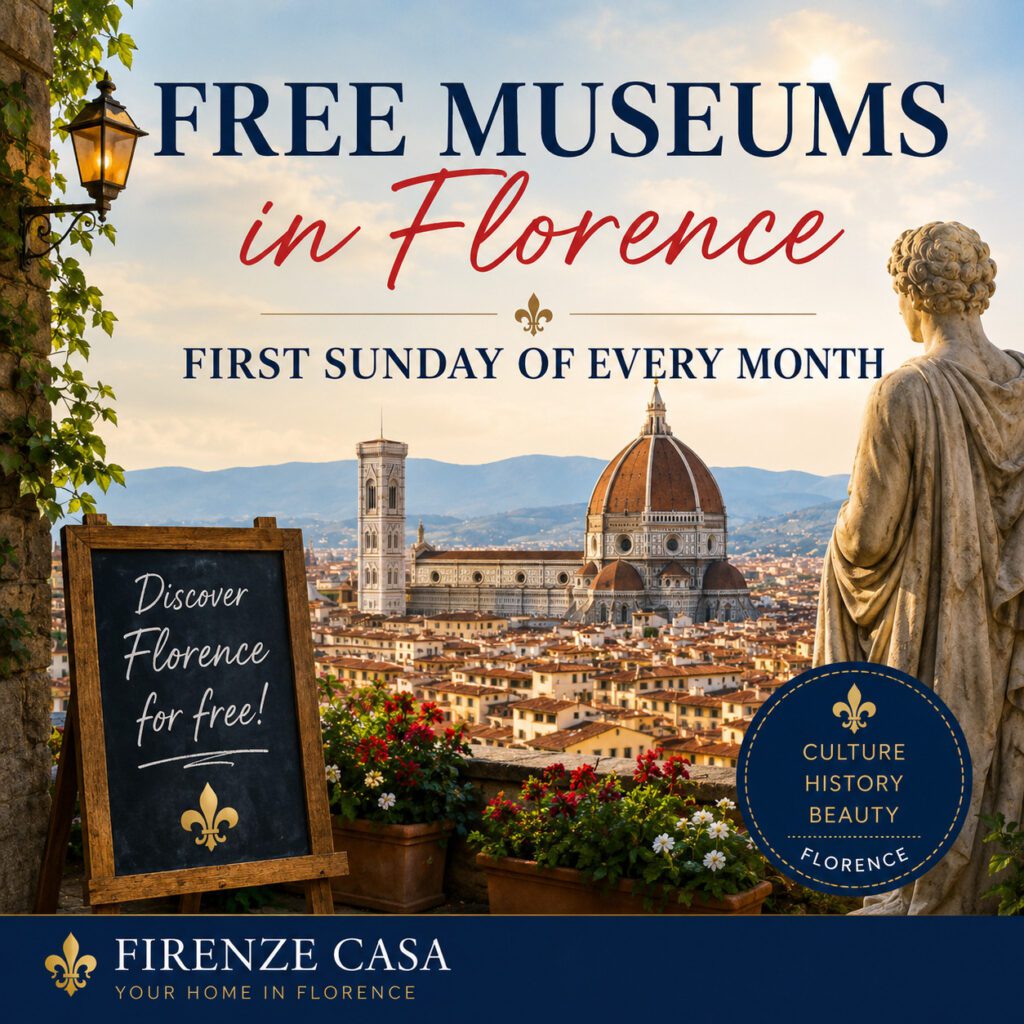
Visiting Florence’s museums can quickly become expensive, especially if you want to see several of the city’s major collections. Fortunately, there is one day each month when many important state museums and cultural sites open their doors free of charge.
On the first Sunday of every month, Italy’s nationwide Domenica al Museo initiative offers free admission to participating state museums, monuments, archaeological sites and cultural institutions. For visitors to Florence, it can be an excellent opportunity to see a major museum or discover places that might otherwise remain outside the usual itinerary.
This guide explains how free museums in Florence work on the first Sunday of the month, which places usually participate and how to plan the day without spending most of it waiting in queues.
What Is Domenica al Museo?
Domenica al Museo – literally “Sunday at the Museum” – is an initiative organised by the Italian Ministry of Culture. On the first Sunday of each month, admission to participating Italian state museums and cultural sites is free.
The important word here is state. Free admission does not automatically apply to every museum in Florence. Municipal museums, church museums, university collections and privately operated institutions may follow different rules.
Participation and access arrangements can also change. Special exhibitions, restoration work or temporary closures may affect individual sites, so it is always sensible to check the official information shortly before your visit.
Which Museums in Florence Are Free on the First Sunday?
Some of Florence’s most important museums usually participate in Domenica al Museo. The list includes major Renaissance collections as well as smaller museums and historic sites that receive far fewer visitors.
- Uffizi Gallery
- Accademia Gallery
- Palazzo Pitti
- Boboli Gardens
- Bargello National Museum
- Medici Chapels
- San Marco Museum
- National Archaeological Museum of Florence
- Casa Martelli Museum
- Andrea del Sarto Last Supper Museum
- Sant’Apollonia Last Supper Museum
- Chiostro dello Scalzo
- Medici Villa La Petraia
- Medici Villa of Cerreto Guidi
Some participating sites have limited or seasonal opening hours. This is particularly important for villas, gardens and smaller museums outside the main tourist routes.
The Major Free Museums in Florence
If this is your first visit to Florence, Domenica al Museo offers the possibility of seeing some of the city’s most famous collections without paying the normal entrance fee. The disadvantage is obvious: these are also the museums that attract the largest crowds.
Uffizi Gallery
The Uffizi Gallery is one of the great art museums of Europe. Its collections include masterpieces by Botticelli, Leonardo da Vinci, Michelangelo, Raphael, Titian and Caravaggio, as well as an extraordinary overview of Italian painting from the Middle Ages to the Baroque period.
Unsurprisingly, the Uffizi is one of the busiest destinations during free museum Sunday. Free admission can represent a considerable saving, but you should balance that advantage against potentially long waiting times.
Accademia Gallery
The Accademia Gallery is best known as the home of Michelangelo’s David. Seeing the sculpture in person is very different from seeing it reproduced in photographs, and for many visitors it remains one of the essential experiences in Florence.
The museum also contains Michelangelo’s unfinished Prisoners, important Renaissance paintings and a collection of historical musical instruments. Like the Uffizi, however, the Accademia can become extremely busy on free admission days.
Palazzo Pitti
Across the Arno, Palazzo Pitti offers a completely different museum experience. The enormous palace became the principal residence of the Medici grand dukes and later housed the Lorraine and Savoy dynasties.
Today its collections allow visitors to explore not only paintings but also the world of court life, historic interiors, fashion and decorative arts. Palazzo Pitti is particularly rewarding if you want to understand how Florence changed after the republican Renaissance and became the capital of a grand-ducal state.
Boboli Gardens
Behind Palazzo Pitti, the Boboli Gardens form one of the most influential historic gardens in Europe. Terraces, sculptures, fountains, avenues and architectural features create a landscape that developed over several centuries.
Combining Palazzo Pitti with the Boboli Gardens can make an excellent half-day itinerary, although the gardens are best enjoyed when the weather is pleasant.
Excellent Alternatives to the Uffizi and Accademia
Domenica al Museo does not have to mean spending hours in a queue for Florence’s two most famous museums. In fact, the first Sunday can be particularly useful for discovering outstanding collections that receive considerably less attention.
Bargello National Museum
The Bargello National Museum is one of Florence’s great museums of Renaissance sculpture. Its collection includes works by Donatello, Michelangelo, Verrocchio, Cellini and Giambologna.
The medieval palace itself is part of the experience, with its monumental courtyard and historic rooms. For visitors interested in sculpture, the Bargello can be every bit as rewarding as the better-known galleries.
San Marco Museum
The San Marco Museum occupies the former Dominican convent associated with Fra Angelico and Savonarola. Fra Angelico’s frescoes remain in the architectural spaces for which many of them were created, giving the museum an atmosphere unlike that of a conventional picture gallery.
The individual monks’ cells, quiet corridors and restrained architecture make San Marco one of Florence’s most contemplative museums.
National Archaeological Museum of Florence
The National Archaeological Museum of Florence reveals a side of the city that many visitors never encounter. Its collections include important Etruscan, Egyptian, Greek and Roman objects.
For anyone who has already spent several days surrounded by Renaissance paintings and sculpture, the museum provides a refreshing change of perspective and an introduction to cultures that shaped Tuscany long before the Medici.
Smaller Museums Worth Considering
One of the best strategies for free museum Sunday is to combine one major museum with one or two smaller institutions. Florence has several state museums where a short visit can reveal remarkable works without requiring half a day. If this quieter side of the city appeals to you, our guide to small museums in Florence worth discovering offers more ideas beyond the major collections.
Casa Martelli
Casa Martelli, close to the Duomo, preserves the atmosphere of an aristocratic Florentine residence. Paintings, furniture and decorative objects remain within a domestic setting rather than a conventional gallery.
It is particularly interesting for visitors who enjoy historic houses and want to understand how wealthy Florentine families lived with their art.
Andrea del Sarto Last Supper Museum
The Andrea del Sarto Last Supper Museum preserves one of the artist’s great frescoes in the former convent of San Salvi. Its location outside the busiest part of the historic centre means that it is often overlooked by visitors.
That relative isolation is also part of its appeal. The experience is quieter and more focused than visiting Florence’s major galleries.
Sant’Apollonia Last Supper Museum
The Sant’Apollonia Last Supper Museum is centred on Andrea del Castagno’s monumental depiction of the Last Supper. The fresco is one of the most striking surviving examples of fifteenth-century Florentine painting.
The museum is compact, making it easy to include in a walking itinerary through the northern part of the historic centre.
Chiostro dello Scalzo
The Chiostro dello Scalzo is another small Florentine treasure. Its monochrome fresco cycle, largely created by Andrea del Sarto, transforms a modest cloister into an unusually intimate Renaissance space.
It is exactly the kind of place that demonstrates why exploring Florence beyond its famous museums can be so rewarding.
Free Medici Sites Beyond the Historic Centre
Domenica al Museo can also provide an opportunity to explore the Medici world beyond central Florence. Several historic villas associated with the dynasty belong to the state museum network.
Medici Villa La Petraia
Villa La Petraia stands in the hills north of Florence and offers a fascinating contrast to the urban Medici palaces. Its architecture, decorated interiors, gardens and elevated position reveal another side of grand-ducal life.
For travellers staying several days in Florence, it can be an excellent alternative to another crowded day in the historic centre.
Medici Villa of Cerreto Guidi
The Medici Villa of Cerreto Guidi lies farther from central Florence and rewards visitors interested in the broader network of Medici residences across Tuscany.
Its location means that it requires more planning than the central museums, but it also provides historical context that is difficult to appreciate when visiting only Palazzo Vecchio and Palazzo Pitti.
How to Plan Free Museum Sunday in Florence
Free admission sounds simple, but the first Sunday of the month requires a little strategy. Trying to visit as many museums as possible is rarely the best approach.
- Choose one priority museum. Decide in advance which major collection matters most to you.
- Start early. The Uffizi and Accademia can attract substantial queues on free admission days.
- Add a smaller museum. The Bargello, San Marco or one of Florence’s smaller state museums can provide a more relaxed second visit.
- Check current opening information. Smaller institutions may have restricted hours or special access arrangements.
- Consider location. Combining nearby museums saves valuable time and avoids crossing the city repeatedly.
- Do not plan too much. Two good museum visits are usually more enjoyable than rushing through four or five.
Is Free Museum Sunday Worth It?
For many visitors, absolutely. Admission to Florence’s major museums can represent a significant part of a sightseeing budget, particularly for families or travellers planning several museum visits.
However, free admission does not necessarily make the first Sunday the best day to visit the Uffizi or Accademia. If seeing a famous collection calmly is more important than saving the entrance fee, visiting on a normal weekday may provide a better experience.
The real strength of Domenica al Museo is choice. You can use it for a major attraction, but you can also take the opportunity to enter a museum you might otherwise have skipped. Sometimes that spontaneous second choice becomes the most memorable visit of the day.
A Different Way to Discover Florence’s Museums
Florence is often reduced to a handful of famous names: the Uffizi, Michelangelo’s David and Palazzo Pitti. Yet its museum landscape is much richer. Former convents, historic houses, sculpture collections, archaeological museums and Medici residences all tell different parts of the city’s story.
Free museum Sunday offers an excellent reason to look beyond the obvious attractions. Instead of treating free admission simply as a way to save money, it can become an opportunity to explore a part of Florence you had not planned to see.
For a broader overview of the city’s collections, including major museums and smaller alternatives, see our Florence Museums: The Complete Guide.
Frequently Asked Questions
Are museums in Florence free on the first Sunday of the month?
Many state museums in Florence are free on the first Sunday of every month as part of Italy’s Domenica al Museo initiative. This does not apply automatically to municipal, church, university or privately operated museums.
Is the Uffizi free on the first Sunday of the month?
Yes, the Uffizi Gallery participates in Domenica al Museo. Admission is free, but the museum can be particularly busy on these Sundays, so visitors should be prepared for possible queues.
Is the Accademia Gallery free on the first Sunday?
Yes, the Accademia Gallery normally participates in Domenica al Museo. This provides free access to Michelangelo’s David and the museum’s other collections, although demand can be very high.
Are Palazzo Pitti and the Boboli Gardens free on the first Sunday?
Palazzo Pitti and the Boboli Gardens participate in the first-Sunday free admission initiative. Current opening hours and access arrangements should always be checked before visiting.
Do I need to book free museums in Florence in advance?
Booking and access arrangements can vary between museums and may change. Some museums operate free Sundays without the normal reservation system, so check the official website of the museum shortly before your visit rather than relying on the arrangements used on regular admission days.
What is the best museum to visit on free museum Sunday in Florence?
The Uffizi and Accademia offer the greatest financial saving but can also attract the longest queues. For a quieter experience, the Bargello, San Marco or one of Florence’s smaller state museums can be an excellent choice.

