
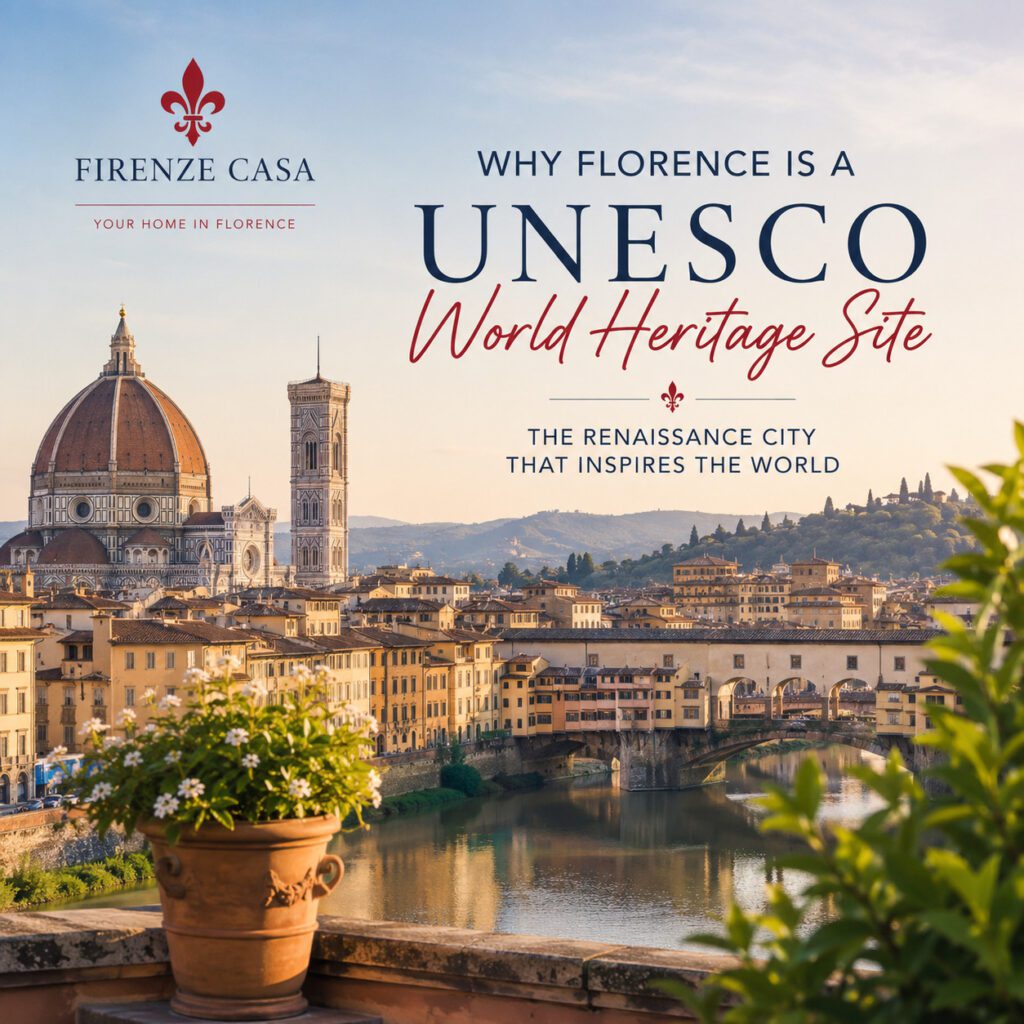
Florence is not simply a city filled with famous monuments. Its historic centre is a remarkably complete work of art, shaped over many centuries by architects, painters, sculptors, merchants and powerful families.
In 1982, the Historic Centre of Florence was added to the UNESCO World Heritage List. The recognition honours not just individual buildings, but the extraordinary urban landscape in which medieval streets, Renaissance palaces, churches, squares and bridges still form a harmonious whole.
But what makes the Florence UNESCO World Heritage Site so exceptional? And which places best reveal the history and character that earned Florence this international recognition?
Why Is Florence a UNESCO World Heritage Site?
UNESCO recognises places that have outstanding cultural or natural importance for humanity. Florence qualified under five cultural criteria, reflecting the city’s architecture, artistic influence, historical importance and close association with some of the most influential figures in European culture.
The UNESCO designation covers the historic centre rather than one isolated monument. This is important because the beauty of Florence lies in the relationship between its buildings, streets and public spaces.
Within a relatively compact area, visitors encounter:
- the medieval street plan and narrow stone lanes;
- monumental Renaissance architecture;
- churches containing internationally important works of art;
- historic palaces associated with the Medici and other Florentine families;
- public squares that have remained at the centre of civic life for centuries;
- traditional materials such as pietra forte, pietra serena, plasterwork and fresco decoration.
This remarkable continuity allows visitors to experience Florence not as a collection of disconnected attractions, but as a living historic city.
Florence: The Birthplace of the Renaissance
Florence is widely regarded as the birthplace of the Renaissance, the cultural movement that transformed European art, architecture, science and philosophy.
During the 15th and 16th centuries, the city became one of Europe’s most important centres of creativity. Wealthy merchants, religious institutions and influential patrons commissioned ambitious buildings and works of art. Among them, the Medici family played an especially important role in supporting artists, architects and scholars.
Figures associated with Florence include Giotto, Filippo Brunelleschi, Sandro Botticelli, Leonardo da Vinci, Michelangelo and Giorgio Vasari. Their achievements helped establish artistic principles that influenced Europe for generations.
The Landmarks of UNESCO Florence
The historic centre contains an exceptional concentration of monuments. Some dominate the skyline, while others reveal themselves unexpectedly at the end of a narrow street or behind an unassuming façade.
| Landmark | Why It Matters | What to Notice |
|---|---|---|
| Cathedral of Santa Maria del Fiore | The religious and architectural heart of Florence | Brunelleschi’s dome, the marble façade and the immense interior |
| Giotto’s Campanile | One of the finest examples of Florentine Gothic architecture | The coloured marble decoration and panoramic views |
| Baptistery of San Giovanni | One of the city’s oldest and most important religious buildings | The geometric marble exterior, mosaics and bronze doors |
| Piazza della Signoria | The historic centre of political and civic life | Palazzo Vecchio, the Loggia dei Lanzi and its open-air sculptures |
| Uffizi Gallery | One of the world’s most important collections of Renaissance art | Works by Botticelli, Leonardo, Raphael, Titian and Caravaggio |
| Ponte Vecchio | A surviving medieval bridge and an enduring symbol of Florence | The historic shops, river views and Vasari Corridor above |
| Basilica of Santa Croce | A major religious and artistic complex | Frescoes, chapels and the memorials of notable Italians |
| Palazzo Pitti | A monumental Renaissance palace associated with the Medici court | The grand façade, historic apartments and nearby Boboli Gardens |
Brunelleschi’s Dome: A Symbol of Florentine Ingenuity
Few structures represent the ambition of Renaissance Florence as powerfully as the dome of the Cathedral of Santa Maria del Fiore.
When Filippo Brunelleschi began work on the dome in the 15th century, its enormous span presented a problem that traditional construction methods could not easily solve. His innovative double-shell design and ingenious building techniques made it possible to complete the structure without the massive wooden framework normally required for such a project.
Today, the dome remains the defining feature of the Florentine skyline. It demonstrates how artistic beauty, engineering skill and civic pride came together during the Renaissance.
Piazza della Signoria: Florence as an Open-Air Museum
Piazza della Signoria has been the political heart of Florence since the Middle Ages. Dominated by Palazzo Vecchio, the square reflects the city’s long tradition of civic government, public debate and artistic representation.
The entrance to Palazzo Vecchio is guarded by monumental sculptures, while the nearby Loggia dei Lanzi displays statues beneath its elegant arches. The result is a public space that feels like an open-air museum, yet remains part of everyday city life.
Standing in the square, it is easy to understand why the historic centre was recognised as a unified cultural landscape rather than merely a group of separate monuments.
The Ponte Vecchio and the River Arno
The River Arno is an essential part of the identity of Florence. It divides the historic centre while also creating some of its most memorable views.
The Ponte Vecchio, with its small shops built along both sides, is the city’s most recognisable bridge. Above the shops runs part of the Vasari Corridor, created to connect Palazzo Vecchio with Palazzo Pitti and allow the ruling family to cross the city privately.
For a classic view of the bridge, walk to Ponte Santa Trinita in the late afternoon. From there, the warm façades, reflections on the Arno and surrounding historic buildings create one of the most beautiful scenes in Florence.
The Uffizi Gallery: Renaissance Art in Its Historic Setting
The Uffizi Gallery is inseparable from the history of Renaissance Florence. Originally designed by Giorgio Vasari for Cosimo I de’ Medici, the building later became home to one of the world’s most celebrated art collections.
Visitors can see masterpieces by Botticelli, Leonardo da Vinci, Michelangelo, Raphael, Titian and many others. Equally impressive is the setting: long corridors, views across the Arno and windows overlooking the historic centre connect the art inside the museum with the city in which it was created.
Read our guide to visiting the Uffizi Gallery in Florence.
A Historic City That Is Still Alive
Florence is not preserved as a museum separated from modern life. Its historic buildings continue to serve as churches, homes, shops, offices, workshops, restaurants and public institutions.
Morning deliveries pass through centuries-old streets. Residents meet for coffee beside Renaissance palaces. Artisans continue traditional crafts in the Oltrarno district, while markets and neighbourhood shops remain part of daily life.
This mixture of cultural heritage and everyday activity is one of the reasons why exploring Florence on foot is so rewarding. The city’s history is not confined behind museum doors: it is visible in façades, courtyards, street corners and views across terracotta rooftops.
The Best Way to Explore the Historic Centre of Florence
The UNESCO-listed centre is compact and best discovered on foot. Many of the principal landmarks lie within comfortable walking distance of one another, but Florence rewards visitors who slow down and look beyond the most famous sights.
A Suggested UNESCO Florence Walk
- Begin at the Cathedral of Santa Maria del Fiore.
- Walk past the Baptistery and Giotto’s Campanile.
- Continue along Via dei Calzaiuoli towards Piazza della Signoria.
- Explore the Loggia dei Lanzi and the exterior of Palazzo Vecchio.
- Walk through the Uffizi courtyard towards the River Arno.
- Cross the Ponte Vecchio into the Oltrarno district.
- Continue towards Palazzo Pitti and the Boboli Gardens.
This route connects several of the city’s most important monuments while revealing how closely architecture, public space and urban history are linked.
How to Experience UNESCO-Listed Florence Responsibly
World Heritage status is both an honour and a responsibility. Florence welcomes millions of visitors, and the preservation of its historic centre depends on respectful tourism.
- Explore on foot whenever possible.
- Respect churches as active places of worship.
- Do not touch sculptures, frescoes or historic surfaces.
- Support independent shops, traditional artisans and local businesses.
- Book major museums in advance to reduce unnecessary queues.
- Discover less crowded streets and neighbourhoods beyond the principal landmarks.
Travelling thoughtfully helps protect the character of Florence and allows local traditions to remain part of the living city.
Stay Close to the Historic Centre with Firenze Casa
Staying in Florence allows you to experience the city beyond the busiest hours of the day. Early mornings and evenings offer a quieter and more intimate view of its streets, squares and monuments.
From Firenze Casa, you can explore Florence at your own pace, return home for a relaxing break and then head out again for an evening walk, dinner or sunset beside the Arno.
A longer stay also creates time to look beyond the major attractions. You can visit neighbourhood markets, explore artisan workshops, enjoy traditional Florentine food and discover the small details that make the city unforgettable.
Why Florence’s UNESCO Heritage Still Matters
The importance of Florence extends far beyond its beauty. The city helped shape the development of Western art, architecture and humanist thought. Its buildings and artworks continue to influence how we understand creativity, urban life and cultural identity.
Being designated a UNESCO World Heritage Site recognises this global significance. It also reminds visitors that Florence is a fragile cultural inheritance that must be appreciated and protected.
From Brunelleschi’s dome and the paintings of Botticelli to the medieval streets, Renaissance palaces and bridges across the Arno, Florence offers an extraordinary journey through European history. Few places allow the past to be experienced so vividly, beautifully and naturally.
Discover More of Florence
This article is the beginning of our Firenze Casa series exploring the history, culture and landmarks of Florence. Further guides will introduce the people, places and ideas that shaped the city.
- The Uffizi Gallery: What to Know Before Your Visit
- The Medici Family and the Florence They Created
- Brunelleschi’s Dome: The Masterpiece Above Florence
- Ponte Vecchio: The Story of Florence’s Famous Bridge
- Palazzo Vecchio: Power and Politics in Renaissance Florence
- The Most Beautiful Walks Through Historic Florence
Florence is a city to see, but also a city to understand. Every palace, church, bridge and square tells part of a story that continues to shape the world today.

