
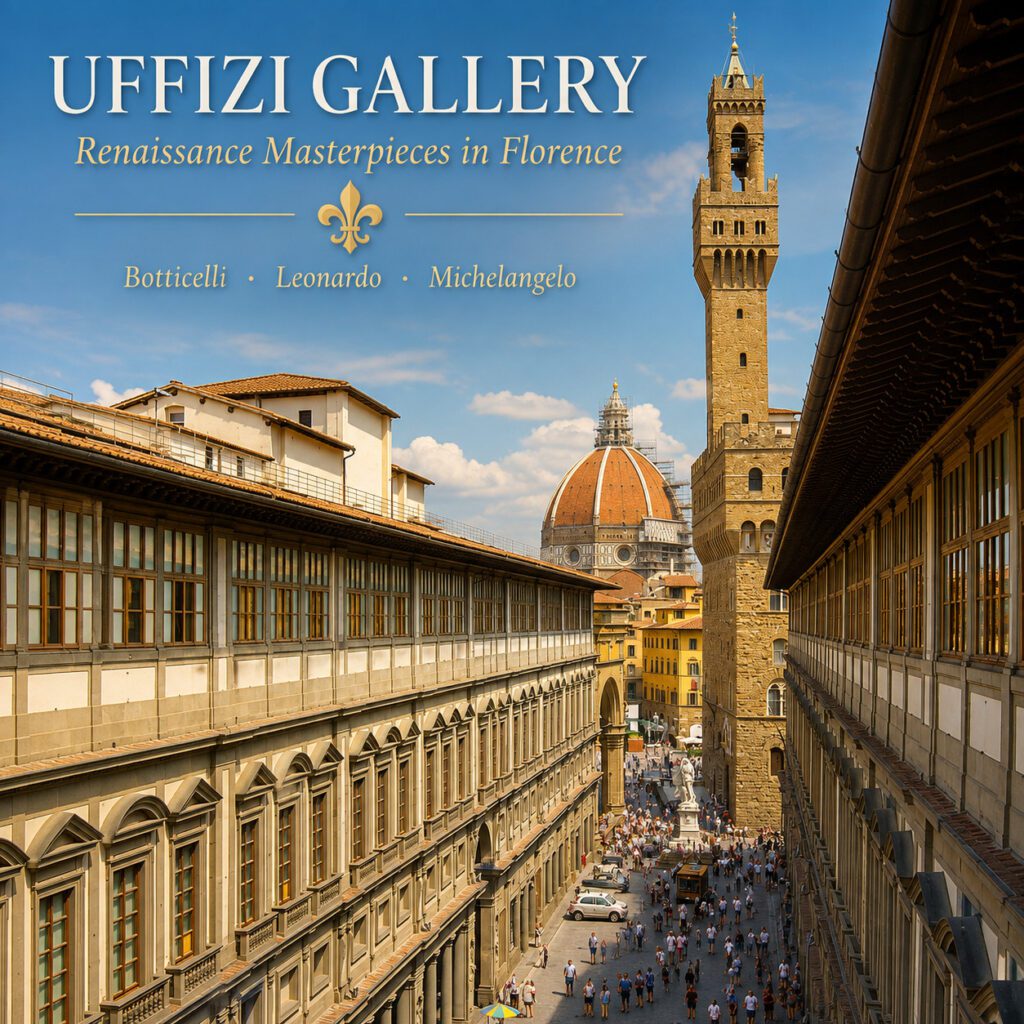
The Uffizi Gallery Florence is one of the world’s great museums of Renaissance art. Standing between Piazza della Signoria and the Arno, the monumental complex contains masterpieces by Botticelli, Leonardo da Vinci, Michelangelo, Raphael, Titian and Caravaggio. For anyone interested in the artistic history of Florence, it is an essential place to visit.
Yet the Uffizi are much more than a collection of famous paintings. Giorgio Vasari designed the building for Cosimo I de’ Medici as government offices rather than as a museum. Over the following centuries, the Medici transformed parts of the complex into a setting for their extraordinary collections. As a result, they created the foundations of the museum visitors know today.
Museum: Uffizi Gallery
Address: Piazzale degli Uffizi 6, Florence
Area: Historic Centre / Piazza della Signoria
Famous for: One of the world’s most important collections of Italian Renaissance art
Highlights: Botticelli’s Birth of Venus and Primavera, works by Leonardo da Vinci, Michelangelo and Raphael
Also worth seeing: Works by Giotto, Caravaggio, Titian and other major Italian and European masters
Best for: Renaissance art, masterpieces of Italian painting and first-time visitors to Florence
Character: World-famous, exceptionally rich and usually one of Florence’s busiest museums
Why the Uffizi Gallery Is So Important
Florence played a central role in the development of Renaissance art. Therefore, the Uffizi Gallery offers an exceptional opportunity to follow that transformation through original masterpieces. Few museums provide such a concentrated view of the changes that took place in Italian painting between the late Middle Ages and the Renaissance.
Giotto, Masaccio, Filippo Lippi and Piero della Francesca lead towards the extraordinary Florentine world of Botticelli, Leonardo and Michelangelo. Later rooms broaden the story through Raphael, Titian, Bronzino, Caravaggio and many other artists.
At the same time, the collection reflects the history of the Medici. Generations of the family commissioned, acquired and inherited works of art. Consequently, their collections eventually became an extraordinary cultural inheritance of Florence.
Do not approach the Uffizi simply as a list of famous paintings. Instead, follow the development from medieval art to the Renaissance. In this way, you can see how artists gradually transformed space, perspective, anatomy and the representation of human emotion.
Why Are They Called the Uffizi?
The name reveals the original purpose of the building. Uffizi is an old spelling connected with the Italian word uffici, meaning offices.
Cosimo I de’ Medici wanted to bring important administrative and judicial institutions of the Florentine state together in a new complex beside Palazzo Vecchio. For this reason, he commissioned Giorgio Vasari to design it in 1560.
The result was one of the most ambitious architectural projects of sixteenth-century Florence. Two long wings frame the narrow Piazzale degli Uffizi and visually connect the political centre around Palazzo Vecchio with the Arno.
Originally, the building represented government rather than public culture. Its transformation into one of the world’s most famous museums happened gradually over the following centuries.
Giorgio Vasari and the Architecture of the Uffizi
Giorgio Vasari was an architect, painter and writer who worked closely with Cosimo I. When designing the Uffizi, he had to fit a large administrative complex into an already densely built part of medieval Florence.
To solve this challenge, Vasari created two elongated wings facing one another across a narrow courtyard-like space. At the river end, an open loggia frames views towards the Arno. Meanwhile, repeated architectural elements give the complex a strong sense of order and unity.
The Uffizi also connect visually with Palazzo Vecchio, reinforcing the relationship between the new offices and Medici government. Vasari’s architecture therefore served both practical and symbolic purposes.
Construction continued after his death in 1574. Among those involved in completing the complex were Bernardo Buontalenti and Alfonso Parigi the Elder.
Before entering the museum, stand in the Piazzale degli Uffizi and look towards the Arno. Vasari deliberately created a long perspective through the complex. As a result, government architecture became one of Florence’s most memorable urban spaces.
The Medici and the Birth of the Uffizi Collection
The transformation of the Uffizi into a place for displaying art developed under Cosimo’s son, Francesco I de’ Medici. During the 1580s, Francesco commissioned Bernardo Buontalenti to create the famous Tribuna on the upper floor.
This remarkable octagonal room displayed precious paintings, sculptures, natural objects and other treasures from the Medici collections. Soon, it became one of Europe’s celebrated spaces for viewing art and curiosities.
Successive generations continued to expand the collections. In addition to works by Tuscan masters, the Medici acquired paintings by artists from other parts of Italy and Europe. Portraits, classical sculpture and objects of scientific or historical importance further enriched their holdings.
Consequently, the Uffizi developed from administrative offices into a place where political power, scholarship, collecting and artistic prestige came together.
Anna Maria Luisa de’ Medici and the Family Pact
A decisive moment came after the extinction of the Medici ruling dynasty. Anna Maria Luisa de’ Medici, the family’s last direct descendant, negotiated the famous Family Pact in 1737.
The agreement helped ensure that the Medici collections remained connected with Florence and Tuscany rather than being dispersed among foreign dynastic possessions. Her decision therefore played an essential role in preserving an extraordinary cultural inheritance in the city.
Without that legacy, Florence’s museums might look very different today.
Anna Maria Luisa de’ Medici is one of the most important figures in the history of Florence’s museums. Through the Family Pact, the artistic treasures accumulated by generations of Medici remained associated with Tuscany.
From Medici Collection to Public Museum
After the Medici dynasty ended, Tuscany passed to the House of Habsburg-Lorraine. Nevertheless, the collections remained in Florence and gradually became more accessible to visitors.
The Uffizi opened to the public in the eighteenth century under Grand Duke Peter Leopold. Over time, its collections were reorganised as modern ideas about museums and art history developed.
Some objects once displayed in the Uffizi later moved to other Florentine museums. Ancient sculpture, scientific instruments and other collections increasingly found specialised homes. Meanwhile, the Uffizi became particularly associated with painting.
This process helps explain Florence’s remarkable museum landscape today. Although visitors now experience many collections separately, several share historical roots in Medici collecting.
Giotto and the Road to the Renaissance
A visit to the Uffizi Gallery Florence should not begin mentally with Botticelli. Earlier paintings provide essential background for understanding what happened during the Renaissance.
Giotto is one of the crucial figures in this story. His Ognissanti Madonna demonstrates a new interest in volume, physical presence and spatial depth. Compared with earlier Byzantine-influenced traditions, the figures occupy their surroundings with greater solidity.
Works by Cimabue and Duccio allow visitors to compare different approaches around the turn of the fourteenth century. Seen together, these monumental paintings reveal an artistic world in transition.
Later, artists such as Masaccio, Paolo Uccello, Piero della Francesca and Filippo Lippi continued to experiment with perspective, light and the human figure. Their innovations prepared the ground for the extraordinary achievements of the later Renaissance.
Botticelli at the Uffizi
For many visitors, the Botticelli rooms form the emotional centre of the museum. Sandro Botticelli created some of the most recognisable images of the Florentine Renaissance.
Two paintings in particular have become icons of Western art: Primavera and The Birth of Venus. Both emerged from the sophisticated cultural environment of late fifteenth-century Florence. Moreover, each combines mythology, poetry and extraordinary visual elegance.
The Birth of Venus
The Birth of Venus shows the goddess arriving on the shore after her birth from the sea. Venus stands on a shell while wind carries her towards land. There, a female figure waits to cover her.
Because the painting is so famous, it can be surprisingly difficult to look at it carefully. Notice Botticelli’s flowing lines, the rhythm of the figures and the almost weightless quality of the composition.
Primavera
Primavera presents an even more complex mythological scene. Venus occupies the centre of a garden populated by figures that include Mercury, the Three Graces and characters associated with the transformation of Chloris into Flora.
Scholars have proposed numerous interpretations of the painting. Rather than searching for one simple explanation, visitors can appreciate how classical mythology, poetry, philosophy and Medici culture intersect within the work.
Botticelli’s most famous paintings attract dense crowds. If the room is busy, move back rather than pressing towards the front. From several metres away, the larger compositions often become easier to appreciate.
Leonardo da Vinci at the Uffizi
Leonardo da Vinci’s presence at the Uffizi offers a fascinating glimpse into the beginning of an extraordinary career. Florence was central to his artistic formation, while the museum preserves works connected with his early development.
The Annunciation is among the most important. Behind the principal figures, the young Leonardo created a landscape of remarkable atmospheric depth. Careful observation also appears throughout the plants, architecture and drapery.
By contrast, the unfinished Adoration of the Magi reveals something different. Because Leonardo never completed the painting, visitors can study parts of his creative process. Figures seem to emerge from the complex underdrawing and preliminary modelling.
Together, these works help explain why Leonardo became such an important figure in the transition towards the High Renaissance.
Michelangelo’s Doni Tondo
The Uffizi contains the only surviving panel painting generally accepted as entirely by Michelangelo: the Doni Tondo. Its circular format contains the Holy Family surrounded by unusually powerful figures.
Michelangelo’s sculptural approach to painting is immediately visible. The bodies have extraordinary physical presence, while the intense colours anticipate aspects of the Sistine Chapel ceiling.
The artist created the work for the Florentine merchant Agnolo Doni and his wife, Maddalena Strozzi. Furthermore, its original frame is itself an exceptional Renaissance object.
Visitors who know Michelangelo primarily through David can therefore discover another side of his art. The Doni Tondo reveals how his understanding of the human body moved between sculpture and painting.
Raphael and the High Renaissance
Raphael’s works introduce another artistic personality. While Michelangelo often emphasised physical power, Raphael became famous for harmony, balance and graceful composition.
The Uffizi collection includes his celebrated portraits of Agnolo Doni and Maddalena Strozzi. These paintings also create a fascinating connection with Michelangelo’s Doni Tondo, which emerged from the same Florentine family environment.
Another highlight is Raphael’s Madonna of the Goldfinch. The composition shows the Virgin with the young Christ and Saint John the Baptist in a serene landscape.
Together, such works illustrate the sophisticated artistic culture of Florence during the opening years of the sixteenth century.
Titian and Venetian Painting
The Uffizi are not limited to Florentine or Tuscan art. Instead, their collections allow visitors to compare the Florentine Renaissance with developments elsewhere in Italy.
Titian represents the extraordinary tradition of Venetian painting. His Venus of Urbino is one of the museum’s most celebrated works and an outstanding example of his mastery of colour, texture and the human figure.
The painting creates an interesting contrast with Botticelli’s Birth of Venus. Although both depict Venus, they belong to very different artistic worlds.
Comparisons like this make the Uffizi particularly rewarding. Rather than presenting the Renaissance as a single style, the museum reveals a rich variety of regional and individual approaches.
Caravaggio and a New Dramatic Language
By the time visitors reach Caravaggio, the artistic world has changed dramatically. His paintings introduce intense realism, dramatic light and psychological immediacy.
Among his most unforgettable creations is the Uffizi’s Medusa. Painted on a convex ceremonial shield, the severed head appears at the instant of horror as snakes twist around it.
Bacchus, meanwhile, offers another side of Caravaggio’s art. The young god appears strikingly physical and immediate rather than distant or idealised.
As a result, these works demonstrate how far Italian painting had travelled from the medieval altarpieces encountered near the beginning of the museum.
One of the best ways to experience the Uffizi is chronologically. Begin with medieval painting and then continue through the Renaissance towards later works. In this way, the visit becomes a journey through several centuries of artistic change.
Ten Masterpieces to Look For
| Artist | Masterpiece |
|---|---|
| Giotto | Ognissanti Madonna |
| Piero della Francesca | Diptych of the Dukes of Urbino |
| Filippo Lippi | Madonna and Child with Two Angels |
| Sandro Botticelli | Primavera |
| Sandro Botticelli | The Birth of Venus |
| Leonardo da Vinci | Annunciation |
| Michelangelo | Doni Tondo |
| Raphael | Madonna of the Goldfinch |
| Titian | Venus of Urbino |
| Caravaggio | Medusa |
The Tribuna of the Uffizi
The Tribuna is one of the most historically important spaces in the Uffizi. Bernardo Buontalenti designed the octagonal room for Francesco I de’ Medici in the 1580s as a setting for exceptional objects from the grand duke’s collection.
Rich materials and complex symbolism shape its extraordinary decoration. Consequently, the room itself became almost as celebrated as the objects displayed within it.
For generations of aristocratic travellers undertaking the Grand Tour, seeing the Tribuna became a highlight of Florence. Moreover, paintings showing visitors admiring the collection helped spread its fame across Europe.
The Tribuna therefore represents an important chapter in the history of collecting and museum culture, not merely an unusual room inside the Uffizi.
The Vasari Corridor
Another remarkable element associated with the Uffizi is the Vasari Corridor. Cosimo I commissioned Giorgio Vasari to construct the elevated passage in 1565 for the marriage celebrations of Francesco de’ Medici and Joanna of Austria.
The corridor allowed the Medici rulers to move securely from Palazzo Vecchio through the Uffizi, across Ponte Vecchio and towards Palazzo Pitti. Along the way, its route passes through and above parts of the existing city.
In this way, the corridor demonstrates how architecture could serve political power. Members of the ruling family could travel between their principal governmental and residential centres without using the crowded streets below.
Today, the Vasari Corridor remains one of Florence’s most extraordinary architectural connections and forms part of the wider history of the Uffizi complex.
The Views from the Uffizi
It is easy to concentrate so completely on the paintings that you forget to look outside. Yet the Uffizi also provide memorable perspectives over Florence.
Windows and passages offer views towards the Arno, Ponte Vecchio, the Oltrarno and nearby historic buildings. These moments provide a welcome visual pause during a long museum visit.
The relationship between art and city is particularly strong here. Many artists represented inside worked only a short distance from the building. At the same time, Medici history surrounds the museum on almost every side.
From the Uffizi, therefore, Florence itself becomes part of the museum experience.
How Long Do You Need at the Uffizi?
Trying to see everything in a single visit can become exhausting. For most first-time visitors, around two to three hours provides enough time to see the major highlights without turning the museum into a marathon.
Visitors with a strong interest in Renaissance art can easily spend much longer. In that case, taking a break becomes important because the quantity and quality of the collection can be overwhelming.
A good strategy is to decide beforehand which artists matter most to you. Afterwards, leave enough time for unexpected discoveries instead of moving mechanically from one famous work to another.
For a first visit, choose a manageable group of masterpieces and spend time actually looking at them. After all, seeing fifteen paintings carefully often creates a better memory than rushing past a hundred.
When Is the Best Time to Visit?
The Uffizi are among Florence’s busiest attractions. Crowds can be substantial, especially during spring, summer, holiday periods and weekends.
Earlier visits often provide a more comfortable experience, although crowd levels vary throughout the year. During busy periods, reserving admission in advance is generally sensible.
Before visiting, always check current opening times, ticket arrangements and temporary closures with the museum. Individual rooms can also close temporarily for conservation or organisational reasons.
If possible, avoid planning another major museum immediately afterwards. Instead, give yourself enough time to absorb what you have seen.
Uffizi Gallery at a Glance
| Category | Information |
|---|---|
| Name | Galleria degli Uffizi / Uffizi Gallery |
| Location | Piazzale degli Uffizi, Florence |
| Original purpose | Government and administrative offices |
| Construction began | 1560 |
| Architect | Giorgio Vasari |
| Commissioned by | Cosimo I de’ Medici |
| Best known for | Italian Renaissance painting and the historic Medici collections |
| Major artists | Giotto, Botticelli, Leonardo, Michelangelo, Raphael, Titian and Caravaggio |
| Suggested visit | Approximately 2–3 hours for a first visit |
Frequently Asked Questions About the Uffizi Gallery
What is the Uffizi Gallery famous for?
The Uffizi Gallery is especially famous for its collection of Italian Renaissance paintings. Highlights include Botticelli’s Birth of Venus and Primavera, Leonardo’s Annunciation, Michelangelo’s Doni Tondo and works by Raphael, Titian and Caravaggio.
Who built the Uffizi?
Cosimo I de’ Medici commissioned Giorgio Vasari to design the Uffizi in 1560. Originally, the complex housed administrative and judicial offices rather than a public museum.
What does Uffizi mean?
The name derives from the Italian word for offices. Therefore, it directly reflects the original administrative purpose of the building.
Is the Birth of Venus in the Uffizi?
Yes. Sandro Botticelli’s The Birth of Venus is one of the most famous paintings in the Uffizi Gallery and one of the museum’s principal attractions.
Is Michelangelo represented in the Uffizi?
Yes. The museum contains Michelangelo’s celebrated Doni Tondo, the only surviving panel painting generally accepted as entirely by the artist.
How much time should I spend in the Uffizi?
For a first visit, around two to three hours is a reasonable starting point. However, art enthusiasts can easily spend considerably longer exploring the collection.
Should I book Uffizi tickets in advance?
Advance planning is advisable, particularly during busy travel periods. Because ticketing arrangements can change, check the official museum information before visiting.
Are the Uffizi close to Ponte Vecchio?
Yes. The Uffizi stand beside the Arno only a short walk from Ponte Vecchio. Moreover, Palazzo Vecchio and Piazza della Signoria are immediately nearby.
Why the Uffizi Gallery Is Worth Visiting
The Uffizi Gallery is not simply a place containing famous paintings. Instead, it tells the story of Florence itself: the rise of Medici power, the transformation of Renaissance art and the development of one of Europe’s great collecting traditions.
Its masterpieces allow visitors to watch artistic ideas change across generations. Giotto gives figures new physical presence, while Botticelli creates poetic worlds of extraordinary elegance. Leonardo investigates nature, Michelangelo transforms the human body, and Caravaggio introduces a new dramatic intensity.
The building adds another layer to this story. Vasari’s former government offices stand beside Palazzo Vecchio and the Arno. Consequently, the museum remains surrounded by the political and architectural landscape that produced many of the works displayed inside.
For anyone who wants to understand why Florence became one of the defining cities of European art, the Uffizi Gallery is indispensable.
Further Reading on Firenze Casa
Continue exploring Florence’s museums, artists and Medici heritage with these related Firenze Casa articles:
- Florence Museums – The Complete Guide
- Accademia Gallery – Home of Michelangelo’s David
- Palazzo Vecchio – Inside the Political Heart of Florence
- Palazzo Pitti – The World of the Medici
- Museo Galileo – Science in Renaissance Florence
- Palazzo Castellani – History and Architecture in Florence
References
Gallerie degli Uffizi – History of the Uffizi and museum collections.
Gallerie degli Uffizi – Collection records for works by Botticelli, Leonardo da Vinci, Michelangelo, Raphael, Titian and Caravaggio.
Gallerie degli Uffizi – Historical information on the Tribuna and the Medici collections.
Encyclopaedia Britannica – Uffizi Gallery.
Paolucci, Antonio – Studies on the Uffizi and Florentine Renaissance art.
Hibbert, Christopher – The House of Medici: Its Rise and Fall.
Hale, J. R. – Florence and the Medici.

