Palazzo Castellani in Florence is one of the historic centre’s most fascinating medieval buildings. Standing in Piazza dei Giudici beside the Arno and immediately east of the Uffizi, the palace developed from the fortified Castello d’Altafronte, whose origins reach back to the late 11th century.
Today, Palazzo Castellani is home to the Museo Galileo and can be entered as part of a museum visit. Yet the building deserves attention in its own right: medieval fortification, noble residence, grand-ducal court, scholarly institutions and a modern museum have all occupied the same site.
Location: Piazza dei Giudici, Florence
Earlier name: Castello d’Altafronte
Origins: Late 11th century
Historic family: Castellani
Architectural character: Medieval stone palace with later alterations
Historic uses: Fortress, noble residence, court and scholarly institutions
Current use: Museo Galileo
Public access: Yes, through the museum
Worth seeing for: Medieval Florence, palace history and the history of science
Palazzo Castellani adds an important medieval chapter to our Historic Palaces of Florence – Complete Guide.
Where Is Palazzo Castellani?
Palazzo Castellani stands in Piazza dei Giudici on the northern bank of the Arno. The Uffizi complex lies immediately to the west, while Piazza della Signoria and Ponte Vecchio are only a few minutes away.
Its position beside the river is fundamental to understanding the building. In medieval Florence, the Arno served as a transport route and economic resource, but it also formed part of the city’s strategic geography.
The modern surroundings can make this difficult to imagine. Today, visitors move between museums and famous Renaissance landmarks, yet Palazzo Castellani preserves the memory of a much earlier Florence.
Approach Palazzo Castellani from Piazza della Signoria and the Uffizi, then continue towards the river. Within only a few minutes, you can compare medieval, Renaissance and grand-ducal Florence in the same urban landscape.
From Castello d’Altafronte to Palazzo Castellani
The history of the building begins with the Castello d’Altafronte, a fortified structure associated with the Altafronte family during the late 11th century.
Its location beside the Arno gave the fortress strategic importance when Florence occupied a much smaller area than today. The building belonged to a defensive urban world of towers, fortified residences and powerful families.
In 1180, the property passed to the Uberti, one of medieval Florence’s leading families. During the following centuries, repeated alterations gradually transformed the fortified structure as the city expanded and residential requirements changed.
At the time of Dante, the building was still known as Castello d’Altafronte. Palazzo Castellani therefore preserves a direct architectural connection with Florence before the great Renaissance transformation.
The Strategic Location beside the Arno
The original fortress occupied a highly significant site. Rivers played a practical and defensive role in medieval cities, and controlling access to the Arno could have economic as well as military importance.
Florence’s later development transformed this part of the city dramatically. Palazzo Vecchio rose nearby, while the Uffizi eventually reshaped the entire area under Medici rule.
Palazzo Castellani nevertheless remained. Its survival provides a rare opportunity to understand how different periods accumulated within the same small part of Florence.
The Castellani Family and the Transformation into a Palace
During the 14th century, the property became associated with the Castellani family, whose name remains attached to the building today.
By then, Florence had evolved considerably from the world in which the original fortress had emerged. Commercial expansion and changing patterns of urban life encouraged powerful families to transform defensive properties into more sophisticated residences.
This evolution from fortified structure to urban palace occurred throughout Florence. Towers and strongholds gradually gave way to buildings that combined security, status and domestic comfort.
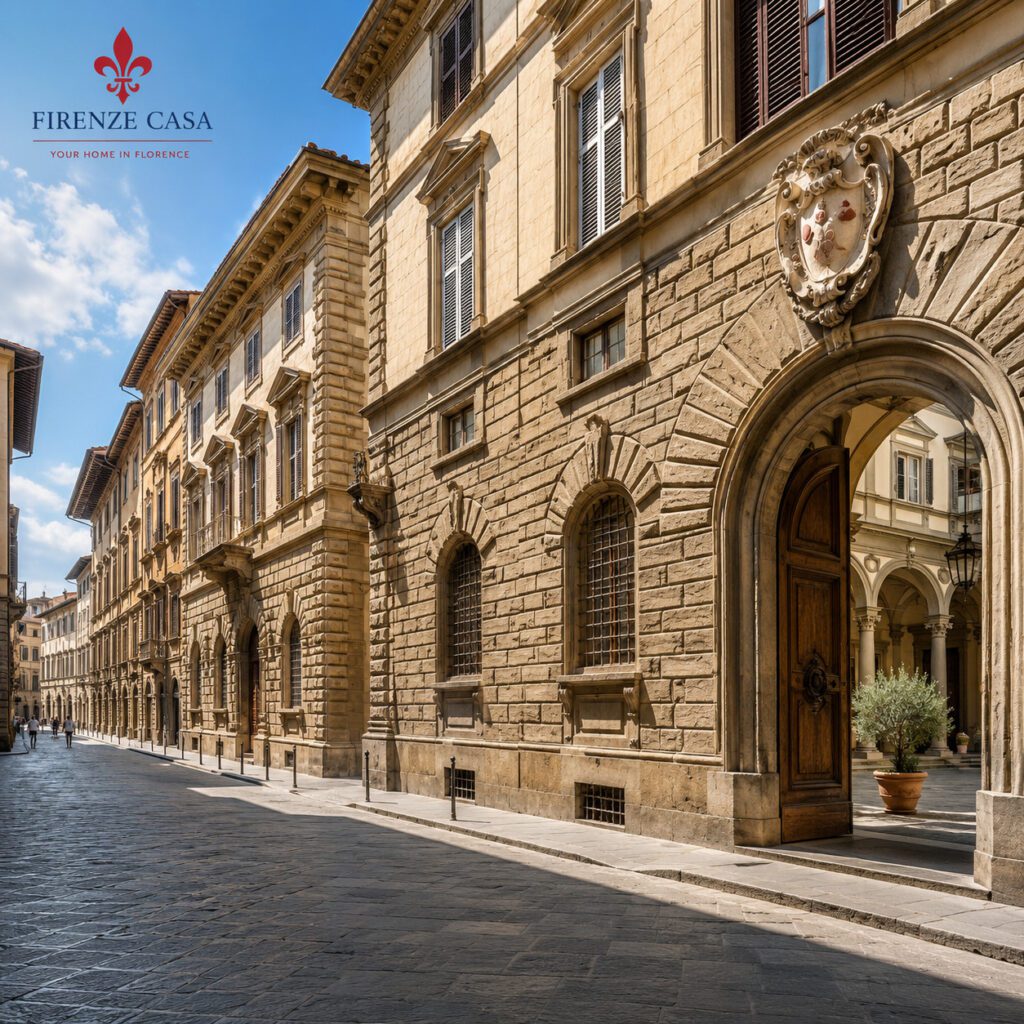
Palazzo Castellani, however, retained a distinctly medieval appearance. Its exposed stone façade still differs dramatically from the ordered architecture of later Renaissance residences.
Compare Palazzo Castellani with Palazzo Medici Riccardi or Palazzo Rucellai. Its heavy stonework belongs to an older architectural tradition and helps show how dramatically Florentine palace design changed during the Renaissance.
The Architecture of Palazzo Castellani
The architecture of Palazzo Castellani reflects centuries of adaptation rather than one unified building campaign. Exposed stone masonry and arched openings give the exterior its strong medieval character.
The façade remains relatively restrained, particularly when compared with the carefully organised Renaissance palaces created during the 15th century. This severity is part of its appeal.
Rather than presenting one perfectly preserved historical moment, the building records repeated alterations and changing functions. Families, courts and cultural institutions all adapted the structure to new needs.
Palazzo Castellani therefore demonstrates an important characteristic of Florence: historic buildings often survived because successive generations reused them rather than replacing them.
The Giudici di Ruota
A major change came in 1574, when Palazzo Castellani became the seat of the Giudici di Ruota, an important judicial institution of the Grand Duchy of Tuscany.
The court remained here until 1841. For more than two and a half centuries, a building that had begun as a medieval fortress served the legal and administrative structures of the Tuscan state.
Coats of arms associated with magistrates survive near the entrance and provide visible evidence of this long judicial period.
Notice the coats of arms near the entrance. They recall the centuries when Palazzo Castellani housed the Giudici di Ruota and connect the building directly with the administrative history of grand-ducal Tuscany.
Palazzo Castellani in the 19th Century
During the first half of the 19th century, the palace underwent significant restoration as its institutional role continued to evolve.
After Italian unification, Palazzo Castellani increasingly became associated with archives, scholarship and cultural institutions. Collections of manuscripts from the Biblioteca Nazionale occupied the building for a period and remained there until the early 20th century.
The palace also housed institutions including the Accademia della Crusca and the Deputazione di Storia Patria per la Toscana.
Its history therefore shifted gradually from defence and justice towards research, scholarship and the preservation of knowledge.
Palazzo Castellani survived because each period found a new purpose for it. Fortress, family residence, courthouse, scholarly institution and museum all form parts of the same architectural biography.
The Hidden Remains of Castello d’Altafronte
Some of the most remarkable evidence for the building’s medieval origins lies below ground.
During restoration work in 2002 and 2003, investigations in the basement revealed four massive stone foundation arches associated with the ancient Castello d’Altafronte.
These structures confirm that parts of the earlier fortress survived beneath later architectural phases. Centuries of rebuilding transformed the palace above ground, while important medieval elements remained incorporated within its foundations.
This makes Palazzo Castellani particularly valuable from an archaeological and architectural perspective. Its earliest history survives not only in written sources but also within the physical structure of the building.
Beneath Palazzo Castellani survive massive foundation arches from the medieval Castello d’Altafronte. Florence often preserves its oldest history underneath buildings that appear much later at street level.
Palazzo Castellani and the Museo Galileo
In 1930, Palazzo Castellani became home to the institution then known as the Museo Nazionale di Storia delle Scienze. After decades of development, the museum adopted the name Museo Galileo in 2010.
The relationship between building and collection is particularly interesting. Medieval architecture now houses instruments documenting centuries of scientific observation, experimentation and discovery.
The museum is especially famous for instruments associated with Galileo Galilei, together with important scientific collections assembled under the Medici and Lorraine dynasties.
A visit therefore provides two historical experiences at once: the development of science through the museum collections and almost a millennium of architectural history through Palazzo Castellani itself.
If you visit the Museo Galileo, look at the palace before concentrating on the collection. Palazzo Castellani is not merely a container for the museum but an important historic monument in its own right.
A Medieval Survivor beside the Uffizi
Palazzo Castellani is particularly easy to overlook because of its extraordinary neighbours. The Uffizi attracts enormous attention, while Piazza della Signoria and Ponte Vecchio draw visitors only a short distance away.
Yet precisely this location makes the palace fascinating. The building originated centuries before the Uffizi and preserves memories of a city that existed long before the great Medici projects reshaped central Florence.
Standing in Piazza dei Giudici allows visitors to read the city almost chronologically. Medieval fortification, republican government, grand-ducal architecture and modern museum culture all survive within a remarkably small area.
Palazzo Castellani and Other Historic Palaces
Within our palace cluster, Palazzo Castellani provides an important starting point because it represents the architectural world that existed before the great Renaissance residences.
Palazzo Vecchio still preserves a powerful medieval fortress character, but its scale and civic purpose differ fundamentally from the family residence that developed at Palazzo Castellani.
Palazzo Medici Riccardi demonstrates the next major transformation. Michelozzo converted the traditional strength of the Florentine palace into a consciously ordered Renaissance architectural system.
Meanwhile, Palazzo Rucellai moved even further towards classical harmony. Together, these buildings allow visitors to trace centuries of architectural change without leaving central Florence.
Palazzo Castellani is especially useful within the cluster because it shows where Florentine palace architecture came from. Its medieval solidity provides the background against which the Renaissance innovations of Michelozzo and Alberti become much easier to understand.
Can You Visit Palazzo Castellani?
Yes. Visitors can enter Palazzo Castellani through the Museo Galileo. The museum provides access to the historic building while presenting one of Europe’s most important collections devoted to the history of scientific instruments.
The exterior can, of course, be appreciated freely from Piazza dei Giudici and the surrounding streets. Visitors interested primarily in architecture should spend a few minutes examining the façade before entering.
Opening hours, admission arrangements and temporary closures can change, so check current information from the Museo Galileo before planning a visit.
Location: Piazza dei Giudici, Florence
Area: Beside the Arno, east of the Uffizi
Current use: Museo Galileo
Public access: Yes, through the museum
Architectural highlight: Medieval stone exterior and surviving earlier structures
Best combined with: Uffizi, Piazza della Signoria and the Arno
What to Notice at Palazzo Castellani
Begin with the exposed stone façade, which preserves the severe character of medieval Florentine architecture. The arched openings and heavy masonry contrast strongly with the regular façades of later Renaissance palaces.
Next, look for the magistrates’ coats of arms near the entrance. These details recall the long period when the Giudici di Ruota occupied the building.
Finally, consider the relationship with the Arno. The strategic importance of the original Castello d’Altafronte becomes much easier to understand once you imagine this location before the Uffizi and modern embankments transformed the riverside.
Why Palazzo Castellani Is Worth Seeing
Palazzo Castellani is worth seeing because it preserves almost a thousand years of Florentine history within a single building. Its story begins with a medieval fortress beside the Arno and continues through powerful families, grand-ducal magistrates, scholarly institutions and the Museo Galileo.
The palace also reminds visitors that Florence existed long before the Renaissance architecture for which it became famous. Beneath and within the present building survive traces of the fortified medieval city.
Its location makes Palazzo Castellani especially easy to include in a walk through central Florence. Only steps from the Uffizi and Piazza della Signoria, it allows visitors to add an unexpectedly deep medieval layer to one of the city’s most familiar areas.
Walk from Palazzo Castellani to Palazzo Vecchio and then towards the Renaissance palaces of the centre. Within a short distance, Florence reveals the evolution from medieval fortified architecture to the ordered urban palace of the Renaissance.
Frequently Asked Questions
Where is Palazzo Castellani in Florence?
Palazzo Castellani stands in Piazza dei Giudici beside the Arno, immediately east of the Uffizi and close to Piazza della Signoria.
How old is Palazzo Castellani?
Its origins reach back to the late 11th century, when the site contained the fortified Castello d’Altafronte.
Why was it called Castello d’Altafronte?
The name came from the Altafronte family, who owned the early fortified building before it passed to the Uberti in 1180.
Who were the Castellani?
The Castellani were the Florentine family who acquired the property during the 14th century. Their name has remained attached to the palace ever since.
What were the Giudici di Ruota?
The Giudici di Ruota were magistrates of an important court in the Grand Duchy of Tuscany. Palazzo Castellani housed the institution from 1574 until 1841.
What is inside Palazzo Castellani today?
The palace houses the Museo Galileo, whose collections document the history of science and include important scientific instruments associated with Galileo, the Medici and the House of Lorraine.
Are parts of Castello d’Altafronte still preserved?
Yes. Restoration work in the early 2000s revealed massive stone foundation arches belonging to the earlier medieval structure.
Can you visit Palazzo Castellani?
Yes. Visitors enter the building through the Museo Galileo, subject to the museum’s current opening and admission arrangements.
Is Palazzo Castellani worth seeing if I do not visit the museum?
Yes. Its medieval exterior, location beside the Arno and proximity to the Uffizi make it a worthwhile architectural stop even from outside.
Further Reading on Firenze Casa
Continue exploring Florence’s historic architecture and the evolution from medieval civic buildings to Renaissance palaces:
- Historic Palaces of Florence – Complete Guide
- Palazzo Vecchio – Florence’s Historic Seat of Government
- Palazzo Medici Riccardi – The First Renaissance Palace in Florence
- Palazzo Rucellai – Alberti’s Renaissance Palace in Florence
- Piazza della Signoria – Florence’s Political Heart
References
- Museo Galileo – Historical Documentation on Palazzo Castellani and Castello d’Altafronte
- Museo Galileo – History of the Istituto e Museo di Storia della Scienza
- Comune di Firenze – Historical and Architectural Heritage of Florence
- Archivio Storico del Comune di Firenze – Historical Documentation on Florentine Buildings and Institutions
- Touring Club Italiano – Firenze e dintorni