
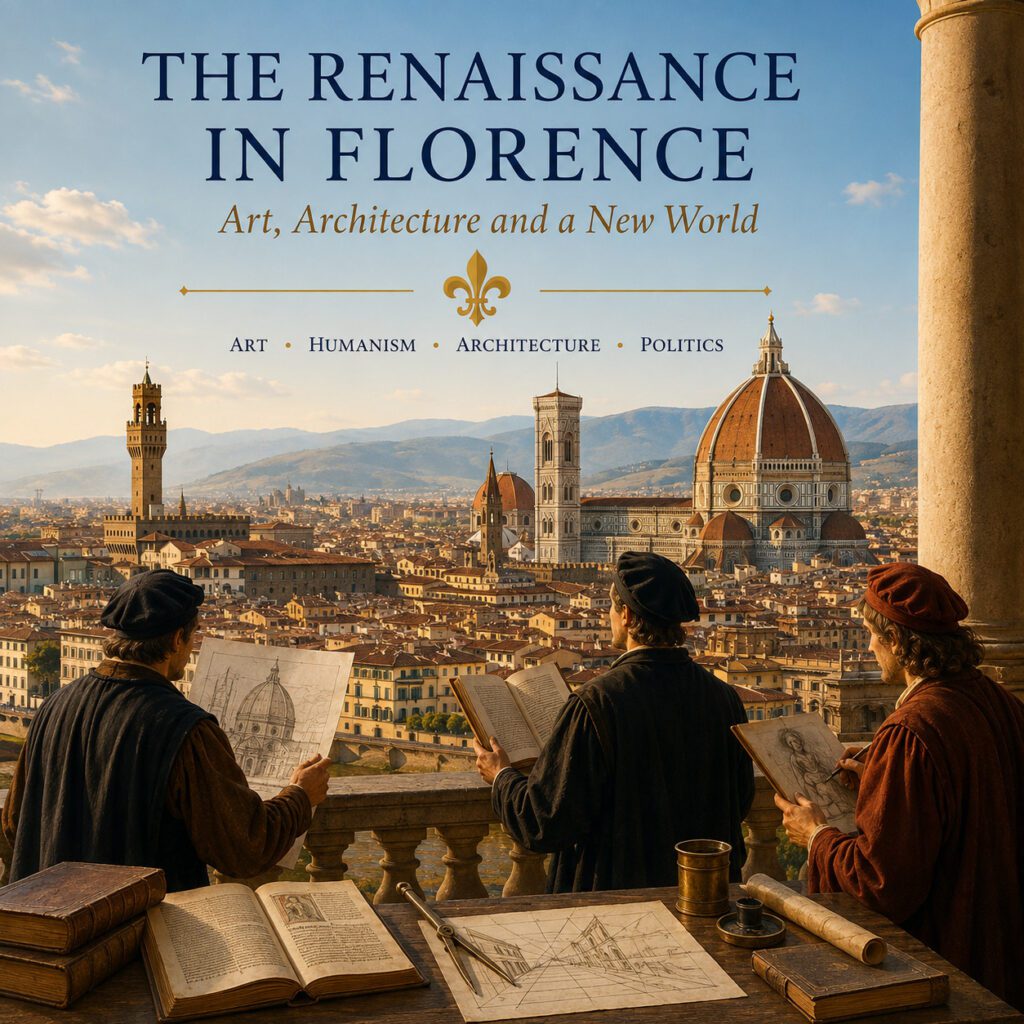
The Renaissance in Florence changed far more than art. Between the fourteenth and sixteenth centuries, new ideas about humanity, knowledge, politics, architecture and the natural world transformed the city. Painters experimented with perspective, architects rediscovered classical principles, humanists studied ancient texts, and powerful families used culture to express wealth and influence.
Florence did not create the Renaissance alone, nor did the movement begin on a single date. Yet few cities played such an important role in its development. To understand Renaissance Florence is therefore to understand a remarkable period when art, money, politics and intellectual curiosity came together and helped reshape European culture.
The Renaissance developed in Italy between the late Middle Ages and the early modern period. Florence became one of its most important centres, particularly during the fifteenth century. Humanism, renewed interest in classical antiquity, artistic innovation, banking wealth, political competition and patronage all contributed to this extraordinary cultural transformation.
What Does Renaissance Mean?
The word Renaissance comes from French and means “rebirth”. The Italian term Rinascimento carries the same idea. Historians use these words to describe a broad cultural movement associated with renewed interest in the literature, philosophy, art and architecture of classical Greece and Rome.
However, the Renaissance was not simply an attempt to copy antiquity. Artists, writers and thinkers studied the ancient world because they believed it could offer models for their own age. They absorbed those ideas, questioned them and created something new.
Nor did medieval culture suddenly disappear. Many institutions, religious traditions and artistic practices continued into the Renaissance. The change unfolded gradually, and different developments occurred at different times.
People living around 1400 did not wake up one morning believing that the Middle Ages had ended and the Renaissance had begun. Historical periods are labels created to help us understand gradual and overlapping changes.
Why Did the Renaissance Flourish in Florence?
There was no single reason. Instead, Florence offered an unusual combination of wealth, political competition, education, craftsmanship and intellectual ambition.
By the late Middle Ages, Florentine merchants operated across Europe. Banking families developed international networks, while the city’s textile industries generated enormous wealth. This prosperity created people and institutions capable of financing expensive buildings, paintings and sculptures.
Florence was also a competitive society. Families sought prestige, while guilds, religious institutions and political bodies commissioned works that demonstrated their importance. Art therefore became part of civic identity as well as private devotion.
At the same time, the city possessed a remarkable network of workshops. Masters trained apprentices who later became important artists themselves. Ideas moved between painters, sculptors, architects, goldsmiths and engineers, encouraging experimentation.
Competition as a Creative Force
Florentine culture often turned rivalry into creativity. Patrons competed for magnificent chapels and palaces, while artists competed for major commissions.
One famous example came in 1401, when the Arte di Calimala organised a competition for new bronze doors for the Baptistery. Lorenzo Ghiberti won the commission, while Filippo Brunelleschi eventually turned increasingly towards architecture.
Such competitions reveal an important characteristic of Renaissance Florence. Artistic achievement could bring prestige not only to an individual artist, but also to a family, guild or the entire city.
Humanism – A New Way of Looking at Humanity
Humanism was one of the intellectual foundations of the Renaissance. Scholars searched for ancient Greek and Roman texts, studied languages and developed new approaches to history, rhetoric, poetry, ethics and philosophy.
Petrarch, who lived in the fourteenth century, is often regarded as an important early humanist. Later generations expanded this intellectual culture, while Florence became a major centre for scholars, libraries and the study of classical texts.
Humanism did not necessarily reject Christianity. Many humanists remained deeply religious. Instead, they explored how classical learning could enrich contemporary intellectual and moral life.
This renewed attention to human experience also influenced the arts. Artists became increasingly interested in individual character, physical anatomy, emotion and the relationship between people and the world around them.
Renaissance humanism was not simply the modern idea of “putting humans instead of God at the centre”. Many humanists were committed Christians. Their innovation lay largely in renewed engagement with classical texts and in the importance they gave to human education, language, history and moral thought.
Money, Banking and the Renaissance
The Renaissance required ideas, but many of those ideas also required money. Monumental architecture, bronze sculpture, fresco cycles and elaborate altarpieces were expensive undertakings.
Florence had both wealthy private patrons and powerful institutions. Merchants and bankers commissioned chapels, paintings and palaces, while guilds funded major civic and religious projects.
The Medici became the most famous patrons, although they were far from the only ones. Families such as the Strozzi, Rucellai, Tornabuoni and Pazzi also contributed to the artistic landscape of the city.
Patronage served several purposes. A commission could express religious devotion, commemorate a family, display wealth or communicate political influence. Consequently, some of Florence’s greatest works emerged from a complex mixture of faith, civic pride and personal ambition.
The Medici and Renaissance Florence
No family is more closely associated with the Florentine Renaissance than the Medici. Their banking fortune gave them enormous influence, although Florence remained formally a republic during much of the fifteenth century.
Cosimo de’ Medici, later known as Cosimo the Elder, became the dominant political figure of his generation. His family supported religious buildings, scholars and artists, while carefully cultivating its position within Florentine society.
His grandson Lorenzo de’ Medici, known as Lorenzo the Magnificent, became one of the most celebrated patrons of Renaissance culture. His circle included poets, philosophers and artists, and his name became closely connected with the cultural brilliance of late fifteenth-century Florence.
However, the relationship between the Medici and the Renaissance should not obscure the wider picture. Florentine culture grew from many patrons, workshops, guilds, churches and civic institutions. The Renaissance was much larger than one family.
When exploring Florence, look beyond the Medici name. The façades, chapels and palaces of rival families reveal a city in which competition for prestige helped stimulate extraordinary artistic creativity.
Politics – A Republic, Powerful Families and Constant Change
Renaissance Florence was politically complex. For much of the period, it described itself as a republic, with government centred on institutions associated with Palazzo Vecchio. Yet political power rarely operated as simply as the formal constitution suggested.
Elite families competed for influence, factions formed and collapsed, and exile remained a powerful political weapon. The Medici dominated Florence for long periods, lost control, returned and eventually transformed their position into hereditary rule.
The city also experienced dramatic upheaval. After the Medici were expelled in 1494, the Dominican friar Girolamo Savonarola became an extraordinary political and religious influence. Florence later experienced further republican government before Medici rule became firmly established during the sixteenth century.
These struggles shaped Renaissance culture. Art and architecture could communicate republican ideals, family prestige or princely authority depending on the political circumstances.
Machiavelli and a New Language of Politics
Few writers demonstrate the political complexity of Renaissance Florence better than Niccolò Machiavelli. He served the Florentine Republic as a diplomat and official, observing rulers, wars and political negotiations at close range.
After the Medici returned to power in 1512, Machiavelli lost his position. During the following period, he wrote the work for which he became most famous: The Prince.
Machiavelli analysed political power with unusual attention to how rulers actually behaved rather than how ideal rulers should behave. As a result, his name became inseparable from debates about political realism, morality and power.
His writings remind us that the Renaissance was not merely an age of beautiful paintings. It was also a period of intense political experimentation and reflection.
A Revolution in Architecture
Renaissance architecture changed the appearance of Florence. Architects looked towards ancient Roman buildings and texts while developing new systems based on geometry, proportion and harmonious relationships between architectural elements.
Filippo Brunelleschi became one of the decisive figures. His buildings employed clear geometric forms and classical architectural vocabulary in ways that differed dramatically from the Gothic traditions around them.
The Ospedale degli Innocenti is a particularly clear example. Its elegant arcade uses repeated columns and proportional bays to create a calm architectural rhythm.
Brunelleschi’s greatest achievement, however, rises above Florence itself.
Brunelleschi’s Dome
The enormous dome of Santa Maria del Fiore became both an engineering triumph and a symbol of Florentine ambition. When construction began, builders faced the challenge of covering a vast octagonal crossing without relying on the traditional wooden centring that such a structure would normally require.
Brunelleschi developed an ingenious solution using a double-shell structure and sophisticated construction techniques. The dome transformed Florence’s skyline and demonstrated that contemporary builders could achieve something worthy of comparison with the monuments of antiquity.
It remains one of the clearest physical expressions of the confidence associated with Renaissance Florence.
The Renaissance city is easiest to understand on foot. Compare the Gothic verticality of earlier buildings with Brunelleschi’s measured spaces and later Renaissance palaces. Florence becomes an open-air lesson in changing architectural ideas.
Alberti and the Language of Classical Architecture
Leon Battista Alberti brought together humanist scholarship and architectural theory. He studied classical principles and wrote influential works on painting and architecture.
In Florence, the façade of Santa Maria Novella demonstrates his ability to create harmony from an existing medieval building. Classical elements, geometry and carefully calculated proportions bring the different parts together.
Palazzo Rucellai similarly reveals how classical architectural ideas could transform the urban palace. Renaissance architecture therefore changed not only churches and monuments, but also the streets of Florence.
Perspective – A New Way of Creating Space
One of the most famous artistic developments of the Renaissance was linear perspective. Artists had long represented space, but fifteenth-century Florentines developed a systematic geometric method for creating the illusion of depth on a flat surface.
Brunelleschi is traditionally associated with important early experiments in perspective. Leon Battista Alberti then explained its principles in his treatise on painting.
The impact was enormous. Buildings, streets and figures could now occupy a convincing visual space organised around the viewer’s position.
Perspective was more than a technical trick. It reflected a broader Renaissance fascination with mathematics, observation and the relationship between the human eye and the visible world.
Painting – From Giotto to Leonardo
The transformation of Florentine painting began before what we usually call the Renaissance. Giotto, working around 1300, gave his figures greater weight, emotion and physical presence. For this reason, later generations regarded him as a crucial predecessor of Renaissance painting.
During the fifteenth century, Masaccio pushed these developments much further. His frescoes in the Brancacci Chapel demonstrate powerful modelling of the human figure and a convincing use of perspective.
Fra Angelico combined Renaissance spatial ideas with an extraordinary sense of spiritual calm. Filippo Lippi brought increasing naturalism and intimacy to religious painting, while Domenico Ghirlandaio filled sacred narratives with people and details drawn from contemporary Florentine life.
By the end of the century, Florence had produced an artistic environment in which Botticelli, Leonardo da Vinci and Michelangelo could develop.
Botticelli and the Poetry of the Renaissance
Sandro Botticelli represents another side of Renaissance culture. Works such as Primavera and The Birth of Venus combine classical mythology, poetry and elegant human forms.
Their subjects demonstrate the renewed fascination with antiquity that flourished within educated Florentine circles. Yet Botticelli did not simply recreate ancient art. Instead, he transformed classical stories into images shaped by the intellectual culture of his own time.
Today, these paintings in the Uffizi have become global symbols of the Florentine Renaissance.
Leonardo and the Observation of Nature
Leonardo da Vinci carried Renaissance curiosity in many directions at once. Painter, draftsman, engineer and investigator of anatomy and nature, he refused to separate artistic creation from observation.
His drawings reveal an extraordinary desire to understand how things work. Muscles, water, plants, machines, faces and geological formations all attracted his attention.
Leonardo therefore embodies an important Renaissance idea: knowledge could grow through close observation as well as through inherited authority.
Sculpture and the Rediscovery of the Human Body
Sculpture offered Florentine artists a particularly direct encounter with the classical past. Ancient statues provided models for anatomy, movement and the representation of the human body.
Lorenzo Ghiberti created extraordinarily sophisticated bronze reliefs for the Baptistery doors. Donatello, meanwhile, explored psychological expression, classical forms and new approaches to the free-standing human figure.
His bronze David became one of the most remarkable sculptures of the fifteenth century. Later, Andrea del Verrocchio continued the Florentine tradition of combining technical mastery with close observation.
Eventually, Michelangelo pushed the Renaissance fascination with the human body to extraordinary heights. His marble David, created at the beginning of the sixteenth century, became both an artistic masterpiece and a powerful symbol of Florence.
Literature Before and During the Renaissance
The literary transformation associated with Renaissance Florence had deep roots. Dante Alighieri, Francesco Petrarch and Giovanni Boccaccio all belonged to the preceding centuries, yet their influence on later Renaissance culture was immense.
Dante demonstrated the literary possibilities of the vernacular through the Divine Comedy. Petrarch became a crucial figure in the development of humanism, while Boccaccio’s Decameron explored human behaviour through a remarkable collection of stories.
The relationship between Latin and the vernacular remained important. Humanists admired classical Latin and worked to recover ancient texts, while writers increasingly demonstrated that Italian could carry sophisticated literary thought.
Later Florentine authors such as Machiavelli continued this tradition. Literature therefore became another field in which classical inheritance and contemporary experience interacted.
Dante, Petrarch and Boccaccio are often discussed alongside Renaissance culture, but their historical positions differ. Dante belongs primarily to the medieval world, while Petrarch is frequently associated with early humanism. The Renaissance developed from earlier transformations rather than appearing suddenly in fifteenth-century Florence.
Science, Anatomy and the Observation of Nature
The Renaissance also encouraged new forms of investigation into the natural world. Artists studied anatomy because understanding the body improved their ability to represent it. Engineers examined forces, machines and materials, while scholars revisited ancient scientific texts.
Leonardo provides the most famous example of the connection between art and investigation. His anatomical drawings combined close observation with extraordinary draughtsmanship.
However, we should avoid describing the Renaissance as the sudden birth of modern science. Medieval scholars had already developed important traditions of mathematics, medicine and natural philosophy. Renaissance thinkers inherited these traditions while adding new approaches and recovering additional ancient knowledge.
The Scientific Revolution would develop more fully during the following centuries. Nevertheless, Renaissance curiosity helped create an intellectual environment in which observation, measurement and questioning acquired increasing importance.
Religion Did Not Disappear During the Renaissance
Modern descriptions sometimes create the impression that Renaissance humanism replaced religion. Florence itself shows why this interpretation is misleading.
Many of the greatest Renaissance masterpieces were religious commissions. Churches, monasteries, confraternities and wealthy families paid artists to create altarpieces, frescoes, chapels and sculptures devoted to Christian subjects.
Brunelleschi designed churches. Fra Angelico painted for a Dominican monastery. Michelangelo created religious works throughout his career. Even when artists used classical forms or humanist ideas, Christianity remained deeply embedded in Florentine society.
The Renaissance therefore brought new ways of representing and thinking about humanity without simply abandoning the religious world that preceded it.
Was the Renaissance Only for the Wealthy?
Much of the art that survives today resulted from wealthy patrons and powerful institutions. Nevertheless, Renaissance culture extended beyond private palaces.
Public buildings, churches, piazzas and sculptures shaped the everyday environment of Florentines. Guilds commissioned works for spaces used by the wider community, while religious festivals and civic ceremonies brought art into public life.
At the same time, social inequality remained substantial. Florence contained labourers, servants, artisans and poor families whose lives differed dramatically from those of bankers and elite patrons.
Understanding the Renaissance therefore requires some caution. The magnificent works that survive tell an extraordinary story, but they do not represent every Florentine experience equally.
Did the Renaissance Really Begin in Florence?
Florence has an exceptional claim to being one of the birthplaces of the Renaissance. Brunelleschi, Donatello, Masaccio and other Florentine figures transformed architecture and the visual arts during the early fifteenth century.
However, describing Florence as the single birthplace oversimplifies a much larger European story. Important developments also occurred in cities such as Siena, Venice, Padua, Mantua, Urbino and Rome. Northern Europe developed its own forms of Renaissance culture as well.
Ideas travelled with artists, merchants, diplomats, books and works of art. Consequently, the Renaissance became a network of interconnected cultural developments rather than an invention belonging to one city.
Florence nevertheless occupied an extraordinary position within that network. Few places brought together so many influential artists, patrons, humanists and political thinkers within such a concentrated urban environment.
Florence did not invent the Renaissance by itself. However, the city became one of its most important laboratories, where new ideas about art, architecture, politics and human experience developed with exceptional intensity.
From Florence to the Rest of Italy and Europe
Renaissance ideas did not remain inside the city walls. Artists travelled, patrons exchanged ideas and printed books circulated knowledge more rapidly than before.
Rome became particularly important during the High Renaissance. Popes attracted artists including Michelangelo and Raphael, while ambitious architectural projects transformed the city.
Venice developed a distinctive artistic tradition in which colour and light played extraordinary roles. Courts in Mantua, Ferrara and Urbino also became important centres of Renaissance culture.
Beyond Italy, artists and scholars adapted Renaissance ideas to local traditions. France, the German lands, England, the Low Countries and other regions consequently developed their own forms of Renaissance culture.
How the Renaissance Changed the Status of the Artist
Another important transformation concerned the position of artists themselves. Medieval workshops had already produced highly skilled masters, but Renaissance culture increasingly celebrated individual artistic achievement.
Artists began to acquire reputations that extended far beyond their cities. Patrons competed for their services, while writers discussed their styles, personalities and achievements.
Leon Battista Alberti wrote theoretical works about painting and architecture. Later, Giorgio Vasari created biographies of famous artists in his Lives of the Most Excellent Painters, Sculptors, and Architects.
The idea of the artist as an exceptional creative individual therefore became increasingly powerful. Names such as Leonardo, Michelangelo and Raphael eventually acquired a cultural status that continues today.
Where to See the Renaissance in Florence Today
One reason Florence remains the ideal city for understanding the Renaissance is that so much survives within a relatively small area. Museums contain the masterpieces, but streets, churches and palaces preserve the architectural world in which they were created.
Florence Cathedral and Brunelleschi’s Dome
Begin with Santa Maria del Fiore. Brunelleschi’s dome dominates the skyline and represents the engineering ambition of early Renaissance Florence.
Ospedale degli Innocenti
Brunelleschi’s arcade on Piazza Santissima Annunziata offers one of the clearest introductions to Renaissance proportion and architectural rhythm.
San Lorenzo
The church and surrounding Medici complex bring together Brunelleschi, Donatello, Michelangelo and generations of Medici patronage.
Santa Maria Novella
Alberti’s façade demonstrates the Renaissance search for geometry and harmony. Inside the church, Masaccio’s Holy Trinity provides one of the most celebrated demonstrations of linear perspective.
Palazzo Medici Riccardi
This palace illustrates how Renaissance architecture transformed elite domestic life. Its restrained exterior also reflects the complex relationship between Medici wealth and republican Florence.
Palazzo Vecchio and Piazza della Signoria
The political centre of Florence provides essential context for understanding republican government, civic identity and the later rise of Medici power.
The Uffizi Gallery
The Uffizi allow visitors to follow the development of Italian painting from medieval traditions through the Renaissance and beyond. Works by Giotto, Botticelli, Leonardo, Michelangelo and Raphael make the museum indispensable for understanding the period.
The Bargello
For Renaissance sculpture, the Bargello is equally important. Its collections include masterpieces by Donatello, Verrocchio, Michelangelo and other major sculptors.
Galleria dell’Accademia
Michelangelo’s David provides perhaps the most famous expression of Renaissance confidence in the human figure. The unfinished Prisoners offer another fascinating insight into his approach to sculpture.
San Marco
Fra Angelico’s frescoes transform the former Dominican monastery into one of Florence’s most moving Renaissance environments. They also demonstrate how deeply religious culture remained connected with artistic innovation.
Do not try to understand the Renaissance only inside museums. Walk between the Duomo, Piazza della Signoria, San Lorenzo and Santa Maria Novella. The short distances reveal how architecture, politics, religion, commerce and art existed side by side in Renaissance Florence.
The Renaissance in Florence at a Glance
| Area | What Changed? | Florentine Examples |
|---|---|---|
| Humanism | Renewed study of classical texts and human experience | Petrarch, Marsilio Ficino, Florentine humanist circles |
| Architecture | Classical forms, proportion and geometry | Brunelleschi, Alberti |
| Painting | Perspective, naturalism, anatomy and emotion | Masaccio, Botticelli, Leonardo |
| Sculpture | Classical forms and renewed study of the human body | Ghiberti, Donatello, Michelangelo |
| Politics | Republican government, family power and political theory | Medici, Savonarola, Machiavelli |
| Literature | Humanism and growing importance of vernacular writing | Dante, Petrarch, Boccaccio, Machiavelli |
| Patronage | Art used for devotion, prestige and civic identity | Medici, guilds, churches and merchant families |
Frequently Asked Questions About the Renaissance in Florence
What does Renaissance mean?
Renaissance means “rebirth”. The term describes a broad cultural movement associated with renewed engagement with classical antiquity and major developments in art, literature, architecture and intellectual life.
When did the Renaissance begin in Florence?
There is no single starting date. Important changes were already visible during the fourteenth century, while Florence became a particularly important centre of Renaissance innovation during the fifteenth century.
Why was Florence so important to the Renaissance?
Florence combined banking and commercial wealth with strong craft traditions, political competition, humanist scholarship and extensive artistic patronage. This environment encouraged experimentation and attracted exceptional talent.
Did the Medici create the Renaissance?
No. The Medici became extraordinarily important patrons, but many other families, guilds, churches and civic institutions financed Renaissance culture. Artistic developments also began before the Medici reached the height of their influence.
Who were the most important Florentine Renaissance artists?
Brunelleschi, Ghiberti, Donatello, Masaccio, Fra Angelico, Botticelli, Leonardo da Vinci and Michelangelo are among the most important names associated with Florence. However, dozens of other artists contributed to the city’s cultural transformation.
Was the Renaissance a rejection of religion?
No. Christianity remained central to Florentine life, and religious institutions commissioned many Renaissance masterpieces. Humanism and renewed interest in classical antiquity often developed alongside Christian belief rather than replacing it.
Where can I best experience the Renaissance in Florence?
The Duomo, Uffizi Gallery, Bargello, Galleria dell’Accademia, San Marco, San Lorenzo, Santa Maria Novella, Palazzo Medici Riccardi and Piazza della Signoria together provide an exceptional introduction to Renaissance Florence.
Why the Renaissance in Florence Still Matters
The importance of the Renaissance in Florence lies not in one invention or one masterpiece. Its significance comes from the interaction of many changes happening within the same city.
Bankers financed artists. Humanists studied ancient manuscripts. Architects measured Roman buildings. Painters explored perspective. Sculptors investigated the human body, while politicians debated liberty, power and government.
These worlds constantly overlapped. Brunelleschi was both artist and engineer. Alberti combined architecture with humanist scholarship. Leonardo moved between painting, anatomy and mechanics. Machiavelli transformed political experience into literature and political thought.
Above all, Florence allows us to see these developments in their original setting. The palaces still face the streets, the churches still shape the piazzas, and the artworks remain only minutes apart on foot.
That is why Renaissance Florence remains more than a chapter in an art history book. It is a city where a profound transformation in European culture can still be experienced through buildings, paintings, sculptures and streets.
Further Reading on Firenze Casa
Continue exploring the art, people and places that shaped Renaissance Florence:
- Uffizi Gallery – Renaissance Masterpieces in Florence
- Accademia Gallery – Home of Michelangelo’s David
- Bargello Museum – Renaissance Sculpture in Florence
- San Marco Museum – Fra Angelico and Monastic Life
- Palazzo Vecchio – Inside the Political Heart of Florence
- Florence Museums – The Complete Guide
References
Gallerie degli Uffizi – Collections and historical resources on Florentine Renaissance art and the Medici.
The Metropolitan Museum of Art – Heilbrunn Timeline of Art History: Architecture in Renaissance Italy.
The Metropolitan Museum of Art – Heilbrunn Timeline of Art History: The Rediscovery of Classical Antiquity.
Encyclopaedia Britannica – Renaissance, Florence, Humanism and the Medici family.
Burckhardt, Jacob – The Civilization of the Renaissance in Italy.
Hale, J. R. – Florence and the Medici.
Najemy, John M. – A History of Florence 1200–1575.
Kent, F. W. – Studies on Lorenzo de’ Medici, patronage and Renaissance Florence.
Vasari, Giorgio – Lives of the Most Excellent Painters, Sculptors, and Architects.

