
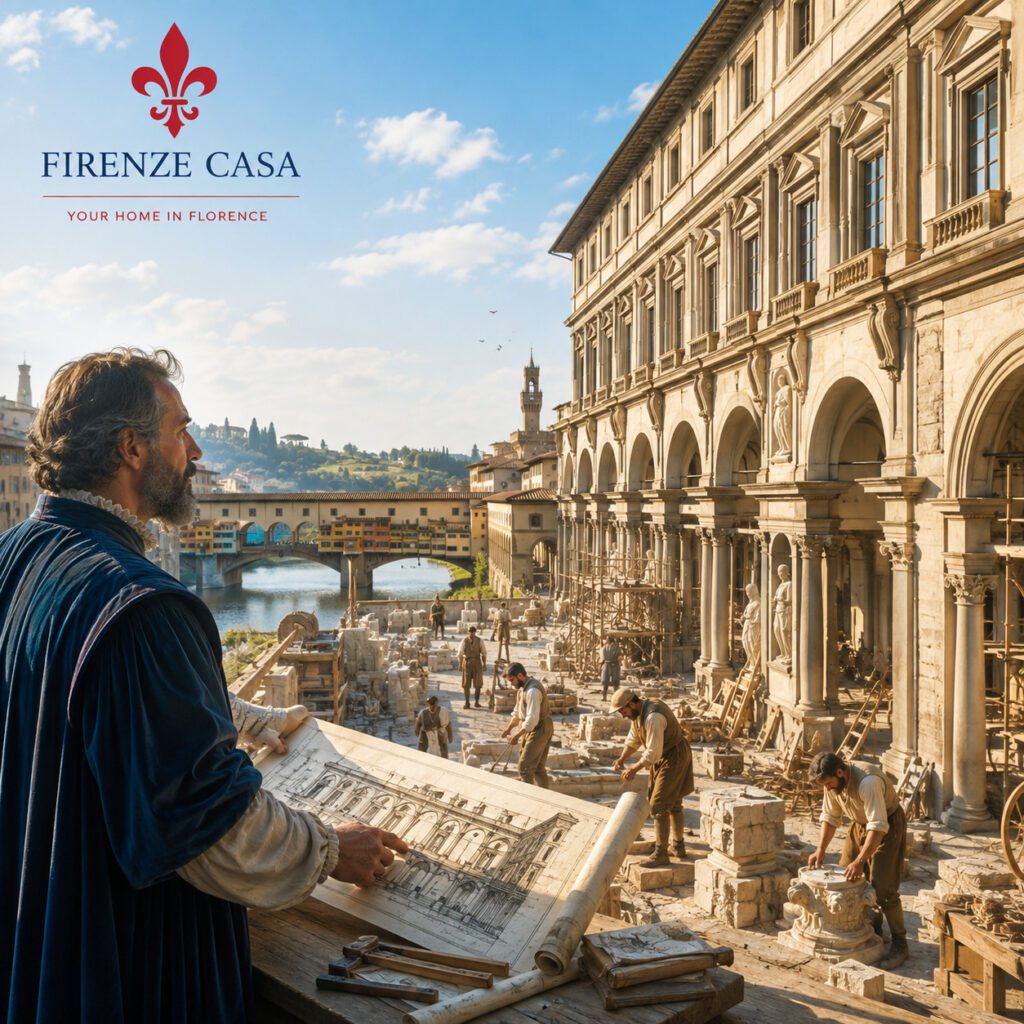
Uffizi Gallery: History, Medici Legacy and the Birth of the Modern Museum
The Uffizi Gallery is one of the world’s greatest museums and undoubtedly one of Florence’s most iconic attractions. Every year, millions of visitors come to admire masterpieces by Botticelli, Leonardo da Vinci, Michelangelo, Raphael and Caravaggio. Yet the Uffizi was never intended to become an art museum. It began life as the administrative heart of the Medici state before gradually evolving into one of the first public museums in Europe.
Its history reflects the extraordinary ambitions of the Medici family, whose political vision, artistic patronage and cultural influence transformed Florence into the cradle of the Renaissance. The Uffizi is therefore far more than a collection of paintings—it is a monument to the city’s political power, architectural innovation and artistic achievement.
Understanding how the Uffizi came into existence allows visitors to appreciate not only the masterpieces hanging on its walls but also the remarkable story behind the building itself. Every corridor, courtyard and gallery reflects centuries of Florentine history, from the rise of the Medici dynasty to the birth of the modern museum.
Historical Timeline
| Year | Event |
|---|---|
| 1560 | Cosimo I de’ Medici commissions Giorgio Vasari to build the Uffizi as the administrative centre of the Grand Duchy of Tuscany. |
| 1565 | The Vasari Corridor is constructed, connecting Palazzo Vecchio with Palazzo Pitti. |
| 1574 | Giorgio Vasari dies; Bernardo Buontalenti and Alfonso Parigi continue the project. |
| 1584 | The famous Tribuna is completed under Francesco I de’ Medici. |
| 1737 | Anna Maria Luisa de’ Medici signs the Patto di Famiglia, ensuring that the Medici collections remain in Florence forever. |
| 1769 | The Uffizi officially opens to the public, becoming one of Europe’s earliest public museums. |
| 1966 | The Arno flood damages parts of the museum and prompts major international restoration efforts. |
| 1993 | A Mafia bomb explodes in Via dei Georgofili, damaging the Uffizi and destroying several artworks. |
| Today | The Uffizi Galleries rank among the world’s most visited museums and continue to expand through restoration, research and digital innovation. |
Why Were the Uffizi Built?
To modern visitors, the Uffizi appears to have been designed as an art museum from the beginning. In reality, its original purpose was entirely administrative. During the sixteenth century, Florence had become the capital of the newly established Grand Duchy of Tuscany, and Cosimo I de’ Medici sought to strengthen his control over the government.
Until then, many state offices had been scattered throughout the city, making administration inefficient and symbolically weakening central authority. Cosimo envisioned a single monumental building that would bring together the most important magistrates, courts and administrative departments under one roof.
The Italian word uffizi simply means “offices.” The building was therefore conceived as a vast governmental complex rather than an artistic institution. Nevertheless, Cosimo recognised that architecture could communicate political power just as effectively as military strength.
Its strategic location between Palazzo Vecchio, the traditional seat of Florentine government, and the River Arno reinforced this message. Anyone entering Florence’s political centre would immediately encounter the impressive new administrative complex, a visible expression of Medici authority and the stability of the Grand Duchy.
Although practical considerations initiated the project, Cosimo’s vision extended far beyond bureaucracy. He wanted the building to embody Renaissance ideals of order, harmony and rational government while demonstrating that Florence remained one of Europe’s leading cultural capitals.
Cosimo I de’ Medici’s Vision
Cosimo I de’ Medici was not merely a ruler; he was an ambitious statesman who understood the power of architecture, urban planning and the arts. Having consolidated Medici authority after decades of political instability, he sought to transform Florence into a modern Renaissance capital worthy of comparison with Rome and other great European cities.
The construction of the Uffizi formed part of a much broader programme of urban renewal. During his reign, bridges, fortifications, churches, public squares and palaces were restored or rebuilt, creating a more coherent and prestigious cityscape.
For Cosimo, architecture served several purposes simultaneously. It improved administration, projected political authority, encouraged economic prosperity and celebrated Florence’s cultural achievements. The Uffizi perfectly embodied this philosophy. It was functional, elegant and symbolic at the same time.
Perhaps most remarkably, Cosimo also appreciated the importance of collecting works of art. While the building initially housed government offices, its upper floors gradually became home to treasures acquired by successive generations of the Medici family. This unexpected development would eventually transform the Uffizi into one of history’s greatest museums.
Giorgio Vasari: The Architect Behind the Uffizi
No discussion of the Uffizi would be complete without recognising the extraordinary contribution of Giorgio Vasari (1511–1574). Best known today as the author of The Lives of the Most Excellent Painters, Sculptors and Architects, Vasari was also one of the leading architects and artists of the Italian Renaissance.
Born in Arezzo, he enjoyed the patronage of the Medici family from an early age and became one of Cosimo I’s most trusted advisers. His architectural commissions included churches, palaces and civic buildings throughout Tuscany, but the Uffizi remains his greatest urban masterpiece.
Vasari conceived the building as a long, elegant corridor framed by harmonious arcades that directed the eye towards the River Arno. This dramatic perspective was revolutionary for its time and transformed what had previously been a dense medieval quarter into one of Florence’s most impressive urban spaces.
Although Vasari died before construction was completed, his vision shaped every stage of the project. Later architects, including Bernardo Buontalenti and Alfonso Parigi, remained remarkably faithful to his original concept, allowing the Uffizi to retain its extraordinary architectural unity.
Architecture and Urban Design
The Uffizi is far more than a museum filled with masterpieces. It is itself one of the most significant works of Renaissance architecture. Giorgio Vasari designed the building not simply as a collection of offices but as an integral part of Florence’s urban landscape, carefully connecting political power, civic life and artistic ambition.
The building stretches between Palazzo Vecchio and the River Arno in a long, elegant U-shaped layout. This arrangement creates one of Florence’s most striking urban perspectives. Visitors walking through the courtyard are naturally guided towards the river, where the open view contrasts beautifully with the enclosed medieval streets surrounding the complex.
The rhythmic arcades, symmetrical façades and carefully proportioned columns reflect the Renaissance ideals of harmony, balance and order. Although designed more than four hundred and fifty years ago, the building still feels remarkably modern because of its clean geometry and carefully planned public space.
Perhaps the greatest achievement of Vasari’s design was the creation of an entirely new urban axis within Florence. Instead of isolated buildings, he conceived an architectural sequence that linked the political centre of the city with the Arno and, ultimately, with the Medici residence on the opposite side of the river.
The Vasari Corridor: A Private Passage Above Florence
One of the most fascinating features associated with the Uffizi is the Vasari Corridor. Commissioned by Cosimo I de’ Medici in 1565, this elevated passageway allowed members of the Medici family to move safely between Palazzo Vecchio and Palazzo Pitti without walking through the crowded streets of Florence.
The corridor was completed in only a few months to celebrate the marriage of Francesco I de’ Medici and Joanna of Austria. Designed by Giorgio Vasari, it extends for approximately one kilometre, crossing the Arno via the upper level of the Ponte Vecchio before continuing through houses, churches and gardens to Palazzo Pitti.
The route offered privacy, security and convenience while symbolising Medici authority over the city. Even today, the corridor remains one of Florence’s most remarkable architectural achievements and an extraordinary example of Renaissance urban planning.
Following extensive restoration and conservation work, parts of the Vasari Corridor have once again become accessible to visitors, offering unique views over Florence that were once reserved exclusively for the ruling Medici family.
The Medici Collections Take Shape
Although the Uffizi had been conceived as an administrative building, the Medici family soon recognised its potential as a place to display their growing collections of art and scientific objects. The upper floors gradually became private galleries where paintings, sculptures, antiquities, maps, rare books and scientific instruments were arranged for distinguished guests.
Collecting art had become an important expression of prestige during the Renaissance. Wealthy rulers demonstrated not only their financial power but also their education, taste and support for artists. The Medici excelled at this form of cultural patronage.
Works commissioned by the family, together with carefully acquired masterpieces from across Italy, transformed the Uffizi into one of Europe’s most extraordinary private collections long before it became accessible to the public.
Artists such as Giotto, Filippo Lippi, Leonardo da Vinci, Michelangelo, Raphael and Titian gradually became represented within the collection, establishing a foundation that would later define the museum’s international reputation.
The Tribuna: The World’s First Great Gallery Room
Among the most celebrated spaces inside the Uffizi is the Tribuna, completed in 1584 under the patronage of Francesco I de’ Medici and designed by Bernardo Buontalenti. This remarkable octagonal room quickly became one of the most admired interiors in Europe.
Rather than serving simply as a display room, the Tribuna was conceived as a carefully orchestrated experience. Precious paintings, ancient sculptures, gemstones, scientific curiosities and luxurious decorative objects surrounded visitors in a single harmonious space.
The richly decorated room symbolised the Renaissance fascination with beauty, knowledge and discovery. Its red velvet walls, marble floor, domed ceiling and carefully controlled natural light created an atmosphere unlike anything previously seen.
European princes, diplomats, artists and scholars travelled to Florence specifically to admire the Tribuna. Many historians regard it as one of the earliest examples of a purpose-designed museum gallery, influencing exhibition design throughout Europe for centuries.
The Birth of the Modern Museum
During the eighteenth century, the purpose of the Uffizi changed fundamentally. What had begun as a private Medici collection gradually evolved into a public institution dedicated to education, scholarship and cultural preservation.
The decisive moment came in 1737 with the death of Gian Gastone de’ Medici, the last Grand Duke of the Medici dynasty. His sister, Anna Maria Luisa de’ Medici, inherited the family’s extraordinary artistic legacy and faced a historic decision.
Rather than allowing the collections to be dispersed among European royal courts, she negotiated the famous Patto di Famiglia. This agreement stipulated that the Medici collections should remain permanently in Florence “for the ornament of the State, for the utility of the public and to attract the curiosity of foreigners.”
Few documents have influenced the cultural history of Europe more profoundly. Without Anna Maria Luisa’s foresight, masterpieces such as Botticelli’s Birth of Venus, Leonardo’s Annunciation and Michelangelo’s works might today be scattered across museums and private collections around the world.
When the Uffizi officially opened to the public in 1769, it became one of Europe’s first great public museums. Scholars, artists and travellers undertaking the Grand Tour soon regarded a visit to the gallery as an essential part of their journey through Italy.
Masterpieces of the Uffizi Gallery
Today, the Uffizi Gallery houses one of the most important collections of Italian Renaissance art in the world. Rather than presenting isolated masterpieces, the museum tells the story of the development of Western painting from the Middle Ages through the High Renaissance and beyond.
Many visitors come specifically to admire Sandro Botticelli’s Birth of Venus and Primavera, two of the most celebrated paintings ever created. These works have become enduring symbols of Florence and continue to define the artistic ideals of the Renaissance.
The collection also includes masterpieces by Giotto, whose revolutionary approach to realism transformed medieval painting; Leonardo da Vinci, represented by works including the magnificent Annunciation; Michelangelo, whose Doni Tondo remains one of the highlights of the museum; and Raphael, whose elegant Madonnas exemplify the harmony of the High Renaissance.
Later galleries introduce visitors to artists such as Titian, Caravaggio, Parmigianino and Artemisia Gentileschi, demonstrating how Italian art continued to evolve over the following centuries.
For many art historians, the Uffizi is unique because it allows visitors to follow the entire development of Renaissance painting in a logical chronological sequence, making it not only one of the world’s finest museums but also one of its greatest educational institutions.
The Flood of 1966 and the Bombing of 1993
Like Florence itself, the Uffizi has faced moments of profound tragedy. The devastating flood of the River Arno in November 1966 affected museums, churches and libraries throughout the city. Although the most severe damage occurred elsewhere, important restoration work became necessary within the Uffizi as conservation specialists from around the world came together to rescue Florence’s artistic heritage.
The disaster marked a turning point in the science of art restoration. New conservation techniques developed during this period continue to influence museums internationally.
An even more direct attack occurred on the night of 27 May 1993, when a Mafia bomb exploded in nearby Via dei Georgofili, only a short distance from the Uffizi.
The explosion killed five people, injured many others and severely damaged parts of the museum. Several paintings were destroyed or permanently damaged, while hundreds of additional works required careful restoration.
Rather than weakening Florence’s cultural identity, the tragedy strengthened international commitment to protecting the city’s artistic treasures. Today, restored galleries stand as symbols of resilience and the enduring importance of cultural heritage.
The Uffizi Today
The modern Uffizi Galleries represent far more than the original museum created during the eighteenth century. Today the institution also includes Palazzo Pitti and the magnificent Boboli Gardens, forming one of Europe’s largest museum complexes.
Extensive renovation programmes known as the Nuovi Uffizi have transformed the visitor experience over recent decades. New exhibition spaces, improved lighting, modern climate-control systems and accessible routes have significantly enhanced the presentation of the collections while preserving the historic character of the building.
Digital technology has also become increasingly important. Online catalogues, virtual exhibitions and interactive educational resources allow people around the world to explore the collections even before arriving in Florence.
Despite these innovations, the essential character of the Uffizi remains unchanged. It continues to fulfil the vision first established by the Medici family: preserving artistic excellence while sharing it with future generations.
Visitor Information
📍 Location
Piazzale degli Uffizi, Historic Centre of Florence.
⏱ Recommended Visit
Allow at least 3–4 hours. Art lovers can easily spend an entire day exploring the collection.
🎟 Tickets
Advance online booking is strongly recommended throughout the year, particularly from April to October.
📅 Best Time to Visit
Early morning or late afternoon generally offer the most comfortable experience. Midweek visits are often less crowded than weekends.
📸 Photography
Photography for personal use is generally permitted without flash. Temporary exhibitions may have different rules.
🎧 Guided Tours
A professional guided tour or audio guide is highly recommended to fully appreciate the historical context of the masterpieces.
🌐 Official Website
https://www.uffizi.it/en
Interesting Facts
- The Uffizi was originally built as government offices rather than as an art museum.
- The Italian word uffizi simply means “offices”.
- The famous Vasari Corridor stretches for approximately one kilometre above the streets of Florence.
- The Tribuna was one of Europe’s earliest purpose-designed museum rooms.
- The Patto di Famiglia ensured that the Medici collections would remain permanently in Florence.
- Botticelli’s Birth of Venus is one of the museum’s most visited masterpieces.
- The Uffizi receives several million visitors every year, making it one of Italy’s most popular museums.
Frequently Asked Questions
Why is the Uffizi Gallery so famous?
The Uffizi houses one of the world’s finest collections of Renaissance art, including masterpieces by Botticelli, Leonardo da Vinci, Michelangelo, Raphael and Caravaggio.
How long should I spend at the Uffizi?
Most visitors should allow at least three to four hours. Those with a particular interest in Renaissance art may wish to spend an entire day.
Who built the Uffizi?
The building was commissioned by Cosimo I de’ Medici in 1560 and designed by the Renaissance architect Giorgio Vasari.
Why was the Uffizi originally constructed?
Its original purpose was to bring together the administrative offices of the Grand Duchy of Tuscany, creating a centralised government complex.
Is the Uffizi suitable for children?
Yes. While younger visitors may not explore every gallery, families can focus on the museum’s most famous masterpieces and enjoy shorter guided routes.
Further Reading from Firenze Casa
- The Medici Family: Bankers, Rulers and Patrons of the Renaissance
- Cosimo I de’ Medici: The Grand Duke Who Transformed Florence
- Giorgio Vasari: Artist, Architect and Historian
- Palazzo Vecchio: The Political Heart of Florence
- The Vasari Corridor: Florence’s Secret Passage
- Palazzo Pitti: The Grand Residence of the Medici
- The Boboli Gardens: The Green Heart of Renaissance Florence
- Piazza della Signoria: Florence’s Historic Centre of Power
- Anna Maria Luisa de’ Medici and the Patto di Famiglia
References
- Gallerie degli Uffizi – Official Website
- John M. Najemy – A History of Florence 1200–1575
- Gene Brucker – Florence: The Golden Age
- Giorgio Vasari – The Lives of the Most Excellent Painters, Sculptors and Architects
- Encyclopaedia Britannica – Uffizi Gallery
- Treccani – Gallerie degli Uffizi
- UNESCO World Heritage Centre – Historic Centre of Florence

