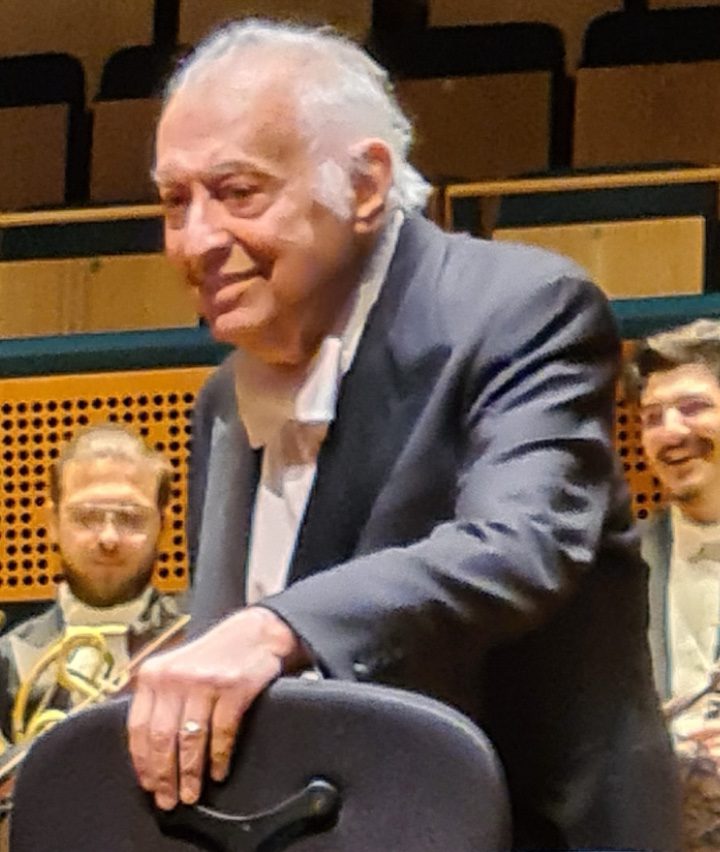
Florence is known worldwide for its Renaissance heritage, its art, and its architecture. Yet the city’s cultural identity is also deeply shaped by music. Few figures embody this connection more strongly than Zubin Mehta. Over several decades, Mehta has built a unique artistic relationship with Florence, leaving a lasting imprint on its musical life through the Maggio Musicale Fiorentino. His presence has helped position Florence as a modern center of classical music alongside its historical legacy.
Zubin Mehta – A Brief Biography
Zubin Mehta was born in 1936 in Bombay (now Mumbai), India, into a family devoted to classical music. His father, Mehli Mehta, was a violinist and founder of the Bombay Symphony Orchestra. Initially studying medicine, Zubin Mehta soon followed his musical calling and moved to Vienna, where he studied conducting under the legendary Hans Swarowsky.
Mehta’s international career developed rapidly. In the early 1960s, he was appointed music director of the Montreal Symphony Orchestra and shortly thereafter of the Los Angeles Philharmonic. These early appointments marked the beginning of a global career that would span continents and generations.
One of Mehta’s most significant achievements is his long-standing association with the Israel Philharmonic Orchestra. Appointed music director in 1977, he later became music director for life, a rare distinction reflecting both artistic excellence and deep mutual trust. Under his leadership, the orchestra achieved worldwide recognition and toured extensively, often under challenging political circumstances.
Throughout his career, Mehta has conducted the world’s leading orchestras, including the Vienna Philharmonic, Berlin Philharmonic, New York Philharmonic, and the Bavarian State Orchestra. His repertoire is particularly associated with the works of Gustav Mahler, Richard Strauss, Ludwig van Beethoven, and Richard Wagner. Mehta is widely admired for his clarity, emotional depth, and ability to balance orchestral power with lyrical sensitivity.
The Maggio Musicale Fiorentino
The Maggio Musicale Fiorentino is one of Europe’s oldest and most prestigious music festivals, founded in 1933. From its beginnings, the festival aimed to combine innovation with tradition, presenting both classical masterpieces and contemporary works. Over the decades, it has become a defining institution in Florence’s cultural life.
Zubin Mehta’s association with the Maggio Musicale began in the 1960s and developed into a lifelong artistic partnership. He served as principal conductor and later as honorary music director, shaping the orchestra’s sound and artistic direction. His interpretations of symphonic and operatic repertoire at the Maggio Musicale are considered milestones in the festival’s history.
Zubin Mehta and Florence – A Special Relationship
Unlike many conductors who appear in Florence as guest artists, Zubin Mehta became an integral part of the city’s cultural identity. Florence was not merely a professional stop in his career; it became a place of artistic continuity. Mehta frequently emphasized the importance of long-term collaboration, and Florence offered exactly this environment.
His work with the Orchestra del Maggio Musicale Fiorentino extended far beyond concerts. Mehta was deeply involved in artistic planning, repertoire choices, and the development of young musicians. This commitment contributed significantly to the orchestra’s international reputation.
When the new Opera House of Florence (Teatro del Maggio Musicale Fiorentino) opened, Mehta played a central role in its artistic inauguration. His presence symbolized continuity between Florence’s musical tradition and its modern cultural ambitions.
A Human and Artistic Legacy
What distinguishes Mehta’s relationship with Florence is its human dimension. Audiences, musicians, and critics alike describe a sense of mutual respect and affection. Mehta’s calm authority, humility, and dedication resonate strongly with the Florentine spirit, which values depth and substance over spectacle.
Even in advanced age, Mehta has continued to appear in Florence, often greeted with long standing ovations. These moments reflect not only admiration for a great conductor but gratitude for decades of artistic companionship.
Conclusion
Zubin Mehta’s connection with Florence is a rare example of a lifelong artistic partnership between a city and a musician. Through his work with the Maggio Musicale Fiorentino, he has shaped generations of performances and helped define Florence as a living, evolving center of classical music. For visitors and music lovers alike, this legacy adds a profound contemporary layer to Florence’s timeless cultural identity.