
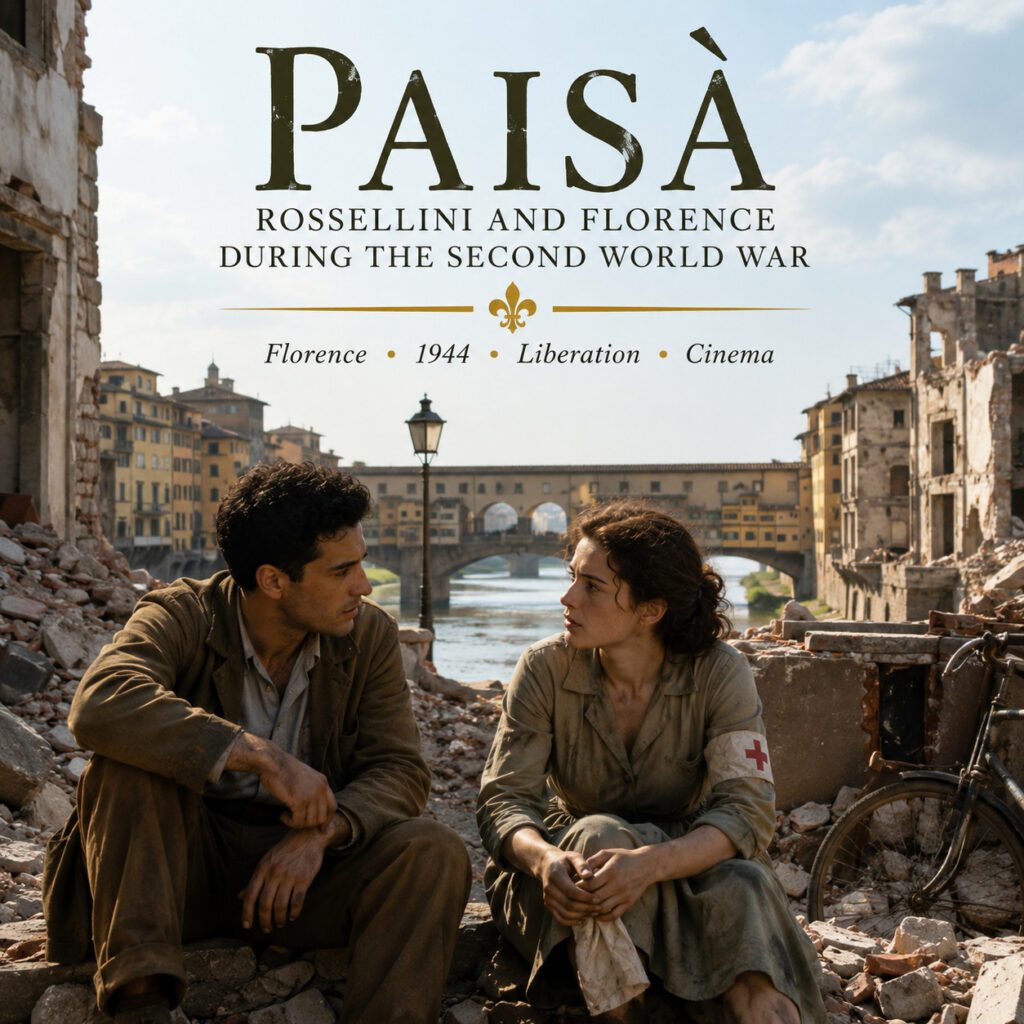
Few films show wartime Florence with the immediacy of Roberto Rossellini’s Paisà. The Paisà Florence episode takes viewers into the city during the dramatic summer of 1944, when Allied forces approached from the south, German troops withdrew northwards and Italian partisans fought for control inside Florence.
Released in 1946, Paisà became one of the defining works of Italian neorealism. Instead of presenting Florence primarily through Renaissance beauty, Rossellini uses streets, damaged buildings, the Arno and the Vasari Corridor to create a city shaped by war. It therefore occupies a unique place in our Movies Filmed in Florence – Famous Films and Locations.
Film: Paisà
Released: 1946
Director: Roberto Rossellini
Genre: Italian neorealism
Structure: six episodes following the Allied advance through Italy
Florence setting: the liberation of the city in August 1944
Key locations: Arno, Oltrarno, historic centre and Vasari Corridor
Historical background: German occupation, Italian Resistance and Allied advance
Paisà Florence – One City in a Journey Through Italy
Paisà does not tell one continuous story. Rossellini divided the film into six episodes that follow the Allied advance northwards through Italy, beginning in Sicily and continuing through Naples, Rome, Florence, the Apennines and finally the Po Delta.
Different characters appear in each section, but together the episodes create a fragmented portrait of a country emerging from Fascism and war.
The Paisà Florence episode occupies a particularly important position within this journey. By the summer of 1944, Rome had already been liberated and Allied forces were advancing through Tuscany. Florence, however, remained caught between retreating German troops, advancing Allied forces and an increasingly active Resistance.
Paisà followed Rossellini’s Rome, Open City and became one of the landmarks of post-war Italian cinema. Its episodic structure presents liberation through individual encounters rather than a conventional heroic narrative.
Roberto Rossellini and Italian Neorealism
Roberto Rossellini became one of the central figures of Italian neorealism, the cinematic movement that emerged around the end of the Second World War. Filmmakers increasingly turned away from polished studio productions and used real streets, damaged neighbourhoods, natural light and performers who often appeared far removed from traditional movie stars.
This approach suited post-war Italy because the country itself still carried visible traces of conflict. Ruined buildings, displaced populations and streets marked by recent fighting required little artificial reconstruction.
In Paisà Florence, the city does not function as an elegant historical backdrop. It becomes part of the drama, giving the episode an almost documentary immediacy.
Florence in the Summer of 1944
The historical background of the episode is essential. After the fall of Mussolini in 1943 and Italy’s armistice with the Allies, German forces occupied much of central and northern Italy. Florence remained under German control as Allied armies advanced northwards during 1944.
By early August, the front had reached the city. German forces withdrew towards the northern side of the Arno while attempting to slow the Allied advance, and the river became a crucial dividing line. Meanwhile, Florentine partisans prepared for insurrection and fought to establish control over parts of the city.
The Renaissance Florence familiar to modern visitors therefore became a battlefield. The wider story of the city beyond the Renaissance is explored in our History of Florence.
The liberation of Florence unfolded over several dramatic days in August 1944. Partisans played an important role inside the city while Allied troops approached from the south, and fighting continued during the German withdrawal.
The Arno – A Front Line Through Florence
The Arno has shaped Florence for centuries, but during the events portrayed in Paisà Florence it acquired an entirely different meaning. The river became a military obstacle separating areas controlled by opposing forces and complicated communication between different parts of the city.
Rossellini uses this geography powerfully. Familiar Florentine landmarks no longer represent beauty or tourism; they become reference points within a dangerous urban landscape. Moving from one side of the Arno to the other can mean crossing a front line.
For anyone walking peacefully along the Lungarni today, this wartime geography can be difficult to imagine.
The Destruction of Florence’s Bridges
One of the most dramatic events occurred during the German withdrawal. During the night of 3 to 4 August 1944, German forces destroyed the bridges across the Arno in central Florence, while Ponte Vecchio itself remained standing.
Its survival did not spare the surrounding area. Buildings at both approaches were demolished, leaving rubble and blocked streets around one of Florence’s most famous monuments.
These events form an essential part of the historical landscape behind the Paisà Florence episode. Rossellini made the film only a short time after the war, when the destruction was not distant history but still part of the city’s physical reality.
Ponte Vecchio survived the demolitions of Florence’s central bridges in August 1944, but buildings at both ends were destroyed to block access. Parts of the surrounding urban fabric were later reconstructed.
Ponte Vecchio in Wartime Florence
Today Ponte Vecchio is one of Florence’s most photographed landmarks, filled with jewellery shops and visitors crossing between the historic centre and Oltrarno. Its wartime history gives the bridge a very different significance.
The decision not to demolish Ponte Vecchio has generated numerous stories, including claims involving direct intervention by senior German leadership. The survival of the bridge is certain, but the precise reasons behind the decision remain more complicated than some popular accounts suggest.
Stories explaining exactly why Ponte Vecchio escaped demolition are often repeated as fact. The bridge’s survival is documented; some of the more dramatic explanations remain difficult to establish conclusively.
The Vasari Corridor in Paisà Florence
One of the most remarkable elements of the Florence episode involves the Vasari Corridor. Built in 1565 for Cosimo I de’ Medici, the elevated passage connected Palazzo Vecchio and the Uffizi with Palazzo Pitti across Ponte Vecchio.
Nearly four centuries later, Rossellini gave this Renaissance structure an entirely different meaning. In Paisà, the corridor becomes part of a dangerous route through the divided city.
A passage originally created to allow the Medici court to move privately between centres of power now belongs to a story about civilians and resistance fighters navigating Florence during battle.
The Vasari Corridor was created for the Medici court, not for military purposes. Its elevated route across the Arno nevertheless made it an extraordinary feature of Florence’s wartime geography and Rossellini’s cinematic city.
Harriet and Massimo – Crossing a Divided City
The Florence episode centres on Harriet, an American nurse, and Massimo, an Italian man trying to reach his family. Harriet searches for an Italian man she loves, while Massimo hopes to discover what has happened to his relatives.
Their journey allows Rossellini to present the liberation of Florence from street level. Instead of generals studying maps or politicians discussing strategy, viewers encounter civilians, partisans and individuals trying to move through an environment where ordinary routes have become dangerous or impossible.
This human scale is fundamental to Paisà. History appears not simply as military victory but as uncertainty experienced by individuals.
Italian Partisans in Paisà Florence
The Italian Resistance plays a central role in Rossellini’s wartime Florence. Partisans organised against German occupation and the Fascist Italian Social Republic, and their activity became particularly important as Allied forces approached the city.
In Paisà Florence, these fighters are not presented as distant military figures. They belong to the streets and buildings around them, creating the sense that the struggle for Florence is taking place within everyday urban life.
This perspective was especially immediate in 1946. Occupation, shortages, bombardment and liberation remained recent memories for the film’s first audiences.
The Florentine Resistance included people from different political backgrounds united by opposition to German occupation and Fascism. Partisan action became an important element in the liberation of the city.
11 August 1944 – Florence Rises
11 August occupies an important place in Florence’s modern history. In the early hours of that morning, the bell of Palazzo Vecchio signalled the insurrection organised by the Tuscan Committee of National Liberation.
Partisan forces moved to establish control while German troops withdrew towards the northern outskirts. Liberation did not mean that fighting ended immediately; combat continued in parts of the city and along the northern approaches.
Palazzo Vecchio, normally associated with the medieval republic and Medici Florence, therefore also belongs to the city’s twentieth-century history.
Why Paisà Looks So Different from Other Florence Films
Many films use Florence to create romance, elegance or mystery. A Room with a View celebrates emotional discovery, while Hannibal uses Renaissance Florence to create cultivated menace and Inferno transforms monuments into clues.
Paisà Florence is fundamentally different. Rossellini is interested in vulnerability, confusion and survival. The city’s artistic beauty remains present, but war has interrupted the normal relationship between people and monuments.
This makes the film particularly valuable within the Firenze Casa cinema cluster. Florence on screen is not only romantic or picturesque; it also preserves memories of occupation, destruction and resistance.
Watch the Florence episode of Paisà after one of the city’s more romantic films. The same architecture remains, but its meaning changes completely when Florence becomes a battlefield rather than a destination.
Real Streets Instead of an Idealised Florence
Italian neorealism is closely associated with location shooting, and the physical reality of post-war Italy became central to its visual language. Rossellini’s Florence therefore feels very different from the polished city seen in later international productions.
The streets carry historical weight because the events depicted had occurred only recently. Post-war Florence still bore visible evidence of the conflict.
This proximity between filmmaking and history gives Paisà much of its power. The viewer never feels completely separated from the reality that inspired the story.
Communication Across Language and War
A recurring theme throughout Paisà is the difficulty of communication between Italians and Allied soldiers. They may share immediate goals while speaking different languages, misunderstanding one another or approaching the war through very different experiences.
The title itself reflects this encounter. The word paisà, related to paesano, evokes familiarity and a sense of belonging to the same place or community.
In the Florence episode, communication becomes especially urgent because information can determine whether someone crosses a street, reaches a neighbourhood or survives a journey through the city.
Florence Between the Allies and the Resistance
The liberation of Florence did not follow the simple cinematic pattern of one army entering and immediately taking control. Allied forces approached from south of the Arno while partisan groups operated within the city and German units continued to hold positions during their withdrawal.
This complex situation explains the fragmented geography shown in Paisà. Different streets and neighbourhoods could present very different levels of danger, while the destroyed bridges made movement across the Arno exceptionally difficult.
The liberation of Florence was a process rather than a single moment. Allied advance, German withdrawal and partisan action overlapped across the city.
Oltrarno During the Liberation of Florence
The Oltrarno had particular strategic importance because Allied forces approached Florence from the south. The hills and neighbourhoods beyond the Arno therefore became closely connected with the advance towards the historic centre.
Today the Oltrarno is associated with artisan workshops, Santo Spirito, Palazzo Pitti and the Boboli Gardens. During the summer of 1944, however, its relationship with the river and the approaching front gave it an entirely different significance.
Understanding this geography helps visitors read Paisà Florence more clearly. The Arno was not simply passing through the city; it divided areas experiencing different phases of occupation and liberation.
The Historic Centre After the Bridge Explosions
The destruction around the bridges caused extensive damage in some of Florence’s oldest areas. Medieval streets and buildings close to Ponte Vecchio disappeared, and post-war reconstruction later reshaped sections of the riverfront.
Visitors may assume that everything around them has survived unchanged for centuries. In reality, parts of central Florence represent careful reconstruction after the devastation of 1944.
This is one reason Paisà matters beyond cinema history. It encourages visitors to see Florence as a living city that has repeatedly changed rather than as a perfectly preserved Renaissance museum.
When walking near Ponte Vecchio, remember that parts of the surrounding streets and buildings were reconstructed after the war. Florence’s apparently continuous historic fabric sometimes conceals dramatic twentieth-century breaks.
Florence as a Character in Paisà
Rossellini does not need sweeping panoramas to establish Florence. Streets, river crossings, architectural fragments and glimpses of familiar structures allow viewers to understand the city through movement.
A Renaissance passage becomes a route through danger, the river becomes a military boundary and an ordinary street can become a place of combat.
Florence therefore becomes a character without being romanticised. Its beauty survives, but the film refuses to separate that beauty from recent history.
From Renaissance City to Modern Battlefield
The Florence episode creates an extraordinary collision between historical periods. Renaissance architecture remains physically present while twentieth-century warfare moves through and around it.
The Vasari Corridor is perhaps the clearest example. A structure created for Medici rulers becomes part of a film about German occupation, Allied advance and Italian resistance.
For visitors interested in history, this is one of the most valuable aspects of Paisà: Florence’s story did not stop with the Renaissance.
Exploring Paisà Florence Today
A modern Paisà Florence walk should focus less on reproducing every camera position and more on understanding wartime geography.
Begin in the Oltrarno, where the Allied advance approached the river, and walk towards Ponte Vecchio. From there, consider how difficult crossing the Arno became after the destruction of bridges and surrounding streets.
Continue through the Uffizi area, where the Vasari Corridor provides a visible link between both sides of the river. The history of this area before and after the war can be explored further through our Uffizi Gallery – History and Medici Legacy.
Finish at Piazza della Signoria and Palazzo Vecchio, connecting the route with the political centre of Florence and the partisan insurrection of August 1944.
Oltrarno → Ponte Vecchio → Vasari Corridor route → Uffizi area → Piazza della Signoria → Palazzo Vecchio. Rather than following the film literally, use the walk to understand how the Arno and historic centre shaped wartime movement through Florence.
What Remains of Wartime Florence?
Much of central Florence has been repaired so carefully that visitors can easily overlook the physical impact of the Second World War. Reconstructed buildings around the Arno, memorial plaques and historical photographs provide clues, but the modern city no longer presents the devastated landscape experienced by the wartime generation.
This makes films and photographs from the period particularly valuable. They preserve views of Florence under conditions that are almost unimaginable today.
Paisà occupies a special position because it combines cinema with immediate post-war visual memory. Rossellini was creating fiction, but he was doing so within a landscape still marked by recent events.
Paisà and the Memory of the Second World War
When Paisà appeared in 1946, the war was not yet a distant historical subject. Audiences had experienced occupation, resistance, bombing, displacement and liberation only months or years earlier.
This immediacy distinguishes Paisà Florence from later historical dramas. The film does not reconstruct the 1940s after decades of hindsight; it emerges directly from the society that had just lived through them.
For modern audiences, this proximity is one of its greatest strengths. The roughness that can initially appear technically simple often reinforces the impression of witnessing history before it was transformed into legend.
Paisà and the Birth of Post-War Italian Cinema
Italian neorealism profoundly influenced filmmakers around the world. Its focus on ordinary people, social reality and location shooting offered an alternative to highly controlled studio cinema.
Rossellini and other Italian directors demonstrated that powerful stories could emerge directly from streets and everyday experience. Paisà became particularly influential because its episodes avoided simple triumphalism: liberation brings hope, but the film repeatedly shows misunderstanding, loss and the human cost of war.
Italian neorealism influenced generations of international directors. Its use of real locations and ordinary lives changed ideas about how cinema could portray recent history and social reality.
Paisà and Florence’s Other Film Stories
Within the history of movies filmed in Florence, Paisà occupies an unusual place. It lacks the romantic Edwardian Florence of A Room with a View, the cultivated darkness of Hannibal, the puzzle-like city of Inferno and the affectionate expatriate memories of Tea with Mussolini.
Instead, Paisà Florence shows a city whose familiar identity has temporarily broken down. Museums, bridges and palaces remain, but survival and communication matter more than beauty.
This gives the film cluster an important historical dimension. Florence on screen is not only a romantic city or Renaissance backdrop; cinema can also preserve memories of some of the darkest years in its modern history.
Watching Paisà Before Exploring Florence
Watching the Florence episode before walking along the Arno can completely change the way visitors perceive the city. Ponte Vecchio no longer appears only as a medieval bridge, and the Vasari Corridor becomes more than an architectural curiosity connected with the Medici.
The film also encourages visitors to search for twentieth-century history within a city dominated by Renaissance narratives. Plaques, reconstructed streets and memorials reveal another Florence that is easy to miss when moving quickly between museums.
For anyone interested in both cinema and history, Paisà therefore offers something rare: a film that changes how familiar monuments are understood without relying on fictional mysteries or romantic nostalgia.
Frequently Asked Questions
What is the Florence episode of Paisà about?
It follows an American nurse and an Italian man attempting to cross a divided Florence during the fighting and liberation of August 1944.
Was Paisà filmed soon after the Second World War?
Yes. The film was released in 1946, giving its wartime locations an immediacy very different from later historical reconstructions.
What happened to Florence’s bridges in 1944?
German forces destroyed the central bridges during their withdrawal in early August 1944. Ponte Vecchio remained standing, although buildings around its approaches were demolished.
What role does the Vasari Corridor play in Paisà?
Rossellini uses the elevated passage as part of the dangerous geography of a divided Florence, transforming a Medici court route into a wartime cinematic space.
Why is 11 August 1944 important in Florence?
The date commemorates the Florentine insurrection and liberation, when partisan forces moved to establish control as German troops withdrew northwards.
Can I follow Paisà locations on foot?
Yes. A walk from the Oltrarno across Ponte Vecchio through the Uffizi area to Piazza della Signoria and Palazzo Vecchio helps explain the geography behind the Florence episode.
Why Paisà Florence Is Worth Exploring
Paisà Florence is worth exploring because Rossellini reveals a city very different from the Florence presented in most films. Renaissance architecture remains recognisable, but war transforms the meaning of streets, bridges and passages.
The Arno becomes a front line. The Vasari Corridor becomes part of a route through danger, and the historic centre becomes contested territory.
The film also connects Florence with the wider history of Italy’s liberation. Allied soldiers, civilians and Italian partisans occupy the same urban landscape, while communication across languages and political divisions becomes a matter of survival.
Most importantly, Paisà reminds visitors that Florence is not frozen in the age of the Medici. The city experienced Fascism, occupation, resistance, destruction and liberation, and traces of that history remain beneath the restored beauty visible today.
Watching Rossellini’s Florence and then walking through the same city creates a powerful contrast. The streets are peaceful again and the bridges have been rebuilt, but Paisà preserves the memory of the moment when Florence stood directly on the front line of European history.
Further Reading on Firenze Casa
- Movies Filmed in Florence – Famous Films and Locations
- History of Florence
- Vasari Corridor – The Secret Passage of the Medici
- Palazzo Vecchio – Political Heart of Florence
- Tea with Mussolini – Florence and the Scorpioni on Screen
- Hannibal – Filming Locations in Florence
- A Room with a View – Florence Through the Locations of the Film
- Uffizi Gallery – History and Medici Legacy
References
- Roberto Rossellini – Paisà.
- Federico Fellini, Roberto Rossellini and collaborators – Paisà screenplay.
- British Film Institute – Paisà and Italian Neorealism.
- Cineteca di Bologna – Roberto Rossellini and post-war Italian cinema.
- Comune di Firenze – Liberation of Florence, August 1944.
- Istituto Storico Toscano della Resistenza e dell’Età contemporanea – Florence and the Resistance.
- Musei Civici Fiorentini – Palazzo Vecchio and the history of Florence.
- Gallerie degli Uffizi – Vasari Corridor.
- Encyclopaedia Britannica – Roberto Rossellini.
- Toscana Film Commission – Cinema and film locations in Tuscany.

