
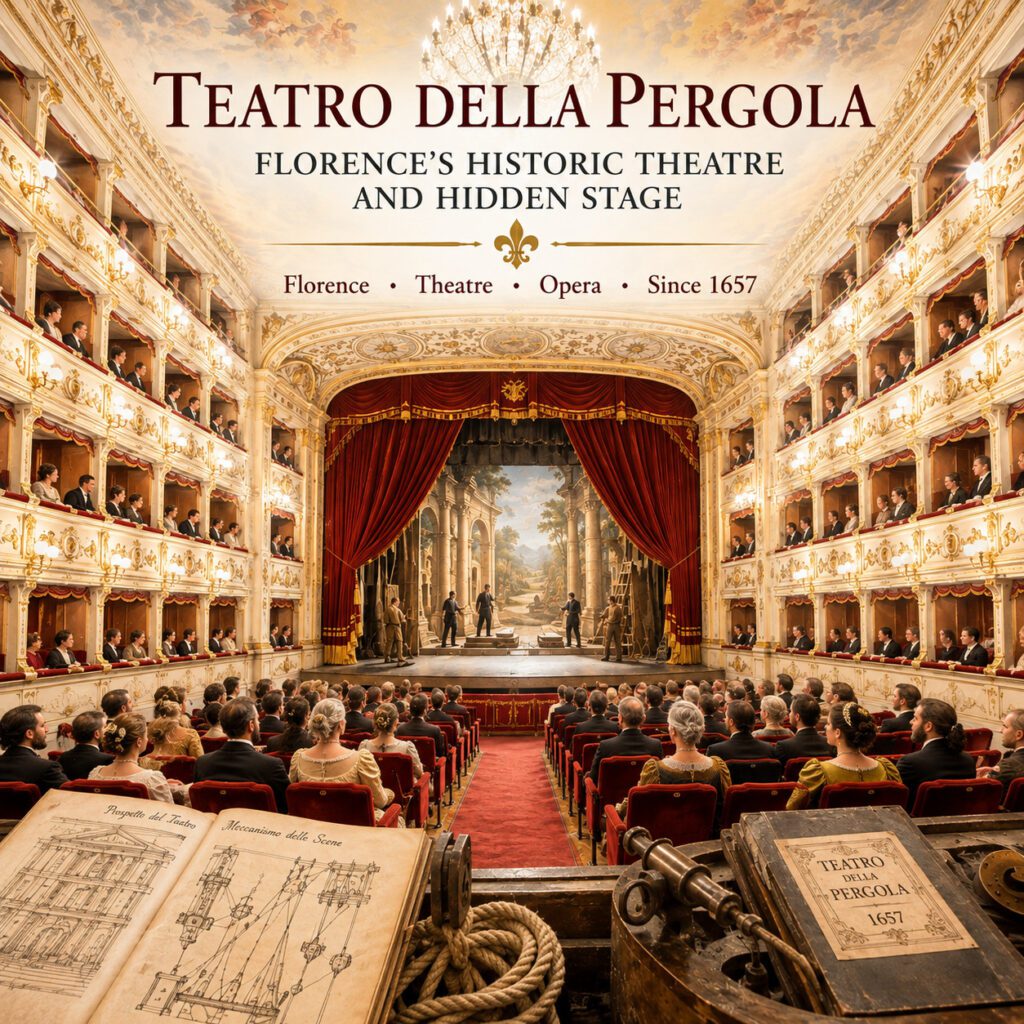
Behind an understated façade in central Florence lies one of Italy’s most remarkable historic theatres. Teatro della Pergola Florence combines seventeenth-century origins, an elegant auditorium and a fascinating world of backstage spaces that reveal how theatrical illusion was created long before modern technology.
Located on Via della Pergola, only a short walk from the Duomo, the theatre remains an active cultural institution rather than a preserved monument. Its history connects Medici Florence with the development of Italian theatre, while its hidden machinery and backstage architecture offer visitors an unusual glimpse behind the curtain. It is one of the key venues in our Theatres and Opera Houses in Florence – Complete Guide.
Name: Teatro della Pergola
Location: Via della Pergola 12/32, Florence
Origins: 17th century
Founded: 1656–1657
Historical patron: Cardinal Giovan Carlo de’ Medici
Associated academy: Accademia degli Immobili
Known for: Historic auditorium, theatre architecture and backstage heritage
Today: Working theatre and part of the Fondazione Teatro della Toscana
Teatro della Pergola Florence – A Theatre Hidden in Plain Sight
Visitors can easily walk along Via della Pergola without realising what lies behind the theatre’s relatively restrained exterior. Unlike Florence’s great churches and palaces, the building does not announce its importance with a monumental façade. The real surprise begins after entering.
Inside, Teatro della Pergola opens into a richly decorated theatrical world of curved tiers, private boxes and historic public spaces. This contrast between street and interior makes the building particularly characteristic of Florence, where remarkable architecture often hides behind surprisingly discreet façades.
Moreover, Teatro della Pergola Florence differs from many historic attractions because audiences still use it for its original purpose. Performances continue a theatrical tradition that began more than three and a half centuries ago.
Do not judge Teatro della Pergola by its exterior. The restrained façade gives little indication of the historic auditorium and theatrical spaces waiting inside.
The Medici Origins of Teatro della Pergola
The story of Teatro della Pergola begins in seventeenth-century Florence. Cardinal Giovan Carlo de’ Medici, a son of Grand Duke Cosimo II de’ Medici, encouraged the creation of a permanent theatrical space for the Accademia degli Immobili.
The project reflected the Medici family’s long-standing enthusiasm for music, spectacle and theatrical innovation. Their patronage extended far beyond painting and sculpture; music, architecture, court festivities and stage design also formed part of the cultural life of the dynasty.
Architect Ferdinando Tacca designed the theatre in a building on Via della Pergola. His father, Pietro Tacca, had been an important sculptor and pupil of Giambologna, while Ferdinando developed his own career through architecture, sculpture, theatrical design and stage machinery.
The new theatre took shape in 1656 and opened during the following year. As a result, the Pergola belongs to a remarkable period of experimentation in Italian performance culture, when theatre architecture itself was changing rapidly.
The Medici supported much more than the visual arts. Music, theatre, elaborate festivities and stage design also helped make Florence a centre of experimentation in the performing arts.
Ferdinando Tacca and a New Kind of Theatre
Ferdinando Tacca designed the Pergola for an age when theatrical performance was becoming increasingly sophisticated. Audiences expected changing scenery, dramatic effects and carefully controlled views of the stage. Architecture therefore had to serve both spectators and the complicated machinery hidden from them.
The original theatre differed from the auditorium visitors see today because successive generations modified and enlarged the building. Nevertheless, its seventeenth-century origins remain fundamental to its identity and explain why Teatro della Pergola holds such an important place in Italian theatre history.
Tacca’s work also illustrates the close relationship between Florentine craftsmanship and theatrical spectacle. Carpenters, painters, engineers, sculptors and designers all contributed to performances, creating temporary worlds that could change before an audience’s eyes.
The Pergola and the Development of the Italian Theatre Box
One of the most significant features associated with the early Pergola was its use of superimposed private boxes. This arrangement contributed to the development of the characteristic Italian theatre auditorium, where multiple tiers of boxes surround the central space and face the stage.
Boxes transformed more than theatre architecture. They also changed the social experience of attending a performance because aristocratic families and wealthy spectators occupied private spaces while remaining visible to the rest of the audience.
Consequently, the theatre became a place for watching the performance and observing society at the same time. Although the auditorium at Teatro della Pergola Florence evolved considerably over the centuries, it still allows visitors to understand this distinctive relationship between architecture, performance and social life.
Stacked private boxes became one of the defining features of Italian theatre architecture. They offered privacy while also turning the auditorium itself into a stage for social display.
Inside Teatro della Pergola Florence
Entering the auditorium reveals the theatrical grandeur hidden behind the exterior. Curving tiers of boxes rise around the audience, while ornament, warm colours and carefully controlled proportions direct attention towards the stage.
This architecture creates a fundamentally different experience from a modern concert hall. Instead of arranging spectators in one large unified seating area, the historic theatre divides them among stalls and surrounding boxes. As a result, the audience itself becomes part of the visual experience.
The auditorium has changed repeatedly as owners and administrators adapted it to new expectations. Renovations improved access, comfort, lighting and safety while preserving the historic character that makes the Pergola distinctive.
A Theatre That Changed with Florence
No theatre survives for centuries without adapting. The Pergola gradually changed from a courtly and academic venue into a theatre serving broader audiences. Alterations to the auditorium, stage and supporting spaces reflected new forms of performance as well as changing social habits.
Florence itself changed just as dramatically. The city passed from Medici rule to the Lorraine dynasty, through the Napoleonic period and the Risorgimento, and eventually became capital of the Kingdom of Italy between 1865 and 1871.
Throughout these transformations, the theatre remained part of Florentine cultural life. This continuity makes Teatro della Pergola Florence particularly valuable: its walls do not represent one historical moment but layers created by generations of performers, architects, technicians and audiences.
The Hidden Stage of Teatro della Pergola
The auditorium provides only the public face of the Pergola. Behind and beneath the stage lies another world created for performers, technicians, scenery and theatrical machinery.
Historic theatres depended on an extraordinary combination of manual skill and mechanical ingenuity. Workers moved scenery, controlled curtains, manipulated stage elements and coordinated transformations from spaces spectators rarely saw.
For this reason, the success of a performance depended as much on hidden workers as on the artists standing under the lights. This backstage heritage gives the Pergola special appeal for visitors interested in craftsmanship and technology.
Florence’s tradition of skilled manual work did not stop at painters’ studios and sculptors’ workshops. It extended directly into the theatre.
The most fascinating parts of a historic theatre are not always visible from the auditorium. Backstage passages, technical spaces and old theatrical mechanisms reveal how much work was required to create illusion on stage.
Stage Machinery Before Electricity
Modern audiences often take rapid changes of scenery and theatrical lighting for granted. Seventeenth- and eighteenth-century stage designers, however, achieved dramatic transformations with ropes, pulleys, counterweights, tracks and carefully coordinated human labour.
Florentine designers had already developed a sophisticated tradition of temporary architecture and theatrical effects through Medici court festivities. A permanent theatre such as the Pergola allowed this knowledge to become part of a dedicated performance environment.
The mechanics remained largely invisible during a production. That invisibility was essential: spectators saw palaces, landscapes and imaginary worlds while teams of workers operated the systems that created them.
Antonio Meucci and Teatro della Pergola
One of the most surprising stories connected with Teatro della Pergola involves Antonio Meucci, the Florentine inventor later associated with the development of voice communication technology. As a young man, Meucci worked at the theatre as a stage technician.
The practical problem of communicating between different areas of a large theatre encouraged experimentation. Meucci developed an acoustic communication system that allowed instructions to pass between the stage and technical areas.
His experience at the Pergola therefore forms an intriguing early chapter in a much larger history of communication technology. More broadly, the connection demonstrates how theatres could function as technological laboratories where practical problems in acoustics, mechanics, lighting and coordination demanded inventive solutions.
Before Antonio Meucci became associated with experiments in electrical voice communication, he worked as a stage technician at Teatro della Pergola. His wider Florentine story is explored in our article Antonio Meucci – Florence and the Invention of the Telephone.
Opera at Teatro della Pergola Florence
Opera forms an important part of the theatre’s history. Florence had already played a crucial role in the emergence of opera around 1600, decades before construction of the Pergola.
The origins of this new art form are explored in our Florence and the Birth of Opera guide. By the seventeenth century, musical drama had developed rapidly, and permanent theatres created new opportunities for increasingly ambitious productions.
The Pergola hosted opera alongside drama and other forms of entertainment. Its stage and auditorium evolved as theatrical requirements changed, allowing the building to participate in several centuries of Italian musical culture.
One particularly famous event occurred in 1847, when the theatre hosted the premiere of Giuseppe Verdi’s Macbeth. Verdi took an unusually close interest in the production, and the Florence premiere became an important moment in the history of the opera.
Giuseppe Verdi’s Macbeth received its first performance at Teatro della Pergola on 14 March 1847.
Verdi’s Macbeth and Florence
Macbeth represented an important experiment for Verdi. Shakespeare’s tragedy offered a darker psychological world than many conventional operatic subjects, and the composer wanted the dramatic impact of the production to match the intensity of the story.
Choosing Florence for the premiere brought Teatro della Pergola into the history of one of Verdi’s most distinctive early operas. At the same time, the event demonstrates the theatre’s importance within nineteenth-century Italian musical life.
Visitors sitting in the auditorium today therefore occupy a space connected not only with Florentine history but also with the broader development of European opera.
Drama and the Italian Stage
Although opera occupies an important place in its history, the Pergola has never been only an opera house. Spoken theatre became increasingly central to its identity, and generations of actors and theatre companies performed on its stage.
The building therefore belongs to the history of Italian drama as much as to musical Florence. Changes in acting style, repertoire and audience expectations continually reshaped what happened inside the theatre without destroying its architectural connection with earlier centuries.
Today, this tradition continues through a programme centred strongly on theatre and cultural performance. Historic architecture and contemporary productions therefore coexist rather than compete.
Teatro della Pergola During Firenze Capitale
When Florence became capital of the Kingdom of Italy in 1865, the city entered a period of rapid social and urban transformation. Government officials, diplomats and members of the new national elite arrived, while architect Giuseppe Poggi reshaped large parts of Florence.
Theatre formed an important part of this new capital’s social life. Cultural venues provided entertainment while also offering places where political, aristocratic and bourgeois society could meet.
Teatro della Pergola already possessed centuries of prestige and therefore remained an important institution during this period of change. The building had witnessed Medici Florence and the grand-ducal city; now it also became part of the cultural life of unified Italy.
Florence served as capital of the Kingdom of Italy from 1865 until 1871. Those six years transformed its streets, neighbourhoods and social life while established institutions such as Teatro della Pergola entered a new national era.
The Theatre as a Social Space
Historic European theatres functioned as social environments as well as performance venues. Audiences arrived not simply to watch a play or hear an opera but also to meet acquaintances, display status and participate in public life.
Private boxes played a particularly important role in this culture. Families could receive guests and converse while remaining part of the spectacle of the auditorium.
Consequently, the boundary between stage and audience was less absolute than modern theatre etiquette might suggest. Understanding this social dimension helps visitors appreciate the architecture of Teatro della Pergola Florence.
Why the Pergola Feels Different from a Modern Theatre
A modern theatre usually prioritises unobstructed views, acoustic consistency and efficient circulation. Historic Italian theatres developed according to different social and architectural principles.
At the Pergola, boxes, narrow passages and elaborate decoration create a more intimate and layered environment. Looking across the auditorium reveals other spectators as well as the stage, recreating something of the social character that shaped Italian theatre for centuries.
The result feels distinctly different from the contemporary Teatro del Maggio Musicale Fiorentino. Experiencing both venues therefore offers an excellent comparison between historic and modern approaches to performance architecture.
For visitors interested in architecture as much as performance, Teatro della Pergola and the modern Teatro del Maggio Musicale Fiorentino make a fascinating pair.
Teatro della Pergola Today
Today, Teatro della Pergola remains a working theatre and forms part of the Fondazione Teatro della Toscana. Its programme continues to bring performers and audiences into spaces shaped by centuries of theatrical history.
This active role matters. Historic theatres can easily become museums, whereas the Pergola continues the purpose for which people created it.
Actors still cross the stage, audiences still fill the auditorium and technicians continue working behind the scenes. The building therefore preserves heritage through use rather than simply through conservation.
Can You Visit Teatro della Pergola?
The best way to experience the theatre depends on its current programme and visitor opportunities. Attending a performance allows visitors to see the auditorium functioning as intended, while guided visits and special openings can provide access to historic areas that audiences do not normally encounter.
Because Teatro della Pergola remains an active theatre, access can vary according to rehearsals, performances and events. Therefore, check current information before planning a daytime visit.
Anyone particularly interested in the hidden stage, backstage history or theatre machinery should look for guided experiences that include more than the public auditorium.
Address: Via della Pergola 12/32, Florence
Area: Historic centre, east of the Duomo
Best experience: Performance or guided visit
Before visiting: Check the current theatre programme, opening information and availability of tours
How to Reach Teatro della Pergola
The theatre sits conveniently within the historic centre. From Piazza del Duomo, the walk leads east through streets associated with some of Florence’s most important cultural institutions.
The Accademia Gallery, Santissima Annunziata, Santa Maria Nuova and the archaeological museum all lie within the wider surrounding area. Teatro della Pergola therefore fits naturally into a day devoted to the less obvious cultural landmarks east of the cathedral.
Its central location also makes an evening performance easy to combine with dinner in the historic centre.
What to Look for Inside Teatro della Pergola
Begin with the overall shape of the auditorium rather than focusing immediately on decoration. The tiers of boxes reveal how Italian theatre architecture organised spectators and created a strong visual relationship between audience and stage.
Then look at the details: ornament around the boxes, circulation spaces, sightlines and the relationship between the public auditorium and the much larger technical world surrounding the stage.
If a visit includes backstage areas, pay particular attention to surviving evidence of older theatrical technology. Those spaces often tell more about how a theatre actually worked than the most ornate parts of the auditorium.
A historic theatre is essentially two buildings in one: the elegant world designed for the audience and the practical world created for performers and technicians.
Teatro della Pergola and Hidden Florence
Teatro della Pergola Florence belongs perfectly to the hidden side of the city. It stands close to some of Florence’s busiest attractions, yet many visitors pass nearby without knowing what lies behind its walls.
The theatre also challenges the idea that Florence’s cultural importance belongs mainly to the Renaissance. Its story stretches from the seventeenth century through Verdi and nineteenth-century Italy to contemporary theatrical life.
For travellers who have already visited the major museums and churches, the Pergola therefore offers a different kind of discovery. Here, Florence’s history comes alive through architecture, performance, technology and the accumulated memory of audiences.
Frequently Asked Questions
When was Teatro della Pergola founded?
The theatre was created in 1656–1657 under the patronage of Cardinal Giovan Carlo de’ Medici for the Accademia degli Immobili.
Why is Teatro della Pergola historically important?
Its long history, early use of private boxes, surviving theatrical spaces and continuing role as a working theatre make it one of Italy’s most important historic performance venues.
Did Giuseppe Verdi premiere an opera at Teatro della Pergola?
Yes. Verdi’s Macbeth received its world premiere at Teatro della Pergola on 14 March 1847.
What is Antonio Meucci’s connection with the theatre?
Antonio Meucci worked at the Pergola as a young stage technician and experimented with systems for communicating between different parts of the theatre.
Can you visit Teatro della Pergola without seeing a performance?
Sometimes. Guided visits and special openings may provide access, but availability depends on rehearsals, performances and the theatre’s current programme.
How does Teatro della Pergola differ from the Maggio Musicale?
The Pergola offers historic Italian theatre architecture and centuries of stage tradition, while the Maggio Musicale Fiorentino is a modern complex designed for large-scale opera and orchestral productions.
Why Teatro della Pergola Florence Is Worth Visiting
Teatro della Pergola Florence is worth visiting because few buildings bring together so many aspects of the city’s cultural history. Medici patronage, seventeenth-century theatre architecture, stagecraft, opera, drama and technological experimentation all meet within the same complex.
The theatre also offers something fundamentally different from Florence’s museums. Visitors do not simply look at objects created centuries ago; they enter a building where the original cultural activity continues.
The connection with Verdi’s Macbeth, the story of Antonio Meucci and the hidden technical spaces add unexpected dimensions to an already remarkable monument. Together, they transform the Pergola from a beautiful historic auditorium into a place where art, engineering and social history intersect.
Most of all, Teatro della Pergola demonstrates that Florence’s creativity extends far beyond painting and sculpture. Behind its quiet façade survives a theatrical world that has entertained the city for more than three centuries.
Further Reading on Firenze Casa
- Theatres and Opera Houses in Florence – Complete Guide
- Antonio Meucci – Florence and the Invention of the Telephone
- Florence and the Birth of Opera
- Teatro del Maggio Musicale Fiorentino – Florence’s Opera House
- Teatro Verdi – Florence’s Historic Theatre
- Teatro Goldoni – A Hidden Theatre in the Oltrarno
- Teatro Niccolini – Florence’s Oldest Theatre
- The Medici Family – The Dynasty That Shaped Florence
References
- Fondazione Teatro della Toscana – Teatro della Pergola.
- Teatro della Pergola – History of the theatre.
- Comune di Firenze – Historic theatres and cultural heritage.
- Treccani – Ferdinando Tacca.
- Treccani – Antonio Meucci.
- Encyclopaedia Britannica – Giuseppe Verdi.
- Archivio Storico del Comune di Firenze – Theatre and cultural life in Florence.
- Dizionario Biografico degli Italiani – Giovan Carlo de’ Medici.
- Fondazione Teatro della Toscana – Historical archive and collections.

