
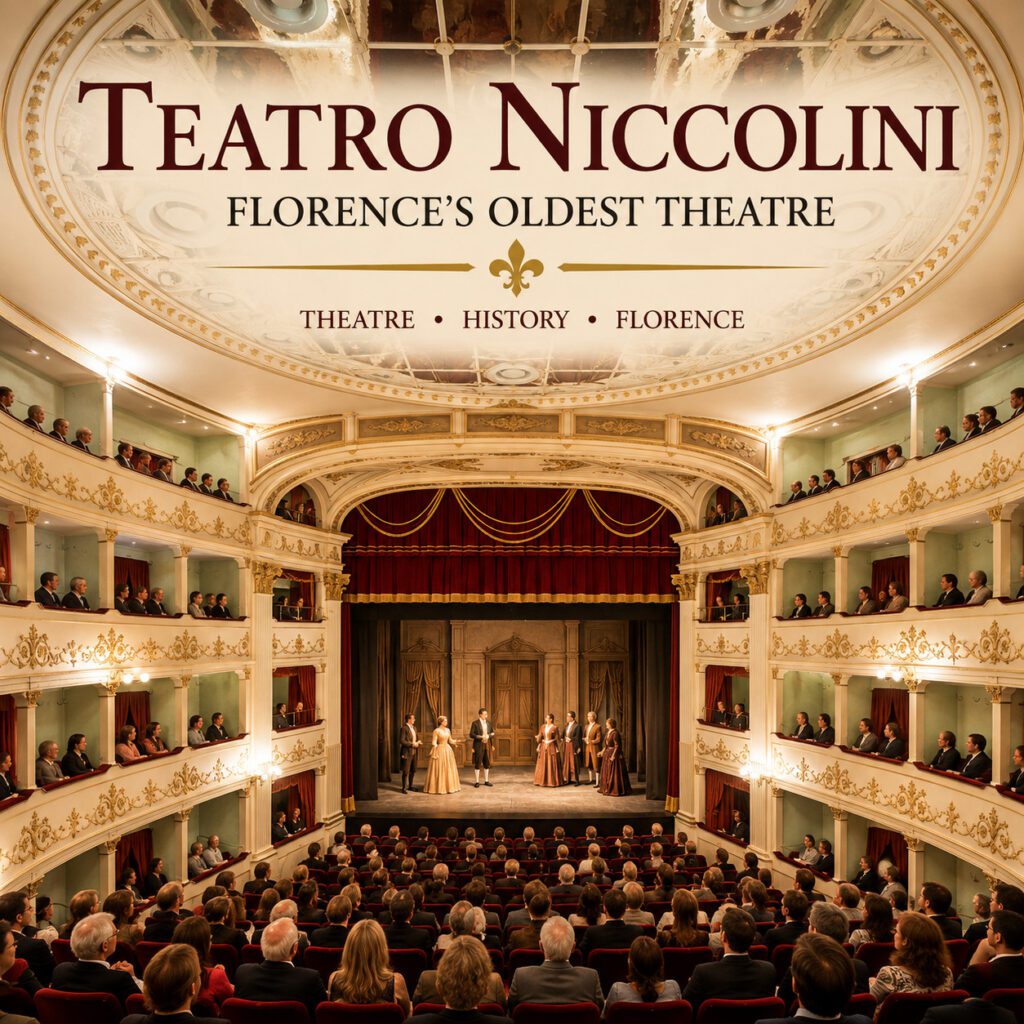
Only a few steps from the Duomo stands the oldest surviving theatre in Florence. Teatro Niccolini Florence traces its origins to the middle of the seventeenth century, when Florentine noblemen created a performance space in Via del Cocomero, today’s Via Ricasoli. Hidden behind an understated façade, the theatre preserves one of the most fascinating chapters in the history of performance in Florence.
Known originally as the Teatro del Cocomero, the theatre opened in 1658 and developed alongside the better-known Teatro della Pergola. After periods of theatrical success, conversion to cinema and a twenty-year closure, an extensive restoration brought the Niccolini back to life in 2016. It remains an active theatre and cultural venue today and forms an essential part of our Theatres and Opera Houses in Florence – Complete Guide.
Name: Teatro Niccolini
Former name: Teatro del Cocomero
Location: Via Ricasoli 3/5, Florence
Area: Historic centre, close to the Duomo
Origins: Around 1650
Opened: 1658
Named Teatro Niccolini: 1860
Reopened after restoration: 2016
Capacity: 406 seats
Today: Active theatre and cultural venue
Teatro Niccolini Florence – The City’s Oldest Theatre
Teatro Niccolini Florence stands on Via Ricasoli, the street that leads directly north from Piazza del Duomo towards the Accademia Gallery. Thousands of visitors walk nearby every day, yet comparatively few realise that one of Florence’s oldest cultural institutions lies behind the buildings of this busy street.
The theatre’s discreet location makes its interior particularly surprising. Beyond the entrance lies a traditional Italian auditorium with four levels of boxes surrounding a horseshoe-shaped seating area. Its architecture tells a story that reaches back more than three and a half centuries.
The Niccolini therefore offers something unusual even in Florence. Renaissance churches and palaces dominate the surrounding streets, while this building preserves the history of another Florentine passion: live performance.
The Niccolini is remarkably easy to overlook. When walking from the Duomo towards the Accademia, look for it on Via Ricasoli before continuing towards Michelangelo’s David.
From Via del Cocomero to Via Ricasoli
The story begins when Via Ricasoli still carried the colourful name Via del Cocomero. In 1650, members of the Accademia degli Immobili rented rooms in Palazzo Ughi and adapted them for theatrical performances.
The initiative grew from Florence’s flourishing culture of academies. Noblemen gathered to discuss literature, listen to music, dance and perform plays, creating cultural circles that operated alongside the official life of the grand-ducal court.
The performance space became known naturally as the Teatro del Cocomero after the street on which it stood. In 1658, the theatre formally opened with a performance of Andrea Moniglia’s Il podestà di Colognole.
The unusual name Teatro del Cocomero simply came from its address. Today’s Via Ricasoli was once called Via del Cocomero – literally “Watermelon Street.”
Niccolini and Pergola – Which Florence Theatre Came First?
The relationship between Teatro Niccolini Florence and Teatro della Pergola is particularly interesting. Both emerged from the same world of seventeenth-century Florentine theatrical academies, and their early histories overlap.
The Accademia degli Immobili initially used the premises in Via del Cocomero. Some of its members subsequently moved towards Via della Pergola, where a new theatre took shape under the direction of Ferdinando Tacca.
The Cocomero continued independently and later became closely associated with the Accademia degli Infuocati. This makes the Niccolini’s origins slightly earlier than those of the Pergola, even though Teatro della Pergola developed into the more famous institution internationally.
Rather than competing for a title, the two theatres reveal different branches of the same extraordinary theatrical culture. Together they explain why seventeenth-century Florence occupies such an important place in the development of Italian theatre architecture.
The Niccolini and the Pergola share common roots in Florence’s seventeenth-century academies. Their intertwined histories are best understood as complementary rather than competing stories.
The Accademia degli Infuocati
The Accademia degli Infuocati became one of the institutions most closely associated with the Teatro del Cocomero. Its memorable emblem showed an exploding or burning bomb accompanied by the motto A tempo infuocati.
The academy maintained the theatrical tradition established in Via del Cocomero and helped shape the building over successive generations. As expectations of performers and audiences changed, the theatre gradually became more sophisticated.
This history gives Teatro Niccolini a character very different from a venue created according to one fixed architectural plan. Instead, the building evolved over centuries, accumulating new spaces and features as theatrical culture itself developed.
The emblem of the Accademia degli Infuocati remains part of the Niccolini’s identity. Its unusual flaming-bomb symbol recalls the academy that shaped centuries of theatrical activity here.
How Teatro Niccolini Florence Developed
The original seventeenth-century theatre did not look exactly like the auditorium visitors see today. Successive generations expanded and modified the building as theatrical conventions changed.
A royal box appeared in 1711. During the eighteenth century, additional tiers increased the number of boxes, while a major intervention in 1764 gave the auditorium its characteristic horseshoe form.
This layout became one of the defining features of the traditional Italian theatre. It concentrated attention on the stage while surrounding the central seating area with boxes where spectators could see one another almost as easily as they could see the performers.
By the end of the eighteenth century, the Niccolini had become part of an architectural tradition that would influence theatres and opera houses across Europe.
Inside Florence’s Oldest Theatre
The auditorium remains the heart of Teatro Niccolini Florence. Four orders of boxes rise around the platea, creating a compact and intimate space that brings performers and spectators relatively close together.
Decorative details provide elegance without the monumental scale of larger nineteenth-century theatres. The proportions reveal how historic Italian theatres balanced architectural beauty with the social rituals of attending a performance.
The wooden structure also carries considerable historical significance. Restoration preserved important historic fabric while introducing the technical and safety systems required by a contemporary working theatre.
When you enter the auditorium, look sideways as well as towards the stage. The tiers of boxes reveal how theatre audiences once watched one another as part of the evening’s social spectacle.
Why Historic Italian Theatres Have Boxes
The boxes of the Niccolini reflect a culture in which going to the theatre meant much more than watching a performance. Families and social groups occupied their own spaces, received acquaintances and participated visibly in the social life of the auditorium.
For aristocratic spectators, the theatre could function almost like an extension of the salon. Conversation and observation formed part of the experience, and the architecture accommodated both activities.
The horseshoe shape reinforced this relationship. Spectators faced the stage but could also look across the auditorium towards other boxes, turning the audience itself into part of the spectacle.
Experiencing Teatro Niccolini today therefore offers more than architectural beauty. The building helps visitors understand how theatre once functioned within Florentine society.
From Teatro del Cocomero to Teatro Niccolini
The theatre carried its original name for approximately two centuries. In 1860, it received a new identity when Florentines renamed it in honour of Giovanni Battista Niccolini.
Niccolini was a Tuscan playwright and poet whose works often engaged with historical and political themes. Naming the theatre after him connected the building with nineteenth-century Italian literary culture at a moment when Tuscany and the rest of the peninsula were undergoing profound political change.
The new name survived even as the theatre itself continued to evolve. Teatro del Cocomero became part of history, while Teatro Niccolini entered the modern cultural vocabulary of Florence.
The name Niccolini does not refer to the theatre’s founder. Florence renamed the former Teatro del Cocomero in 1860 in honour of Tuscan playwright Giovanni Battista Niccolini.
Teatro Niccolini During Firenze Capitale
Only a few years after receiving its new name, the theatre witnessed another dramatic transformation. Florence became capital of the Kingdom of Italy in 1865 and remained the national capital until 1871.
Government officials, politicians, diplomats and new residents arrived in the city. Florence expanded and modernised rapidly, while theatres became important places for entertainment, encounters and social display.
The Niccolini already possessed two centuries of theatrical history by this point. It therefore connected the older grand-ducal city with the emerging national culture of unified Italy.
This period forms part of the wider nineteenth-century transformation explored in our History of Florence.
The First Electrically Lit Theatre in Tuscany
The Niccolini did not remain technologically frozen in the seventeenth century. In 1888, it became the first theatre in Tuscany to use electric lighting, an extraordinary innovation for audiences accustomed to older forms of illumination.
Electric light improved safety and transformed what theatre designers could achieve inside the auditorium. At the same time, it demonstrated the willingness of an ancient institution to adopt modern technology.
Further alterations followed in the early twentieth century. A new entrance on Via Ricasoli, a foyer and other improvements adapted Teatro Niccolini to changing expectations while preserving its theatrical function.
In 1888, Teatro Niccolini became the first theatre in Tuscany illuminated by electricity – a remarkable technological milestone for a venue whose origins reached back to the seventeenth century.
When Teatro Niccolini Became a Cinema
The arrival of cinema transformed theatres throughout Europe, and the Niccolini was no exception. Like many historic performance venues, it adapted to the new medium and operated for a period as a cinema.
This change helped keep the building in public use, but it also altered its relationship with live theatre. By the twentieth century, many traditional theatres faced the same challenge as audiences increasingly embraced film and new forms of popular entertainment.
The Niccolini eventually returned decisively to spoken theatre. During the 1970s and 1980s, it became an important venue for contemporary Italian performance and regained a strong theatrical identity.
Gassman, Carmelo Bene and Carlo Cecchi
The modern history of Teatro Niccolini Florence includes some of the most important names in twentieth-century Italian theatre. Vittorio Gassman, Carmelo Bene, Carlo Cecchi and Paolo Poli all appeared in or developed strong connections with the venue.
Carlo Cecchi played a particularly significant role during the theatre’s revival as a centre for spoken drama. Productions at the Niccolini helped establish the theatre as a place where important actors and directors could experiment with both classical and contemporary repertoire.
This period prevented the Niccolini from becoming merely an architectural survivor. Its historic auditorium once again became a place for innovative live performance.
The Niccolini’s importance does not end with the seventeenth century. Some of the leading figures of modern Italian theatre performed here during the twentieth century, adding another major chapter to its history.
Why Teatro Niccolini Closed in 1995
Despite its artistic importance, the theatre faced increasing difficulties. Maintaining a centuries-old building while meeting modern requirements demanded substantial investment.
The Niccolini finally closed in November 1995. What might have been a temporary interruption became a silence lasting approximately twenty years.
During that period, the future of Florence’s oldest theatre became uncertain. The building suffered from neglect and required a major intervention before audiences could safely return.
The eventual rescue of Teatro Niccolini therefore represents one of the most encouraging stories of theatrical preservation in the city.
Mauro Pagliai and the Rescue of the Niccolini
A decisive moment came in 2006 when Florentine publisher and entrepreneur Mauro Pagliai purchased the theatre. His objective was not simply to conserve an old building but to return it to cultural use.
Architect André Benaim directed the extensive restoration. The project repaired the historic structure, restored architectural elements and introduced modern technical installations and safety systems.
The work took years because the restoration had to reconcile preservation with contemporary performance requirements. Historic theatres cannot survive as working venues unless audiences, performers and staff can use them safely and effectively.
The rescue of the Niccolini depended on private commitment as well as architectural expertise. Mauro Pagliai purchased the closed theatre in 2006 and supported the long restoration that eventually returned it to Florence.
The Reopening of Teatro Niccolini Florence
After approximately twenty years without regular theatrical life, Teatro Niccolini Florence reopened in January 2016. The event returned one of the city’s most historic cultural spaces to its original purpose.
The restored theatre contains 406 seats and four orders of boxes. Its historic character remains immediately recognisable, but modern infrastructure now allows the building to host contemporary performances and events.
The reopening also restored spaces beyond the auditorium. The foyer again became part of the public experience, while cultural and hospitality functions helped transform the building into a multipurpose venue.
The result demonstrates how careful restoration can preserve historic architecture without turning it into a static museum.
Is Teatro Niccolini Florence Still Open?
Yes. Teatro Niccolini Florence remains an active theatre in 2026. Its programme includes live performances and cultural events, and the theatre continues to welcome audiences more than a decade after its restoration and reopening.
The building can also accommodate conferences, cultural initiatives and other events. Nevertheless, visitors should check the programme before going because the Niccolini functions as a working cultural venue rather than a museum with guaranteed continuous access.
Teatro Niccolini is open and active in 2026. Performances and cultural events continue to take place here, but access to the auditorium depends on the current programme and scheduled activities.
A Historic Theatre Beside the Duomo
Few theatres can claim such an extraordinary location. Teatro Niccolini Florence stands only a short distance from the Cathedral of Santa Maria del Fiore, placing more than three centuries of theatrical history beside Florence’s most famous religious monument.
The contrast is fascinating. Piazza del Duomo represents the monumental public face of Florence, while the Niccolini remains relatively discreet within Via Ricasoli.
This proximity also makes the theatre exceptionally easy to incorporate into a walk through central Florence. Continue a few minutes farther along Via Ricasoli and you reach the Accademia Gallery, home of Michelangelo’s David.
Combine the Niccolini with the Duomo, Via Ricasoli and the Accademia Gallery. The theatre adds an unexpected layer of seventeenth-century cultural history to one of Florence’s busiest sightseeing routes.
Teatro Niccolini or Teatro della Pergola?
The two theatres make a fascinating pair because their histories began within the same seventeenth-century Florentine cultural environment. Yet they developed very differently.
Teatro della Pergola became one of Italy’s most celebrated historic theatres and developed particularly strong associations with opera, stage technology and major musical premieres. Its architecture and surviving backstage machinery make it an exceptional monument to theatrical history.
The Niccolini offers a more intimate story. Its origins as Teatro del Cocomero predate the Pergola, while its later history encompasses spoken theatre, cinema, twentieth-century experimentation, closure and dramatic restoration.
Visitors interested in Florence’s theatrical history should therefore see the two as complementary. Our complete guide to Florence’s theatres and opera houses places both venues within the wider development of performance culture in the city.
Teatro Niccolini: Florence’s oldest surviving theatre, intimate and closely associated with spoken drama.
Teatro della Pergola: A major seventeenth-century theatre famous for its architecture, opera history and historic stage machinery.
What to Look for Inside Teatro Niccolini Florence
Begin with the shape of the auditorium. The horseshoe arrangement reflects the eighteenth-century development of Italian theatre architecture and creates an intimate relationship between the stage and surrounding boxes.
Then look at the four levels rising above the platea. Their arrangement reveals how social hierarchy and theatrical architecture once worked together, allowing spectators to occupy distinct spaces while remaining visible to the rest of the audience.
Finally, remember how much of the building’s history remains invisible. The auditorium has witnessed aristocratic academies, nineteenth-century drama, electric illumination, cinema, experimental twentieth-century theatre and a twenty-year closure.
That accumulation of stories makes the Niccolini much more than an attractive historic interior.
Planning a Visit to Teatro Niccolini Florence
The easiest way to experience the theatre is to attend a performance or scheduled cultural event. This allows visitors to see the auditorium functioning as intended, with actors, lighting and an audience bringing the architecture to life.
Because programming changes, check current schedules before planning a visit specifically around the Niccolini. Ticket availability and access can vary according to the event.
The central location makes an evening performance particularly convenient. Restaurants, cafés and Florence’s major monuments all lie within easy walking distance.
Address: Via Ricasoli 3/5, Florence
Area: Historic centre, near Piazza del Duomo
Status: Active theatre and cultural venue
Capacity: 406 seats
Best experience: Attend a scheduled performance or cultural event
Before visiting: Check the current programme and access arrangements
Frequently Asked Questions
Is Teatro Niccolini the oldest theatre in Florence?
Yes. Its origins reach back to around 1650, and it opened as the Teatro del Cocomero in 1658, making it Florence’s oldest surviving theatre.
Where is Teatro Niccolini?
The theatre stands at Via Ricasoli 3/5, only a short walk from Piazza del Duomo and the Accademia Gallery.
Why was it called Teatro del Cocomero?
The name came from its original street address. Today’s Via Ricasoli was formerly known as Via del Cocomero.
When did it become Teatro Niccolini?
The theatre was renamed in 1860 in honour of Tuscan playwright and poet Giovanni Battista Niccolini.
Was Teatro Niccolini really the first electrically lit theatre in Tuscany?
Yes. In 1888, the theatre became the first in Tuscany to use electric lighting.
When did Teatro Niccolini reopen?
After closing in 1995 and undergoing an extensive restoration, the theatre reopened in January 2016.
Can you visit without attending a performance?
Access depends on scheduled events and current arrangements. Attending a performance or cultural event is usually the best way to experience the auditorium.
Why Teatro Niccolini Florence Is Worth Visiting
Teatro Niccolini Florence is worth discovering because few buildings tell such a long and varied story of Florentine performance. Its origins reach back to around 1650, when noble academicians created the Teatro del Cocomero in rooms on what is now Via Ricasoli.
The theatre evolved repeatedly rather than remaining frozen in one period. It gained boxes, a horseshoe-shaped auditorium and electric lighting, became a cinema, returned to spoken drama and welcomed some of the great figures of twentieth-century Italian theatre.
Its survival was never guaranteed. After closing in 1995, the Niccolini remained silent for two decades before a major restoration allowed it to reopen in 2016. Today, audiences once again sit beneath its historic galleries and watch performances on its stage.
Most remarkable of all is its location. Only steps from the Duomo and close to the Accademia Gallery, Florence’s oldest theatre hides in plain sight – a living reminder that the city’s cultural history extends far beyond its famous churches, museums and Renaissance palaces.
Further Reading on Firenze Casa
- Theatres and Opera Houses in Florence – Complete Guide
- Teatro della Pergola – Florence’s Historic Theatre and Hidden Stage
- Accademia Gallery – Home of Michelangelo’s David
- Florence Museums – Complete Guide
- History of Florence
- Teatro Goldoni – A Hidden Theatre in the Oltrarno
- Teatro Verdi – Florence’s Historic Theatre
References
- Teatro Niccolini Firenze – Official history and theatre profile.
- Teatro Niccolini Firenze – Current programme and season information.
- Teatro Niccolini Firenze – Archive of performances.
- Comune di Firenze – Historic theatres and cultural heritage.
- Archivio Storico del Comune di Firenze – Florentine theatre and cultural life.
- Fondazione Teatro della Toscana – History of theatre in Florence.
- Treccani – Giovanni Battista Niccolini.
- Treccani – Italian theatre and theatrical academies.

