
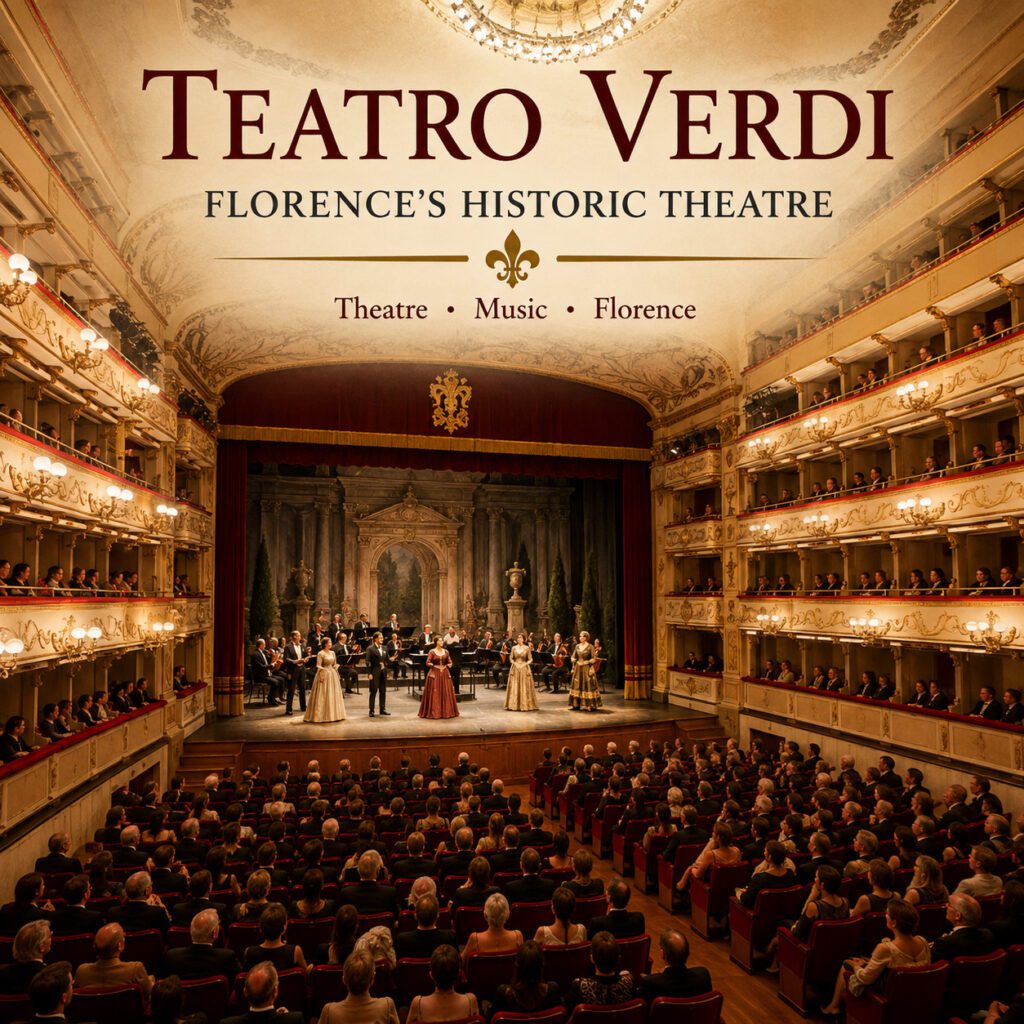
Just a few streets from Santa Croce stands one of Florence’s great nineteenth-century theatres. Teatro Verdi Florence combines a grand historic auditorium with an active programme of concerts, theatre, musicals and other performances, making it an important link between the city’s cultural past and present.
Located on Via Ghibellina in the eastern part of the historic centre, Teatro Verdi offers a very different experience from the seventeenth-century Teatro della Pergola or the contemporary Teatro del Maggio Musicale Fiorentino. Its story belongs primarily to nineteenth-century Florence, when theatres became increasingly important places of public entertainment and social life. It is one of the principal venues in our Theatres and Opera Houses in Florence – Complete Guide.
Name: Teatro Verdi
Location: Via Ghibellina 99, Florence
Area: Santa Croce
Opened: 1854
Original name: Teatro Pagliano
Later name: Teatro Verdi
Known for: Large historic auditorium and varied programme
Today: An active venue for concerts, theatre, musicals and live performances
Teatro Verdi Florence – A Theatre Near Santa Croce
Teatro Verdi Florence stands on Via Ghibellina, one of the long historic streets crossing the eastern centre of the city. The Basilica of Santa Croce lies only a short walk away, yet many visitors pass through the neighbourhood without discovering the theatre.
The building does not compete visually with Florence’s great Renaissance monuments. Its importance becomes much clearer inside, where the large auditorium recalls the flourishing world of nineteenth-century Italian theatre.
Unlike many historic buildings that now function mainly as museums, Teatro Verdi remains an active performance venue. Audiences still arrive in the evening, the lights dim and the stage continues to serve the purpose for which the theatre was created.
Teatro Verdi fits perfectly into an evening around Santa Croce. Explore the neighbourhood in the late afternoon, have dinner nearby and then attend a performance in one of Florence’s great historic theatres.
From Teatro Pagliano to Teatro Verdi
The theatre opened in 1854 under the name Teatro Pagliano. Its founder, Girolamo Pagliano, was an entrepreneur and former baritone whose ambitions extended well beyond the stage. He wanted to create a major theatre capable of attracting large audiences in a rapidly changing Florence.
The new venue soon became an important place for opera and theatrical entertainment. Its large capacity distinguished it from more intimate historic theatres and reflected the growing nineteenth-century demand for public performance.
The name Teatro Verdi came later. By adopting the name of Giuseppe Verdi, the theatre associated itself with the composer who had become one of the defining figures of Italian musical culture.
Teatro Verdi did not originally bear Verdi’s name. Florentines first knew it as Teatro Pagliano, after its founder Girolamo Pagliano.
Girolamo Pagliano and the Birth of the Theatre
Girolamo Pagliano provides one of the most colourful chapters in the story of Teatro Verdi Florence. His career connected performance, entrepreneurship and the expanding entertainment culture of nineteenth-century Italy.
Pagliano had performed as a baritone before turning increasingly towards business. His success allowed him to invest in the creation of a substantial new theatre in Florence, an undertaking that required both considerable resources and ambition.
The project transformed part of the urban fabric along Via Ghibellina into a major entertainment venue. Unlike the aristocratic academies associated with Florence’s earlier theatrical history, the new theatre was intended for a much broader public.
Inside Teatro Verdi Florence
The auditorium provides the clearest expression of Teatro Verdi’s nineteenth-century identity. Multiple levels rise around the central seating area and direct attention towards the stage, creating the enveloping atmosphere characteristic of traditional Italian theatres.
Warm colours, decorative details and the rhythm of the surrounding tiers give the room a sense of occasion. Even before a performance begins, the architecture helps transform an ordinary evening into a theatrical event.
The size of the auditorium also distinguishes Teatro Verdi from more intimate venues. Its generous proportions allowed large audiences to attend opera, drama and popular entertainment and continue to make it suitable for substantial contemporary productions.
When you enter the auditorium, look beyond the stage. The surrounding tiers and their relationship with the central seating area reveal how nineteenth-century theatre architecture combined spectacle with social interaction.
Why Italian Historic Theatres Look This Way
Italian theatre architecture evolved around a distinctive relationship between stage and audience. Tiers and boxes did more than provide seating: they divided spectators into visible social spaces and turned the auditorium itself into part of the evening’s spectacle.
Going to the theatre meant watching performers, but it also meant meeting acquaintances and observing other members of society. The architecture encouraged this interaction by allowing spectators to see across the auditorium as well as towards the stage.
Teatro Verdi preserves much of this traditional theatrical atmosphere. A performance here therefore offers an architectural experience very different from a modern concert hall.
Teatro Verdi and Giuseppe Verdi
The theatre’s present name inevitably creates a connection with Giuseppe Verdi, although the building did not begin as a theatre dedicated to the composer. Verdi dominated nineteenth-century Italian opera to such an extent that his name became inseparable from the musical culture of the period.
Florence itself holds an important place in Verdi’s career. His opera Macbeth received its world premiere at Teatro della Pergola in 1847, several years before Teatro Pagliano opened its doors.
The later adoption of Verdi’s name therefore links the theatre symbolically with a much broader Florentine operatic tradition. That tradition reaches back centuries and is explored in our Florence and the Birth of Opera guide.
Giuseppe Verdi’s strongest direct theatrical connection with Florence belongs to Teatro della Pergola, where Macbeth premiered in 1847. Teatro Verdi received the composer’s name later in its history.
Opera at Teatro Verdi Florence
Opera played an important role in the theatre’s earlier history. Nineteenth-century audiences expected large venues to provide musical drama alongside spoken theatre and other forms of entertainment, and Teatro Pagliano participated fully in this flourishing culture.
As Florence changed, so did its theatrical landscape. Different venues assumed different roles, and the centre of major operatic production eventually shifted elsewhere. Today, the Teatro del Maggio Musicale Fiorentino near Parco delle Cascine serves as Florence’s principal opera house.
Teatro Verdi Florence, however, remains strongly connected with music. Concerts and other musical performances continue to form an important part of its programme, preserving the relationship between the building and live music.
Teatro Verdi During Firenze Capitale
When Florence became capital of the Kingdom of Italy in 1865, Teatro Pagliano was still relatively young. The city suddenly welcomed politicians, officials, diplomats and members of the national elite, while major construction projects transformed its streets and neighbourhoods.
Theatres formed an important part of this expanding social world. An evening performance offered entertainment, but it also created opportunities for conversation, encounters and public display. A large theatre such as Pagliano naturally participated in this increasingly cosmopolitan urban culture.
The period of Firenze Capitale lasted only until 1871, yet it permanently changed the city. This important chapter of nineteenth-century development belongs to the broader story explored in our History of Florence.
Teatro Verdi was already operating when Florence became the capital of Italy in 1865. Its audiences therefore experienced one of the most dramatic periods of social and urban change in modern Florentine history.
Via Ghibellina and the Theatre’s Neighbourhood
The location of Teatro Verdi Florence adds considerably to its character. Via Ghibellina crosses a part of the historic centre filled with layers of medieval, Renaissance and later Florentine history.
Santa Croce dominates the wider neighbourhood, but the surrounding streets contain much more than the famous basilica. Palaces, workshops, restaurants and residential buildings create a dense urban environment that remains lively well into the evening.
Teatro Verdi belongs naturally to this setting. Rather than standing apart as an isolated cultural monument, it forms part of the everyday streetscape of central Florence.
Do not visit the Santa Croce area only for the basilica. Via Ghibellina and the surrounding streets reveal a more varied side of central Florence, especially towards the end of the day when the neighbourhood changes from sightseeing to evening life.
A Theatre for a Changing Audience
The history of Teatro Verdi demonstrates how entertainment changed during the nineteenth and twentieth centuries. Audiences developed new tastes, technologies altered performances and theatres had to adapt if they wanted to survive.
Some historic venues disappeared because their buildings could no longer accommodate modern requirements. Others lost their theatrical function entirely. Teatro Verdi followed a different path and continued to welcome audiences while adjusting its programme over time.
This adaptability explains much of its longevity. The theatre preserved its identity without restricting itself to the entertainment of the period in which it opened.
What Can You See at Teatro Verdi Today?
The contemporary programme is deliberately varied. Depending on the season, visitors may find concerts, musicals, comedy, dance, theatrical productions and other live performances.
This diversity makes Teatro Verdi Florence particularly accessible to international visitors. You do not necessarily need to understand Italian fluently to enjoy a concert, musical or dance performance, although spoken theatre naturally requires more knowledge of the language.
The programme changes throughout the year, so checking what is scheduled during your stay is more useful than approaching the theatre with one particular type of performance in mind.
Check Teatro Verdi’s programme before your Florence trip. A concert, musical or dance production can provide an excellent evening activity after museums and sightseeing have closed.
The Orchestra della Toscana and Teatro Verdi
Classical music has an important presence at Teatro Verdi through the Orchestra della Toscana. Founded in Florence in 1980, the orchestra developed into one of Tuscany’s significant musical institutions and has a close relationship with the theatre.
Its concerts bring symphonic and chamber-orchestra repertoire into the historic auditorium, creating an appealing combination of nineteenth-century architecture and contemporary musical life.
For visitors who enjoy classical music but do not want to attend a full opera, an orchestral concert at Teatro Verdi can provide an excellent alternative.
Look for concerts by the Orchestra della Toscana when checking the Teatro Verdi programme. They offer an opportunity to experience a working Florentine musical institution inside a historic theatre.
Teatro Verdi, Teatro della Pergola or the Maggio?
Florence’s major theatres offer distinctly different experiences. Teatro della Pergola provides the strongest connection with seventeenth-century theatrical history, historic boxes and the hidden mechanics of the traditional stage.
The Teatro del Maggio Musicale Fiorentino represents the opposite end of the architectural spectrum. Its contemporary complex near Parco delle Cascine provides the city with the technical infrastructure required for major modern opera and orchestral productions.
Teatro Verdi Florence occupies an interesting position between them. Its nineteenth-century auditorium offers the atmosphere of a traditional Italian theatre, while its broad contemporary programme keeps the building accessible to a wide audience.
For historic theatre architecture: Teatro della Pergola
For major opera: Teatro del Maggio Musicale Fiorentino
For concerts and varied live entertainment in a historic setting: Teatro Verdi
Can You Visit Teatro Verdi Without a Performance?
Teatro Verdi primarily functions as a working performance venue rather than as a museum with continuous daytime admission. Access therefore depends on the programme, events and any special visitor opportunities available at the time.
For most travellers, attending a performance provides the most satisfying way to experience the auditorium. It also preserves the essential relationship between architecture, stage and audience that gives a theatre its meaning.
Always check current information before making a special trip solely to see the interior. Performance schedules and access arrangements can change throughout the season.
Planning an Evening at Teatro Verdi Florence
The central location makes a performance easy to incorporate into a day in Florence. Visitors can explore Santa Croce and the eastern historic centre during the afternoon before returning to Via Ghibellina for an evening event.
Restaurants and cafés throughout the surrounding neighbourhood provide plenty of options before or after a performance. Arriving early also allows time to appreciate the theatre interior before the auditorium fills completely.
Formal evening dress is generally unnecessary for ordinary performances. Smart, comfortable clothing works well unless a particular event suggests otherwise.
Address: Via Ghibellina 99, Florence
Area: Santa Croce
Best experience: Attend a concert, musical or theatrical performance
Nearby: Basilica di Santa Croce and the eastern historic centre
Before visiting: Check the current programme and performance times
What to Look for Inside Teatro Verdi
When entering the auditorium, take a moment to look back and around rather than immediately towards the stage. The scale of the room and surrounding tiers become much clearer from inside than the exterior suggests.
Notice how the architecture frames the stage while simultaneously allowing the audience to remain visible. This arrangement reflects the social traditions of historic Italian theatre, when spectators formed part of the spectacle themselves.
Also consider the contrast between the nineteenth-century surroundings and the production you have come to see. Modern lighting, sound and performance technology now operate within architecture created for a very different theatrical world.
Teatro Verdi and Florence Beyond the Renaissance
Teatro Verdi Florence helps correct one of the most common impressions visitors have of the city: that Florence essentially stopped developing after the Renaissance. The theatre belongs to a later Florence shaped by the Risorgimento, urban expansion and the emergence of modern public entertainment.
This nineteenth-century history matters because it created much of the city visitors encounter today. Florence became the capital of Italy, demolished sections of its old walls, constructed new boulevards and expanded beyond its historic boundaries.
Teatro Verdi belongs to this broader story of a city adapting to modern life while retaining its extraordinary cultural identity.
Florence’s nineteenth-century theatres, boulevards, squares and cultural institutions reveal a city very different from that of the Medici. Exploring them adds an important chapter to the familiar Renaissance story.
Frequently Asked Questions
When did Teatro Verdi open?
The theatre opened in 1854 as Teatro Pagliano. It later took the name of Giuseppe Verdi.
Where is Teatro Verdi in Florence?
Teatro Verdi stands at Via Ghibellina 99 in the Santa Croce area, within easy walking distance of the basilica and Piazza Santa Croce.
Is Teatro Verdi Florence an opera house?
Opera played an important role in its earlier history, but today the theatre presents a broader programme of concerts, musicals, theatre, dance and other performances.
What is the connection between Giuseppe Verdi and Florence?
Verdi’s Macbeth received its world premiere at Teatro della Pergola in Florence in 1847. Teatro Pagliano adopted Verdi’s name later.
What is the Orchestra della Toscana?
The Orchestra della Toscana is a Florence-based orchestra founded in 1980 and closely associated with Teatro Verdi, where it regularly performs.
Can I visit Teatro Verdi without attending a performance?
Daytime access is not always available because Teatro Verdi functions primarily as a working theatre. Attending a performance is usually the best way to experience the auditorium.
Which Florence theatre should I choose?
Choose Teatro della Pergola for historic theatre architecture, the Maggio Musicale Fiorentino for major opera, and Teatro Verdi for a varied programme in a traditional nineteenth-century setting.
Why Teatro Verdi Florence Is Worth Visiting
Teatro Verdi Florence is worth visiting because it remains both a historic building and a living part of the city. Its nineteenth-century auditorium preserves the atmosphere of traditional Italian theatre without turning the venue into a museum.
The theatre also offers a useful contrast with Florence’s other major performance spaces. Teatro della Pergola reaches back to the seventeenth century, while the Maggio represents contemporary opera architecture. Teatro Verdi occupies the fascinating period between these two worlds.
Its location near Santa Croce makes it particularly easy to incorporate into a Florence itinerary. A daytime visit to churches, museums and historic streets can naturally lead into an evening of live performance on Via Ghibellina.
Most importantly, Teatro Verdi reminds visitors that Florence’s cultural life did not end with Michelangelo and the Medici. Music, theatre and performance continued to evolve, and the curtain still rises on that story today.
Further Reading on Firenze Casa
- Theatres and Opera Houses in Florence – Complete Guide
- Teatro della Pergola – Florence’s Historic Theatre and Hidden Stage
- Teatro del Maggio Musicale Fiorentino – Florence’s Opera House
- Florence and the Birth of Opera
- Basilica of Santa Croce – Florence’s Monumental Church
- History of Florence
- Teatro Goldoni – A Hidden Theatre in the Oltrarno
- Teatro Niccolini – Florence’s Oldest Theatre
References
- Teatro Verdi Firenze – History of the theatre.
- Teatro Verdi Firenze – Current programme and visitor information.
- Fondazione ORT – Orchestra della Toscana.
- Comune di Firenze – Historic theatres and cultural heritage.
- Archivio Storico del Comune di Firenze – Nineteenth-century cultural life in Florence.
- Fondazione Teatro della Toscana – History of Florentine theatre.
- Treccani – Giuseppe Verdi.
- Treccani – Florence in the nineteenth century.

