
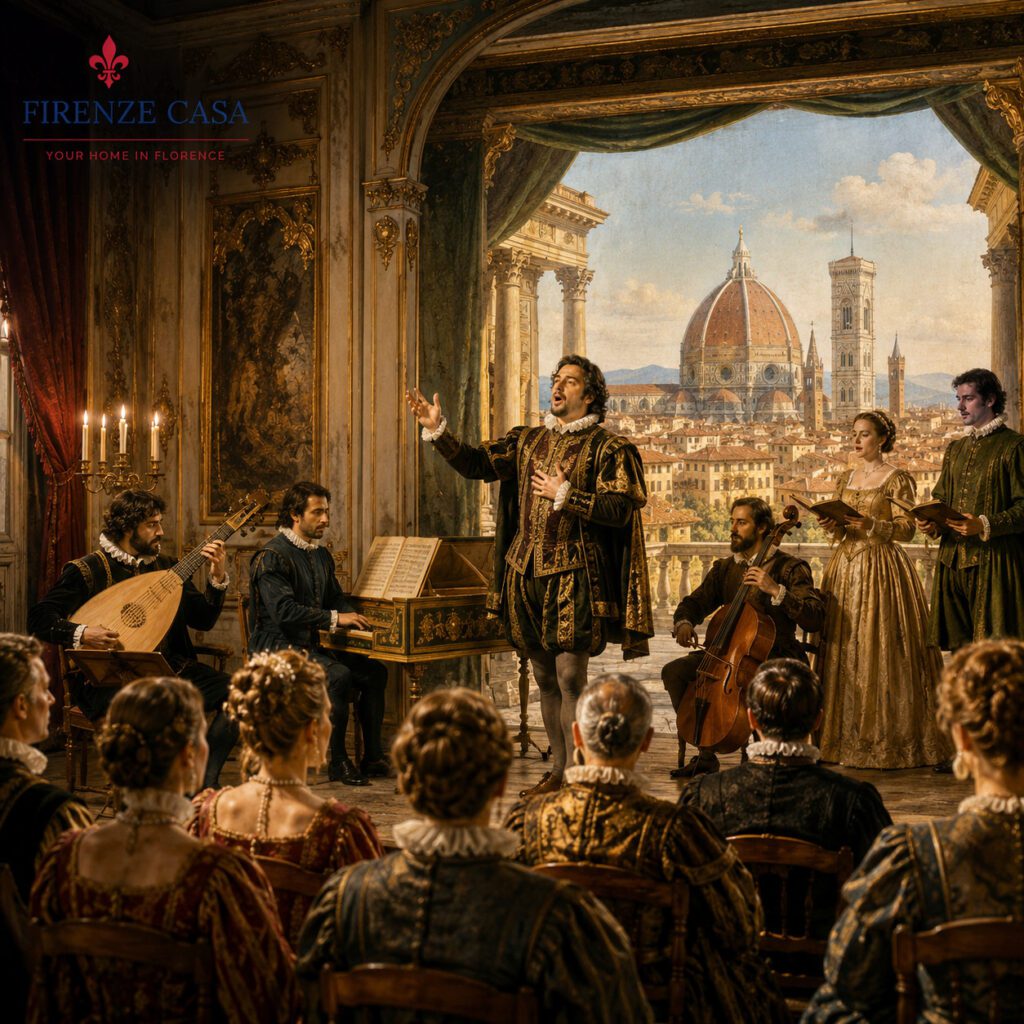
Florence and the birth of opera are inseparably connected. Around the end of the sixteenth century, a remarkable circle of Florentine musicians, poets and intellectuals began experimenting with a radically different way of combining words, music and drama. Their ideas helped create one of Europe’s most influential art forms.
The story did not begin in an opera house. It developed in aristocratic residences and within the intellectual world of late Renaissance Florence, supported by courtly patronage and the Medici. Figures such as Jacopo Peri, Giulio Caccini, Vincenzo Galilei and Emilio de’ Cavalieri transformed discussions about ancient Greek drama into musical experiments that eventually became opera.
Where: Florence, Tuscany
When: late 16th and early 17th centuries
Key figures: Jacopo Peri, Giulio Caccini, Vincenzo Galilei, Emilio de’ Cavalieri and Francesca Caccini
Key milestone: Jacopo Peri’s Euridice, performed in Florence in 1600
Musical innovation: expressive solo singing, monody and early recitative
Why it matters: Florentine experiments with music, poetry and drama helped create the art form that became opera
Contents – Florence and the Birth of Opera
- Why Was Opera Born in Florence?
- The Florentine Camerata
- A New Way of Singing
- Vincenzo Galilei and the Ideas Behind Opera
- Jacopo Peri and the First Operas
- Euridice and the Year 1600
- Giulio Caccini and the New Musical Style
- Emilio de’ Cavalieri and Court Spectacle
- From Renaissance Intermedi to Opera
- The Medici and the Birth of Opera
- Francesca Caccini and the Next Generation
- From Florence to Europe
- Opera in Florence Today
Why Was Opera Born in Florence?
Florence had already transformed European art, architecture, literature and political thought during the Renaissance. By the late sixteenth century, the city also provided an unusually fertile environment for musical experimentation.
Humanist scholars studied classical Greece and Rome and attempted to understand how ancient tragedies might originally have been performed. Music became part of this investigation. Some Florentine thinkers believed that Greek drama had combined speech and song in a way capable of intensifying emotion.
They therefore began searching for a musical style that could reproduce what they imagined to be the expressive power of ancient theatre. The same fascination with antiquity that had transformed painting and architecture now became a catalyst for musical innovation.
Opera did not emerge from a single moment of inspiration or from one inventor. It developed through years of discussion, experimentation and collaboration among musicians, poets, scholars, performers and aristocratic patrons in Florence.
The Florentine Camerata
At the centre of the story was the intellectual circle traditionally known as the Florentine Camerata, or Camerata de’ Bardi. During the late sixteenth century, musicians and scholars gathered around the nobleman Giovanni de’ Bardi to discuss poetry, philosophy, ancient drama and music.
Among the figures associated with this environment were Vincenzo Galilei, Giulio Caccini and the scholar Girolamo Mei. Jacopo Peri belonged to the wider Florentine musical world in which these ideas developed.
The Camerata was especially interested in the relationship between words and music. Complex Renaissance polyphony could involve several independent vocal lines sounding simultaneously. The result could be musically sophisticated, yet the dramatic text was sometimes difficult to follow.
The Florentine experimenters wanted something different: music that strengthened the meaning and emotional force of words rather than obscuring them.
A New Way of Singing
This search encouraged the development of a style in which a single vocal line could follow the rhythm and emotional character of spoken language. The approach became closely associated with monody: expressive solo singing supported by instrumental accompaniment.
Instead of several equally important voices competing for attention, listeners could concentrate on one singer and understand the dramatic text more clearly. The singer could vary rhythm, ornamentation and intensity according to the emotions of a character.
This innovation had enormous consequences. Music could now carry dialogue and dramatic action in a way that helped open the door to an entirely new form of theatre.
The pioneers of Florentine opera placed dramatic text at the centre of the musical experience. A single voice could communicate individual emotion while instrumental accompaniment supported the words.
Vincenzo Galilei and the Ideas Behind Opera
One of the most fascinating figures in this intellectual transformation was Vincenzo Galilei. Today he is often remembered primarily as the father of Galileo Galilei, yet Vincenzo was an important musician, theorist and experimenter in his own right.
He participated in the discussions surrounding the Florentine Camerata and challenged established musical conventions. His study of ancient Greek music and his interest in the expressive possibilities of a single melodic line contributed to the theoretical environment from which opera emerged.
The story also illustrates how interconnected Florentine intellectual culture could be. Music, mathematics, philosophy and classical scholarship were not isolated disciplines but part of a broader willingness to question inherited authority and experiment with new ideas.
Jacopo Peri and the First Operas
If the Camerata helped create the intellectual foundations of opera, Jacopo Peri helped transform those ideas into musical drama. Born in Rome but raised and educated in Florence, Peri became closely associated with the Medici court as a singer and composer.
His Dafne, created with the poet Ottavio Rinuccini during the 1590s, is generally regarded as the earliest opera. Most of its music has unfortunately been lost, but the work demonstrated that sustained dramatic storytelling through music was becoming possible.
Peri was not working alone. The collaboration between composer and poet was fundamental from the beginning, and the competitive musical environment of Florence encouraged several musicians to experiment with similar ideas.
Euridice and the Year 1600
The decisive surviving milestone came with Peri’s Euridice, again based on a libretto by Ottavio Rinuccini. It was performed in Florence on 6 October 1600 during celebrations connected with the marriage of Maria de’ Medici to King Henry IV of France.
The work tells the classical story of Orpheus and Eurydice, perfectly reflecting the fascination with antiquity that had inspired the Florentine experiments from the beginning.
Euridice occupies a special position in musical history because it is the earliest opera whose music survives substantially complete. What began as an elite court entertainment became one of the defining milestones in the development of European music theatre.
The performance of Euridice in Florence in 1600 brought together music, classical mythology, Medici diplomacy and court spectacle at one of the defining moments in the history of opera.
Giulio Caccini and the New Musical Style
Giulio Caccini was another central figure in Florence and the birth of opera. A singer, composer and teacher, he worked for the Medici court and participated in the musical culture surrounding the Camerata.
Caccini strongly promoted expressive solo singing. His collection Le nuove musiche, published in Florence in 1602, became an important statement of the emerging style. Its title – “The New Music” – captures the sense of artistic change that characterised the period.
He also created his own setting of Rinuccini’s Euridice. The existence of competing versions illustrates how rapidly Florentine composers were exploring the possibilities of musical drama.
Caccini’s importance extended beyond composition. As a renowned singer and teacher, he helped develop the kind of vocal performance required by the new music and transmitted that knowledge to another generation.
Emilio de’ Cavalieri and the World of Court Spectacle
Emilio de’ Cavalieri belonged to the same broader world of musical experimentation, although his role developed primarily through Medici court culture rather than the Camerata itself.
Composer, performer, administrator and theatrical organiser, Cavalieri worked where music and spectacle met. He was closely involved in the extraordinary celebrations surrounding the 1589 marriage of Grand Duke Ferdinando I de’ Medici and Christine of Lorraine.
His career reminds us that early opera depended on much more than composers. Poets, singers, patrons, architects, costume designers, stage technicians and organisers were all necessary to create increasingly ambitious theatrical productions.
From Renaissance Intermedi to Opera
Opera did not appear from nowhere. Florence already possessed a sophisticated tradition of musical theatre, particularly the intermedio. These elaborate combinations of music, dance, poetry, scenery and theatrical effects were performed between the acts of spoken plays.
The famous intermedi created for the Medici wedding celebrations of 1589 demonstrated how spectacular such productions could become. Music, costumes, moving scenery and sophisticated stage machinery created extraordinary visual and acoustic effects.
Early opera added something crucial: sustained dramatic storytelling through music rather than musical episodes inserted between acts of another play.
The Florentine intermedi were not operas, but they provided an important theatrical laboratory in which musicians, singers, poets and stage designers learned how music and spectacle could work together.
The Medici and the Birth of Opera
Artistic innovation in Florence rarely existed independently of patronage. The Medici family provided musicians with employment, audiences and spectacular occasions on which new forms of music and theatre could be tested.
Dynastic weddings were particularly important because they combined diplomacy with displays of culture and political power. Music, poetry, costumes, architecture and stage machinery all contributed to these celebrations.
The performance of Euridice during festivities surrounding Maria de’ Medici’s royal marriage demonstrates this relationship especially clearly. Opera’s beginnings therefore belong not only to musical history but also to the political and ceremonial world of the Florentine court.
The same dynasty that transformed Florence through paintings, sculpture, palaces and gardens also supported performing arts that left no permanent monument behind. Opera is therefore one of the least visible but most consequential elements of the Medici cultural legacy.
Francesca Caccini and the Next Generation
The story continued through Giulio Caccini’s daughter Francesca Caccini, one of the most remarkable musicians of early seventeenth-century Florence.
Born in 1587, she became an accomplished singer, composer, instrumentalist and teacher at the Medici court. Her career demonstrates that women could achieve significant professional positions within this sophisticated musical environment, even though such opportunities remained exceptional.
Her best-known surviving stage work, La liberazione di Ruggiero dall’isola d’Alcina, was first performed at the Villa del Poggio Imperiale in 1625. It is generally recognised as the earliest surviving opera composed by a woman.
By Francesca’s generation, the experiments of Peri and Giulio Caccini were already becoming an established theatrical language. Her career therefore provides a bridge between opera’s invention and its rapid development.
A Musical Tradition Older Than Opera
Florence’s importance in European music did not begin around 1600. More than two centuries earlier, Francesco Landini had become one of the most celebrated composers of fourteenth-century Italy.
The blind Florentine musician belonged to a very different musical world dominated by the polyphonic culture of the Trecento. His surviving works form one of the richest bodies of secular music from medieval Italy.
The comparison is useful because it prevents us from imagining opera as Florence’s first significant musical achievement. Instead, the new genre represented a revolutionary chapter within a much longer tradition of music, poetry and performance.
Where Did Florence’s First Operas Take Place?
Visitors searching for the birthplace of opera should not expect to find one historic opera house where everything began. The earliest experiments belonged largely to courtly environments, aristocratic residences and temporary performance spaces.
Opera emerged before public opera houses became characteristic institutions of Italian cities. This makes the surviving architecture of Medici Florence especially important: palaces, villas and court spaces provide the physical setting for a musical world whose performances themselves disappeared as soon as they ended.
For the later development of permanent performance spaces, our Theatres and Opera Houses in Florence – Complete Guide follows the story from seventeenth-century theatres to the city’s modern opera house.
Think of early opera as part of the wider world of Medici Florence rather than as the product of a modern theatre. Palaces, villas, court ceremonies, private gatherings and temporary stages all formed part of this musical environment.
From Court Entertainment to the Public Theatre
The transformation from private court spectacle to permanent theatre took place gradually. Florence itself gained important theatrical venues during the seventeenth century, while elsewhere in Italy opera increasingly moved beyond aristocratic courts.
Teatro della Pergola, founded in the seventeenth century, provides an important Florentine connection with this later phase. Its history belongs to a world in which opera and theatre acquired permanent architectural spaces, formal auditoriums and increasingly diverse audiences.
Venice played an especially important role after commercial public opera houses opened there during the 1630s. Audiences no longer needed to belong to an aristocratic court, and opera developed into a commercial theatrical culture.
In only a few decades, an experiment that began within elite Florentine circles had become a new Italian art form.
From Florence to Monteverdi
Claudio Monteverdi’s L’Orfeo, first performed in Mantua in 1607, demonstrated how rapidly the new genre could develop. Monteverdi expanded its musical vocabulary through richer instrumentation, stronger dramatic organisation and extraordinary emotional range.
Opera subsequently spread through Italian courts and cities before developing distinctive traditions across Europe. France, Germany, Austria and England all adapted the genre according to their own languages and theatrical cultures.
The composers of the Florentine Camerata could not have anticipated this future. They were trying to solve a specific artistic problem: how to make words, music and dramatic emotion work together more effectively.
From Peri to Cherubini
Florence’s relationship with opera did not end after its pioneering generation. More than a century and a half later, the Florence-born composer Luigi Cherubini carried the city’s musical tradition into an entirely different European world.
Born in 1760, Cherubini eventually established himself in Paris, where works including Lodoïska and Médée brought him international recognition.
His career illustrates how far opera had travelled since the experiments of Peri and Caccini: from intimate Florentine court culture around 1600 to one of Europe’s great international theatrical traditions.
Florence’s Lasting Influence on Opera
The musical language of opera soon moved far beyond the experiments of Peri and Caccini, yet their fundamental idea survived: music could carry dramatic action while expressing the emotions of individual characters.
Monteverdi, Handel, Mozart, Rossini, Verdi, Wagner, Puccini and countless later composers transformed that principle in radically different ways.
Florence’s role is consequently not that it produced every later development in opera. Its importance lies in creating the intellectual and musical environment in which the genre first took recognisable form.
This is one of Florence’s least visible cultural legacies. Its influence on architecture and painting can be seen everywhere; its musical revolution survives principally in sound and in the history of an art form now performed around the world.
Opera in Florence Today
Florence’s relationship with opera remains very much alive. The city’s modern theatrical landscape ranges from historic auditoriums to a major contemporary opera complex.
The Theatres and Opera Houses in Florence – Complete Guide introduces Teatro della Pergola, Teatro Verdi, Teatro Goldoni, Teatro Niccolini and the Teatro del Maggio Musicale Fiorentino.
The Maggio Musicale Fiorentino continues Florence’s operatic tradition through major productions, orchestral concerts and one of Italy’s most important music festivals. Attending an opera in Florence therefore connects a contemporary performance culture with experiments that began more than four centuries ago.
The first Florentine operas were created for court celebrations. Today, opera belongs to public theatres and international audiences – yet Florence remains one of the places where the story began.
Why the Birth of Opera Matters to Florence
Florence is often described as the cradle of the Renaissance. That description is justified, but it can obscure the city’s influence on later European culture.
The birth of opera in Florence demonstrates that the city’s creative importance did not end with Brunelleschi, Donatello, Botticelli or Michelangelo. At the transition from Renaissance to Baroque culture, Florentine musicians and intellectuals were still experimenting with entirely new forms of artistic expression.
Their attempt to recover the emotional power they associated with ancient Greek drama produced something they could hardly have predicted: a theatrical genre that would survive for more than four centuries.
Florence’s greatest cultural achievements often emerged where disciplines met. Opera brought together humanist scholarship, poetry, music, theatre, architecture, stage design, court ceremony and Medici patronage – a characteristically Florentine combination.
Florence and the Birth of Opera: A Cultural Revolution
The birth of opera was not the achievement of one composer. It resulted from a remarkable network of musicians, scholars, poets, performers and patrons.
Vincenzo Galilei and other intellectuals explored the relationship between ancient drama and music. Giulio Caccini developed and promoted expressive solo singing. Jacopo Peri transformed these ideas into early musical dramas, while Emilio de’ Cavalieri contributed to the world of court spectacle and theatrical experimentation.
Poets such as Ottavio Rinuccini provided the words, while Medici patronage created the environment in which increasingly ambitious performances could take place. Francesca Caccini then demonstrated how quickly the new genre could develop within the next generation of Florentine court culture.
Together, their stories reveal another side of a city usually celebrated for paintings, sculptures and architecture. Around 1600, Florence once again became a laboratory for European culture. This time, the result was opera.
Frequently Asked Questions
Was opera really invented in Florence?
Opera developed through several Florentine experiments around the end of the sixteenth century rather than through one single invention. Florence nevertheless occupies a central place in the genre’s origins.
Who invented opera?
No single person invented opera. Jacopo Peri, Giulio Caccini, Vincenzo Galilei, Emilio de’ Cavalieri, Ottavio Rinuccini and other musicians and intellectuals all contributed to its development.
What was the Florentine Camerata?
The Camerata de’ Bardi was an intellectual circle in late sixteenth-century Florence whose members discussed ancient drama, poetry and music. Its ideas helped create the theoretical environment from which early opera emerged.
What was the first opera?
Jacopo Peri’s Dafne, created during the 1590s, is generally regarded as the earliest opera, although most of its music has been lost.
Why is Peri’s Euridice so important?
Performed in Florence in 1600, Euridice is the earliest opera from this formative period whose music survives substantially complete.
What did the Medici have to do with opera?
The Medici employed musicians and financed elaborate court celebrations where composers, poets and theatrical designers could experiment with new forms of musical drama.
Who was Francesca Caccini?
Francesca Caccini was a Florentine composer, singer and instrumentalist at the Medici court. Her La liberazione di Ruggiero is generally recognised as the earliest surviving opera composed by a woman.
Can you still experience opera in Florence today?
Yes. Florence has several historic theatres and a major contemporary opera house, while the Maggio Musicale Fiorentino remains an important international festival of opera and classical music.
Further Reading on Firenze Casa
- Giulio Caccini – Music and the Birth of Opera in Florence
- Jacopo Peri – The Florentine Composer Who Helped Invent Opera
- Francesca Caccini – Florence’s Pioneering Female Composer
- Vincenzo Galilei – Music, Florence and the Father of Galileo
- Emilio de’ Cavalieri – Florence and the Origins of Opera
- The Medici Family – The Dynasty That Shaped Florence
- Theatres and Opera Houses in Florence – Complete Guide
- Teatro della Pergola – Florence’s Historic Theatre and Hidden Stage
References
- Encyclopaedia Britannica – Opera: Western Theatre and the Origins of Opera.
- Encyclopaedia Britannica – Jacopo Peri.
- Encyclopaedia Britannica – Giulio Caccini.
- Encyclopaedia Britannica – Francesca Caccini.
- Oxford Music Online – Florentine Camerata.
- New Grove Dictionary of Music and Musicians – Early Opera and Seventeenth-Century Italian Music.
- Palisca, Claude V. – The Florentine Camerata: Documentary Studies and Translations.
- Carter, Tim – studies on music in late Renaissance and early Baroque Italy.

