
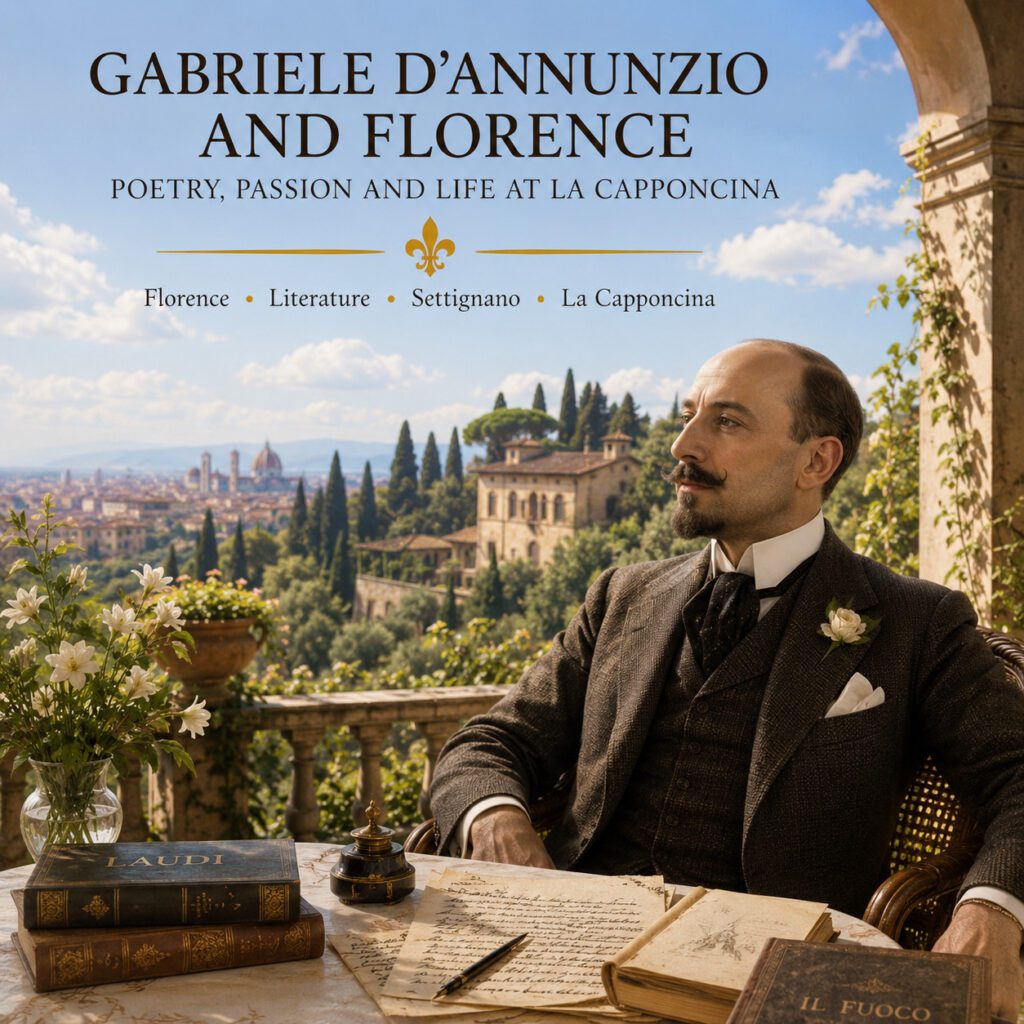
Gabriele D’Annunzio and Florence are connected through one of the most productive and theatrical periods of the writer’s life. From 1898, D’Annunzio lived at La Capponcina in Settignano, in the hills east of Florence, while Eleonora Duse stayed nearby at La Porziuncola. Here literature, theatre, love and an extraordinary way of life became almost impossible to separate.
Florence also connected D’Annunzio with an influential literary world of journals, writers and intellectual debate. His years around Settignano produced important works and reveal a fascinating chapter of Florentine culture between the nineteenth century and the modern literary avant-garde.
Born: Pescara, 12 March 1863
Florentine residence: La Capponcina, Settignano
Years at La Capponcina: 1898–1910
Nearby: Eleonora Duse at La Porziuncola
Known for: Poetry, novels, theatre and political activism
Florentine literary connection: Il Marzocco
Major works from this period: Il fuoco, Francesca da Rimini, Laudi, La figlia di Iorio
Died: Gardone Riviera, 1 March 1938
D’Annunzio adds another important chapter to our Florence in Literature – Complete Guide, taking the story beyond medieval and Renaissance writers into the intense literary culture around 1900.
Who Was Gabriele D’Annunzio?
Gabriele D’Annunzio was born in Pescara in 1863 and became one of the most famous and controversial figures in modern Italian culture. Poet, novelist, playwright, journalist and later political activist, he deliberately blurred the boundaries between literature and public life.
Even as a young man, D’Annunzio understood the importance of creating a public image. His literary career developed alongside an increasingly elaborate personal mythology built around beauty, luxury, sensual experience and artistic individuality.
His writing crossed almost every major literary form. Poetry, novels, theatre, journalism and lyrical prose all became vehicles for a highly distinctive language that exercised enormous influence on Italian culture around the turn of the twentieth century.
D’Annunzio was much more than a novelist or poet. He attempted to transform his own life into a work of art, making houses, clothes, relationships, public appearances and eventually politics part of the identity he created.
From Pescara to Tuscany
D’Annunzio’s connection with Tuscany began long before his years in Florence. As a boy, he attended the prestigious Collegio Cicognini in Prato from 1874 until 1881.
His literary talent emerged remarkably early. By the time he left school, he had already attracted attention as a young poet and soon moved into the literary and journalistic world of Rome.
During the following years, his reputation grew through poetry, fiction and journalism. Works such as Il piacere helped establish him as a leading representative of Italian Decadentism and as a writer fascinated by beauty, desire and cultivated aesthetic experience.
Tuscany would later offer something Rome could not: a landscape close to Florence where D’Annunzio could construct an environment designed around his own artistic mythology.
D’Annunzio and Florence’s Literary World
By the 1890s, Florence had developed into one of Italy’s most dynamic centres of literary journalism. Journals, publishers and intellectual circles helped the city regain cultural importance in a very different form from its Renaissance past.
D’Annunzio became closely connected with this environment. In 1896, he was an important inspiration behind the Florentine literary journal Il Marzocco, which became an influential forum for literature, criticism and cultural debate.
The journal brought together writers and intellectuals interested in defending artistic culture against what they regarded as the increasing materialism of modern society.
D’Annunzio’s presence within this world helped reinforce Florence’s position within contemporary Italian literature. The city was becoming a place where writers debated not only literature but the role of culture in modern Italy.
Around 1900, Florence’s literary importance increasingly depended on journals, publishers and intellectual networks. Il Marzocco belonged to the generation immediately preceding the more radical avant-garde circles of the early twentieth century.
La Capponcina in Settignano
The most important physical connection between Gabriele D’Annunzio and Florence is found in Settignano, the historic village in the hills east of the city.
In 1898, D’Annunzio established himself at La Capponcina, an old villa associated with the Capponi family. The house stood close to La Porziuncola, the villa occupied by the celebrated actress Eleonora Duse.
D’Annunzio transformed La Capponcina into far more than a residence. Rooms, furniture, artworks, textiles and objects contributed to an elaborate environment in which daily life became part of his artistic self-presentation.
The villa reflected his conviction that art and life should not remain separate. Beauty was something to be written about, but also something to be surrounded by and performed.
La Capponcina still gives its name to Via della Capponcina in Settignano. The surrounding roads and villas preserve one of the strongest geographical connections between D’Annunzio and Florence.
D’Annunzio and Eleonora Duse
No account of D’Annunzio’s Florentine years is complete without Eleonora Duse, one of the greatest actresses of her generation.
Their relationship combined love, artistic collaboration and emotional conflict. Duse had rented La Porziuncola in Settignano before D’Annunzio established himself nearby at La Capponcina.
The proximity of the two villas allowed their personal and artistic lives to overlap intensely. D’Annunzio wrote plays associated with Duse, while she helped bring his theatrical ambitions to the stage.
Their relationship was nevertheless difficult and eventually deteriorated. D’Annunzio’s fictional use of intimate material, particularly in Il fuoco, added further tension to an already complicated partnership.
Settignano was not simply a romantic background for D’Annunzio and Duse. Their neighbouring villas became part of an intense creative relationship linking literature, theatre and the construction of artistic celebrity.
The Creative Years at La Capponcina
D’Annunzio’s years in Settignano coincided with an exceptionally productive phase of his career. The villa became both an elaborate stage for his lifestyle and a serious place of work.
During this broader period he produced works that remain central to his literary reputation, including the novel Il fuoco, the tragedy Francesca da Rimini and the first books of the poetic cycle Laudi del cielo del mare della terra e degli eroi.
The famous collection Alcyone, published within the Laudi, contains some of D’Annunzio’s most celebrated poetry. Its intense attention to landscape, sound, nature and physical sensation demonstrates his extraordinary linguistic ability.
Other major works of these years included the tragedy La figlia di Iorio, first performed in 1904.
The Settignano years coincided with works including Il fuoco, Francesca da Rimini, the first three books of the Laudi and La figlia di Iorio. La Capponcina was extravagant, but it was also a place of intense literary work.
Alcyone and the Tuscan Landscape
Among D’Annunzio’s works, Alcyone has a particularly strong relationship with the Tuscan landscape. Its poems transform nature into an intensely sensual literary experience.
Much of the collection evokes the Tuscan coast rather than Florence itself, especially the landscape around Versilia. Yet the work belongs to the creative period when D’Annunzio was based at La Capponcina.
Nature in Alcyone is never merely scenery. Heat, rain, vegetation, sea, light and sound become part of the poet’s physical and emotional experience.
The collection therefore helps explain D’Annunzio’s attraction to Tuscany. The region offered landscapes capable of becoming part of the aesthetic world he was constructing around himself.
La Pioggia nel Pineto
One of the best-known poems in Alcyone is La pioggia nel pineto. The poem describes two people walking through a pine forest as summer rain begins to fall.
Human identity gradually seems to merge with the surrounding natural world. Rain strikes leaves, branches and vegetation, creating a musical landscape in which the boundary between people and nature becomes increasingly uncertain.
The poem demonstrates why D’Annunzio became so influential as a stylist. Language itself creates sound, rhythm and physical sensation.
If you want a short introduction to D’Annunzio rather than beginning with a novel, La pioggia nel pineto is an excellent choice. Reading it aloud reveals how strongly sound and rhythm contribute to his poetry.
Dante, Florence and D’Annunzio
D’Annunzio was also an attentive reader of Dante Alighieri and the Divine Comedy. His interest in Dante belonged to a broader fascination with medieval culture, literary language and the construction of great national figures.
Dante’s influence appears through quotations, references and D’Annunzio’s engagement with the Divine Comedy. He annotated his own copy extensively and contributed to the continuing reinterpretation of Dante in modern Italian culture.
The connection creates an interesting bridge across centuries of literary Florence. Dante represents the medieval city of political conflict and exile, while D’Annunzio belongs to the modern Italy that increasingly transformed Dante into a national cultural symbol.
Settignano – The Florence Beyond the Centre
Settignano is essential to understanding D’Annunzio’s Florentine years. The village sits in the hills east of the historic centre, surrounded by villas, gardens and landscapes that have attracted artists and writers for centuries.
Its character is very different from Piazza della Signoria or the streets around the Duomo. Florence feels close, yet the surrounding hills create a quieter world of stone walls, cypress trees, gardens and views across the countryside.
D’Annunzio’s choice of Settignano therefore makes sense. He could remain connected with Florence’s cultural world while constructing a private environment removed from everyday urban life.
Nearby La Porziuncola reinforced this unusual literary geography by placing Eleonora Duse within walking distance.
Settignano rewards slow exploration. Via della Capponcina and the surrounding lanes reveal a Florence of villas and hills rather than monuments, while the connection with D’Annunzio and Duse adds an unexpected literary layer.
A Life Designed as Art
La Capponcina became one of the clearest early expressions of D’Annunzio’s belief that artistic identity should extend beyond literature.
He surrounded himself with carefully selected objects, elaborate furnishings, animals and symbols. Clothing, interiors, relationships and public gestures became part of a larger aesthetic performance.
This lifestyle was impressive but extraordinarily expensive. D’Annunzio’s appetite for luxury repeatedly exceeded his financial resources, and debts accumulated during his years in Settignano.
The tension between extraordinary literary productivity and financial disorder became one of the defining contradictions of his life at La Capponcina.
The End of the Capponcina Years
By 1910, D’Annunzio’s financial problems had become impossible to contain. Creditors closed in on his possessions, and the elaborate Florentine life he had created could no longer continue.
He left La Capponcina and departed for France, describing the move as a form of voluntary exile. The villa and many of its contents were subsequently lost to him.
His departure ended an extraordinary twelve-year relationship with Settignano. Yet the years between 1898 and 1910 remained central to his literary biography.
The story also reveals the instability behind D’Annunzio’s carefully constructed public image. The luxurious artistic existence at La Capponcina depended on financial circumstances that could not be sustained indefinitely.
The idea of transforming a residence into an expression of personal mythology did not end with Settignano. D’Annunzio later created an even more extraordinary environment at the Vittoriale degli Italiani on Lake Garda.
D’Annunzio After Florence
D’Annunzio’s life after Florence became increasingly public and political. After several years in France, he returned to Italy during the First World War and became one of the country’s most prominent interventionist voices.
Despite being over fifty, he participated in military actions and transformed his wartime activities into another chapter of his public legend.
After the war, his occupation of Fiume further increased his political fame and controversy. He later withdrew to the Vittoriale degli Italiani at Gardone Riviera, where he spent the final phase of his life.
D’Annunzio died there on 1 March 1938.
D’Annunzio, Nationalism and Fascism
D’Annunzio’s political legacy requires careful distinction from his literary importance. His nationalism, wartime rhetoric and occupation of Fiume influenced the language and spectacle of Italian politics after the First World War.
Some rituals and forms of political theatre associated with D’Annunzio were later adopted by Fascism. His relationship with Benito Mussolini and the Fascist regime, however, was more complicated than a simple identification of the two.
For literary Florence, the most relevant period remains his earlier life around Settignano, before the soldier, nationalist and political celebrity came to dominate his public image.
D’Annunzio’s literary achievement and political legacy should be considered separately but not artificially disconnected. His talent for language, symbolism and public spectacle became important both to his art and to his later political persona.
D’Annunzio and the Next Generation of Florentine Writers
The literary Florence associated with D’Annunzio did not remain unchanged. During the first decades of the twentieth century, a younger generation increasingly challenged the established cultural world.
Writers including Aldo Palazzeschi became associated with new journals, experimentation and the avant-garde. Florence’s intellectual landscape shifted from the world of Il Marzocco towards publications such as La Voce and Lacerba.
Palazzeschi and D’Annunzio therefore represent two overlapping but distinctly different moments in modern literary Florence. D’Annunzio cultivated beauty, aestheticism and the exceptional artistic personality; Palazzeschi increasingly used irony and experimentation to question established literary seriousness.
Together, they demonstrate how rapidly Florence’s cultural world changed between the 1890s and the years before the First World War.
D’Annunzio helps us understand Florence around 1900; Palazzeschi takes us into the experimental avant-garde that followed. Reading their stories together creates a bridge between two generations of modern Italian literature.
Where to Discover D’Annunzio’s Florence
D’Annunzio’s Florentine geography lies largely outside the most visited historic centre. That makes it particularly interesting for visitors who already know the major monuments.
Settignano
The hillside village is the natural starting point. Its streets and surrounding landscape provide the setting for understanding why D’Annunzio chose to establish himself here.
Via della Capponcina
This road preserves the name of the villa where D’Annunzio lived. La Capponcina stood at number 32, while the nearby landscape also recalls the presence of Eleonora Duse at La Porziuncola.
La Porziuncola
Duse’s nearby villa forms an essential part of the story. The physical proximity of their residences reflects the close connection between their personal and artistic lives during these years.
The Hills East of Florence
Walking around Settignano reveals a landscape often overlooked by visitors who remain within the historic centre. Villas, gardens and country roads connect Florence with a long tradition of artists and writers seeking space beyond the city walls.
D’Annunzio’s Florence is unusual because its most important literary landscape is not Piazza della Signoria or Santa Croce. It lies in the hills around Settignano, where Florence gradually dissolves into the Tuscan countryside.
Gabriele D’Annunzio in Literary Florence
D’Annunzio occupies a distinctive place in the long history of Florence in Literature.
Unlike Dante, Boccaccio or Machiavelli, he was not born in Florence. Nor was he primarily a foreign observer like E. M. Forster or Elizabeth Barrett Browning. Instead, he chose the Florentine hills as the setting for a crucial phase of his creative life.
His story also broadens the geography of literary Florence. Settignano, La Capponcina and La Porziuncola demonstrate that the city’s literary history extends far beyond the streets around the Duomo and Palazzo Vecchio.
Most importantly, D’Annunzio connects Florence with the transformation of Italian literature around 1900 – the moment immediately before writers such as Palazzeschi and the Florentine avant-garde began challenging the cultural world that preceded them.
Why Gabriele D’Annunzio Is Worth Discovering in Florence
Gabriele D’Annunzio is worth discovering in Florence because his years at La Capponcina reveal an unexpected chapter of the city’s literary history. Settignano became the setting for an intense mixture of writing, theatre, love, aesthetic experimentation and extravagant self-invention.
His relationship with Eleonora Duse adds another dimension to the story, while his involvement with Il Marzocco connects him with Florence’s developing modern literary culture.
The period also produced some of the works for which he remains best known. Poetry, theatre and prose emerged from an environment in which D’Annunzio attempted to make everyday life itself part of his art.
For visitors, his story offers something particularly valuable: a reason to leave the monumental centre and discover the quieter hills of Settignano, where another Florence waits beyond the familiar Renaissance city.
Frequently Asked Questions
Did Gabriele D’Annunzio live in Florence?
Yes. From 1898 until 1910, D’Annunzio lived at La Capponcina in Settignano, in the hills east of central Florence.
Where was La Capponcina?
La Capponcina was in Settignano, along the road now known as Via della Capponcina. The villa was close to La Porziuncola, where Eleonora Duse lived.
Why did D’Annunzio live in Settignano?
Settignano allowed him to remain close to Florence while creating a private and highly aesthetic environment in the surrounding hills. The proximity of Eleonora Duse was also important during this period.
Who was Eleonora Duse?
Eleonora Duse was one of the most celebrated Italian actresses of her generation. She had an important personal and artistic relationship with D’Annunzio and lived near him in Settignano.
What did D’Annunzio write during his Florentine years?
His years around La Capponcina coincided with major works including Il fuoco, Francesca da Rimini, the first three books of the Laudi and La figlia di Iorio.
What is D’Annunzio’s connection with Il Marzocco?
D’Annunzio was an important inspiration behind the Florentine literary journal Il Marzocco, founded in 1896, and contributed to its cultural environment.
Was D’Annunzio connected with Dante?
D’Annunzio was an attentive reader of Dante and extensively annotated his own copy of the Divine Comedy. Dante formed part of his broader fascination with medieval culture and Italian literary tradition.
Why did D’Annunzio leave Florence?
By 1910, his severe financial difficulties and accumulated debts made his extravagant life at La Capponcina unsustainable. He left Italy for France.
Can you visit D’Annunzio’s Florence today?
Visitors can explore Settignano, Via della Capponcina and the surrounding hills associated with D’Annunzio and Eleonora Duse. Access to individual historic properties may be limited, so current conditions should be checked before planning a visit.
Why is D’Annunzio important to literary Florence?
His years in Settignano connect Florence with Italian literature around 1900, the cultural world of Il Marzocco and the generation immediately preceding the Florentine avant-garde.
Further Reading on Firenze Casa
Continue exploring Florence through its writers, literary movements and places:
- Florence in Literature – Complete Guide
- Aldo Palazzeschi and Florence
- Dante Alighieri and the Divine Comedy
- A Literary Walk Through Florence
- Books to Read Before Visiting Florence
References
- Treccani – Gabriele D’Annunzio
- Treccani, Dizionario Biografico degli Italiani – Gabriele D’Annunzio
- Treccani, Enciclopedia Dantesca – Gabriele D’Annunzio
- Comune di Firenze, Quartiere 2 – Settignano and the D’Annunzio–Duse Literary Landscape
- Biblioteca Marucelliana – D’Annunzio and Duse Correspondence and Florentine Collections
- Istituto Centrale per il Catalogo e la Documentazione – La Capponcina Photographic Archive
- D’Annunzio, Gabriele. Il fuoco.
- D’Annunzio, Gabriele. Alcyone.
- D’Annunzio, Gabriele. Francesca da Rimini.
- D’Annunzio, Gabriele. La figlia di Iorio.

