
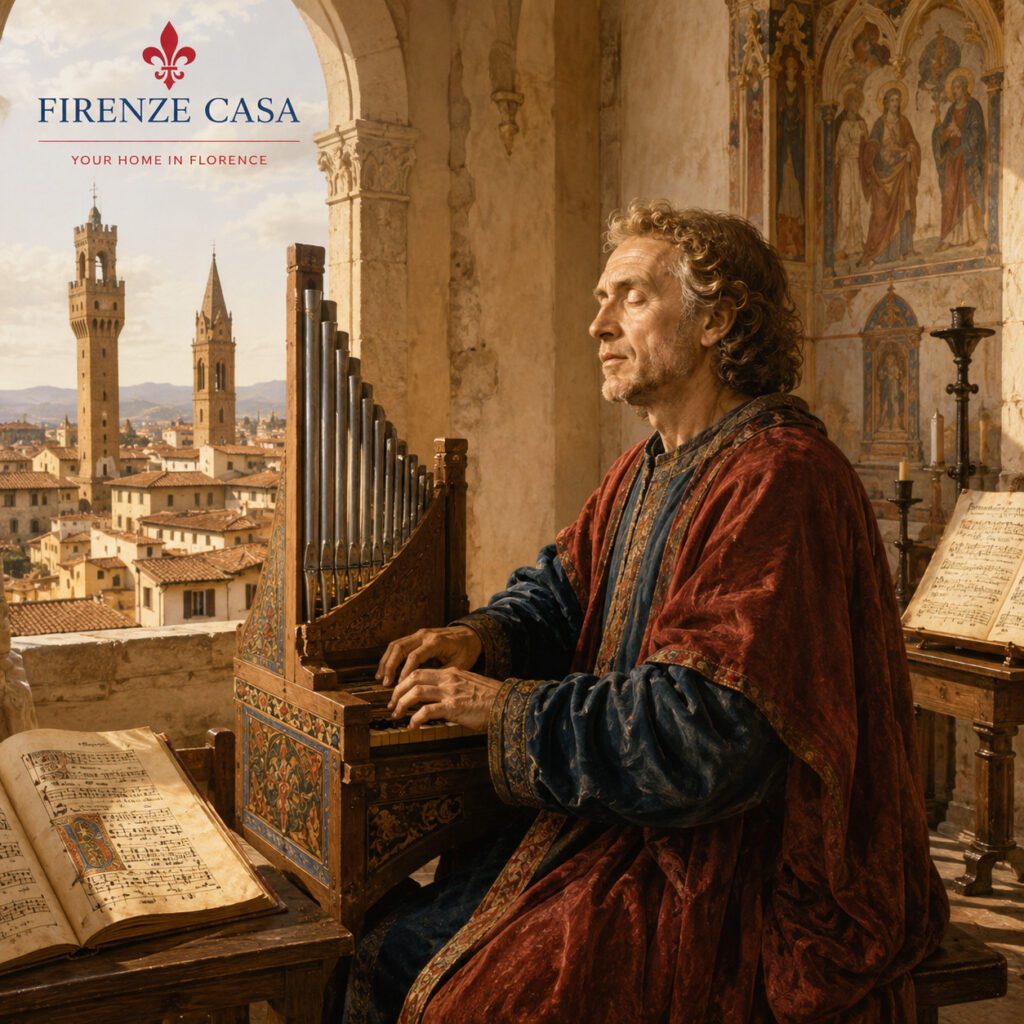
Francesco Landini was one of the most remarkable musicians of medieval Florence. Blind from childhood, he became a celebrated composer, poet, singer and organist whose music belonged to the sophisticated cultural world of fourteenth-century Italy.
His story takes us into a Florence very different from the Renaissance city of the Medici. This was the Florence of the Trecento: a wealthy but turbulent republic shaped by merchants, guilds, churches, political rivalries and extraordinary artistic creativity. Landini also reminds us that Florence possessed a rich musical culture long before the experiments that produced opera, making him an important earlier chapter in our Florence and the Birth of Opera story.
Born: around 1325, probably in or near Florence
Died: 1397, Florence
Known as: Francesco degli Organi
Profession: composer, poet, singer and organist
Musical period: Italian Trecento
Main surviving genre: secular vocal music, especially ballate
Florentine connection: organist at San Lorenzo
Why he matters: one of the most important composers of fourteenth-century Italian music
Who Was Francesco Landini?
Francesco Landini was born around 1325, probably in or near Florence. Contemporary and later sources also identify him as Francesco degli Organi, a name reflecting his extraordinary reputation as an organist.
His father was the painter Jacopo del Casentino, connecting Landini from birth with the artistic culture of Tuscany. As a child, Francesco contracted smallpox and lost his sight.
Blindness profoundly shaped his life but did not prevent him from developing exceptional musical abilities. He learned to sing and play several instruments and became particularly famous for his mastery of the organ.
Landini was often called Francesco degli Organi – “Francesco of the Organs.” His contemporaries admired him not only as a composer but also as an exceptional performer.
Francesco Landini and Medieval Florence
To understand Francesco Landini, it helps to imagine Florence during the fourteenth century. The city was already one of Europe’s great commercial centres, enriched by banking, textile production and international trade.
Powerful guilds shaped political and economic life, while ambitious families competed for influence. Prosperity existed alongside instability, however, and the catastrophic Black Death reached Florence in 1348.
The same century produced an extraordinary cultural flowering. Giotto transformed painting, Dante’s legacy dominated Florentine literature, and Giovanni Boccaccio turned the plague-stricken city into the dramatic starting point of the Decameron. Landini belonged to this same creative world – but expressed it through music.
A Musician Who Could Not See
Landini’s blindness became an important part of how contemporaries understood his remarkable talent. Accounts emphasise his skill as a singer and instrumentalist and the extraordinary impression made by his performances.
His reputation spread beyond Florence, and he moved within sophisticated artistic and intellectual circles as both musician and poet.
His disability makes his career remarkable, but it should not overshadow his artistic achievement. Landini became famous because contemporaries considered him an exceptional musician.
Landini lost his sight in childhood yet became one of the most celebrated musicians of his generation through composition, poetry, singing and extraordinary instrumental skill.
The Sound of the Florentine Trecento
The Italian word Trecento literally refers to the 1300s. In cultural history, it describes one of the most fascinating periods of medieval Italian creativity.
Italian music changed significantly during this century. Composers developed increasingly sophisticated forms of secular polyphony in which multiple vocal lines interacted while preserving melodic elegance and rhythmic vitality.
Florence became one of the important centres of this musical culture, and Landini emerged as its most famous representative. The unusually large number of surviving works attributed to him demonstrates both his productivity and the esteem in which his music was held.
What Kind of Music Did Francesco Landini Compose?
Landini composed primarily secular vocal music. The ballata became especially important to his work, combining elegant melodies with poetry concerned with love, longing and emotional experience.
He also composed madrigals and other works associated with the musical culture of the Trecento.
His compositions reveal a refined understanding of melody and vocal interaction. Rather than sounding like a primitive precursor to Renaissance music, the best works possess their own highly developed musical language and offer modern listeners a rare acoustic window onto medieval Italy.
The Ballata and the Poetry of Love
The ballata offered Landini an ideal form for exploring relationships between poetry and music. Many texts deal with unattainable love, separation, desire or emotional uncertainty – themes deeply rooted in medieval literary culture.
Music intensified these emotions. Melodic lines could express tenderness or melancholy, while the interaction between voices gave the poetry additional depth.
This close relationship between literature and music places Landini naturally beside the literary culture explored in our Florence in Literature – Complete Guide. Fourteenth-century Florence was producing remarkable innovations in both written and musical expression.
When hearing Landini today, imagine the music as part of Florence’s living culture. Poetry, performance and music belonged to the same sophisticated society that produced the city’s churches, paintings and literature.
Francesco Landini the Poet
Landini did not separate music completely from literature. He was also recognised as a poet, and texts associated with his compositions demonstrate the close relationship between words and musical expression.
Poetry occupied a prestigious position in medieval Italian culture. Dante Alighieri had demonstrated the expressive possibilities of the Tuscan vernacular, while Petrarch and Boccaccio further transformed Italian literary culture.
Landini participated in this same world through a different medium: his music allowed poetry to become performance.
Landini and the Organ
Despite his fame today as a composer, contemporaries particularly admired Landini as an organist. The association became so strong that the name Francesco degli Organi appeared alongside his own.
The organ occupied an important position in medieval musical life, particularly within churches and ceremonial settings.
This reputation creates an interesting contrast with the music that survives today. Most of Landini’s preserved compositions are secular vocal works rather than organ pieces. The performer whom contemporaries heard and the composer whom modern audiences know are therefore not exactly the same Landini.
San Lorenzo and Francesco Landini
One of Landini’s strongest surviving connections with the physical city of Florence is the Basilica of San Lorenzo, where he served as organist during the later part of his career.
The church visitors see today owes much of its appearance to the Renaissance rebuilding associated with Filippo Brunelleschi and later Medici patronage. Landini knew an earlier medieval San Lorenzo.
This distinction makes the connection especially evocative. Musical life existed here long before Brunelleschi transformed the building and before San Lorenzo became one of the monuments most closely associated with the Medici dynasty.
Landini knew a different San Lorenzo from the Renaissance church visitors see today. His story adds an important medieval layer to a place now strongly associated with Brunelleschi and the Medici.
Music Inside Medieval Florence
Music in Landini’s Florence did not belong to concert halls in the modern sense. People encountered it in churches, religious processions, private residences, civic ceremonies and festive gatherings.
Sacred music served worship, while secular songs accompanied social occasions and urban entertainment. Wealthy households could support musicians, while public celebrations brought sound into streets and squares.
Landini moved across several of these environments. His fame demonstrates that musical virtuosity could attract considerable admiration within late medieval Florentine society.
The Squarcialupi Codex
Much of what we know about the musical world of the Florentine Trecento survives because later generations valued this repertoire enough to preserve it.
The most spectacular example is the Squarcialupi Codex, created in Florence during the early fifteenth century. The richly decorated manuscript contains an extraordinary collection of secular Italian music from the preceding generations.
Landini occupies an exceptionally prominent position within it. Numerous compositions are attributed to him, and the manuscript includes a famous representation of the blind musician with an instrument.
For music historians, the codex is one of the great treasures of medieval Italian music.
A Musical Treasure of Florence
The Squarcialupi Codex is more than a practical collection of musical notation. Its decoration transforms music into a prestigious visual object, with illuminated portraits and elaborate ornamentation presenting composers as important cultural figures.
This is particularly valuable for understanding Landini because music normally disappears the moment a performance ends. Manuscripts allowed melodies to survive, while visual decoration preserved something of the status attached to their creators.
The codex demonstrates how seriously Florence regarded its musical heritage even before the Renaissance reached its fifteenth-century peak.
The richly illuminated Squarcialupi Codex was produced in Florence after Landini’s death. Its extraordinary collection helped preserve the music of the Italian Trecento and demonstrates his enduring reputation.
The Famous “Landini Cadence”
Students of medieval music often encounter Landini’s name through the so-called Landini cadence.
The melodic pattern occurs when an upper voice approaches the final note through a characteristic movement that became common in late medieval polyphony.
The name can be misleading. Landini did not invent the cadence, nor was he the only composer to use it. Modern musical terminology attached his name to the pattern largely because of his prominence and its frequent appearance in music associated with his period.
Landini and the Cultural World of Florence
Landini’s career becomes even more interesting when placed beside the other arts flourishing around him.
Fourteenth-century Florence was already developing cultural traditions that would help prepare the ground for the Renaissance. Painters explored space, human emotion and narrative with increasing sophistication, while writers demonstrated the expressive power of the Italian vernacular.
Musicians participated in the same broader culture of experimentation. Landini therefore belongs within the artistic history of Florence just as surely as Giotto, Dante and Boccaccio do.
Before the Medici Renaissance
Visitors often associate Florence almost automatically with the fifteenth and sixteenth centuries – Brunelleschi, Donatello, Botticelli, Leonardo and Michelangelo. Landini reveals an earlier city.
He belonged to Florence before Brunelleschi’s dome, before Lorenzo the Magnificent and before the great Medici collections. Medieval towers played a larger role in the skyline, fortified family buildings remained common and the republican city was shaped by guild politics and commercial wealth.
Our History of Florence places this Trecento world within the city’s longer development from Roman Florentia through the Middle Ages and Renaissance.
Landini and the Black Death
Landini lived through one of the greatest catastrophes in European history. The Black Death reached Florence in 1348 when he was still a young man and devastated the city’s population and social life.
Boccaccio famously used plague-stricken Florence as the opening setting of the Decameron. Landini’s surviving music should not simply be interpreted as a response to the epidemic, but knowing that he lived through the same catastrophe provides important historical context.
The elegant musical culture of the Trecento developed within a society repeatedly confronted by disease, political conflict and mortality.
Music, Nature and Landini’s Reputation
Later accounts celebrated the emotional effect of Landini’s performances and portrayed listeners as deeply moved by his playing.
Such descriptions should not always be read as literal reportage because medieval and early Renaissance writers frequently used literary conventions when praising exceptional artists.
The persistence of these stories nevertheless reveals something important: Landini’s contemporaries and successors remembered him as a musician of extraordinary expressive power.
How Much of Landini’s Music Survives?
An unusually substantial body of music attributed to Landini survives compared with many medieval composers. His works appear in several manuscripts, with the Squarcialupi Codex providing particularly important evidence.
Most of this repertoire consists of secular vocal compositions, especially ballate.
The survival of these works has made Landini central to modern understanding of Italian Trecento music. Without them, our picture of fourteenth-century Florentine musical culture would be far poorer.
Can You Hear Landini’s Music Today?
Yes. Ensembles specialising in medieval music regularly perform and record Landini’s compositions.
Modern performances inevitably involve interpretation because medieval manuscripts do not answer every question about instrumentation, vocal style, tempo or performance practice. Historically informed performers nevertheless use surviving evidence to reconstruct plausible approaches.
Listening to Landini while exploring Florence creates an unusual connection with the city. Instead of the grand operatic sounds associated with later centuries, visitors encounter a more intimate musical world of voices, poetry and medieval instruments.
Where to Find Landini’s Florence
Landini’s Florence survives only in fragments because the city changed enormously after his death. Renaissance rebuilding transformed churches and palaces, while later centuries altered streets and public spaces again.
Yet medieval Florence remains visible. Palazzo Vecchio, the Bargello and surviving tower houses evoke aspects of the civic world of the Trecento, while narrow streets still preserve patterns familiar to inhabitants of the fourteenth century.
San Lorenzo provides the most direct connection with Landini’s professional life, despite the dramatic transformation of the church after his lifetime.
Try exploring Florence occasionally without looking for the Renaissance. Medieval towers, narrow streets, churches and civic buildings reveal the city Landini knew – a Florence that already possessed an extraordinary artistic culture.
From Landini to the Birth of Opera
Landini died roughly two centuries before the musical experiments that produced opera in Florence, so there is no simple direct line from his ballate to Peri’s Euridice.
The comparison is valuable for another reason. Landini represents the sophisticated musical culture of the medieval republic, while Peri, Caccini, Cavalieri and Vincenzo Galilei belonged to a later Florence transformed by Renaissance humanism and Medici court culture.
Together, they demonstrate the extraordinary depth of the city’s musical history. Florence was an important centre of musical creativity long before the Camerata began discussing ancient Greek drama.
The Death of Francesco Landini
Francesco Landini died in Florence in 1397 after a long career and a reputation extending well beyond the city.
His death came near the end of the century whose Italian musical culture he had helped define. The survival of so much of his work ensured that his reputation did not disappear with the medieval world that produced it.
More than six centuries later, musicians still perform his compositions and scholars continue to study his remarkable contribution to European music.
Why Francesco Landini Matters
Landini matters because he gives Florence a musical history before the Renaissance. His life connects the city of merchants, guilds and medieval churches with a sophisticated world of poetry and secular music.
His surviving ballate preserve melodies that once belonged to the cultural life of fourteenth-century Italy, while the Squarcialupi Codex later transformed that heritage into one of the great manuscript treasures associated with Florence.
Florence was not only the birthplace of Renaissance perspective or the city where opera emerged around 1600. Long before those revolutions, musicians were already creating works sophisticated enough to resonate far beyond Tuscany.
Francesco Landini – The Sound of Medieval Florence
Francesco Landini allows us to imagine Florence through sound rather than stone or paint. He lived in a city marked by prosperity and catastrophe, artistic ambition and political conflict, yet became one of the most admired musicians of his age.
His compositions belonged to the world of the Florentine Trecento, when poetry, painting and music were developing new forms of expression.
Today, the streets and buildings of medieval Florence provide only part of that story. Landini’s surviving music supplies something architecture cannot preserve: an echo of how the city might once have sounded.
For anyone interested in Florence beyond its most famous Renaissance masterpieces, Landini is one of the most compelling figures in the city’s earlier cultural history.
Frequently Asked Questions
Who was Francesco Landini?
Francesco Landini was a fourteenth-century Florentine composer, poet, singer and organist and one of the most important representatives of Italian Trecento music.
Was Francesco Landini blind?
Yes. He lost his sight after contracting smallpox in childhood but went on to become a celebrated musician and performer.
What kind of music did Landini compose?
Most of his surviving works are secular vocal compositions, especially ballate dealing with themes such as love, longing and emotional experience.
What is the Landini cadence?
It is a melodic cadential pattern frequently associated with late medieval polyphony. Landini did not invent it, but his name became attached to it because of his prominence and frequent use of similar formulas.
What is the Squarcialupi Codex?
It is a richly illuminated early fifteenth-century Florentine manuscript preserving a major collection of Italian Trecento music, including numerous works attributed to Landini.
Where did Francesco Landini work in Florence?
One of his strongest documented connections is with San Lorenzo, where he served as organist during the later part of his career.
Was Landini connected with the birth of opera?
Not directly. He died around two centuries before opera emerged, but his career demonstrates that Florence already possessed a sophisticated musical culture long before Peri, Caccini and the Florentine Camerata.
Further Reading on Firenze Casa
- Florence and the Birth of Opera
- History of Florence
- Basilica of San Lorenzo – The Medici Church of Florence
- Giotto – The Artist Who Transformed Medieval Florence
- Dante Alighieri and the Divine Comedy
- Giovanni Boccaccio and the Decameron
- Florence in Literature – Complete Guide
- Jacopo Peri – The Florentine Composer Who Helped Invent Opera
References
- Oxford Music Online – Francesco Landini.
- New Grove Dictionary of Music and Musicians – Francesco Landini.
- Encyclopaedia Britannica – Francesco Landini.
- Biblioteca Medicea Laurenziana – Squarcialupi Codex, Mediceo Palatino 87.
- Nino Pirrotta – studies on music and culture in medieval and Renaissance Italy.
- Kurt von Fischer – studies in the music of the Trecento.
- F. Alberto Gallo – studies on medieval Italian music.
- John Nádas – studies on the transmission of Trecento secular polyphony.

