
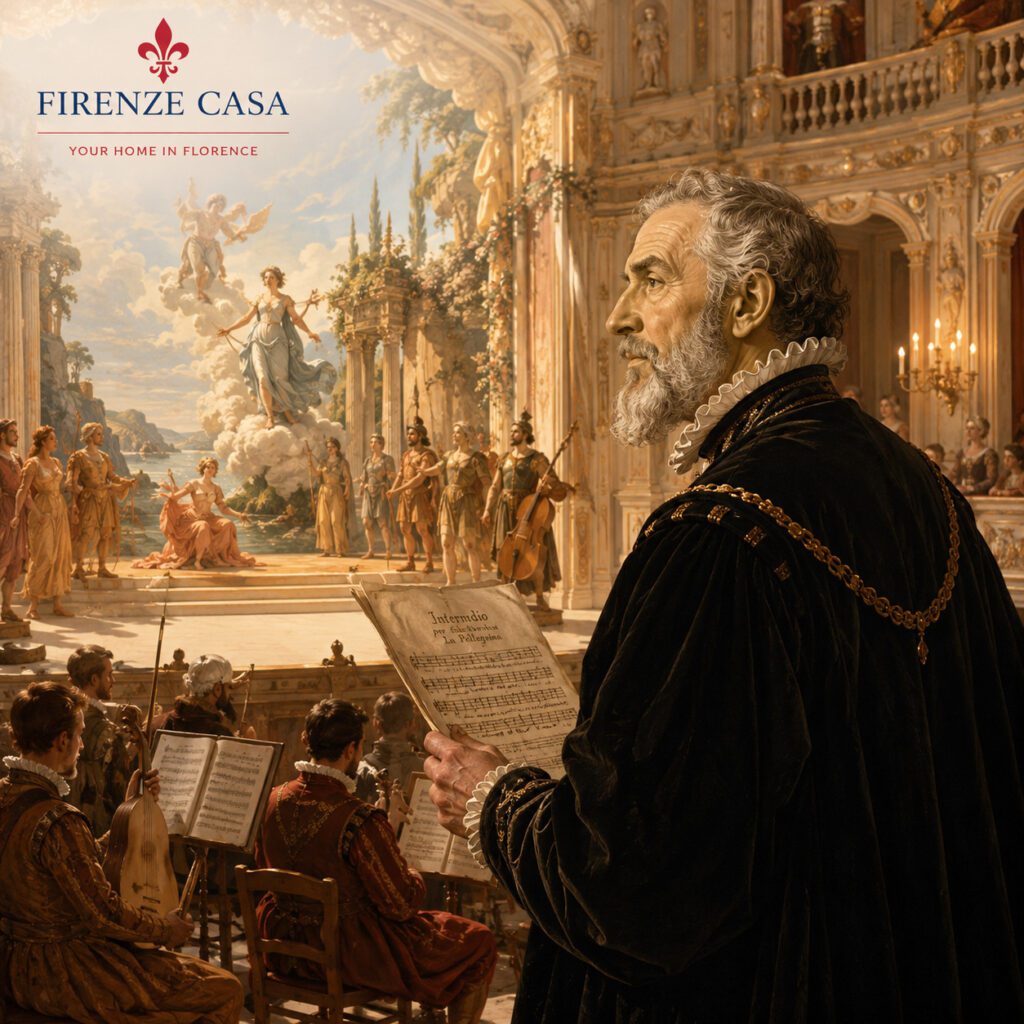
Emilio de’ Cavalieri occupies a fascinating place in the musical history of Florence. Composer, performer, diplomat and theatrical organiser, he became an important figure at the Medici court during the years when musicians were experimenting with new ways to unite words, drama and music.
His name is less familiar today than those of Jacopo Peri or Giulio Caccini, yet Cavalieri belonged to the same extraordinary cultural world that transformed musical theatre around 1600. His career demonstrates especially clearly that opera did not emerge through one inventor but through overlapping networks of composers, poets, scholars, patrons and theatrical organisers. His story forms an essential part of our Florence and the Birth of Opera guide.
Born: around 1550, Rome
Career: composer, performer, administrator and theatrical organiser
Florentine patronage: Medici court under Ferdinando I de’ Medici
Major Florentine context: the spectacular intermedi of 1589
Major work: Rappresentatione di Anima et di Corpo, Rome, 1600
Why he matters: an important pioneer in the development of expressive musical drama at the threshold of opera and oratorio
Who Was Emilio de’ Cavalieri?
Emilio de’ Cavalieri was born in Rome around 1550 into a well-connected family. His father, Tommaso de’ Cavalieri, belonged to Rome’s cultivated elite and is remembered for his close friendship with Michelangelo.
Emilio developed considerable abilities as a musician and composer, but his career extended far beyond composition. He understood theatrical production, administration and the elaborate organisation required for court entertainment.
These abilities eventually brought him into the orbit of the Medici. In the late 1580s, Grand Duke Ferdinando I de’ Medici brought Cavalieri to Florence, where he entered one of Europe’s most sophisticated court cultures at a crucial moment in musical history.
Emilio de’ Cavalieri was much more than a composer. At the Medici court, he combined music with theatrical organisation and administration – skills essential to the spectacular court productions of late Renaissance Florence.
Emilio de’ Cavalieri in Medici Florence
Florence during the final decades of the sixteenth century offered Cavalieri an exceptional environment for experimentation.
The Medici family invested heavily in art, architecture, music and elaborate court celebrations. Weddings and diplomatic occasions became opportunities to demonstrate political prestige through spectacular performances.
Cavalieri became deeply involved in this world and worked with performers, composers and theatrical specialists. His responsibilities placed him precisely where music, spectacle and court politics intersected.
The surviving architecture of Palazzo Pitti still evokes the grand-ducal environment in which music and theatrical display became important expressions of Medici power.
The Medici Wedding of 1589
In 1589, Florence celebrated the marriage of Grand Duke Ferdinando I de’ Medici and Christine of Lorraine. The festivities became one of the most spectacular artistic events of late Renaissance Florence.
The comedy La pellegrina formed part of the celebrations. Between its acts, audiences watched and heard elaborate musical interludes known as intermedi.
These were far more than simple musical breaks. Singers, instrumentalists, poetry, costumes, stage machinery, scenery and dramatic action combined within extraordinarily ambitious spectacles.
Cavalieri participated in the organisation and music of these celebrations alongside other leading Florentine musicians.
The Florentine intermedi were not operas. However, their combination of music, drama, scenery and stage effects provided an important theatrical laboratory for the musical experiments that followed.
Why the Intermedi Matter
Florentine court entertainment had combined music and theatrical spectacle before 1589, but these productions reached an extraordinary level of sophistication.
They also brought together many of the people involved in Florence’s musical experiments. Composers and performers could observe how music affected dramatic action, while stage designers explored ways to transform theatrical spaces.
The result created fertile ground for a more ambitious idea: a drama in which music would no longer appear only between acts but become part of the continuous dramatic structure.
A New Relationship Between Words and Music
One of the central musical questions of late Renaissance Florence concerned the intelligibility of words. Complex polyphonic music could be extraordinarily beautiful, but several simultaneous vocal lines sometimes made individual texts difficult to understand.
Musicians searching for stronger dramatic expression began exploring alternatives. A solo singer supported by relatively simple instrumental accompaniment could communicate words more directly and respond to their emotional meaning.
Cavalieri participated actively in this changing musical world and contributed to the broader movement towards expressive solo singing.
Cavalieri and the Development of Monody
The new solo style that emerged around this period became closely associated with monody.
Instead of several independent voices carrying equal musical importance, a single singer delivered the text while instruments provided harmonic support. This apparently simple change had profound dramatic consequences.
A singer could now portray an individual character, while musical gestures responded directly to particular words and emotions. Such techniques became essential to early opera.
Cavalieri explored this changing language alongside musicians including Giulio Caccini and Jacopo Peri.
Was Cavalieri a Member of the Florentine Camerata?
Cavalieri is often discussed alongside the Florentine Camerata because their musical ideas developed within closely related circles. The relationship, however, requires some precision.
The Camerata associated with Count Giovanni de’ Bardi brought together scholars and musicians interested in ancient Greek music and drama. Vincenzo Galilei and Giulio Caccini became particularly important participants in that intellectual environment.
Cavalieri’s role developed primarily through the Medici court and theatrical production. These circles overlapped intellectually and artistically, but they should not be treated as one single organised group.
The birth of opera was not the project of one formal group. The Florentine Camerata, Medici court musicians, poets, singers and theatrical organisers belonged to overlapping networks that exchanged ideas and experimented with new forms.
Cavalieri, Peri and Caccini
The relationship between Emilio de’ Cavalieri, Jacopo Peri and Giulio Caccini reveals how competitive Florence’s musical environment could become.
All three explored new approaches to solo singing and dramatic expression. Each also had reason to defend his own contribution to musical innovation.
Questions of priority therefore became important: who first developed a particular vocal technique, who created the earliest convincing dramatic monody and who deserved recognition for the emerging musical style?
These disputes remind us that opera’s development was not a simple collaborative project. Artistic ambition and court politics accompanied experimentation.
The First Operas in Florence
During the 1590s, Florence moved closer to what we now recognise as opera.
Jacopo Peri and the poet Ottavio Rinuccini created Dafne, generally regarded as the earliest opera although most of its music has disappeared.
The decisive surviving milestone followed in 1600 when Peri’s Euridice, again with a text by Rinuccini, was performed in Florence during celebrations surrounding the marriage of Maria de’ Medici and Henry IV of France.
Giulio Caccini also created a setting of Euridice. By then, Florentine musical drama had entered a new phase.
Cavalieri Leaves Florence
Cavalieri’s relationship with the Florentine court eventually became more difficult. Competition among musicians and changing court relationships contributed to tensions, and by the end of the 1590s he had returned to Rome.
His years in Florence nevertheless remained crucial to his artistic development.
In Rome, he produced the work for which he is now best remembered: Rappresentatione di Anima et di Corpo.
Rappresentatione di Anima et di Corpo
Rappresentatione di Anima et di Corpo – “Representation of Soul and Body” – was performed in Rome in February 1600.
The work presents an allegorical drama in which personified figures such as Soul, Body, Pleasure and Time confront moral and spiritual choices. Music accompanies the dramatic action through expressive solo singing, dialogue and instrumental support.
Its subject differs significantly from the mythological dramas associated with Peri and Caccini. Rather than telling a classical love story, Cavalieri created a spiritual allegory.
Was Rappresentatione the First Opera?
The answer depends largely on how opera is defined.
Rappresentatione di Anima et di Corpo contains many characteristics associated with early opera, including dramatic characters, extensive musical continuity and expressive solo singing. However, scholars also regard it as an important precursor of the oratorio because of its religious and allegorical subject.
Calling it simply “the first opera” therefore creates more problems than it solves. Dafne predates it, while Peri’s Euridice provides the earliest substantially surviving example generally classified as opera.
Cavalieri’s work is especially valuable because it demonstrates how fluid the boundaries between emerging musical genres remained around 1600.
Cavalieri’s Rappresentatione di Anima et di Corpo stands between categories that later became more clearly separated. That ambiguity makes the work particularly revealing for understanding musical theatre around 1600.
Florence and Rome – Two Centres of Innovation
Cavalieri’s career connects two cities central to Italian cultural history.
Rome gave him his origins and eventually the setting for his most famous work. Florence provided the court environment in which he participated directly in some of the period’s most important theatrical experiments.
The exchange between the cities mattered. Musicians, artists and patrons travelled frequently, and ideas did not remain confined within individual courts.
Opera itself would soon demonstrate this mobility as the new genre spread from Florence to Mantua, Rome, Venice and eventually across Europe.
The Importance of Dance and Stagecraft
Another aspect distinguishes Cavalieri from several other figures in Florence’s early operatic world: dance and theatrical organisation played particularly important roles in his thinking.
Court spectacle relied on movement as well as music, poetry and scenery. Choreographed action could communicate hierarchy, allegory and dramatic meaning.
Cavalieri understood this wider theatrical vocabulary, reminding us that early opera did not emerge solely from composers writing scores. It developed from a living performance culture involving singers, dancers, costumes, spaces, instruments, technicians and elaborate visual effects.
The Medici Court as a Musical Laboratory
Florence’s role in the birth of opera cannot be separated from Medici patronage.
Large court celebrations required substantial resources. Musicians needed performers, rehearsal spaces and instruments, while stage designers required craftsmen, materials and sophisticated machinery.
The Medici could provide these resources, while artistic innovation simultaneously served political purposes by displaying wealth, refinement and cultural authority to visiting diplomats and aristocrats.
Within this environment, Cavalieri could combine his talents as musician, administrator and theatrical organiser.
Opera Was a Collective Florentine Achievement
Looking at Cavalieri alongside the other pioneers reveals one of the most important lessons in the history of opera: no single person invented it.
Vincenzo Galilei questioned established musical theories and explored the expressive potential of solo song. Giulio Caccini developed new vocal techniques, while Jacopo Peri composed the earliest works generally recognised as opera. Poet Ottavio Rinuccini provided texts capable of sustaining the new dramatic form.
Cavalieri contributed another essential dimension: practical expertise in musical theatre, court spectacle and expressive performance.
Together, these overlapping experiments produced something unprecedented.
From Court Entertainment to Permanent Theatres
The earliest operatic experiments took place within relatively exclusive environments. Medici celebrations were designed for courts, aristocrats and invited guests rather than a broad paying public.
During the seventeenth century, this gradually changed as permanent theatres and public opera houses developed. Florence’s later theatrical landscape is explored in our Theatres and Opera Houses in Florence – Complete Guide.
The Teatro della Pergola, founded in the seventeenth century, belongs to this next chapter. It represents the transformation from temporary court spectacle into an established theatrical culture with permanent architectural spaces.
Cavalieri worked in a world of court celebrations and temporary theatrical spectacle. Within a few generations, opera had acquired permanent theatres and increasingly public audiences.
Why Emilio de’ Cavalieri Matters
Cavalieri matters because his career shows how complicated the birth of opera really was.
He moved between composition, performance, administration and theatrical organisation. His work connected Florentine court spectacle with experiments in expressive solo singing, while Rappresentatione di Anima et di Corpo demonstrated how related musical innovations could sustain an extended dramatic work in Rome.
His career also challenges the temptation to search for one inventor of opera. Instead, we find interconnected musicians pursuing similar questions, sometimes collaborating and sometimes competing for recognition.
Emilio de’ Cavalieri and Florence Today
Cavalieri left fewer obvious traces in Florence than artists whose paintings, sculptures and buildings still dominate the historic centre.
Music is more ephemeral, but the spaces of Medici Florence help visitors imagine the world in which these experiments occurred. Palazzo Pitti and the city’s surviving Renaissance architecture provide the physical setting for a culture that treated artistic spectacle as an expression of power.
The later Teatro della Pergola belongs to another generation, yet Florence’s continuing theatrical tradition reflects the remarkable musical history that preceded it.
Florence’s musical history is easy to overlook because sound leaves no permanent monument. Yet behind many Renaissance palaces lies a history of performances, rehearsals and experiments that changed European music forever.
Emilio de’ Cavalieri – A Pioneer at the Edge of Opera
Emilio de’ Cavalieri stands at one of the most fascinating turning points in European musical history. He arrived in Florence when musicians were questioning how words, music and drama should interact, and the Medici court gave him opportunities to participate in spectacular theatrical productions.
His later Rappresentatione di Anima et di Corpo carried many of these ideas to Rome and demonstrated the dramatic possibilities of continuous musical storytelling.
Cavalieri did not invent opera alone, nor can one work provide a simple starting date for the genre. His importance lies precisely in that complexity.
Together with Peri, Caccini, Galilei and other musicians around Florence, he belonged to the generation that transformed Renaissance musical experimentation into a new theatrical language that would soon become opera.
Frequently Asked Questions
Who was Emilio de’ Cavalieri?
Emilio de’ Cavalieri was a Roman-born composer, performer and theatrical organiser who became an important figure at the Medici court during the formative years of early opera.
Was Cavalieri a member of the Florentine Camerata?
Not in the same sense as figures such as Vincenzo Galilei. His work developed primarily through the Medici court, although the intellectual and musical circles overlapped.
What was Cavalieri’s role in the 1589 Medici wedding?
He contributed to the musical and theatrical organisation surrounding the famous intermedi for La pellegrina, one of the most spectacular court productions of late Renaissance Florence.
What is Rappresentatione di Anima et di Corpo?
It is Cavalieri’s most famous work, performed in Rome in 1600. Its combination of allegorical drama, solo singing and continuous music places it at the boundary between early opera and the developing oratorio tradition.
Did Emilio de’ Cavalieri invent opera?
No. Opera emerged through overlapping experiments by several Florentine and Italian musicians, poets and patrons rather than through one inventor.
What is Cavalieri’s connection with the Medici?
Ferdinando I de’ Medici brought him to Florence, where Cavalieri became involved in court music, administration and theatrical productions.
Where can I explore Florence’s opera history today?
Medici sites such as Palazzo Pitti provide context for the court culture in which early opera developed, while Teatro della Pergola represents a later stage in the evolution of permanent theatre in Florence.
Further Reading on Firenze Casa
- Florence and the Birth of Opera
- Jacopo Peri – The Florentine Composer Who Helped Invent Opera
- Giulio Caccini – Music and the Birth of Opera in Florence
- Vincenzo Galilei – Music, Florence and the Father of Galileo
- The Medici Family – The Dynasty That Shaped Florence
- Palazzo Pitti: History, Architecture & Museums
- Theatres and Opera Houses in Florence – Complete Guide
- Teatro della Pergola – Florence’s Historic Theatre and Hidden Stage
References
- Oxford Music Online – Emilio de’ Cavalieri.
- New Grove Dictionary of Music and Musicians – Emilio de’ Cavalieri.
- Emilio de’ Cavalieri – Rappresentatione di Anima et di Corpo.
- Claude V. Palisca – The Florentine Camerata: Documentary Studies and Translations.
- Claude V. Palisca – Humanism in Italian Renaissance Musical Thought.
- Tim Carter – studies on music in late Renaissance and early Baroque Italy.
- Nino Pirrotta and Elena Povoledo – Music and Theatre from Poliziano to Monteverdi.
- Howard Mayer Brown – studies on the music of the Florentine intermedi.

