
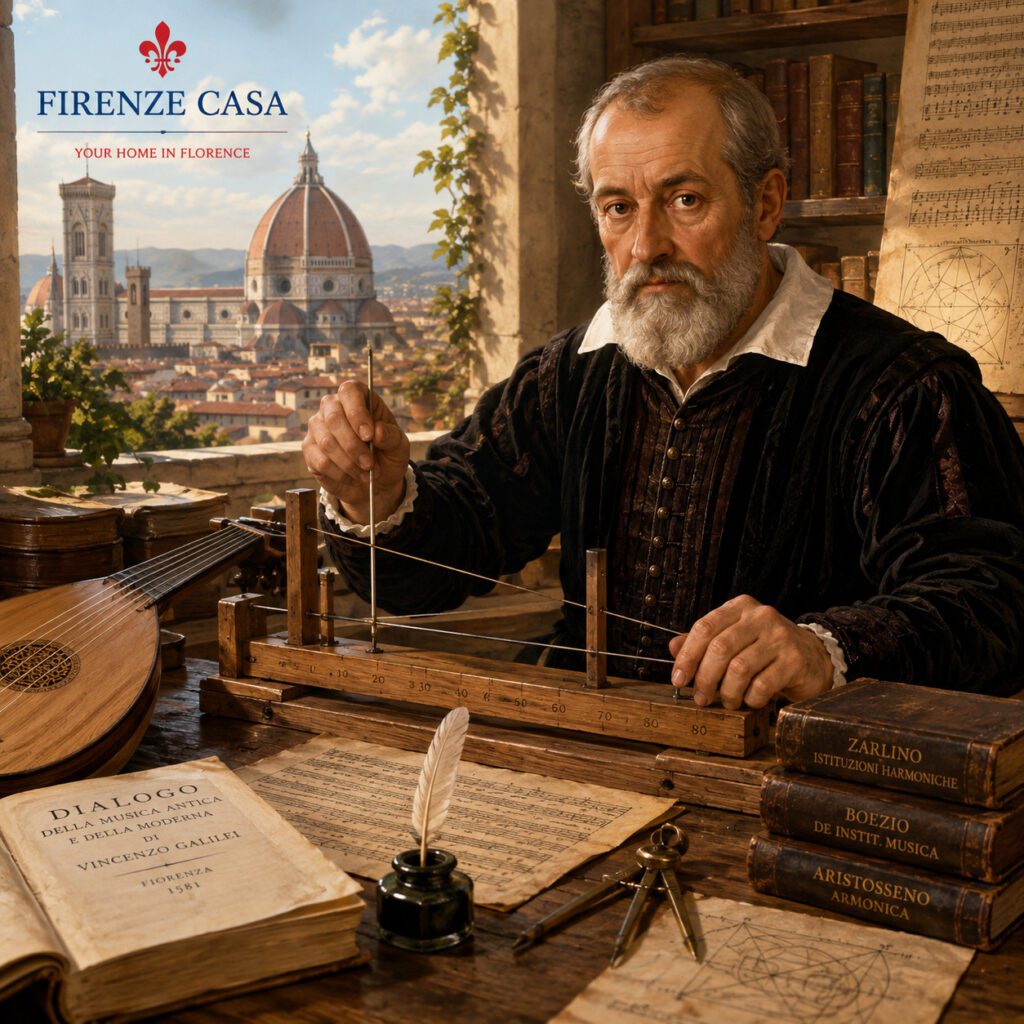
Vincenzo Galilei is often introduced simply as the father of Galileo Galilei. Yet in late Renaissance Florence, he built an important reputation of his own. As a musician, composer and theorist, he challenged established ideas and participated in the intellectual movement that helped prepare the way for opera.
His work belonged to a remarkable Florentine search for a more expressive relationship between words and music. Together with scholars and musicians associated with the Florentine Camerata, Galilei looked back to ancient Greece while questioning some of the dominant musical traditions of his own age. His ideas form an important part of the story explored in our Florence and the Birth of Opera guide.
Born: around 1520, Santa Maria a Monte, Tuscany
Died: 1591, Florence
Profession: lutenist, composer and music theorist
Key circle: Florentine Camerata
Important work: Dialogo della musica antica et della moderna, 1581
Family: father of Galileo Galilei
Why he matters: his ideas about words, music and monody helped prepare the intellectual foundations of early opera
Who Was Vincenzo Galilei?
Vincenzo Galilei was born around 1520 in Santa Maria a Monte, a Tuscan town between Florence and Pisa. He later established himself in Florence, where he became part of the city’s sophisticated musical and intellectual culture.
Galilei was an accomplished lute player, composer and theorist. His interests extended beyond performance to fundamental questions about harmony, tuning, musical expression and the relationship between words and sound.
During his career, he studied with the influential theorist Gioseffo Zarlino in Venice but eventually challenged several ideas associated with established musical theory. This willingness to question authority became one of the defining characteristics of his work.
Vincenzo Galilei was an important musical thinker in his own right. His famous son Galileo grew up in a household where established theories could be questioned through observation, reasoning and experiment.
Vincenzo Galilei in Renaissance Florence
Florence provided an ideal environment for Galilei’s intellectual curiosity. During the second half of the sixteenth century, the city remained deeply influenced by Renaissance humanism and its fascination with classical antiquity.
Scholars studied Greek and Roman literature, philosophy and art. Musicians joined this broader intellectual movement by asking what ancient music might have sounded like and how it had functioned within Greek drama.
Because ancient musical practice had left relatively little direct evidence, these questions encouraged experimentation. Rather than simply following existing traditions, Florentine thinkers tried to reconstruct principles they believed had given ancient drama its emotional power.
Galilei became one of the most important voices in this debate, within the wider cultural environment supported by the Medici family.
The Florentine Camerata
Galilei is closely associated with the intellectual circle now known as the Florentine Camerata or Camerata de’ Bardi.
The group gathered around Count Giovanni de’ Bardi, a Florentine nobleman with strong interests in poetry, music and classical culture. Musicians, poets and scholars met to discuss the arts and the legacy of antiquity.
Giulio Caccini belonged to this musical environment, while the scholar Girolamo Mei strongly influenced its ideas through his research into ancient Greek music. Jacopo Peri later worked within the broader Florentine culture that developed from these experiments.
The Camerata did not simply set out to “invent opera.” Its members explored broader questions about music, poetry and dramatic expression. Nevertheless, their ideas created some of the intellectual foundations on which the first operas would soon develop.
The Florentine Camerata did not begin with a plan to create modern opera. Its members investigated ancient drama and the expressive power of music; opera emerged from the experiments that followed.
Why Galilei Challenged Renaissance Polyphony
Renaissance composers had developed polyphonic music to extraordinary levels of complexity. Several independent vocal lines could weave together into sophisticated musical structures.
Galilei questioned whether this complexity always served the meaning of a text. When several voices sang different words or phrases simultaneously, listeners could struggle to understand the poetry.
He increasingly favoured an approach in which a single melodic line could communicate text clearly while instrumental accompaniment provided harmonic support. This emphasis on words, emotion and the individual voice became crucial to the development of monody and early opera.
Music and the Power of the Individual Voice
The emphasis on a single voice represented more than a technical change. It shifted attention towards the individual character and the emotions contained in the words.
A singer could alter rhythm, intensity and melodic expression according to the meaning of a text, bringing music closer to dramatic speech. For theatre, this offered enormous possibilities.
Peri and Caccini would later transform these principles into the musical language of Florence’s earliest operas.
Girolamo Mei and Ancient Greek Music
One of the most important intellectual influences on Vincenzo Galilei came from Girolamo Mei, a Florentine scholar who studied ancient Greek writings about music.
Mei corresponded extensively with Galilei and argued that Greek drama had probably relied heavily on a single melodic line rather than the complex polyphony common in Renaissance music.
Their correspondence helped convince Galilei that monodic singing might possess greater emotional force because listeners could follow both the words and their musical expression clearly. Ancient Greece thus became an inspiration for musical innovation in Renaissance Florence.
Dialogo della musica antica et della moderna
Galilei presented many of his most important ideas in Dialogo della musica antica et della moderna, published in Florence in 1581.
The title translates as “Dialogue on Ancient and Modern Music” and captures the central question occupying Galilei and his intellectual circle: what could contemporary musicians learn from antiquity?
In the work, Galilei criticised aspects of contemporary musical practice and explored the expressive advantages he associated with ancient music. His argument went beyond historical curiosity; he wanted to change the way musicians composed and performed.
The musicians who helped create something radically new were trying to recover something extremely old. Their fascination with ancient Greek drama ultimately contributed to the birth of a completely new European art form.
Vincenzo Galilei as an Experimental Thinker
One of the most intriguing aspects of Galilei’s work concerns his experiments with sound. Rather than relying entirely on inherited theoretical rules, he investigated how changes in physical conditions affected musical pitch and consonance.
Strings provided an especially useful tool. By altering factors such as length, tension and material, Galilei could compare the sounds they produced and place practical observation alongside mathematical theory.
His investigations should not simply be equated with modern experimental science, but they reveal a significant willingness to test established claims against physical experience.
The Father of Galileo Galilei
Vincenzo’s most famous child, Galileo Galilei, was born in Pisa in 1564. The family later moved to Florence, and the young Galileo grew up within an environment shaped by his father’s music and intellectual interests.
It would be too simple to claim that Vincenzo directly taught Galileo the scientific method. Nevertheless, the similarities between their intellectual attitudes are striking. Both questioned respected authorities and showed interest in the relationship between mathematical theory and observable physical phenomena.
This connection makes Vincenzo’s story especially interesting beyond music. Visitors who want to explore the scientific world associated with his son can also discover Galileo and Florence’s wider scientific heritage through our Florence Museums: The Complete Guide, which includes the Museo Galileo.
Galileo became one of the great figures in the history of science. Yet the intellectual atmosphere of his childhood included a father who was already challenging established theories through musical investigation and experiment.
Was Vincenzo Galilei an Opera Composer?
Galilei’s importance to opera requires a careful distinction. He was not one of the composers responsible for the earliest complete operas in the way Jacopo Peri was, nor should he be described as the individual inventor of opera.
His contribution came earlier and at a more fundamental level. Galilei helped challenge the musical assumptions of his age, while his arguments about expressive solo singing, clear text and ancient Greek drama contributed to an intellectual climate in which a new type of musical theatre could emerge.
He helped prepare the ground on which others built.
From Galilei to Jacopo Peri
Galilei died in Florence in 1591. The decisive experiments that produced the earliest operas followed during the next decade.
Jacopo Peri and the poet Ottavio Rinuccini created Dafne during the 1590s, generally regarded as the earliest opera although most of its score has disappeared. In 1600, Peri’s Euridice was performed during the celebrations surrounding the marriage of Maria de’ Medici and King Henry IV of France.
Giulio Caccini developed his own operatic and vocal works during the same formative period. Galilei therefore did not live to witness the full consequences of the musical transformation he had helped encourage.
From Renaissance Music to Opera
The emergence of opera involved several developments rather than one sudden invention. Florentine court spectacles already combined music, poetry, costumes and elaborate scenery, while the famous intermedi demonstrated the spectacular possibilities of theatrical music.
Humanist scholarship contributed an intense fascination with Greek drama. Meanwhile, composers experimented with expressive solo singing and increasingly direct relationships between words and music.
These traditions eventually converged. By around 1600, Florence had produced a form of continuous musical drama that we can recognise as early opera, and Vincenzo Galilei belonged to the intellectual generation that made this convergence possible.
The Galilei Family and Music
Music remained important within the Galilei family beyond Vincenzo himself. His son Michelagnolo Galilei became a professional lutenist and composer and continued the family’s strong connection with the instrument Vincenzo had mastered.
Galileo also possessed musical knowledge and played the lute. The family therefore occupied an unusual intersection between music, mathematics and natural philosophy.
Today, the Galilei name immediately evokes telescopes and astronomy. In late Renaissance Florence, however, it could just as easily have suggested music.
Vincenzo Galilei’s Florence
Galilei lived in a city where artistic and intellectual worlds constantly overlapped. Musicians interacted with poets and scholars, aristocratic patrons created private spaces for discussion, and the Medici court supported elaborate performances and cultural experimentation.
Unlike paintings or buildings, musical debates leave few obvious monuments in the streets. Yet Florence’s palaces and historic centre still provide the physical setting for this extraordinary intellectual world.
The later development of permanent performance spaces can be explored in our Theatres and Opera Houses in Florence – Complete Guide. These theatres belong to a later period, but they show how the musical theatre prepared by Galilei’s generation eventually became an established part of Florentine cultural life.
Florence’s musical revolution is largely invisible today. The palaces and streets survive, but the discussions, experiments and performances have disappeared. Knowing their stories adds an entirely different layer to exploring the Renaissance city.
Why Vincenzo Galilei Matters
The importance of Vincenzo Galilei lies in his willingness to question how music should work. He challenged aspects of established theory and criticised musical complexity when it weakened the expressive force of words.
His experiments with sound reveal another dimension of his intellectual character: observation mattered alongside inherited theory. These qualities connect Galilei with two remarkable transformations associated with his family and Florence.
His musical ideas helped prepare the environment from which opera emerged. A generation later, his son would become one of the central figures in the transformation of European science.
Vincenzo Galilei and Florence’s Musical Revolution
Vincenzo Galilei never became famous in the way his son did, nor did he compose the first surviving opera. Yet history often depends on people who change the questions before others provide the answers.
Galilei asked whether complex musical traditions truly served poetry and human emotion. He questioned whether established theories accurately described the physical behaviour of sound and joined a Florentine intellectual culture willing to challenge convention.
Within a few years of his death, Jacopo Peri, Giulio Caccini and their contemporaries began creating the first operas. Behind that extraordinary cultural revolution stood the ideas of musicians and thinkers such as Vincenzo Galilei – the father of Galileo, but also one of Renaissance Florence’s most fascinating musical innovators.
Frequently Asked Questions
Who was Vincenzo Galilei?
Vincenzo Galilei was a Renaissance lutenist, composer and music theorist closely associated with the Florentine Camerata. He was also the father of Galileo Galilei.
What did Vincenzo Galilei contribute to opera?
He did not compose the earliest operas himself, but his ideas about clear text, solo singing and dramatic expression helped create the intellectual foundations from which opera emerged.
Was Vincenzo Galilei a member of the Florentine Camerata?
Yes. He was closely associated with the Camerata de’ Bardi and became one of its most important musical thinkers.
What was Dialogo della musica antica et della moderna?
Published in Florence in 1581, it was Galilei’s influential discussion of ancient and contemporary music and his criticism of aspects of Renaissance musical practice.
How did Vincenzo Galilei influence Galileo?
A direct line to Galileo’s later scientific method cannot be proved, but Vincenzo created a household in which observation, experiment and the questioning of established theories were clearly valued.
Did Vincenzo Galilei live to see the first operas?
No. He died in Florence in 1591, shortly before Jacopo Peri and other Florentine musicians began creating the works generally recognised as the earliest operas.
Further Reading on Firenze Casa
- Florence and the Birth of Opera
- Giulio Caccini – Music and the Birth of Opera in Florence
- Jacopo Peri – The Florentine Composer Who Helped Invent Opera
- Francesca Caccini – Florence’s Pioneering Female Composer
- The Medici Family – The Dynasty That Shaped Florence
- Florence Museums: The Complete Guide
- Theatres and Opera Houses in Florence – Complete Guide
- Emilio de’ Cavalieri – Florence and the Origins of Opera
References
- Encyclopaedia Britannica – Vincenzo Galilei.
- Oxford Music Online – Vincenzo Galilei.
- New Grove Dictionary of Music and Musicians – Vincenzo Galilei.
- Vincenzo Galilei – Dialogo della musica antica et della moderna.
- Claude V. Palisca – The Florentine Camerata: Documentary Studies and Translations.
- Claude V. Palisca – Humanism in Italian Renaissance Musical Thought.
- Dava Sobel – Galileo’s Daughter.
- Stillman Drake – Galileo at Work: His Scientific Biography.
- Tim Carter – studies on music in late Renaissance and early Baroque Italy.

