
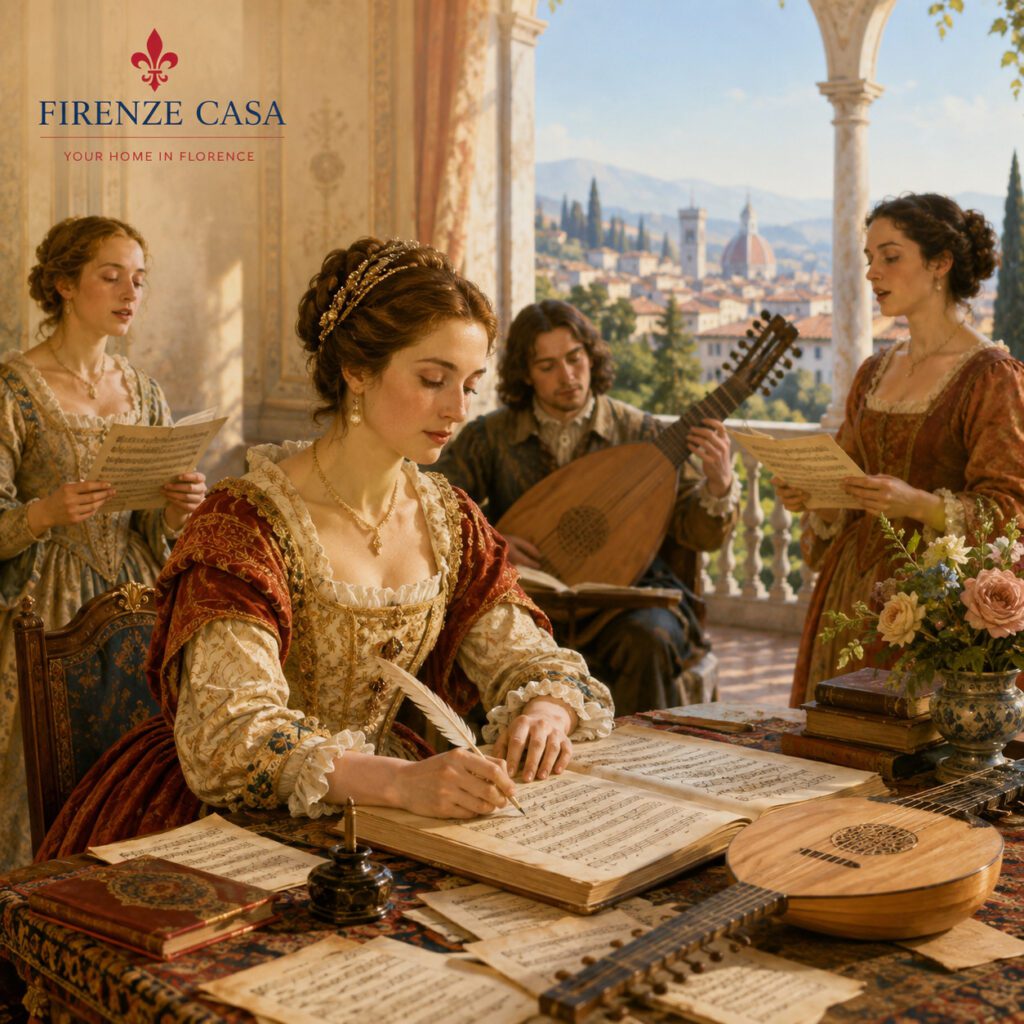
Francesca Caccini was one of the most remarkable musicians of early seventeenth-century Florence. Born into a family closely connected with the birth of opera, she became a celebrated singer, composer, instrumentalist and teacher at the Medici court.
Her career was exceptional not simply because she succeeded as a female composer in a musical world dominated by men. Francesca belonged to the generation that transformed the experimental musical theatre of her father’s time into an increasingly sophisticated dramatic art. Her story is therefore an essential continuation of our Florence and the Birth of Opera guide.
Born: 18 September 1587, Florence
Profession: singer, composer, instrumentalist and teacher
Family: daughter of Giulio Caccini
Patronage: Medici court
Important publication: Il primo libro delle musiche, 1618
Major stage work: La liberazione di Ruggiero dall’isola d’Alcina, 1625
Why she matters: composer of the earliest surviving opera generally attributed to a woman
Who Was Francesca Caccini?
Francesca Caccini was born in Florence on 18 September 1587 into an unusually musical family. Her father, Giulio Caccini, was a singer, composer and influential advocate of the expressive solo style that helped shape early opera.
Her mother, Lucia Gagnolanti, also sang professionally. Francesca therefore grew up inside one of the most innovative musical environments in Europe rather than encountering it later as an outsider.
She received an unusually broad education for a woman of her period, studying literature and languages alongside singing, composition and instrumental performance. These skills prepared her for a professional career that eventually made her one of the most important musicians at the Medici court.
Francesca was born while Florentine musicians were still developing the ideas that led to opera. She therefore grew up inside the musical revolution rather than after it.
Growing Up in the Caccini Family
The Caccini household stood at the centre of Florentine musical life. Giulio Caccini worked for the Medici and maintained close connections with singers, poets and musicians associated with the emerging new style.
From a young age, Francesca performed with members of her family in an ensemble often known as Le donne di Giulio Romano, a reference to her father’s Roman origins. Her younger sister Settimia also developed into an accomplished singer and composer.
For Francesca, family life and professional musical training were therefore inseparable. She learned not only how to perform but also how music functioned within the complex social world of an early Baroque court.
Francesca Caccini and the Medici Court
In 1607, Francesca formally entered the service of the Medici family. Court musicians occupied an important position within the cultural machinery of the dynasty, providing music for private entertainment, religious occasions, theatrical productions and diplomatic celebrations.
Francesca sang, composed and taught music. Her talents earned considerable recognition, and during part of her career she ranked among the highly paid musicians employed by the court.
This professional success distinguishes her from the stereotype of the gifted female amateur. Francesca built a genuine career and earned her livelihood through musical expertise.
Francesca Caccini was not simply a woman who composed music privately. She built a professional career within one of Europe’s most sophisticated courts as a performer, teacher and composer.
A Woman in Medici Florence
Francesca’s career developed within a society that imposed substantial restrictions on women’s public and professional lives. Her success therefore depended on exceptional talent, education, family connections and the opportunities created by the Medici court.
Women of the ruling family also played an important role in Florentine patronage. Christine of Lorraine and later Maria Maddalena of Austria supported music, theatre and court culture, helping create environments in which accomplished women could participate at unusually high levels.
Francesca operated skilfully within this world and developed a reputation extending beyond Florence.
From Singer to Composer
Francesca first gained considerable attention as a singer. Contemporary court culture placed great value on expressive vocal performance, particularly because the new Florentine style emphasised the ability of a single voice to communicate emotion.
This was precisely the musical tradition championed by her father. Francesca, however, moved far beyond performance and wrote music for court entertainments, sacred and secular occasions and theatrical productions.
Much of her output has unfortunately been lost. The works that survive nevertheless reveal a sophisticated understanding of the relationship between text and music.
Il primo libro delle musiche
In 1618, Francesca published Il primo libro delle musiche, an important collection of sacred and secular vocal works.
The volume demonstrates the breadth of her compositional abilities and provides valuable evidence of the musical culture surrounding the Florentine court. Publishing music under her own name also strengthened her public standing as a composer rather than merely a performer.
Her works show close attention to the emotional meaning of words, continuing the Florentine emphasis on expressive text-setting that had helped give rise to opera.
Florence After the Birth of Opera
When Francesca began her professional career, opera was still extraordinarily young. Florence had already witnessed Jacopo Peri’s Dafne during the 1590s and his Euridice in 1600, while Giulio Caccini created his own setting of Euridice during the same formative period.
Francesca inherited this musical revolution. Her generation no longer needed to prove that composers could sustain drama through song. Instead, they could explore how the new form might develop artistically.
Giulio Caccini belonged to the generation that helped create the musical language of early opera. Francesca belonged to the generation that transformed those experiments into increasingly sophisticated theatrical works.
La liberazione di Ruggiero
The work that secured Francesca Caccini a lasting place in opera history was La liberazione di Ruggiero dall’isola d’Alcina.
The Medici court presented the work at the Villa del Poggio Imperiale in 1625, with a libretto by Ferdinando Saracinelli. Its story draws on characters associated with Ludovico Ariosto’s Orlando Furioso.
At the centre of the drama is the knight Ruggiero, who has fallen under the spell of the enchantress Alcina. The sorceress Melissa intervenes and attempts to free him from Alcina’s magical world.
The subject allowed Caccini to combine music with transformation, magic and theatrical spectacle – themes ideally suited to the sophisticated entertainment culture of the Medici court.
The Earliest Surviving Opera by a Woman
Music historians generally describe La liberazione di Ruggiero as the earliest surviving opera composed by a woman.
That distinction gives the work enormous historical significance, but concentrating solely on the composer’s gender risks overlooking its artistic importance. Caccini uses contrasting musical styles to distinguish dramatic worlds and characters, combining vocal writing, instrumental passages and ensemble scenes within a sophisticated theatrical structure.
By 1625, opera was no longer merely an intellectual experiment inspired by theories about ancient Greece. In only a quarter of a century, Florentine composers had transformed it into a flexible dramatic form capable of portraying magic, conflict and individual psychology.
A Performance at Poggio Imperiale
The setting of the premiere adds another fascinating Florentine dimension to the story. Villa del Poggio Imperiale stands on the hills south of the historic centre and became an important grand-ducal residence.
In 1625, its courtly environment offered an ideal setting for a production combining music, poetry and theatrical spectacle. Public opera houses had not yet created the commercial operatic world that later flourished in Venice and elsewhere.
Caccini’s work still belonged to the elite political and diplomatic environment of the court, where opera remained closely connected with dynastic representation.
Villa del Poggio Imperiale provides one of the strongest surviving geographical links between modern Florence and Francesca Caccini’s operatic career.
Music, Theatre and Medici Diplomacy
Medici theatrical productions served purposes far beyond entertainment. Dynastic celebrations allowed the ruling family to display wealth, learning and cultural sophistication, while music and theatre became instruments of diplomacy.
La liberazione di Ruggiero accompanied the visit of Prince Władysław Sigismund of Poland, the future King Władysław IV. The work subsequently travelled beyond Florence, with a performance in Warsaw in 1628.
This journey illustrates how court networks helped spread the new Italian art form through Europe long before modern public opera culture emerged.
Francesca Caccini as a Teacher
Teaching formed another important part of Francesca’s professional life. Musical education at court involved more than technical instruction because singing, instrumental performance and musical knowledge were valued aristocratic accomplishments.
Her teaching abilities therefore strengthened her position within the Medici household.
Her multiple roles also remind us that modern distinctions between composer, performer and teacher do not always fit the musical world of the seventeenth century. Successful court musicians frequently moved between all three activities.
Marriage and Family Life
Francesca married the musician Giovanni Battista Signorini in 1607, and the couple had a daughter, Margherita.
After Signorini died, Francesca married Tommaso Raffaelli in 1627 and moved to Lucca for a period. Her second husband died a few years later, after which she returned to Florence and renewed her connection with Medici service.
These changes illustrate how closely a woman’s professional opportunities could depend on marriage, widowhood and family circumstances.
What Happened to Francesca Caccini?
The later years of Francesca’s life are less clearly documented than her remarkable period at the Medici court.
After her return to Florentine service, her name eventually disappears from surviving court records. Historians have not established the precise date and circumstances of her death with certainty.
This incomplete documentary record contrasts sharply with the significance of her surviving music and reflects a broader historical pattern in which prominent women could receive considerable recognition during their lifetimes but far less attention from later generations.
The Rediscovery of Francesca Caccini
Modern scholarship and renewed interest in women composers have restored Francesca Caccini to a more prominent place in European music history.
Performances and recordings of La liberazione di Ruggiero now allow audiences to encounter a work that remained largely outside the standard operatic repertoire for centuries.
Her music also challenges an oversimplified account of early opera as an exclusively male achievement. Women participated in the new musical culture as singers, patrons and teachers, and in Francesca’s exceptional case as an important composer.
Discovering Francesca Caccini’s Florence
Florence still preserves much of the architectural world associated with the Medici dynasty, even though the sounds of its early court music have disappeared.
Palazzo Pitti evokes the scale and splendour of grand-ducal life, while the Boboli Gardens reflect the elaborate court culture in which architecture, landscape and spectacle interacted. Further south, Villa del Poggio Imperiale provides the strongest direct connection with Francesca’s operatic career.
The larger story of how courtly musical entertainment eventually moved into permanent theatrical spaces is explored in our Theatres and Opera Houses in Florence – Complete Guide.
Exploring these places adds another dimension to Florence. The city was not only a centre of Renaissance painting, sculpture and architecture but also one of Europe’s great laboratories of musical innovation.
Florence’s musical history is easy to overlook because music leaves fewer visible monuments than architecture or sculpture. Medici palaces and villas provide the surviving stage on which some of Europe’s most important musical experiments once unfolded.
From Court Opera to Florence’s Theatres
Francesca’s operas belonged to private court culture rather than the later world of public opera houses. That distinction is important because the development of permanent theatres fundamentally changed how audiences experienced musical drama.
The Teatro della Pergola, founded later in the seventeenth century, belongs to this next chapter. Instead of temporary court spaces and villas, opera increasingly acquired purpose-built stages and formal auditoriums.
Seen together, Poggio Imperiale and the Pergola reveal a remarkable transformation: opera moved from a dynastic spectacle for invited guests to an art form with permanent theatrical architecture.
Why Francesca Caccini Matters Today
Francesca Caccini deserves attention for several reasons. She built an accomplished professional career in an age when women faced major restrictions on public life, participated directly in the extraordinary musical culture of Medici Florence and composed one of the landmark surviving works of early opera.
Perhaps the most interesting aspect of her story is its continuity with the wider history of Florence. Her father belonged to the generation that experimented with a new relationship between speech, emotion and music; Francesca absorbed that language from childhood and transformed it into works of her own.
Her career therefore connects two crucial stages in the history of opera: invention and development.
Francesca Caccini and Florence’s Musical Legacy
Francesca Caccini reveals a Florence that visitors do not always encounter. Behind the city’s famous paintings, sculptures and Renaissance palaces existed an equally sophisticated world of singers, composers, poets and theatrical performers.
The Medici court gave these artists an environment in which they could experiment with new forms of expression, and Francesca became one of the most remarkable musicians to emerge from that world.
Her surviving music allows us to encounter the work of a woman who participated directly in the transformation of European musical theatre. More than four centuries after La liberazione di Ruggiero premiered in Florence, her achievement remains extraordinary.
Florence helped give birth to opera. Francesca Caccini ensured that a woman stood among the important composers who shaped its earliest history.
Frequently Asked Questions
Who was Francesca Caccini?
Francesca Caccini was a Florentine singer, composer, instrumentalist and teacher who worked professionally at the Medici court during the early seventeenth century.
Who was Francesca Caccini’s father?
Her father was Giulio Caccini, one of the musicians closely associated with the Florentine experiments that helped create opera around 1600.
What is La liberazione di Ruggiero?
It is Francesca Caccini’s best-known surviving stage work, first performed at Villa del Poggio Imperiale in 1625. It is generally recognised as the earliest surviving opera composed by a woman.
Where was La liberazione di Ruggiero first performed?
The work was presented at Villa del Poggio Imperiale in Florence during a Medici court occasion in 1625.
Was Francesca Caccini only a composer?
No. She was also an accomplished singer, instrumentalist and teacher and built a substantial professional career at the Medici court.
Why is Francesca Caccini important in opera history?
She connects the pioneering generation around 1600 with the more developed court opera of the 1620s and composed the earliest surviving opera generally attributed to a woman.
Where can I explore her Florence today?
Palazzo Pitti and the Medici court sites provide important context, while Villa del Poggio Imperiale is directly connected with the premiere of her most famous surviving opera.
Further Reading on Firenze Casa
- Florence and the Birth of Opera
- Giulio Caccini – Music and the Birth of Opera in Florence
- Jacopo Peri – The Florentine Composer Who Helped Invent Opera
- The Medici Family – The Dynasty That Shaped Florence
- Palazzo Pitti – History, Architecture & Museums
- Theatres and Opera Houses in Florence – Complete Guide
- Teatro della Pergola – Florence’s Historic Theatre and Hidden Stage
- Vincenzo Galilei – Music, Florence and the Father of Galileo
References
- Encyclopaedia Britannica – Francesca Caccini.
- Oxford Music Online – Francesca Caccini.
- New Grove Dictionary of Music and Musicians – Francesca Caccini.
- Cusick, Suzanne G. – Francesca Caccini at the Medici Court: Music and the Circulation of Power.
- Caccini, Francesca – Il primo libro delle musiche.
- Caccini, Francesca – La liberazione di Ruggiero dall’isola d’Alcina.
- Palisca, Claude V. – The Florentine Camerata: Documentary Studies and Translations.
- Carter, Tim – studies on music in late Renaissance and early Baroque Italy.

