
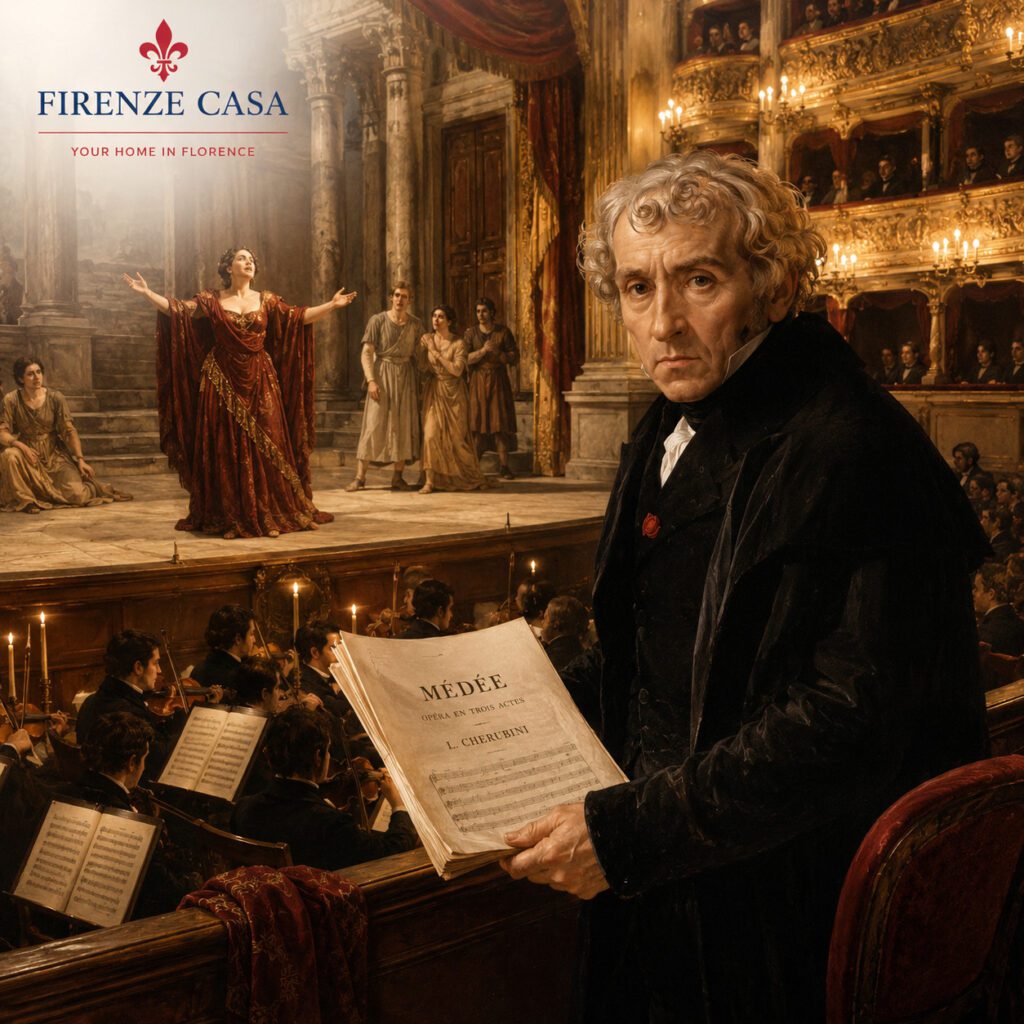
Luigi Cherubini was born in Florence in 1760 and became one of the most respected composers of his generation. His career eventually carried him far beyond Tuscany, especially to Paris, where he achieved international recognition through opera, sacred music and musical education.
Cherubini occupies a fascinating position in Florence’s musical history. More than a century and a half separated his birth from the experiments of Jacopo Peri and Giulio Caccini that had helped create opera in the city. By Cherubini’s lifetime, that Florentine invention had developed into one of Europe’s great theatrical traditions. His story therefore forms an important later chapter in our Florence and the Birth of Opera guide.
Born: 14 September 1760, Florence
Died: 15 March 1842, Paris
Profession: composer and musical educator
Major works: Lodoïska, Médée, Requiem in C minor
Career centre: Paris
Institutional role: Director of the Paris Conservatoire from 1822
Why he matters: a major link between Classical and Romantic musical culture
Who Was Luigi Cherubini?
Maria Luigi Carlo Zenobio Salvatore Cherubini was born in Florence on 14 September 1760. Music surrounded him from childhood.
His father, Bartolomeo Cherubini, worked as a musician and gave his son his earliest instruction. Luigi showed exceptional ability at a young age and soon began studying composition more seriously.
Florence offered a rich musical environment. Churches, theatres, aristocratic households and the grand-ducal court all supported professional musicians and provided opportunities for talented young composers.
Cherubini began composing while still a child in Florence. The city provided the foundation for a career that would eventually make him one of the most respected musicians in Paris.
Growing Up in Musical Florence
The Florence of Cherubini’s childhood differed greatly from the Renaissance city of the first opera pioneers. The Medici dynasty had ended in 1737, and Tuscany was now ruled by the Habsburg-Lorraine family.
Yet Florence retained a deep musical tradition. During the late sixteenth and early seventeenth centuries, figures such as Jacopo Peri, Giulio Caccini and Francesca Caccini had helped shape the earliest history of opera.
By the eighteenth century, that once experimental form had become an established international tradition. Cherubini therefore entered a musical world with deep local roots and extensive European connections.
Cherubini’s Early Musical Education
After his first lessons with his father, Cherubini studied with several Florentine and Tuscan musicians. His education included counterpoint, composition and the sacred musical traditions essential to professional composers of the period.
A decisive opportunity arrived when Grand Duke Pietro Leopoldo of Tuscany supported further study for the talented young musician. Cherubini subsequently studied with Giuseppe Sarti, one of the leading Italian opera composers of the age.
Sarti’s influence introduced him to a broader professional world and strengthened his command of dramatic composition. This training prepared Cherubini for the demanding Italian operatic stage.
The Young Opera Composer
Cherubini began his professional career within the conventions of late eighteenth-century Italian opera. Success required composers to move between cities, respond rapidly to commissions and work closely with singers and theatrical companies.
He gradually developed a more individual dramatic language while gaining valuable experience in Italian theatres.
The musical world he entered was already far removed from the intimate court experiments of Peri and Caccini. Opera now belonged to an international theatrical network.
Cherubini’s career followed a path familiar to ambitious Italian musicians of his period: Florence provided the foundations, but international success required travel, adaptation and contact with major European musical centres.
From Italy to London
During the 1780s, Cherubini’s career became increasingly international. He travelled to London, where Italian opera enjoyed great popularity among aristocratic and fashionable audiences.
The experience broadened his professional network and exposed him to musical life outside Italy. Yet another European capital would ultimately define his career far more strongly.
In the mid-1780s, Cherubini travelled to Paris. The French capital soon became the centre of his professional life.
Luigi Cherubini in Paris
Paris transformed Cherubini from a successful Italian musician into a major European composer.
The city’s musical environment differed significantly from the operatic world in which he had trained. French audiences expected strong dramatic structures, substantial orchestral writing and close relationships between music and theatrical action.
Cherubini absorbed these influences while retaining elements of his Italian background. The resulting combination helped create a distinctive musical language characterised by dramatic intensity, sophisticated orchestration and serious theatrical storytelling.
Paris on the Eve of Revolution
Cherubini arrived in France during one of the most turbulent periods in European history. The French Revolution began in 1789 and transformed the political and cultural institutions surrounding him.
The monarchy collapsed, social structures changed and artistic organisations had to adapt to a radically different society. Cherubini nevertheless remained active through the revolutionary period, the rise of Napoleon and the subsequent Bourbon Restoration.
His ability to maintain a long career through such dramatic political transitions reveals considerable professional adaptability.
Lodoïska and Dramatic Opera
One of Cherubini’s major early successes in Paris was Lodoïska, first performed in 1791.
The opera combines personal danger, imprisonment and rescue within an intensely dramatic setting. Its theatrical force helped establish Cherubini’s reputation in France and contributed to the tradition often described as rescue opera.
The combination of dramatic tension and orchestral power would influence later composers and helped move opera towards the heightened emotional world of the nineteenth century.
Médée – Cherubini’s Great Operatic Masterpiece
Today, Luigi Cherubini is perhaps best known for Médée, first performed in Paris in 1797.
The opera draws on the ancient story of Medea, one of the most disturbing figures in Greek mythology. Betrayed by Jason, Medea responds with devastating revenge.
Cherubini created music capable of portraying rage, despair and psychological conflict, while the orchestra functions as an active dramatic force rather than mere accompaniment.
The classical subject also creates an intriguing link with opera’s Florentine origins. The earliest operas repeatedly drew on Greek mythology, and almost two centuries later the Florence-born Cherubini returned to antiquity for one of his most powerful works.
The first Florentine operas frequently used Greek myths. Cherubini’s Médée continued that fascination with antiquity but transformed it into an intense late eighteenth-century psychological drama.
Why Médée Still Matters
Médée occupies an unusual position between musical periods. The work emerged from the Classical era, yet its emotional intensity often points towards Romanticism.
The title role requires exceptional vocal and theatrical abilities, while Cherubini’s orchestral writing amplifies the psychological drama with unusual force.
During the twentieth century, Maria Callas became particularly associated with the role and helped return the opera to international stages. Modern productions continue to demonstrate the extraordinary theatrical strength of Cherubini’s score.
Cherubini and Beethoven
One of the clearest indications of Cherubini’s reputation comes from the admiration he received from Ludwig van Beethoven.
Beethoven valued Cherubini’s dramatic seriousness, orchestral skill and command of musical structure. The connection is significant because Beethoven stood at the centre of the transition from Classical to Romantic music.
Cherubini belonged to the same broader transformation, linking eighteenth-century discipline with the increasing dramatic intensity of the nineteenth century.
Napoleon and Cherubini
Cherubini’s relationship with Napoleon Bonaparte adds another intriguing chapter to his career.
The two men did not always share the same musical tastes, and Napoleon reportedly preferred a lighter Italian style than the increasingly serious and complex music Cherubini composed.
Despite such differences, Cherubini remained an important figure in French musical life. His reputation depended not simply on political favour but also on professional networks, musical institutions and the esteem of other musicians.
From Opera to Sacred Music
As Cherubini grew older, sacred music became increasingly important. He composed masses, motets and other religious works that reveal another side of his musical personality.
His requiems became particularly significant. The Requiem in C minor, written in memory of King Louis XVI, received widespread praise and became one of Cherubini’s most celebrated sacred compositions.
Beethoven admired the work, which combines disciplined structure with considerable emotional power.
Cherubini’s lifetime reputation rested not only on opera. His sacred works, particularly the requiems, contributed greatly to the respect he received from musicians across Europe.
The Paris Conservatoire
Cherubini eventually became one of Europe’s most influential musical educators. In 1822, he became director of the Paris Conservatoire and remained in the position for two decades.
His responsibilities now extended far beyond composition. He helped shape professional musical education, institutional standards and the training of a new generation of musicians.
The Florentine who had arrived in Paris as an ambitious young composer had become one of the guardians of French musical culture.
Cherubini and the New Generation
The musical world changed dramatically during Cherubini’s long life. He was born during the mature Classical period, while Romanticism increasingly transformed European music during his later career.
Younger composers sometimes viewed him as a representative of an older institutional establishment. Hector Berlioz famously had a difficult relationship with him at the Paris Conservatoire.
Their clashes symbolise wider tensions between established musical institutions and a younger Romantic generation eager to challenge conventions. Yet Cherubini’s influence remained substantial even as musical fashions changed.
A Florentine in French Musical History
Because Cherubini spent most of his mature career in Paris, audiences sometimes forget how deeply his story begins in Florence.
His musical education grew from Tuscan traditions, grand-ducal patronage helped advance his studies and Italy provided the operatic training that formed the basis of his early career.
For Florence, Cherubini represents something important: the city’s musical history did not end after the invention of opera around 1600. Florentine musicians continued to participate in European musical culture for centuries.
Florence and the Long History of Opera
Placing Cherubini beside Peri, Giulio Caccini, Francesca Caccini and Vincenzo Galilei reveals the extraordinary length of Florence’s relationship with music.
The early pioneers belonged to the experimental world that created opera. Cherubini entered a very different musical landscape almost two centuries later, when the genre had become international.
Orchestras had grown, vocal techniques had changed and composers could draw upon a vast dramatic tradition. Cherubini became part of the next chapter in a story that had begun in Florence.
Can You Discover Cherubini’s Florence Today?
Unlike the Medici rulers or Renaissance artists, Cherubini left relatively few obvious landmarks for visitors to Florence. Yet the city’s musical institutions preserve his memory.
The Conservatorio di Musica Luigi Cherubini bears his name and provides a direct connection between the composer and musical education in his native city. The conservatory stands near Piazza San Marco, within an area rich in cultural institutions.
Florence’s broader performance tradition can be explored through our Theatres and Opera Houses in Florence – Complete Guide, which follows the development of permanent theatrical spaces long after Cherubini’s Florentine predecessors created the first operas.
Visitors often explore Florence through painting, sculpture and architecture. The Conservatorio Luigi Cherubini is a living reminder of another Florentine tradition: the city has trained and inspired musicians for centuries.
From Cherubini to Florence’s Opera Houses
By Cherubini’s lifetime, opera had long since moved beyond the temporary court settings of its Florentine origins. Permanent theatres had become essential parts of European musical life.
In Florence, the Teatro della Pergola represents one of the most important surviving links with this later theatrical culture. Founded in the seventeenth century, it belongs to the world in which opera became an established institutional art form.
Today, Florence continues the tradition through historic theatres and the Teatro del Maggio Musicale Fiorentino, demonstrating how remarkably long the city’s relationship with musical theatre has endured.
Cherubini’s Final Years
Cherubini remained active in Paris into old age. His position at the Conservatoire gave him considerable institutional authority, while his compositions continued to command respect.
He died in Paris on 15 March 1842 at the age of 81 and was buried at Père Lachaise Cemetery.
By then, the musical world of his Florentine childhood had changed dramatically. Romanticism now dominated European culture, and a new generation of composers was reshaping opera and orchestral music.
Why Luigi Cherubini Matters Today
Cherubini’s modern reputation presents an interesting paradox. During his lifetime, leading musicians regarded him as one of Europe’s major composers, yet his name is now less familiar to general audiences than Mozart, Beethoven or the great Italian opera composers of the nineteenth century.
Works such as Médée reveal why his contemporaries took him so seriously. His music combines disciplined craftsmanship with dramatic power and occupies an important historical position between Classical balance and Romantic intensity.
For Florence, his career carries additional significance. Cherubini demonstrates how a musician educated in Tuscany could become a central figure in the cultural life of another European capital.
Luigi Cherubini – From Florence to European Music
Luigi Cherubini began life in a city already famous for musical innovation. Florence had helped create opera long before his birth, but Cherubini carried that heritage into a new age.
His journey took him from Florence through Italy and London to Paris, where he experienced revolution, empire and restoration while developing a musical language admired by some of the greatest composers of his time.
His operas brought psychological intensity to the stage, his sacred works demonstrated remarkable structural control, and his leadership of the Paris Conservatoire allowed him to influence generations of musicians.
From the experiments of Peri and Caccini to Cherubini’s European career, Florence’s contribution to Western music extended far beyond a single moment around 1600.
Frequently Asked Questions
Who was Luigi Cherubini?
Luigi Cherubini was a Florence-born composer who built most of his mature career in Paris. He became famous for opera, sacred music and his leadership of the Paris Conservatoire.
What is Cherubini’s most famous opera?
Médée, first performed in Paris in 1797, is his best-known opera today and is admired for its psychological intensity and dramatic orchestration.
Did Beethoven admire Cherubini?
Yes. Beethoven held Cherubini’s music in high regard, particularly appreciating his structural discipline and dramatic seriousness.
What is Cherubini’s connection with Florence?
He was born and received his earliest musical training in Florence before developing an international career in Italy, London and especially Paris.
Was Cherubini connected with the birth of opera?
Not directly. He was born more than 150 years after the earliest Florentine operas, but his career shows how far the genre created in Florence had developed by the late eighteenth century.
Is there a Cherubini institution in Florence today?
Yes. The Conservatorio di Musica Luigi Cherubini in Florence bears his name and continues the city’s tradition of professional musical education.
Where can I explore opera history in Florence?
Florence’s historic theatres and modern opera house provide the strongest visible links, especially Teatro della Pergola and the Teatro del Maggio Musicale Fiorentino.
Further Reading on Firenze Casa
- Florence and the Birth of Opera
- Jacopo Peri – The Florentine Composer Who Helped Invent Opera
- Giulio Caccini – Music and the Birth of Opera in Florence
- Francesca Caccini – Florence’s Pioneering Female Composer
- Vincenzo Galilei – Music, Florence and the Father of Galileo
- Theatres and Opera Houses in Florence – Complete Guide
- Teatro della Pergola – Florence’s Historic Theatre and Hidden Stage
- Emilio de’ Cavalieri – Florence and the Origins of Opera
References
- Encyclopaedia Britannica – Luigi Cherubini.
- Oxford Music Online – Luigi Cherubini.
- New Grove Dictionary of Music and Musicians – Luigi Cherubini.
- Basil Deane – Cherubini.
- Luigi Cherubini – Médée.
- Luigi Cherubini – Lodoïska.
- Luigi Cherubini – Requiem in C minor.
- Paris Conservatoire – institutional history.
- Conservatorio di Musica Luigi Cherubini, Florence – institutional history.

