
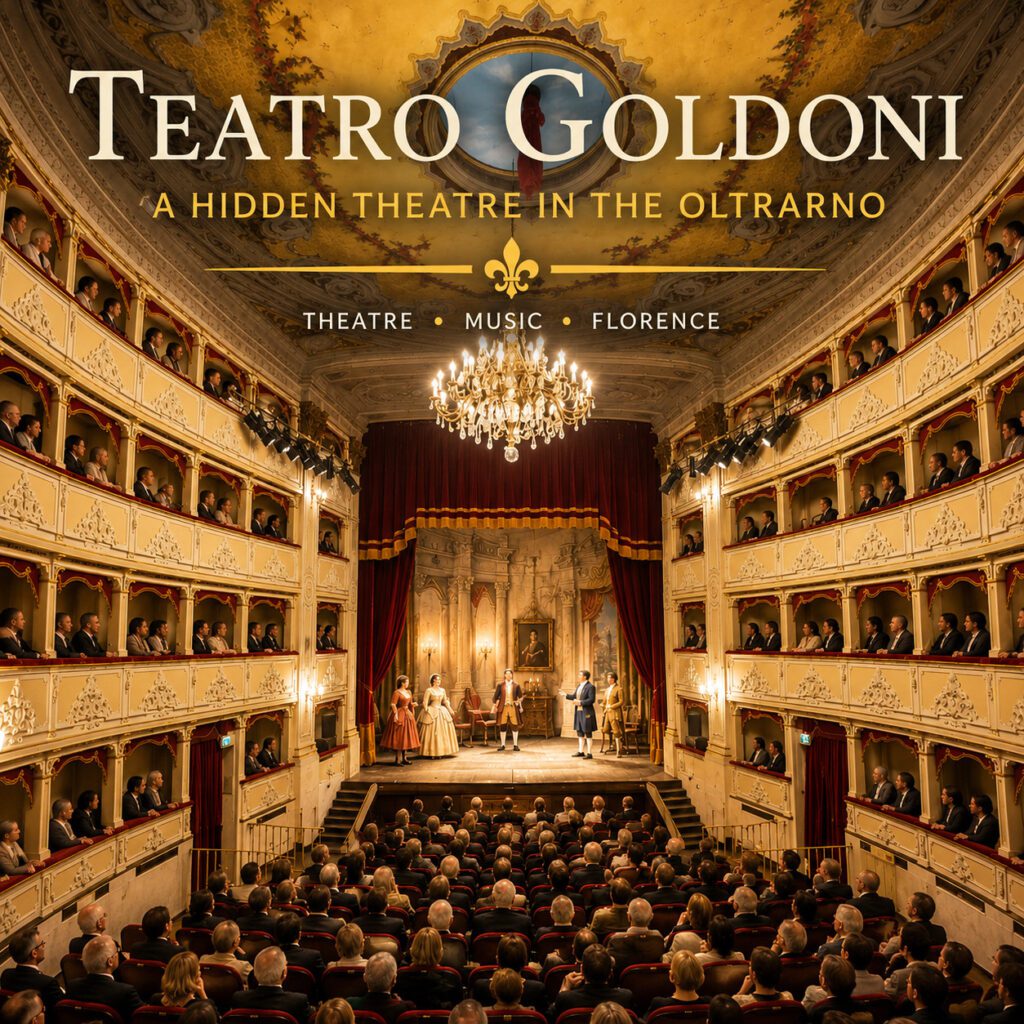
Hidden behind the streets of the Oltrarno lies one of Florence’s least expected historic theatres. Teatro Goldoni Florence combines an intimate nineteenth-century auditorium with a turbulent history of closure, restoration and revival. Unlike the monumental Teatro della Pergola or the contemporary Teatro del Maggio, the Goldoni feels almost secret.
The theatre stands on Via Santa Maria, between Santo Spirito and the Boboli Gardens. After long periods of decline and closure, it returned to theatrical life following an extensive restoration. Performances still take place here today, making the Goldoni not simply a historic monument but a living cultural venue. It is one of the distinctive venues in our Theatres and Opera Houses in Florence – Complete Guide.
Name: Teatro Goldoni
Location: Via Santa Maria 15, Florence
Area: Oltrarno
Opened: 1817
Architect: Giuseppe Del Rosso
Historic character: Intimate Italian-style theatre
Restored and reopened: 1998
Today: Active performance venue used for theatre, music and selected productions
Teatro Goldoni Florence – Hidden in the Oltrarno
Teatro Goldoni Florence stands in a part of the Oltrarno that feels far removed from the monumental architecture north of the Arno. Via Santa Maria runs through a predominantly residential area between Santo Spirito and the Boboli Gardens, where workshops, houses and small businesses still shape the streetscape.
Nothing about the approach prepares visitors for a historic theatre. This sense of discovery forms an important part of the Goldoni’s charm. Instead of announcing itself across a large piazza, the building appears almost absorbed into the surrounding neighbourhood.
The location makes Teatro Goldoni one of the most intriguing cultural surprises in the Oltrarno. Nearby, the Basilica of Santo Spirito provides one of the defining landmarks of this side of Florence, while the streets around Via Santa Maria preserve a quieter residential character.
Teatro Goldoni is easy to miss if you are not looking for it. Via Santa Maria lies away from the main tourist routes through Santo Spirito, which makes discovering the theatre part of the experience.
The Origins of Teatro Goldoni Florence
The history of Teatro Goldoni Florence begins in the early nineteenth century. Luigi Gargani promoted the creation of the theatre and commissioned architect Giuseppe Del Rosso to design the new performance space.
The theatre opened in 1817, initially establishing itself as a venue for spoken drama. Its creation reflected a period when Florence’s theatrical culture was expanding beyond the older court and academy traditions that had shaped venues such as Teatro della Pergola.
The Goldoni developed within a neighbourhood rather than a monumental cultural district. This setting gave it a distinctive identity from the beginning and continues to distinguish it from Florence’s larger theatres today.
When Teatro Goldoni opened in 1817, Florence was entering a new cultural era. The age of exclusive court entertainment was giving way to a broader theatrical world aimed at increasingly diverse audiences.
Giuseppe Del Rosso and the Theatre’s Design
Architect Giuseppe Del Rosso designed the Goldoni according to the Italian theatrical tradition while adapting the building to its Oltrarno setting. The result created an intimate relationship between stage and audience.
Rather than relying on monumental scale, the theatre draws its character from proportion and atmosphere. The auditorium surrounds spectators with the architectural language of historic Italian performance spaces, creating a sense of closeness that larger venues cannot easily reproduce.
This intimacy remains one of the strongest reasons to experience a performance at Teatro Goldoni. The architecture makes the audience feel physically connected with the stage.
Inside Teatro Goldoni Florence
The interior reveals a world that the surrounding streets barely suggest. The auditorium follows the traditional Italian model, with several levels rising around the central seating area and focusing attention towards the stage.
Its relatively compact dimensions create a very different atmosphere from Teatro Verdi. Instead of the grandeur of a large nineteenth-century entertainment venue, Teatro Goldoni offers something quieter and more intimate.
The relationship between audience and performers becomes particularly noticeable during smaller theatrical or musical productions. The stage never feels remote, and subtle gestures can carry throughout the room.
The Goldoni demonstrates that a historic theatre does not need monumental dimensions to create atmosphere. Its relatively intimate scale is one of the building’s greatest strengths.
A Theatre Used by the Lorraine Court
The theatre’s history also intersects with Florence’s grand-ducal period. Members of the House of Lorraine used the Goldoni as a court theatre, connecting this relatively discreet Oltrarno venue with the ruling dynasty of Tuscany.
This relationship makes geographical sense. Palazzo Pitti, the principal grand-ducal residence, stands nearby, while the surrounding Oltrarno contained numerous buildings connected with court life.
Yet the Goldoni gradually developed an identity that extended beyond aristocratic entertainment. Like other nineteenth-century theatres, it responded to changing audiences and new expectations of public cultural life.
Music and the Teatro Goldoni
Music became an important part of the theatre’s history. The Società Filarmonica Fiorentina performed at the Goldoni, creating an important connection between the building and the development of Florence’s orchestral tradition.
This musical story eventually leads towards one of the city’s great twentieth-century institutions. The Stabile Orchestrale Fiorentina, founded by Vittorio Gui in 1928, became an important predecessor of the orchestra associated with the Maggio Musicale Fiorentino.
The Goldoni therefore occupies an interesting place in Florence’s musical history. Its relatively modest scale conceals connections with institutions that later became internationally significant.
Teatro Goldoni forms part of the story that eventually led to Florence’s modern orchestral tradition. Its history connects the intimate theatre of the Oltrarno with the much larger world of the Maggio Musicale Fiorentino.
Florence Capital and a Period of Decline
The years surrounding Firenze Capitale brought enormous change to the city. Florence became capital of the Kingdom of Italy in 1865, attracting government institutions, officials and new residents while major urban projects transformed its streets.
For Teatro Goldoni, however, this period did not simply produce growth. The changing theatrical landscape and competition from other venues contributed to periods of difficulty. The theatre passed through phases of reduced activity and closure.
Restoration and technical improvements periodically brought new life to the building. Gas lighting, for example, formed part of the modernisation that allowed the theatre to respond to changing expectations. The wider transformation of the city during these years forms part of our History of Florence.
Firenze Capitale transformed Florence between 1865 and 1871, but cultural institutions experienced those changes differently. Teatro Goldoni’s history includes periods of success as well as decline and repeated attempts at revival.
Rossini and the Reopening of Teatro Goldoni
One important revival brought opera back to the theatre with Gioachino Rossini’s L’italiana in Algeri. The choice connected the Goldoni with the great Italian operatic repertoire while signalling renewed theatrical activity.
Opera suited the intimate auditorium particularly well. Singers and musicians could create a direct relationship with spectators, while the traditional architecture reinforced the atmosphere of Italian musical theatre.
The revival did not guarantee permanent stability. The Goldoni would experience further interruptions during the following decades, creating the complicated pattern of openings and closures that characterises much of its modern history.
Why Teatro Goldoni Closed
By the twentieth century, maintaining a historic theatre had become increasingly difficult. Older buildings had to meet modern expectations for structural safety, technical equipment and audience facilities.
Serious structural problems eventually forced Teatro Goldoni Florence to close in 1976. This closure proved far more significant than the temporary interruptions the theatre had experienced earlier.
For more than two decades, the curtain remained down. The building survived, but returning it to theatrical use required an extensive restoration capable of preserving its historic character while making performance possible again.
Teatro Goldoni remained closed for more than twenty years after serious structural problems forced its closure in 1976. Its later revival saved an important part of Florence’s theatrical heritage.
The Restoration and Rebirth of Teatro Goldoni Florence
A long restoration eventually returned the theatre to the city. The project had to balance two objectives: conserving the historic architecture and creating a venue capable of supporting contemporary performance.
The restored Teatro Goldoni Florence reopened in 1998. After decades of silence, performers and audiences could once again use the theatre for its original purpose.
The restoration also introduced flexibility into the building. The renewed design allows the venue to function in different configurations, including arrangements that create a more open relationship between performance and surrounding spaces.
This revival prevented the Goldoni from becoming merely an architectural relic. Its value lies precisely in the fact that the building returned to cultural life.
The survival of Teatro Goldoni is not simply a story of preservation. Restoration returned the building to performance, allowing a historic theatre hidden in the Oltrarno to become a working cultural space once again.
Is Teatro Goldoni Florence Still Open?
Yes. Teatro Goldoni Florence remains an active performance venue. It does not operate like a museum with regular daily opening hours, which may explain why visitors sometimes assume that the theatre has closed.
Instead, the Goldoni opens according to its programme of performances and cultural events. Recent seasons have included theatre and musical productions, while the Teatro del Maggio Musicale Fiorentino continues to use the venue for selected performances.
Current programming confirms that the theatre remains active in 2026, including productions connected with the Maggio Musicale Fiorentino.
Teatro Goldoni is still in use in 2026. Access generally follows the performance schedule rather than regular museum-style opening hours. Always check the current programme before planning a visit.
Teatro Goldoni and the Maggio Musicale Fiorentino
The relationship with the Maggio gives the historic theatre a particularly interesting contemporary role. Florence’s principal opera institution now performs primarily in its modern complex beside Parco delle Cascine, yet selected productions also return to the intimate surroundings of the Goldoni.
This works especially well for repertoire that benefits from a smaller theatrical environment. Baroque opera, chamber-scale productions and experimental performances can create a very different experience here from one in a large contemporary opera house.
The contrast also connects different chapters of Florentine musical history. The modern Maggio uses a theatre whose own musical traditions reach back into the nineteenth century.
If the Maggio schedules a production at Teatro Goldoni during your stay, consider it a special opportunity. The small historic auditorium offers a very different theatrical experience from the large modern halls of the Teatro del Maggio.
Baroque Opera in an Intimate Theatre
The Goldoni has also provided a setting for the Maggio’s exploration of Baroque repertoire. This combination feels particularly appropriate because smaller historic theatres can create a close relationship between singers, musicians and audience.
Rather than overwhelming spectators with monumental staging, these productions can focus attention on voices, instruments and dramatic interaction. The architectural scale becomes part of the performance.
This approach demonstrates how Teatro Goldoni Florence continues to find a distinctive role within the city’s much larger theatrical landscape.
The Teatro delle Donne at the Goldoni
The Goldoni has also become an important Florentine home for the Teatro delle Donne. Its productions bring contemporary drama, new writing and performances centred on female voices into the historic auditorium.
This relationship gives the building another layer of identity. A theatre created in the early nineteenth century now hosts work addressing contemporary society, memory, relationships and the experiences of women.
The combination illustrates one of the most valuable qualities of a living historic theatre. Preserving architecture does not require preserving the cultural world that originally created it; new generations can use the same stage to tell entirely new stories.
The Goldoni is not frozen in the nineteenth century. Contemporary companies and performers continue to use its historic stage, adding new stories to more than two centuries of theatrical history.
Teatro Goldoni and the Oltrarno
The location makes Teatro Goldoni Florence especially appealing for travellers interested in the quieter side of the city. The Oltrarno has always developed somewhat differently from the monumental centre around the Duomo and Piazza della Signoria.
Artisans, religious communities, aristocratic residences and ordinary Florentine neighbourhoods have all shaped this side of the Arno. Santo Spirito remains one of the best places to experience that distinctive atmosphere, while nearby Palazzo Pitti recalls the courtly history of the district.
The Goldoni fits naturally into this environment. It feels less like a monumental institution and more like a cultural space embedded within the neighbourhood.
Combine the Goldoni with a walk through Santo Spirito and the streets around Via Santa Maria. This part of the Oltrarno rewards slow exploration, particularly in the late afternoon and early evening.
Teatro Goldoni, Pergola or Verdi?
Florence’s historic theatres reveal different periods of the city’s cultural development. Teatro della Pergola reaches back to the seventeenth century and the world of Medici patronage, elaborate stage machinery and the development of Italian theatre architecture.
Teatro Verdi represents the larger public entertainment culture of the nineteenth century. Its substantial auditorium and broad contemporary programme create a very different experience.
Teatro Goldoni Florence offers the most intimate experience of the three. Its Oltrarno location, compact auditorium and history of disappearance and revival give it a character unlike any other theatre in the city.
Teatro della Pergola: Medici history and historic stagecraft
Teatro Verdi: Grand nineteenth-century theatre and varied performances
Teatro Goldoni: Intimate atmosphere and a hidden Oltrarno setting
Can You Visit Teatro Goldoni Without a Performance?
The Goldoni should not be approached like a conventional tourist attraction with guaranteed daily admission. Opening generally depends on performances, events and other scheduled activities.
For most visitors, attending a performance provides the best opportunity to experience the interior. Seeing the auditorium filled with spectators and watching performers use the stage also reveals the building as its architects intended.
Visitors who specifically want to see the theatre should check current schedules shortly before their stay rather than relying on older guidebooks or fixed opening times.
Address: Via Santa Maria 15, Florence
Area: Oltrarno
Status: Active performance venue
Opening: Generally connected to scheduled performances and events
Best experience: Attend a theatre, music or opera performance
Before visiting: Check the current programme and access information
What to Look for Inside Teatro Goldoni Florence
First notice the scale. The Goldoni does not try to impress through the monumental dimensions found in larger theatres. Instead, its architecture draws the audience towards the stage and creates a sense of intimacy.
Look at the relationship between the central seating area and the surrounding levels. These elements preserve the spatial logic of the traditional Italian theatre while giving the Goldoni its own distinctive proportions.
Most importantly, observe how the architecture changes when a performance begins. Lights, voices, music and an audience transform the restored historic interior into a living theatrical space.
A Hidden Theatre in a City of Famous Monuments
Florence contains so many internationally famous buildings that smaller cultural sites can disappear from visitors’ itineraries. The Goldoni demonstrates why exploring beyond the major monuments can be rewarding.
There is no vast piazza announcing its presence and no queue stretching along the street. Many travellers can spend several days in the Oltrarno without realising that a historic theatre stands behind the buildings of Via Santa Maria.
That anonymity gives Teatro Goldoni Florence much of its appeal. Discovering it feels less like checking another famous attraction from a list and more like uncovering one of the city’s quieter cultural layers.
Frequently Asked Questions
When did Teatro Goldoni open?
Teatro Goldoni opened in 1817 and was designed by architect Giuseppe Del Rosso.
Where is Teatro Goldoni in Florence?
The theatre stands at Via Santa Maria 15 in the Oltrarno, between the Santo Spirito area and the Boboli Gardens.
Is Teatro Goldoni still open?
Yes. It remains an active performance venue, although access generally follows the theatre’s programme rather than fixed museum-style opening hours.
When was Teatro Goldoni restored?
After closing in 1976 because of serious structural problems, the theatre underwent extensive restoration and reopened in 1998.
Does the Maggio Musicale use Teatro Goldoni?
Yes. Selected Maggio Musicale Fiorentino productions are staged at the Goldoni, particularly when a more intimate theatrical setting suits the repertoire.
Can you visit Teatro Goldoni without attending a performance?
Sometimes, but regular daytime admission is not guaranteed. Attending a scheduled performance is usually the best way to experience the interior.
Which historic Florence theatre is the most intimate?
Teatro Goldoni offers a particularly intimate atmosphere because of its compact auditorium and secluded Oltrarno setting.
Why Teatro Goldoni Florence Is Worth Visiting
Teatro Goldoni Florence is worth visiting because its story combines survival, architecture and living performance. Opened in 1817, closed after serious structural problems in 1976 and revived after a major restoration, the theatre embodies more than two centuries of changing Florentine cultural life.
Its location also sets it apart. Hidden in the Oltrarno near Santo Spirito and the Boboli Gardens, the Goldoni feels deeply connected with its neighbourhood rather than with Florence’s monumental tourist centre.
Most importantly, the theatre is alive. Performances continue to bring audiences into the auditorium, while organisations including the Maggio Musicale Fiorentino use the historic venue for selected productions.
For travellers who enjoy discovering places that many visitors overlook, Teatro Goldoni offers exactly what its title promises: a genuine hidden theatre in the heart of the Oltrarno.
Further Reading on Firenze Casa
- Theatres and Opera Houses in Florence – Complete Guide
- Basilica of Santo Spirito – Brunelleschi’s Renaissance Church
- Palazzo Pitti – History, Architecture & Museums
- Teatro della Pergola – Florence’s Historic Theatre and Hidden Stage
- Teatro Verdi – Florence’s Historic Theatre
- Teatro del Maggio Musicale Fiorentino – Florence’s Opera House
- History of Florence – Complete Guide
References
- Comune di Firenze – Feel Florence, Teatro Goldoni.
- Comune di Firenze – Cultura, Teatro Goldoni and contemporary performances.
- Fondazione Teatro del Maggio Musicale Fiorentino – Teatro Goldoni performances and programme.
- Fondazione Teatro del Maggio Musicale Fiorentino – 2026–2027 programme.
- Teatro delle Donne – Teatro Goldoni programme.
- Comune di Firenze – Historic theatres and cultural heritage.
- Archivio Storico del Comune di Firenze – Theatre and cultural life in nineteenth-century Florence.

