
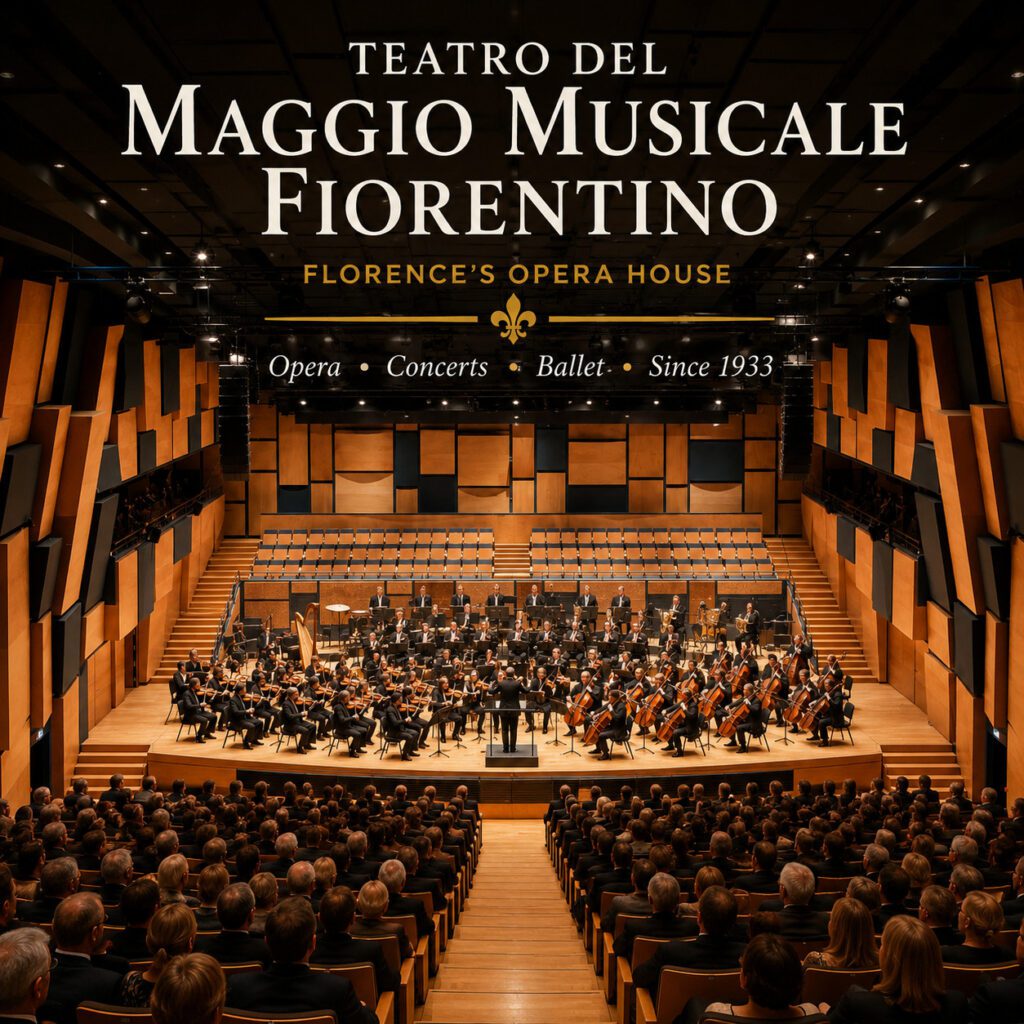
Florence’s great operatic tradition now has a striking contemporary home beside Parco delle Cascine. The Teatro del Maggio Musicale Fiorentino is the city’s principal opera house and the permanent home of the Orchestra and Chorus of the Maggio Musicale Fiorentino. Its modern halls host opera, symphonic concerts, ballet and one of Italy’s most prestigious music festivals.
Visitors sometimes confuse the present theatre with the former Teatro Comunale on Corso Italia, which served Florence’s musical life for much of the twentieth century. The Maggio has since moved west to its new complex near the Cascine, while the former theatre site entered an extensive redevelopment programme. Understanding this transition helps explain both the history and the contemporary identity of opera in Florence. For an overview of the city’s principal performance venues, start with our Theatres and Opera Houses in Florence – Complete Guide.
Name: Teatro del Maggio Musicale Fiorentino
Location: Piazzale Vittorio Gui, Florence
Area: Near Parco delle Cascine
Opened: 2011
Home of: Orchestra and Chorus of the Maggio Musicale Fiorentino
Programme: Opera, concerts, ballet and special events
Festival: Maggio Musicale Fiorentino
Important: This is Florence’s current principal opera venue, not the former Teatro Comunale on Corso Italia
Teatro del Maggio Musicale Fiorentino – Florence’s Modern Opera House
The Teatro del Maggio Musicale Fiorentino stands immediately west of Florence’s historic centre, close to the eastern edge of Parco delle Cascine. Its location creates an interesting transition between monumental Florence and the city’s largest public park.
Architecturally, the complex differs radically from historic venues such as Teatro della Pergola. Instead of an ornate auditorium, tiers of private boxes and centuries of theatrical decoration, the Maggio offers a large contemporary cultural complex designed for modern opera and orchestral performance.
This contrast makes the theatre especially interesting within Florence. The city helped shape the beginnings of opera around 1600, yet its principal opera house today belongs unmistakably to the twenty-first century.
Do not look for Florence’s main opera season at the former Teatro Comunale on Corso Italia. The Teatro del Maggio beside Parco delle Cascine is now the principal home of the city’s opera, orchestra and chorus.
From the Teatro Comunale to the New Maggio
For generations, Florentines associated major opera and orchestral performances with the Teatro Comunale on Corso Italia. The building developed from the nineteenth-century Politeama Fiorentino and became one of the principal centres of musical life in twentieth-century Florence.
The creation of a new opera complex changed this geography. Florence needed a venue capable of meeting contemporary requirements for stage technology, rehearsal areas, acoustics, audience facilities and large-scale productions. Therefore, the new theatre near the Cascine provided possibilities that were increasingly difficult to accommodate in the older building.
The transition did not happen in a single moment. The new complex opened in 2011 and gradually assumed the role previously associated with the Teatro Comunale. Today, the Teatro del Maggio Musicale Fiorentino serves as the permanent home of the institution’s orchestra and chorus.
Former home: Teatro Comunale, Corso Italia
Current home: Teatro del Maggio Musicale Fiorentino, beside Parco delle Cascine
The move represents one of the most important changes in Florence’s modern cultural geography.
What Happened to Florence’s Former Teatro Comunale?
The former Teatro Comunale no longer serves as Florence’s principal opera house. After the Maggio moved to its new home, the large site on Corso Italia became the subject of an extensive urban redevelopment project.
The plans introduced substantial new residential use while treating the historically protected frontage along Corso Italia differently from later parts of the theatre complex. Florence’s planning requirements called for this historic façade to remain and undergo restoration as the wider site changed function.
The transformation is striking. A place once associated with generations of conductors, singers and opera audiences has become part of a new chapter in the residential development of this part of Florence.
Older books and websites may still associate the Maggio Musicale Fiorentino with the Teatro Comunale on Corso Italia. That information reflects the institution’s former home rather than the location of Florence’s present opera house.
Why Florence Built a New Opera House
Opera has changed enormously since the great historic Italian theatres took shape. Contemporary productions require extensive backstage facilities, sophisticated lighting, large rehearsal spaces and complex systems for moving scenery and equipment.
A modern orchestra also needs carefully designed acoustics and working spaces that historic buildings cannot always provide without major intervention. Consequently, the new Teatro del Maggio Musicale Fiorentino allowed Florence to create a cultural complex around contemporary requirements rather than forcing them into an older structure.
The result deliberately avoids imitating a historic Italian opera house. Its architectural language belongs to its own period, just as Teatro della Pergola reflects the theatrical culture from which it emerged centuries earlier.
Architecture of the Teatro del Maggio Musicale Fiorentino
The theatre forms part of a broad architectural composition of performance halls, foyers, terraces and open spaces. Horizontal forms give much of the complex a low profile, while its scale becomes clearer as visitors approach the entrances and public areas.
The design connects interior performance spaces with terraces and exterior areas. Rather than hiding behind a traditional urban façade, the theatre creates a modern cultural landscape near the Cascine.
In 2014, the complex received Italy’s national award for the best architectural work completed in the preceding five years. The recognition underlined the significance of the project beyond its function as an opera venue.
The Maggio is worth approaching as a piece of contemporary Florence rather than comparing it directly with a historic opera house. Its terraces, large volumes and open spaces form part of the architectural experience.
Inside Florence’s Opera House
Inside, the architecture places the focus on performance. Large contemporary halls provide the acoustics and technical infrastructure needed for opera, symphonic music and other major productions.
The experience differs considerably from sitting inside Teatro della Pergola. At the Pergola, the auditorium itself tells centuries of social and architectural history. At the Maggio, by contrast, sightlines, acoustics, technical flexibility and the demands of modern productions play a more prominent role.
For visitors interested in theatre architecture, seeing both venues provides an excellent comparison. Together they demonstrate how radically the relationship between audience, stage and performance has changed.
The Cavea – Opera and Music Under the Florence Sky
One of the most distinctive spaces of the Teatro del Maggio Musicale Fiorentino is the Cavea, an open-air performance area on the roof of the complex. Its stepped seating and elevated position create a completely different atmosphere from the enclosed halls below.
During summer, the Cavea can host opera, concerts and other cultural events. Performances take place beneath the evening sky, adding an unusually informal dimension to an institution associated with some of Europe’s greatest musical traditions.
The rooftop location also provides broad views towards Florence. Arriving before an evening event therefore gives visitors time to experience the terraces and changing light over the city before the performance begins.
If you visit Florence in summer, check whether the Cavea has performances scheduled. An open-air evening at the Maggio offers a very different experience from traditional indoor opera.
The Maggio Musicale Fiorentino Festival
The theatre takes its name from one of Italy’s most important music festivals. The Maggio Musicale Fiorentino began in 1933 and developed into an internationally respected celebration of opera, orchestral music and ambitious musical programming.
The festival helped establish twentieth-century Florence as a major centre for classical music. Distinguished conductors, singers, directors and orchestras have contributed to its history, while its programming has often combined established masterpieces with works heard less frequently on conventional opera stages.
This artistic ambition remains central to the identity of the Teatro del Maggio Musicale Fiorentino. The institution represents much more than a building: theatre, festival, orchestra and chorus together form one of Florence’s principal cultural organisations.
The Maggio Musicale Fiorentino was founded in 1933. Its long history means that the festival is much older than the contemporary theatre that now carries its name.
Florence and the Origins of Opera
A visit to the Maggio has special meaning because Florence played a fundamental role in the birth of opera. Around the end of the sixteenth century, musicians, poets and intellectuals experimented with a new relationship between music and dramatic text.
The circle traditionally known as the Florentine Camerata included figures whose ideas influenced the development of early opera. Vincenzo Galilei and Giulio Caccini belonged to this intellectual environment, while Jacopo Peri worked within the wider Florentine musical culture that emerged from these experiments.
Jacopo Peri transformed many of these ideas into musical drama. His Dafne, created in Florence during the 1590s, is usually regarded as the earliest opera, although most of its music has disappeared. His Euridice, performed in Florence in 1600, survives and provides an extraordinary connection with the formative years of the genre.
Peri was not alone. Giulio Caccini helped develop the expressive solo singing that became fundamental to early opera, while his daughter Francesca Caccini became one of the most remarkable composers to emerge from Medici court culture.
Attending an opera in Florence creates an unusual historical circle: the city that helped give birth to opera around 1600 continues to stage the art form more than four centuries later.
Orchestra and Chorus of the Maggio Musicale Fiorentino
The orchestra and chorus form the musical heart of the institution. Their work extends across opera, symphonic concerts and choral repertoire, giving the Maggio a musical identity that reaches beyond individual festival productions.
Over the decades, major conductors have developed close relationships with the institution. Zubin Mehta holds a particularly important place in its modern history, while many other internationally renowned conductors have appeared with the orchestra.
Today, the permanent ensembles allow the theatre to sustain an extensive season rather than functioning only during the traditional festival period.
Opera at the Teatro del Maggio Musicale Fiorentino Today
The current programme demonstrates that opera remains central to the institution. Seasons combine works from different periods with symphonic concerts, ballet, recitals and projects aimed at younger audiences.
Productions range from Baroque and Classical repertoire through nineteenth-century opera to twentieth-century and contemporary works. This breadth reflects the festival’s long-standing interest in presenting musical theatre as a living art rather than simply repeating a small number of familiar titles.
For travellers who want to experience opera during a stay in Florence, the current Maggio programme should therefore be one of the first places to check.
Opera seasons do not follow the daily schedules of museums. Check the programme before your trip if attending a performance is important to you, particularly when travelling for only a few days.
More Than Opera
Despite its reputation as Florence’s opera house, the Maggio offers much more than staged opera. Symphonic and choral concerts form an important part of the programme, alongside ballet, recitals and special events.
The institution also experiments with ways of reaching audiences beyond conventional opera culture. Outdoor performances and projects in other parts of Florence extend musical theatre beyond the walls of the main building.
This variety makes the Teatro del Maggio Musicale Fiorentino relevant even for visitors who would not normally choose a full opera performance.
From Historic Florence to Contemporary Florence
Travellers often arrive expecting Florence to end with the Renaissance. The Maggio provides a useful corrective. Its bold modern architecture demonstrates that the city continues to create major cultural buildings rather than simply conserving monuments inherited from the past.
The location reinforces that message. Walking west from the historic centre gradually changes the character of Florence, from Renaissance streets and nineteenth-century boulevards towards the Cascine and contemporary cultural architecture.
The theatre therefore offers more than an evening of music. It introduces visitors to a Florence that many short itineraries overlook.
The Teatro del Maggio is an excellent example of contemporary Florence. Pairing it with the historic Teatro della Pergola reveals how the city’s performing spaces have evolved across more than three centuries.
The Teatro del Maggio and Parco delle Cascine
The proximity of Parco delle Cascine gives the theatre a setting unlike any of Florence’s historic stages. The vast green area stretches west along the Arno and has served generations of Florentines as a place for walking, sport and recreation.
Visitors attending an evening performance can combine the theatre with a walk around the eastern Cascine or along the Arno. This works particularly well during the warmer months, when the park and the theatre’s outdoor spaces become part of the same evening experience.
The combination also makes the Maggio feel less isolated from everyday Florence. It stands at the meeting point between culture, parkland and the modern city.
If you continue deeper into the Cascine, look for the unusual Ghiacciaia delle Cascine, a historic ice-storage building whose pyramid-like form is one of the park’s more unexpected sights.
How to Reach Teatro del Maggio Musicale Fiorentino
The theatre lies west of the historic centre and is easily reachable without a car. Its position near major public transport routes makes it convenient for visitors staying in central Florence.
Walking is also possible from the western part of the centre. Along the way, the route provides an interesting transition away from the dense medieval and Renaissance streets towards broader nineteenth- and twentieth-century Florence.
For an evening performance, allow enough time to arrive before the curtain rises. The scale of the complex and its public spaces makes arriving early more pleasant than rushing directly to your seat.
Address: Piazzale Vittorio Gui, Florence
Area: Near Parco delle Cascine
Best reason to visit: Opera, symphonic concert or festival performance
Summer: Check the programme for events in the rooftop Cavea
Before visiting: Confirm performance times and current ticket information
What to Expect at a Performance
Visitors do not need specialist knowledge of opera or classical music to attend the Maggio. The atmosphere reflects a major international cultural institution, but audiences include both dedicated music lovers and people simply enjoying an evening performance in Florence.
Arriving early allows time to explore the foyer and public areas. For opera, it also helps to read a short synopsis beforehand, particularly when the work is unfamiliar.
Dress varies according to the performance, and visitors generally do not need formal evening wear. A smart but comfortable approach works well for most occasions unless a particular event specifies otherwise.
Teatro della Pergola or Teatro del Maggio?
The two theatres offer complementary experiences rather than competing ones. Teatro della Pergola provides historic architecture, intimate boxes and a direct connection with seventeenth- and nineteenth-century theatrical culture. The Maggio, by contrast, provides the technical scale and acoustics of a contemporary international opera house.
Visitors primarily interested in historic theatre architecture may prefer the Pergola. Those who want to attend a major opera or orchestral performance should examine the programme at the Teatro del Maggio Musicale Fiorentino.
Experiencing both reveals something important about Florence: its performing arts belong simultaneously to history and the present.
Teatro della Pergola: Historic atmosphere, theatre architecture and centuries of stage history.
Teatro del Maggio: Major opera, orchestral music and contemporary performance architecture.
Frequently Asked Questions
What is Florence’s main opera house?
The Teatro del Maggio Musicale Fiorentino is Florence’s principal contemporary opera venue and the permanent home of the Orchestra and Chorus of the Maggio Musicale Fiorentino.
Is the Teatro del Maggio the same as the former Teatro Comunale?
No. The Teatro Comunale on Corso Italia was the institution’s former home. The present Teatro del Maggio is the modern complex near Parco delle Cascine.
When did the Teatro del Maggio open?
The new complex opened in 2011 and gradually assumed the role previously associated with the Teatro Comunale.
Can you see opera at the Teatro del Maggio?
Yes. Opera is central to the programme, alongside symphonic concerts, ballet, recitals and other cultural events.
What is the Cavea?
The Cavea is the theatre’s open-air rooftop performance space. It can host concerts and other events during the warmer months.
What is the connection between Florence and the birth of opera?
Florentine musicians, poets and intellectuals helped develop the earliest opera around 1600. Jacopo Peri, Giulio Caccini and Vincenzo Galilei were among the important figures in this musical transformation.
Can I combine the theatre with Parco delle Cascine?
Yes. The theatre stands beside the eastern part of the Cascine, making a walk through Florence’s largest public park a natural addition before an evening performance.
Why Teatro del Maggio Musicale Fiorentino Is Worth Visiting
The Teatro del Maggio Musicale Fiorentino is worth visiting because it shows that Florence’s extraordinary musical history remains alive. The city that helped create opera around 1600 continues to invest in ambitious productions, orchestral music and international performance more than four centuries later.
The contemporary building also offers a refreshing contrast with Florence’s historic monuments. Its large halls, terraces and rooftop Cavea demonstrate how the city has created a modern home for an institution founded in the twentieth century but rooted in a much older musical tradition.
The move from the former Teatro Comunale to the new complex near Parco delle Cascine marks an important chapter in modern Florence. One building belongs to the memory of twentieth-century musical life; the other carries that tradition into the future.
For visitors who want to discover Florence beyond paintings, palaces and Renaissance churches, an evening at the Maggio can therefore become one of the city’s most memorable cultural experiences.
Further Reading on Firenze Casa
- Theatres and Opera Houses in Florence – Complete Guide
- Florence and the Birth of Opera
- Teatro della Pergola – Florence’s Historic Theatre and Hidden Stage
- Jacopo Peri – The Florentine Composer Who Helped Invent Opera
- Giulio Caccini – Music and the Birth of Opera in Florence
- Vincenzo Galilei – Music, Florence and the Father of Galileo
- Parco delle Cascine Florence – The City’s Most Local Park
References
- Fondazione Teatro del Maggio Musicale Fiorentino – The Theatres.
- Fondazione Teatro del Maggio Musicale Fiorentino – Historical Archive.
- Fondazione Teatro del Maggio Musicale Fiorentino – Season and Festival programmes.
- Fondazione Teatro del Maggio Musicale Fiorentino – History of the Institution.
- Comune di Firenze – Ex Teatro Comunale redevelopment documentation.
- Comune di Firenze – Urban planning documentation for the former Teatro Comunale.
- Treccani – Maggio Musicale Fiorentino.
- Treccani – Florentine Camerata.
- Encyclopaedia Britannica – Opera and its origins.

