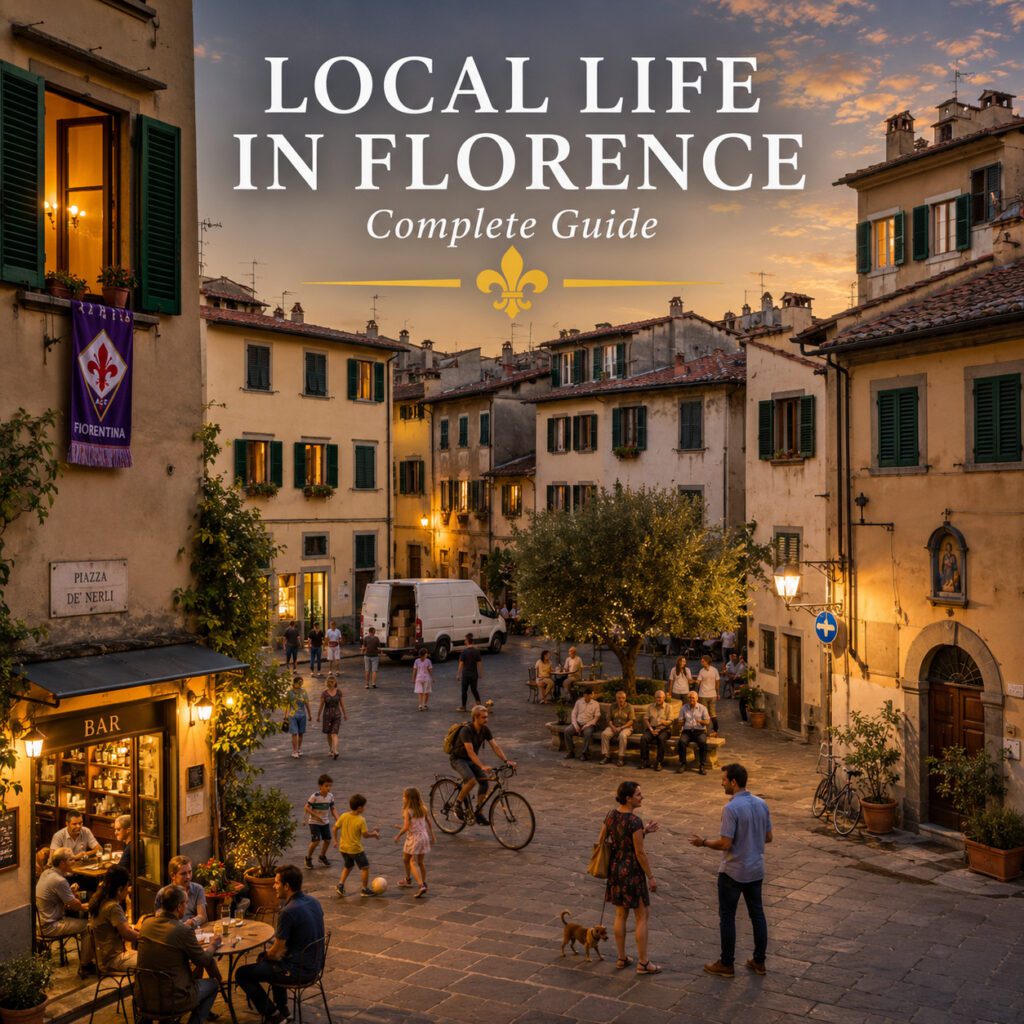
Local life in Florence begins where the usual sightseeing guide ends. Florence may be famous for Renaissance masterpieces, monumental churches and museums, but behind this extraordinary cultural heritage is a real city where people wake early, drink coffee at the bar, argue about football, close their shutters against the summer heat and celebrate traditions their families have known for generations.
To understand Florence, it is therefore worth looking beyond what the city preserves and paying attention to how it still lives. From the quiet streets of the early morning to the evening passeggiata, from Ferragosto to San Giovanni, and from Fiorentina to the fierce rivalry of Calcio Storico, everyday Florence reveals a side of the city that no museum ticket can provide.
Main theme: Everyday life, traditions and neighbourhood Florence
Best perspective: Florence as a living city rather than an open-air museum
Quietest time: Early morning
Daily ritual: Coffee at the bar and the evening passeggiata
Summer turning point: Ferragosto on 15 August
Patron saint: San Giovanni Battista, celebrated on 24 June
Modern passion: ACF Fiorentina
Historic rivalry: Calcio Storico Fiorentino
Major tradition: Scoppio del Carro at Easter
Florence Is a City Before It Is a Destination
Millions of visitors come to Florence because of what happened here centuries ago. Brunelleschi, Michelangelo, Donatello, Botticelli and the Medici created a cultural legacy so powerful that it can sometimes overwhelm the contemporary city surrounding it. Much of that legacy is preserved in the extraordinary collections introduced in our Florence Museums: The Complete Guide.
Yet Florence did not stop when the Renaissance ended. People still live above the streets where visitors photograph palaces. Children go to school beside medieval churches, deliveries arrive beneath Renaissance façades, neighbours meet at the bar and residents notice when another familiar shop disappears.
This coexistence between extraordinary heritage and ordinary life is one of Florence’s most fascinating characteristics. The city is historic, but it is not frozen in history.
Florence is famous for what it preserves. However, to understand the city, it is just as important to notice how Florence still lives.
Is Florence an Open-Air Museum?
It is easy to understand why visitors sometimes describe Florence as an open-air museum. Walk for a few minutes through the historic centre and you encounter sculptures, churches, palaces, medieval streets and Renaissance architecture that elsewhere might each constitute a major attraction.
Yet the comparison has its limits. As our guide Is Florence an Open-Air Museum? – How to Visit a Living City explores in greater depth, a museum exists primarily for its exhibits and visitors. Florence does not. The historic centre is also a residential neighbourhood, workplace and commercial centre where ordinary daily life continues.
That distinction changes how we experience the city. A doorway may belong to someone’s home rather than a monument. A narrow street is not merely picturesque; somebody may be trying to get groceries through it. Florence’s piazzas are architectural spaces, but they are also part of daily urban life, as our guide to the most beautiful squares in Florence makes especially clear.
Seeing Florence as a living city does not diminish its beauty. Instead, it makes that beauty more interesting.
Living Above the Street
One of the easiest aspects of Florence to overlook is that thousands of people live directly above the streets visitors explore every day. Look upwards and the historic centre changes. Laundry may hang behind shutters, plants appear on balconies, windows open in the morning and lights reveal apartments after sunset.
Our article Living Above the Street – Everyday Life in Florence’s Historic Centre looks more closely at this residential Florence. Living in a centuries-old building can sound romantic, but historic architecture also shapes everyday routines.
Stairs can be steep, lifts may be tiny or absent, walls are thick and getting furniture into an upper-floor apartment can become a logistical exercise. Meanwhile, the street itself is always present through church bells, delivery vehicles, conversations, restaurant tables and scooters.
When walking through the historic centre, occasionally stop looking at shop windows and monuments and look at the upper floors instead. Open shutters, balconies, plants and windows are small reminders that the Renaissance city is also somebody’s neighbourhood.
The Rhythm of a Day in Florence
The rhythm of a day in Florence changes constantly, and one of the pleasures of staying in the city rather than simply passing through it is beginning to notice those changes.
The day often starts simply. A coffee and perhaps a pastry at the bar may take only a few minutes. Shops open, shutters rise, delivery vehicles disappear and the streets gradually fill. By midday, the historic centre has become the Florence most visitors recognise.
Later, the tempo changes again. Work finishes, people meet friends, children appear in neighbourhood squares and the evening passeggiata brings residents back onto streets that during the busiest hours may have seemed dominated by tourism.
There is no need to organise a day around a strict timetable to experience this. Simply remaining in Florence long enough to see the same neighbourhood at different moments can reveal how much the city changes over the course of a day.
Morning Coffee Is a Small Florentine Ritual
Italian coffee culture is often presented to visitors as a collection of rules: when to order cappuccino, whether to stand at the bar and how quickly espresso should be consumed. Those details can be entertaining, but they miss the more interesting point.
A neighbourhood bar is part of everyday social infrastructure. The exchange may last only a minute, yet regular customers are recognised, greetings are exchanged and the same people often appear at approximately the same point in their morning routine.
For visitors, there is no need to imitate anyone artificially. Order what you enjoy, observe the rhythm around you and remember that the person beside you may not be having an “Italian coffee experience”. They may simply be on their way to work.
One of the easiest ways to experience everyday Florence is to return to the same neighbourhood bar more than once. Familiarity changes the experience far more than memorising a list of supposed Italian coffee rules.
Florence Before the Crowds
Florence before the crowds reveals another version of the city. Before the main visitor flows arrive, footsteps echo differently through narrow streets, delivery workers prepare shops and restaurants, residents walk dogs and shutters begin to open.
Piazza della Signoria, Piazza del Duomo and Ponte Vecchio are especially striking when there is room to notice the architecture rather than navigate a crowd. Smaller streets can be even more rewarding because they show Florence gradually becoming active rather than simply appearing as an empty postcard.
You do not need to wake at an unreasonable hour. Going for a walk before breakfast is often enough to encounter a Florence many day visitors never see.
Quiet Florence Still Exists
One of the great misconceptions about Florence is that every worthwhile place must involve a queue. The Uffizi, Accademia and Duomo naturally attract enormous numbers of visitors, but they represent only a fraction of the city’s cultural landscape.
Our guide to Quiet Florence: The Best Places We Never Queued For explores the streets, small discoveries and slower experiences that exist away from the most heavily travelled routes. Smaller churches, cloisters, gardens, neighbourhood streets and viewpoints can still provide remarkably peaceful moments.
The quieter side of Florence is not necessarily hidden. Often, it is simply a few streets away from the routes followed by the majority of visitors. Places such as the Badia Fiorentina, only steps from some of the busiest parts of the historic centre, demonstrate how quickly the atmosphere can change.
Exploring these places also changes the pace of a stay. Instead of measuring the day by reservations and entrance times, there is room for discovery.
A queue is not a measure of cultural importance. Some of the most memorable places in Florence are precisely those where there is still time and space to stop and look.
Neighbourhoods Change the Experience
Florence’s historic centre is compact enough to cross on foot, yet its neighbourhoods do not all feel the same. The streets around Santa Maria Novella have a different rhythm from Santa Croce, while crossing the Arno into the Oltrarno can alter the atmosphere within minutes.
Santo Spirito and San Frediano are often described as more local, although those labels should not be romanticised. Tourism, short-term rentals and changing commerce affect both sides of the river. Nevertheless, neighbourhood markets, workshops, bars and residential streets still give different parts of Florence recognisable personalities.
Piazza Santo Spirito illustrates this mixture particularly well. Brunelleschi’s Basilica of Santo Spirito stands beside cafés, markets, apartments and everyday neighbourhood activity. The surrounding Oltrarno has also long been associated with artisans and workshops, making the area an especially clear example of how monumental and everyday Florence overlap.
The best way to notice these differences is not to race between landmarks. Walk without making every street a route to somewhere else.
The Passeggiata and the Social City
As the heat and intensity of the day begin to ease, public space changes character. People meet friends, stop for an Italian aperitivo, walk through familiar streets or simply spend time outdoors.
The Italian idea of the passeggiata is often translated as an evening stroll, but the social element is at least as important as the walking. It is about being outside among other people without necessarily having a specific destination.
Florence’s squares make this particularly visible. A piazza is architecture, but it is also a social room without a roof. Piazza Santo Spirito is perhaps the clearest example: Brunelleschi’s church stands on one side while cafés, markets and neighbourhood life unfold immediately outside.
Summer Changes Florence
Seasonality affects local life in Florence dramatically. Spring and early summer bring long evenings and major civic celebrations, while the hottest weeks of July and August change both the pace and population of the city.
Shutters close against the heat, residents organise their days differently and businesses may reduce their opening hours. Meanwhile, the city remains busy with international visitors even while many Florentines begin disappearing for their own summer holidays.
Nowhere is that contrast more obvious than around Ferragosto.
Ferragosto – When Florence Slows Down
Ferragosto in Florence on 15 August is one of the most important markers of the Italian summer. Its roots reach back to antiquity, while the date later became associated with the Catholic Feast of the Assumption.
In modern Italy, however, Ferragosto also means holidays, family meals and escaping the city. Florence does not literally empty, especially in the age of international tourism. The historic centre can remain crowded. What changes is who is occupying it.
Some neighbourhood businesses close, familiar faces disappear and many Florentines head towards the Tuscan coast, mountains or family homes elsewhere. The paradox is striking: central Florence may look busy while simultaneously feeling unusually absent of Florentines.
A crowded street does not necessarily mean the city is following its normal rhythm. Around Ferragosto, Florence can be full of visitors while much of everyday local life has temporarily moved somewhere else.
San Giovanni – Florence Celebrates Its Patron Saint
On 24 June, Florence celebrates San Giovanni Battista – Saint John the Baptist – the city’s patron saint. It is one of the most important dates in the Florentine calendar and brings together religious devotion, civic tradition and public celebration.
The relationship between Florence and San Giovanni is visible throughout the city, most obviously in the Baptistery opposite the cathedral. Yet the feast day demonstrates that this connection is not merely historical.
Ceremonies and events take place during the day, while the evening traditionally culminates in the Fochi di San Giovanni, the famous fireworks that illuminate the city and the Arno.
For visitors, San Giovanni provides an opportunity to see Florence celebrating something for itself. You are welcome to watch, but the celebration does not exist because you came.
Scoppio del Carro – Easter, Fire and a Mechanical Dove
Easter brings one of Florence’s most extraordinary traditions to Piazza del Duomo. During the Scoppio del Carro, a monumental historic cart known as the Brindellone is brought through the city and positioned outside Santa Maria del Fiore.
During Easter Mass, the small mechanical Colombina travels along a cable between the cathedral and the cart, triggering an elaborate display of fireworks. Smoke, sparks and explosions fill the piazza in broad daylight.
The ceremony combines Christian Easter symbolism with centuries of Florentine history and popular tradition. The successful journey of the Colombina has traditionally been regarded as a favourable omen for the city and the coming year.
What makes the event particularly revealing is that this spectacular ritual still takes place in contemporary Florence. The Brindellone is not simply a museum object explaining what Florentines once did. Florence still brings it out and continues the tradition.
The difference between history and tradition is sometimes simple: history tells us what people once did; a living tradition is something a community continues to do.
Football in Florence Means Fiorentina
To understand modern local life in Florence, Renaissance history is not enough. You also need a little Viola. Our guide to football in Florence and ACF Fiorentina explores why the club means so much to the city.
Fiorentina has represented Florence in professional football since 1926, and its distinctive purple colours have become part of the city’s visual identity. On matchdays, scarves appear, bars fill and conversations turn towards formations, referees, transfers and whatever happened the previous weekend.
Supporting Fiorentina is not simply about sporting success. Clubs accumulate family memories, disappointments, rivalries and stories across generations. That emotional continuity makes football part of local identity rather than merely entertainment.
Visitors do not need to become football supporters to notice this. Look for purple scarves and shirts on matchday and listen to the conversations around you. Florence may be the birthplace of the Renaissance, but it can also spend an extraordinary amount of time discussing football.
From Viola to the Four Colours of Calcio Storico
If modern football turns Florence purple, Calcio Storico Fiorentino divides it into four colours: the Azzurri of Santa Croce, Bianchi of Santo Spirito, Rossi of Santa Maria Novella and Verdi of San Giovanni.
Every June, Piazza Santa Croce becomes a sand-covered arena for one of Florence’s most extraordinary traditions. Teams of 27 calcianti compete in a game combining ball movement with intense physical confrontation.
The modern tournament was revived in 1930, but its historical inspiration reaches back to Renaissance calcio and particularly to the famous match played in Piazza Santa Croce on 17 February 1530 while imperial forces were besieging Florence.
The besieged Florentines played anyway. The episode became remembered as an act of civic defiance and today provides Calcio Storico with one of its most powerful historical stories. The broader military setting can also be understood through the surviving city walls and fortifications of Florence, which still reveal how seriously defence shaped the historic city.
Why Calcio Storico Is More Than a Spectacle
To an outsider, Calcio Storico can initially appear to be a spectacular mixture of Renaissance costume and fighting. Short online videos reinforce that impression because the most physical moments naturally attract attention.
However, the tradition makes more sense when understood through the four historic quarters. Players represent parts of Florence, supporters identify with their colours and the competition is surrounded by the civic ceremony of the Corteo Storico della Repubblica Fiorentina.
It is therefore not simply Florence recreating a historic sport for visitors. It is modern Florence using history to express neighbourhood rivalry and civic identity.
Santa Croce: Azzurri – Blue
Santo Spirito: Bianchi – White
Santa Maria Novella: Rossi – Red
San Giovanni: Verdi – Green
Old Traditions in a Modern City
Florence has an unusually visible relationship with its past. Historical processions pass through modern shopping streets, flags bearing old symbols appear during civic celebrations and Renaissance-inspired costumes return during major events.
It would be easy to dismiss all this as nostalgia. Yet traditions survive because contemporary communities continue to find meaning in them. The meaning may change, but repeating them creates continuity between generations.
San Giovanni, Scoppio del Carro and Calcio Storico are good examples. None is experienced today exactly as it would have been centuries ago, but each gives historical memory a place in the modern city’s calendar.
Florence Is Not Always Picturesque
Understanding local life also means accepting that a real city cannot remain permanently arranged for photographs. Delivery vans block beautiful streets. Rubbish has to be collected. Scooters make noise. Roadworks appear in inconvenient places and residents sometimes become impatient with crowds.
These things do not represent failures of the Florentine experience. Instead, they are evidence that Florence is functioning as a city.
The challenge facing Florence is substantial. It must protect one of the world’s most important historic centres while remaining somewhere people can afford, and want, to live.
That tension between preservation, tourism and residential life is likely to shape Florence just as profoundly in the coming decades as restoration and conservation have shaped it in the past.
How to Experience Florence More Like a Resident
There is no need to pretend to be Florentine. Visitors are visitors, and tourism has been part of Florence for centuries. Trying too hard to “live like a local” can itself become another form of tourism.
A better approach is simply to slow down and pay attention. Return to the same bar. Shop occasionally in the neighbourhood where you are staying. Walk early in the morning. Sit in a piazza without immediately checking which monument comes next.
Notice when the streets change, when shops close, when residents appear and when the city seems to belong almost entirely to visitors. If a procession passes, find out why. If everyone is wearing purple, ask whether Fiorentina is playing.
Look also for buildings that combine multiple layers of city life. Orsanmichele, for example, began as a grain market, became a church and still stands directly within one of Florence’s busiest pedestrian routes – an unusually clear reminder that commerce, religion, art and everyday movement have always overlapped here.
Local life in Florence becomes visible when you stop treating every minute as sightseeing.
Do not try to complete Florence. No one can. Leave some empty space in your day and allow the city to provide something you did not schedule.
Respecting a City Where People Live
Respect for Florence does not require a long list of rules. Most of it comes naturally once you remember that the historic centre is not a stage set.
Churches remain places of worship. Residential entrances need to remain accessible. Streets must accommodate people going to work as well as visitors stopping for photographs. Public squares belong to the city rather than functioning exclusively as outdoor visitor attractions.
This does not mean experiencing Florence cautiously or apologetically. Enjoy the city, sit outside, photograph it, celebrate its beauty and participate in its public life. However, remember that the most famous streets and piazzas also form part of somebody else’s ordinary day.
A little awareness changes surprisingly much. Moving aside when people need to pass, keeping doorways clear and treating neighbourhood streets as residential spaces rather than scenery are small gestures, but they help preserve the balance between tourism and daily life.
What Quiet Florence Teaches Us
The philosophy behind Quiet Florence is not that famous places should be avoided. The Duomo, Uffizi, Ponte Vecchio and Piazza della Signoria deserve their reputation.
Rather, the idea is to leave enough space around those experiences for Florence itself to appear. A quiet street after breakfast, an unexpected church, a coffee without a queue or twenty minutes spent sitting in a neighbourhood square can become just as memorable as a famous masterpiece.
Visitors who slow down also tend to notice relationships between places. A market becomes connected with its surrounding neighbourhood, a historic café becomes part of the city’s social history and a civic celebration begins to make sense within the geography of Florence.
Even famous institutions reveal this overlap. The elegant historic cafés around Piazza della Repubblica, such as Caffè Gilli, belong not only to tourism but to Florence’s longer history of cafés as meeting places and social spaces.
As a result, the city becomes less like a collection of attractions and more like a coherent place.
Local Life Changes With the Seasons
There is no single version of everyday Florence. Winter mornings feel different from June evenings, while August can seem almost like a parallel city.
Spring brings outdoor life back into piazzas and gardens. June culminates in San Giovanni and Calcio Storico, while July increasingly follows the rhythms of heat and summer holidays.
Ferragosto marks the centre of August, and autumn gradually restores a more familiar local rhythm. By winter, shorter days and fewer visitors change the atmosphere again, especially in residential streets away from the principal monuments.
Returning to Florence in different seasons therefore reveals how strongly everyday life responds to climate, holidays, school schedules, tourism and civic traditions.
Frequently Asked Questions About Local Life in Florence
Is Florence still a real city or mainly a tourist destination?
Florence is both. Tourism strongly influences the historic centre, but residents still live, work, shop, attend school and maintain neighbourhood traditions throughout the city.
What is the best time to see Florence without the crowds?
Early morning is one of the best times to experience the historic centre more quietly. Streets and major piazzas usually become noticeably busier as the morning progresses.
What is the passeggiata?
The passeggiata is a social stroll, usually in the late afternoon or evening. It is as much about meeting people and enjoying public space as it is about walking.
What happens in Florence during Ferragosto?
Ferragosto on 15 August is a major Italian holiday. Many Florentines leave for the coast, countryside or mountains, and some local businesses close even while central Florence remains busy with visitors.
When does Florence celebrate San Giovanni?
Florence celebrates its patron saint, San Giovanni Battista, on 24 June. The festivities traditionally culminate in the Fochi di San Giovanni, the city’s famous fireworks.
What is Scoppio del Carro?
Scoppio del Carro is Florence’s Easter tradition in which a historic cart outside the cathedral is ignited by a mechanical dove travelling along a wire during Easter Mass.
Why is Fiorentina important in Florence?
ACF Fiorentina represents much more than professional football. Its purple colours, memories, rivalries and matchday rituals have become part of modern Florentine identity.
What is Calcio Storico Fiorentino?
Calcio Storico is Florence’s historic team competition played in Piazza Santa Croce. Four teams representing traditional city quarters compete in an intensely physical game surrounded by civic ceremony and neighbourhood rivalry.
How can visitors experience a more local Florence?
Walk early, return to the same neighbourhood bar, spend time beyond the busiest routes and leave room for unplanned discoveries. Most importantly, observe how the city changes throughout the day instead of treating every hour as sightseeing.
Why Local Life in Florence Is Worth Discovering
Local life in Florence is worth discovering because it transforms the city from a collection of masterpieces into a place inhabited by real people.
Early mornings reveal streets before the visitor crowds arrive, while evenings bring residents back into piazzas and bars. Ferragosto changes the population of the city, San Giovanni fills the calendar with civic celebration and Scoppio del Carro brings centuries-old ritual into the present.
Fiorentina demonstrates the passions of modern Florence, while Calcio Storico shows how neighbourhood identity and historical memory continue to overlap. Residential life above the streets adds another essential perspective to a historic centre often viewed primarily from ground level.
Most importantly, understanding everyday Florence encourages a slower relationship with the city. You begin to notice not only what Florence contains but how Florence functions.
The monuments remain extraordinary. Yet the living city around them is what allows Florence to remain more than a museum.
Further Reading on Firenze Casa
- Quiet Florence: The Best Places We Never Queued For
- Is Florence an Open-Air Museum? – How to Visit a Living City
- The Rhythm of a Day in Florence – From Morning Coffee to Passeggiata
- Living Above the Street – Everyday Life in Florence’s Historic Centre
- Italian Coffee Culture – How Florence Enjoys Coffee
- The Most Beautiful Squares in Florence
- The Most Beautiful Churches in Florence
- Florence Museums: The Complete Guide
References
- Comune di Firenze – Historical and civic information on Florence and its neighbourhoods
- Feel Florence – Cultural information on Florentine festivals and traditions
- Comune di Firenze – Historical documentation on San Giovanni and the Fochi di San Giovanni
- Opera di Santa Maria del Fiore – Historical information on Scoppio del Carro
- ACF Fiorentina – Club history and institutional information
- Comune di Firenze – Historical documentation on Calcio Storico Fiorentino and the Corteo Storico della Repubblica Fiorentina
- Historical studies on Florentine neighbourhoods, civic traditions and twentieth-century urban life