Living in Florence’s historic centre means experiencing the city from the other side of its famous façades. Visitors see Renaissance palaces, medieval streets and shuttered windows; residents see the same buildings as homes, staircases, kitchens, bedrooms and places to return to at the end of the day.
Life here can be extraordinarily beautiful, but it is not a permanent Renaissance dream. Church bells, delivery vans, neighbours, restaurants, summer heat, old staircases and the sounds of the street are all part of the experience. Understanding this everyday Florence reveals something that is easy to miss when the historic centre is seen only as a collection of monuments. It is also one of the central themes of our Local Life in Florence – Complete Guide.
Where: Florence’s historic centre and surrounding central neighbourhoods
The attraction: extraordinary architecture combined with everyday city life
The character: lively, walkable, historic and intensely urban
The pleasures: markets, cafés, neighbourhood streets and almost everything within walking distance
The realities: stairs, noise, deliveries, summer heat and buildings designed centuries before modern conveniences
The reward: experiencing Florence as a place to live rather than simply a destination to visit
Behind the Renaissance Façades
Walk through central Florence and it is easy to imagine the buildings as part of an enormous architectural exhibition. Rusticated stone palaces, medieval houses, Renaissance windows and monumental doorways seem to belong naturally to the history books. Yet many remain part of the ordinary residential fabric of the city.
Behind a grand doorway may be a communal entrance hall with bicycles parked against the wall. An elegant upper-floor window may belong to someone’s kitchen. Laundry, shopping bags, parcels and recycling coexist with pietra serena staircases, vaulted entrances and architectural details that have survived for centuries.
Florence’s great Renaissance palaces make this coexistence particularly visible. Buildings such as Palazzo Pitti represent the monumental end of Florentine residential architecture, while countless less famous palazzi and houses continue to accommodate everyday life throughout the centre.
This contrast is one of the fascinating aspects of living in Florence’s historic centre. History is not separated from everyday life. It surrounds it.
From the street, an old Florentine building may look like a monument. From inside, it is also a place where someone makes coffee, searches for their keys, carries groceries upstairs and opens the shutters every morning.
Living Above the Street
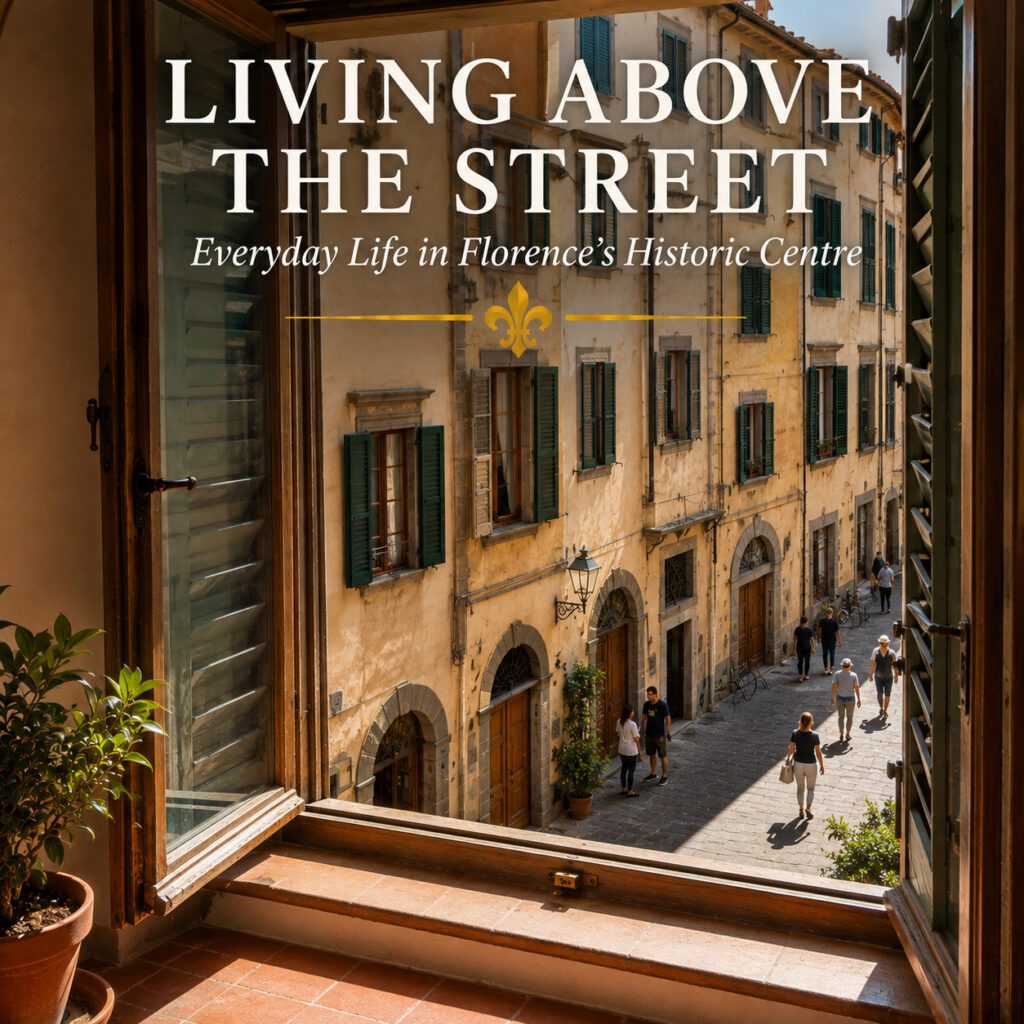
The title of this article describes one of the defining experiences of central Florence. Many apartments sit directly above streets that remain active throughout much of the day, and sometimes well into the evening. Open a window and the boundary between home and city can become surprisingly thin.
You may hear footsteps on stone paving, the acceleration of a scooter, conversations below, restaurant tables being prepared or someone calling to a neighbour. In the morning there are deliveries and street cleaning; later come shoppers, visitors and residents returning from work.
For someone accustomed to a detached house or a quiet suburban street, this immediacy can initially be surprising. Yet it also creates a powerful sense of connection. You do not simply look at Florence through the window – you hear its day unfolding beneath you. Our article The Rhythm of a Day in Florence – From Morning Coffee to Passeggiata follows these changes from early morning until evening.
The Beautiful Imperfections of Historic Homes
Historic Florentine apartments can contain details that would be difficult to reproduce convincingly in a modern building. High ceilings, heavy wooden beams, terracotta floors, thick masonry walls, old fireplaces and enormous doors create a character that comes from age rather than interior design.
But old buildings were not constructed around twenty-first-century expectations. Floor plans can be irregular, staircases steep and lifts small or entirely absent. Some rooms receive wonderful light while others remain surprisingly dark because narrow medieval streets leave little space between neighbouring buildings.
These are not necessarily defects. They are part of the compromise involved in adapting structures created for earlier ways of life to modern needs. The result is often less perfect than a new apartment – and considerably more interesting.
The charm of an old Florentine apartment often lies precisely in the things that are not perfectly uniform: a slightly uneven wall, an unexpected change in floor level, an old beam or a room shaped by a building that has evolved over generations.
Windows, Shutters and the Street Below
Windows play a surprisingly important role in everyday Florentine life. Traditional shutters are beautiful architectural elements, but they are also practical devices developed for a Mediterranean climate. They control light, provide privacy and help protect interiors from the strongest summer sun.
Opening the windows in the morning creates another connection with the street. Sounds and smells enter immediately: coffee from a nearby bar, food being prepared in a restaurant, rain on stone or voices rising from below. Looking down from an upper floor can become an effortless way of observing the rhythm of the neighbourhood.
The same openness also explains why residents manage windows and shutters carefully during hot weather and why street noise can be much more noticeable inside historic buildings than visitors might expect.
The Hidden World Behind Florentine Doorways
One of the pleasures of walking through Florence is occasionally seeing an old doorway open and catching a glimpse of what lies beyond. The public façade may conceal an entrance passage, a small courtyard, an elegant staircase or architectural fragments from several different periods.
For residents, these spaces are not hidden attractions. They are simply the route home. Bicycles may stand beside centuries-old stonework, postboxes occupy a Renaissance entrance and plants soften a courtyard originally designed for an entirely different way of life.
These semi-private spaces remind us how much of Florence remains invisible from the street. The city we visit and the city people inhabit overlap, but they are never quite the same.
Church Bells Are Part of Everyday Life
For visitors, the sound of church bells can feel wonderfully atmospheric. Heard while crossing a piazza or sitting at a café, they seem to provide the perfect soundtrack to historic Florence. For residents, bells are something more ordinary: they are simply part of the acoustic landscape.
Living near one of Florence’s many churches means hearing bells regularly and sometimes very clearly. Buildings such as Santa Croce, Santa Maria Novella and Santo Spirito are famous monuments, but they also remain part of neighbourhoods whose daily rhythms continue around them.
After a while, familiar sounds can become part of the structure of the day rather than something consciously noticed every time. This is typical of living among famous monuments: what feels exceptional to someone seeing Florence for the first time gradually becomes woven into daily routine.
Church bells, scooters, footsteps, voices, street cleaning and the clatter of restaurant tables all belong to central Florence. Historic cities have their own soundscape, and living in one means becoming familiar with it.
Morning Deliveries and a City That Has to Function
The beautiful historic centre requires an enormous amount of practical work every day. Restaurants need food, shops need merchandise, hotels need supplies and residents need parcels, repairs and everyday services. Much of this activity happens early because the narrow streets become increasingly difficult to navigate as the day progresses.
This explains why central Florence can be surprisingly active at an hour when many visitors are still asleep. Delivery vehicles stop briefly, bottles and crates are unloaded, rubbish is collected and streets are cleaned before the main pedestrian flows begin.
It may not be the romantic Florence of travel brochures, but it is essential to the city. A historic centre survives only if it continues to function.
Shopping for Everyday Life
Living in central Florence also changes the meaning of shopping. The city has international fashion stores and countless businesses aimed at visitors, but everyday life depends on much more ordinary places: supermarkets, pharmacies, bakeries, food shops, markets and neighbourhood bars.
Traditional markets such as Sant’Ambrogio reveal this practical side particularly well. Visitors may come because the market feels authentically Florentine, while residents may simply need vegetables, cheese, bread or something for dinner.
Small purchases gradually create familiarity. The person behind the counter recognises a customer, greetings become routine and a shop ceases to be an interesting discovery and becomes simply “the place where we buy bread”. That transition is one of the subtle differences between visiting a neighbourhood and living in it.
Neighbours, Staircases and the Condominio
Italian apartment life also means sharing a building. The condominio is both the community of owners and residents and the practical structure through which common parts of an apartment building are managed.
Staircases, entrances, roofs, lifts and courtyards are shared spaces, and everyday life inevitably brings people into contact. Neighbours pass on the stairs, parcels occasionally need to be accepted, doors open and close, and familiar faces gradually become part of the building.
Not every Florentine apartment block is a close community, of course. Yet the shared architecture creates small encounters that are less common in more isolated forms of housing.
Summer Behind Old Walls
Florentine summers can be intensely hot. Historic architecture offers both advantages and challenges: thick masonry walls may help interiors remain cooler, while apartments with limited cross-ventilation or strong sun exposure can become very warm during prolonged periods of heat.
Traditional habits suddenly make practical sense. Shutters are adjusted to keep direct sunlight out, windows may be closed during the hottest hours and reopened when temperatures fall, and daily activity shifts towards the cooler morning and evening.
Air conditioning has changed life in many buildings, but the architecture still influences how people respond to summer. The relationship between light, shade and thick walls is not merely picturesque – it developed for practical reasons.
Florence’s green and brown shutters are part of the city’s visual character, but their purpose is practical. Controlling direct sunlight can make a significant difference inside an old building during a hot Tuscan summer.
Winter Has a Different Character
The postcard image of Florence is dominated by blue skies and warm Tuscan light, but residents experience the city through winter as well. Damp days, rain and cold evenings give stone streets and old buildings an entirely different atmosphere.
High ceilings and thick masonry that feel wonderful in summer can require substantial heating in winter. Meanwhile, cafés, restaurants and homes become more important as indoor spaces, and the historic centre feels more intimate once the busiest travel season has passed.
Seeing Florence in winter is a useful reminder that a city is not permanently illuminated by the light in which tourism photography prefers to show it.
Living with Tourism
Few aspects of everyday life in Florence are as complex as tourism. Visitors support thousands of jobs, sustain museums and cultural institutions, fill restaurants and shops, and contribute enormously to the city’s economy. Florence has also welcomed travellers for centuries, long before modern mass tourism existed.
At the same time, residents of the historic centre share relatively compact streets and public spaces with enormous numbers of visitors. Popular routes can become congested, evening noise can affect residential streets and businesses serving everyday needs may compete with those designed primarily for tourists.
Both realities can be true at the same time. Tourism is neither an alien presence that does not belong in Florence nor something without consequences for local life. The challenge is finding ways for an extraordinary destination to remain an ordinary home. We explore that balance more closely in Is Florence an Open-Air Museum? – How to Visit a Living City.
When Your Front Door Becomes Someone’s Photograph
Living in a beautiful historic city produces situations that rarely arise elsewhere. A doorway that a resident uses several times a day may attract visitors because of its stone surround, old wood or brass fittings. A narrow street that serves as someone’s route to work may appear on social media as a perfect hidden corner of Florence.
Most encounters are harmless and often pleasant. Problems arise mainly when the function of a place is forgotten – when an entrance becomes a seat, a passage is blocked for photographs or voices carry late into apartments above.
Thinking about Florence as a living city does not require visitors to stop enjoying its beauty. It simply adds another piece of information to what they see: somebody may live behind that beautiful door.
The historic centre works because the same spaces serve many purposes at once. A beautiful doorway can be worth photographing and still need to remain clear for the person coming home with groceries.
The Extraordinary Luxury of Walking Everywhere
For all the compromises of historic-centre living, there is one advantage that is difficult to overstate: much of everyday life can happen on foot. Florence’s centre is remarkably compact, and distances that look significant on a map often become ordinary walks.
A resident may walk to the market in the morning, cross the Arno in the afternoon and meet someone for dinner without ever considering a car. Museums, churches, cafés, restaurants, pharmacies and shops are woven into the same urban fabric as homes.
Walking also changes one’s relationship with the city. The same streets are experienced repeatedly in different weather, seasons and hours of the day, and details that a visitor might photograph once gradually become familiar landmarks of everyday life.
When the Famous Becomes Familiar
There is something curious about living near places that other people travel thousands of kilometres to see. A monumental church may become the landmark used to explain where to turn. A Renaissance palace becomes part of the route to the supermarket. A famous piazza may simply be somewhere crossed on the way home.
This familiarity does not necessarily make Florence less beautiful. Instead, appreciation changes. The spectacular becomes integrated into ordinary experience, and smaller changes become more noticeable: the colour of stone after rain, winter light on a façade, a quiet piazza early in the morning or the first warm evening of spring.
The layers of the city are particularly visible around Piazza della Repubblica. Today’s open square occupies the area of the former Mercato Vecchio, once a dense neighbourhood of houses, workshops and market activity. The transformation is a reminder that even Florence’s most familiar urban spaces have never remained unchanged.
Perhaps this is one of the greatest differences between visiting Florence and spending more time here. The monuments stop existing only as destinations and begin to form part of the landscape of everyday life.
After the Day Visitors Leave
The historic centre changes throughout the day. During peak hours, some streets seem almost entirely devoted to visitors moving between major attractions. Towards evening, the balance gradually shifts.
Shops close, delivery activity disappears and some day visitors leave. Restaurants fill, residents return home and neighbourhood squares take on a different character. Florence does not suddenly become empty – far from it – but its rhythm changes.
Later at night, familiar buildings can appear completely different. Illuminated façades, quieter streets and footsteps echoing between stone walls reveal a city that is difficult to experience during the busiest hours. The opposite transformation can be seen in Florence Before the Crowds – The City in the Early Morning, when residents, deliveries and opening shops briefly become more visible than sightseeing groups.
Living in History Without Living in the Past
There is a temptation to imagine people living in central Florence as custodians of an older world. Yet residents lead entirely contemporary lives. They work online, receive deliveries, use smartphones, worry about bills, order takeaway food and complain when the internet connection fails.
The Renaissance surrounds these activities but does not define every moment of them. A centuries-old building can contain modern kitchens, televisions and laptops; a historic street can be crossed by electric bicycles and delivery scooters.
This coexistence is not a contradiction. It is exactly what makes Florence a living historic city rather than a reconstructed historical environment. Even Florence’s great family palaces were once homes as well as demonstrations of status and power. The story of the Strozzi family, for example, shows how domestic architecture, family ambition and the public image of Renaissance Florence became inseparable.
Preserving Florence does not mean freezing it in the Renaissance. Historic buildings survive precisely because successive generations continue to adapt, maintain and use them.
Staying Long Enough to Notice the Difference
A short visit naturally focuses attention on Florence’s extraordinary monuments. There is nothing wrong with that: seeing the Duomo, Uffizi, Santa Croce or Michelangelo’s David for the first time can be unforgettable.
Stay a little longer, however, and other memories begin to accumulate. You recognise the person at the bar, know which street is quieter on the way home, notice when the market closes and begin to understand when a particular piazza changes character during the day.
This does not mean that a visitor suddenly becomes a local. It simply means that repetition creates familiarity. Florence becomes less like a sequence of attractions and more like a place. That slower perspective is also at the heart of Quiet Florence: The Best Places We Never Queued For.
Why Everyday Life in Florence’s Historic Centre Is Worth Understanding
Living in Florence’s historic centre means sharing everyday life with an extraordinary inheritance. Medieval streets and Renaissance buildings provide the setting, but the actual story continues through morning deliveries, neighbours on staircases, coffee at the bar, shopping, church bells and evening conversations beneath apartment windows.
There are inconveniences. Old buildings require compromises, summer can be hot, central streets can be noisy and tourism places enormous pressure on some neighbourhoods. Ignoring those realities would turn Florence into precisely the romantic stage set that it is not.
Yet the rewards are equally real. Few cities allow history, beauty and ordinary life to coexist so closely. The ability to walk almost everywhere, watch the city change through the day and gradually become familiar with streets known around the world creates an unusual relationship with place.
Florence is extraordinary not because it has escaped everyday life, but because everyday life continues within something extraordinary.
Frequently Asked Questions About Living in Central Florence
Do people actually live in Florence’s historic centre?
Yes. Despite the enormous importance of tourism, the historic centre remains home to residents alongside hotels, holiday accommodation, offices, shops, restaurants, cultural institutions and public services.
What is it like living in an old Florentine building?
Historic apartments may have beautiful features such as high ceilings, wooden beams, terracotta floors and thick walls, but they can also have irregular layouts, steep staircases, small lifts or no lift at all.
Is central Florence noisy?
Some streets can be, particularly those with restaurants, nightlife, heavy visitor traffic or early-morning deliveries. Noise depends greatly on the exact location, building and orientation of the apartment.
Why are there shutters on so many Florentine windows?
Traditional shutters provide privacy and help regulate sunlight and heat. During hot weather, keeping strong direct sunlight outside can make historic interiors more comfortable.
Do you need a car if you live in central Florence?
Many everyday destinations can be reached on foot, while public transport and bicycles provide alternatives. Driving in the centre is also affected by traffic restrictions, so a car is unnecessary for many routine journeys.
What is a condominio?
A condominio is the shared ownership and management structure of an apartment building, covering common areas and services such as entrances, staircases, roofs, courtyards and lifts.
Does Florence become quiet after tourists leave?
The city does not become empty, particularly in busy seasons, but its character changes during the evening as some day visitors depart and residential life becomes more noticeable.
Is living in Florence’s historic centre romantic?
It certainly can be, but everyday life is more complex than the romantic image suggests. Historic beauty exists alongside practical realities such as stairs, deliveries, maintenance, heat and noise.
Does living near famous monuments make them feel ordinary?
Familiarity changes the relationship rather than necessarily reducing appreciation. A famous church or piazza may become part of an everyday route while changes in light, weather and season become increasingly noticeable.
What is the biggest advantage of living in central Florence?
For many people, it is the combination of walkability and cultural richness. Markets, restaurants, cafés, museums, churches, shops and neighbourhood life coexist within a remarkably compact urban area.
Further Reading on Firenze Casa
- Local Life in Florence – Complete Guide
- The Rhythm of a Day in Florence – From Morning Coffee to Passeggiata
- Is Florence an Open-Air Museum? – How to Visit a Living City
- Quiet Florence: The Best Places We Never Queued For
- Florence Before the Crowds – The City in the Early Morning
- Palazzo Pitti: History, Architecture & Museums
- Basilica of Santa Croce – Florence’s Monumental Church
- The Lost Mercato Vecchio of Florence
References
- Comune di Firenze. Information on the historic centre, residential life, urban services and mobility.
- UNESCO World Heritage Centre. Historic Centre of Florence.
- Regione Toscana. Cultural heritage and urban life in Florence and Tuscany.
- Fanelli, Giovanni. Florence: Architecture, City and Landscape.
- Goldthwaite, Richard A. The Building of Renaissance Florence: An Economic and Social History.
- Preyer, Brenda. Studies on Florentine domestic architecture and the Renaissance palace.