
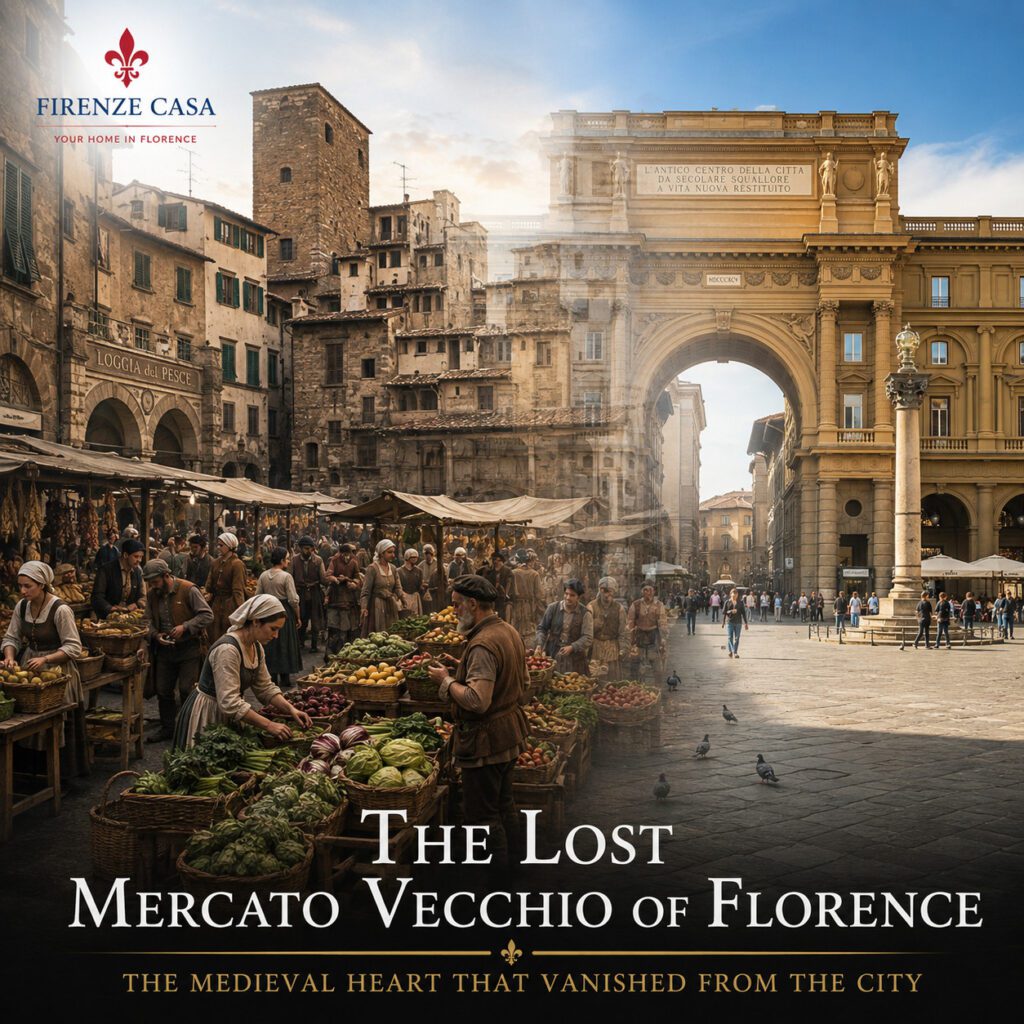
Mercato Vecchio Florence once occupied one of the busiest and most historic parts of the city. Where visitors now cross the spacious Piazza della Repubblica, medieval Florence was packed into a dense neighbourhood of narrow streets, market stalls, workshops, houses and towers.
Almost all of it disappeared during the dramatic redevelopment of Florence in the late nineteenth century. The old market vanished, streets were erased and buildings that had evolved over centuries gave way to a new vision of a modern European city.
Today, Piazza della Repubblica feels open and monumental. To understand what was lost, however, we have to imagine an entirely different Florence beneath it.
Historic site: Mercato Vecchio, Florence’s Old Market
Location: Present-day Piazza della Repubblica
Origins: Developed over the Roman forum of Florentia
Historic character: Market stalls, workshops, houses, towers and narrow streets
Demolished: During the late nineteenth-century redevelopment of central Florence
Visible today: Colonna dell’Abbondanza and surviving architectural fragments
Best for: Understanding Florence’s lost medieval city
Mercato Vecchio Florence – The Heart of the Old City
The Mercato Vecchio, or Old Market, was much more than a place to buy food and everyday goods. It formed the centre of a densely inhabited urban quarter that had developed over many centuries.
Merchants, craftsmen, residents and customers shared a maze of streets and small squares. Workshops opened directly onto busy lanes. Medieval towers rose between ordinary houses, while religious buildings and commercial spaces stood close together.
The result was probably chaotic by modern standards. Yet this density was characteristic of historic Florence.
The neighbourhood connected trade with everyday life. People did not travel to a separate commercial district and then return home. Buying, selling, working and living happened side by side.
A Market Built Over Roman Florence
The history of the site reaches much further back than the Middle Ages.
The Mercato Vecchio developed over the area of the ancient Roman forum of Florentia. The forum had occupied the centre of the Roman settlement at the intersection of its two principal streets, the cardo and decumanus.
That central position never completely lost its importance. Roman civic space gradually became part of the medieval city, and later generations continued to use the area as a centre of commerce and urban life.
The Column of Abundance in today’s Piazza della Repubblica still marks this historic centre. Elsewhere in Florence, the ancient city survives in equally unexpected ways: the curved streets around Via Torta still preserve the footprint of Florence’s lost Roman amphitheatre, while Via delle Terme preserves the memory of Roman baths hidden beneath Florence.
The centre of Roman Florentia, the medieval Mercato Vecchio and modern Piazza della Repubblica occupy essentially the same part of the city. The architecture changed dramatically, but the location remained central to Florence.
What Did the Mercato Vecchio Look Like?
Historical images of the Mercato Vecchio can be surprising for anyone familiar only with modern Florence.
Instead of the broad rectangular Piazza della Repubblica, there was a compact and irregular urban landscape. Buildings crowded close together. Narrow passages opened unexpectedly into small spaces filled with stalls, people and goods.
It was not the polished Renaissance Florence that dominates postcards today. The district represented the working city: noisy, crowded and constantly changing.
Among its architectural features was the Loggia del Pesce, designed by Giorgio Vasari in the sixteenth century. Fishmongers used the elegant loggia as part of a commercial environment that otherwise grew organically from centuries of urban development.
Nearby stood houses, workshops, medieval towers and religious buildings. The Jewish ghetto also occupied part of this central area.
The Jewish Ghetto and a Lost Neighbourhood
The disappearance of the Mercato Vecchio cannot be understood simply as the demolition of an old market. A much larger historic neighbourhood disappeared with it.
Florence’s Jewish ghetto had been established near the market in 1571 under Cosimo I de’ Medici. For centuries, this restricted district contained homes, shops, schools, baths and synagogues and became an important centre of Jewish life in the city.
By the nineteenth century, the former ghetto and Mercato Vecchio formed a complex urban environment containing structures from different periods of Florentine history.
When redevelopment began, this accumulated history was largely swept away together. Our article on Florence’s Lost Jewish Quarter explores the history of this vanished community and the neighbourhood that once stood beside the old market.
The transformation erased streets, homes, workshops, medieval buildings and much of the physical history of Florence’s former Jewish ghetto. Piazza della Repubblica therefore represents one of the most radical changes ever made to the historic centre.
Florence Becomes the Capital of Italy
The beginning of the end for the old district came with an extraordinary change in Florence’s political status.
In 1865, Florence became the capital of the recently unified Kingdom of Italy. Although the capital moved to Rome in 1871, the period triggered ambitious plans to modernise the city.
Florence suddenly had to present itself as the capital of a modern European state. New boulevards, public buildings and infrastructure changed its appearance.
The old centre increasingly appeared incompatible with this vision.
Narrow streets, crowded housing and poor sanitary conditions provided powerful arguments for redevelopment. Supporters described the transformation as a necessary risanamento – literally a process of making the city healthier.
But modernisation came at an enormous historical cost.
The Destruction of Mercato Vecchio
During the 1880s and 1890s, large sections of the historic centre around the old market were demolished.
The changes went far beyond clearing individual unsafe buildings. Entire blocks disappeared. Ancient street patterns were erased, and structures representing centuries of Florentine history were removed.
The Mercato Vecchio Florence that generations had known ceased to exist.
Some architectural elements were saved, but most could not be preserved within the new urban plan. Vasari’s Loggia del Pesce was dismantled and eventually reconstructed elsewhere in Florence.
The transformation created the large open space that became today’s Piazza della Repubblica.
The Controversial Risanamento of Florence
The redevelopment remains one of the most debated episodes in Florence’s modern urban history.
There were genuine problems in the old district. Overcrowding and sanitation were serious concerns in nineteenth-century European cities, and Florence was no exception.
Yet critics argued that improvement did not require the destruction of so much historic fabric.
The project reflected contemporary ideas about what a modern city should look like. Broad spaces, monumental architecture and orderly streets were preferred to the irregular complexity inherited from the Middle Ages.
What one generation considered unhealthy and obsolete, later generations came to recognise as irreplaceable urban history.
The contrast becomes particularly clear in nearby Via delle Terme, which escaped the most radical phase of the Risanamento and still preserves a far more intimate historic streetscape.
Was the redevelopment necessary modernisation or an unnecessary destruction of historic Florence? The answer is not simple. Sanitary problems were real, but the scale of demolition permanently erased an extraordinary part of the medieval city.
From Mercato Vecchio to Piazza della Repubblica
The contrast between the old market and the new square could hardly have been greater.
The former neighbourhood had been dense, irregular and intimate. Its replacement was spacious, symmetrical and monumental.
The large triumphal arch and surrounding buildings gave the new square the architectural language expected of a prosperous nineteenth-century city. Vincenzo Micheli’s monumental portico, completed in the 1890s, became one of its defining features.
Cafés and elegant commercial establishments gradually replaced the market stalls and workshops that had characterised the old district.
Florence had gained a modern public square. It had also lost a neighbourhood that could never be reconstructed. Our guide to Piazza della Repubblica follows the complete history of the square from Roman Florentia to the modern city.
What Survived from the Old Market?
Very little remains in its original context, which makes the surviving traces particularly interesting.
The Column of Abundance continues to mark the ancient centre of the area. Although altered and restored over time, it provides an important visual connection between the modern square and its earlier history.
The Loggia del Pesce had a more complicated fate. After being dismantled during the redevelopment, it was eventually reconstructed in Piazza dei Ciompi.
Fragments and objects removed during the demolitions also entered museums and collections.
Yet isolated architectural pieces cannot recreate the neighbourhood itself. What disappeared was not simply a collection of old buildings. It was the relationship between streets, houses, businesses and people.
The Mercato Centrale Replaces the Old Market
Florence did not abandon the idea of a central food market when the old district disappeared.
New covered markets formed part of the nineteenth-century modernisation programme. The most important was the Mercato Centrale near San Lorenzo, designed by Giuseppe Mengoni and inaugurated in 1874.
Its iron, glass and masonry construction represented a completely different approach to urban commerce. Instead of market activity spreading organically through medieval streets, vendors could operate within a purpose-built modern structure.
The Mercato Centrale therefore represents more than a new market building. It reflects the transition between two different ideas of the city.
Standing in Piazza della Repubblica Today
Piazza della Repubblica is now one of the most recognisable spaces in central Florence. Historic cafés, restaurants and shops surround an open square crossed by residents and visitors throughout the day.
Nothing immediately communicates the density of the neighbourhood that once occupied the same ground.
This makes the square particularly fascinating for anyone interested in Florence’s hidden history.
Imagine removing the nineteenth-century façades. Replace the open space with narrow lanes. Add market stalls, workshops, medieval houses, towers and crowds moving through confined passages.
Then add another largely invisible layer: immediately beside the market stood the former Jewish quarter of Florence, whose streets, homes and synagogues disappeared during the same transformation.
The change is almost impossible to comprehend without historical photographs, drawings and maps. Yet this vanished Florence existed until surprisingly recently.
Stand near the Column of Abundance and forget the modern cafés for a moment. You are standing at the historic heart of Florence, where the Roman forum and later the Mercato Vecchio shaped city life for centuries.
Mercato Vecchio as Part of Hidden Florence
The lost market belongs to a larger group of places where Florence’s past survives without an obvious monument. These stories are collected in our Hidden Stories of Florence.
Some vanished places survive through the shape of streets, as with the lost Roman amphitheatre around Via Torta. Others survive through names and archaeological evidence, as in Via delle Terme. Mercato Vecchio is different again: the neighbourhood disappeared almost completely, but the modern square that replaced it makes the scale of that loss unusually easy to understand.
Together, these places reveal a Florence beyond the familiar Renaissance monuments – a city that has repeatedly rebuilt itself while leaving fragments of earlier worlds behind.
Why the Lost Mercato Vecchio Matters
The story of Mercato Vecchio Florence is not simply a nostalgic tale about an attractive old market that disappeared.
It raises a question every historic city eventually faces: how much of the past should be preserved when the needs of the present change?
Nineteenth-century Florence chose transformation. The decision produced some of the streets and public spaces that now seem inseparable from the city.
But it also destroyed physical evidence of centuries of everyday life.
The Renaissance masterpieces survived elsewhere. What disappeared here was largely the Florence of merchants, craftsmen, shopkeepers, residents and small communities whose buildings seemed less worthy of protection at the time.
That is precisely why the loss matters.
Why the Lost Mercato Vecchio Is Worth Discovering
The lost Mercato Vecchio is worth discovering because it changes the way you see Piazza della Repubblica. What appears today to be an elegant nineteenth-century square occupies one of the oldest and most continuously important parts of Florence.
Beneath the open piazza lies the memory of the Roman forum. Above it grew the medieval Mercato Vecchio, surrounded by generations of buildings, workshops and streets. The Jewish ghetto added another important layer to the neighbourhood before almost the entire district disappeared during the nineteenth-century redevelopment.
Florence is often celebrated for what it preserved. Mercato Vecchio reminds us that understanding the city also requires remembering what it lost.
Few places demonstrate that more powerfully than Piazza della Repubblica.
Further Reading on Firenze Casa
- Hidden Stories of Florence
- Florence’s Lost Jewish Quarter
- Florence’s Lost Roman Amphitheatre
- Via delle Terme – The Roman Baths Hidden Beneath Florence
- Piazza della Repubblica – Florence’s Historic Central Square
- Mercato Centrale – Florence’s Historic Central Market
- Florence’s Medieval Trades Hidden in Its Street Names
- Via dell’Inferno – The Story Behind Florence’s Street of Hell
References
- Comune di Firenze / FeelFlorence – historical documentation on Piazza della Repubblica, the Mercato Vecchio and the nineteenth-century redevelopment of the historic centre.
- Comune di Firenze / FeelFlorence – resources on Florence’s historic markets and the construction of the Mercato Centrale during the period of Firenze Capitale.
- Fondazione MUS.E – historical and archaeological resources concerning Roman Florentia and the ancient forum beneath today’s Piazza della Repubblica.
- Archivio Storico del Comune di Firenze – historical maps, photographs and documentation relating to the Mercato Vecchio and the nineteenth-century risanamento.
- Fanelli, Giovanni – studies on the architecture, urban development and historical topography of Florence.

