
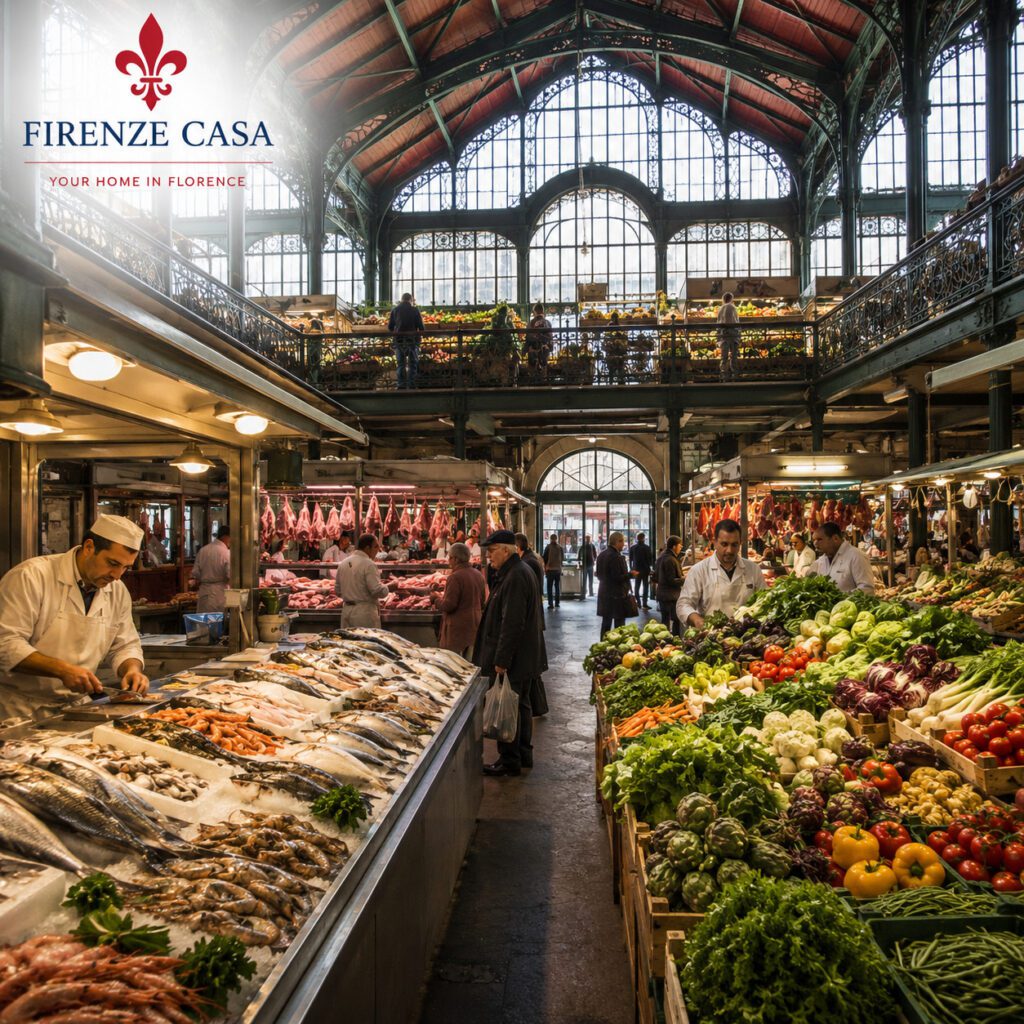
Mercato Centrale Florence is both a historic food market and one of the clearest symbols of the city’s nineteenth-century transformation. Opened in 1874 in the San Lorenzo district, its monumental iron-and-glass hall brought food traders together beneath one purpose-built roof.
Today, the building combines traditional market stalls with a contemporary food hall, but its history remains closely connected with something much simpler: supplying Florence with the ingredients of everyday life. For the wider story of the city’s markets, see our Historic Food Markets of Florence – Complete Guide.
Opened: 1874
Architect: Giuseppe Mengoni
District: San Lorenzo
Architecture: Iron, glass and masonry
Ground floor: Traditional food market
Upper floor: Contemporary food hall
Best time to visit: Morning
Look for: Cheese, salumi, vegetables, meat, fish, bread and other Tuscan ingredients
📑 Contents – Explore This Article
- Why Florence Needed a Central Market
- The Construction of Mercato Centrale
- Giuseppe Mengoni and the Architecture
- Mercato Centrale and San Lorenzo
- What Was Sold at the Market?
- Mercato Centrale in the Twentieth Century
- Mercato Centrale Today
- What to Notice When You Visit
- Mercato Centrale and Florence’s Other Markets
- Frequently Asked Questions
Why Florence Needed a Central Market
For centuries, Florentines bought food from street vendors, specialised shops and markets scattered throughout the city. Farmers and merchants brought vegetables, grain, livestock, cheese and other products into Florence from the surrounding countryside.
By the nineteenth century, however, the city was growing and attitudes towards public health, traffic and urban organisation were changing. Municipal authorities increasingly favoured purpose-built covered markets that could bring numerous traders together in cleaner and more manageable surroundings.
This transformation accelerated after Florence became capital of the Kingdom of Italy in 1865. Although the capital moved to Rome in 1871, the brief period profoundly changed the city through new infrastructure, streets and public buildings.
Mercato Centrale emerged from this wider programme of modernisation.
Mercato Centrale belongs to the Florence of the nineteenth century rather than the Renaissance. Understanding the building means seeing Florence as a growing modern city that needed new solutions for transport, sanitation and food distribution.
The Construction of Mercato Centrale
Florence commissioned architect Giuseppe Mengoni to design the new market in San Lorenzo. The building opened in 1874 and represented a striking departure from the stone palaces and churches for which the city was famous.
Mengoni combined iron, glass and masonry to create a spacious, well-lit interior. The structure allowed many specialised food sellers to work beneath one roof while providing better circulation and ventilation than the crowded street markets it helped replace.
The building therefore expressed both architectural ambition and practical municipal planning.
Giuseppe Mengoni and a New Architecture for Florence
Giuseppe Mengoni was one of the most important Italian architects associated with large-scale commercial architecture during the nineteenth century. His best-known work is Milan’s Galleria Vittorio Emanuele II.
At Mercato Centrale, the iron framework made broad interior spaces possible while extensive glazing brought natural light into the hall. The high roof gave the building an almost industrial grandeur quite unlike Florence’s older commercial streets.
Function shaped the design. Traders required space, shoppers needed accessible aisles and perishable foods benefited from improved light and ventilation.
The market stalls naturally attract attention, but the roof and iron structure are equally important. Mercato Centrale belongs to the same architectural age that produced Europe’s great railway stations, exhibition halls and covered markets.
Mercato Centrale and San Lorenzo
The location in San Lorenzo was not accidental. The district already had a strong commercial identity, with workshops, shops, traders and busy streets close to the centre of Florence.
The new covered market strengthened that role while changing the organisation of local food commerce. Traders moved into the hall, while commercial activity continued in the surrounding streets.
That distinction remains visible today. Mercato di San Lorenzo refers largely to the surrounding outdoor street market, now associated mainly with leather goods, clothing and souvenirs, while Mercato Centrale remains the covered food market.
Mercato Centrale and Mercato di San Lorenzo are next to one another but offer very different experiences. Enter the covered hall for food; explore the surrounding streets for the outdoor market.
What Was Sold at Mercato Centrale?
Historically, the market centred on the everyday ingredients needed by Florentine households and food businesses. Fruit and vegetables came from farms around the city, while butchers supplied meat and poultry.
Cheese, cured meats, legumes, bread and other staples filled the stalls according to season and availability. Through these products, Mercato Centrale connected urban Florence directly with producers throughout the Tuscan countryside.
Many ingredients remain strongly associated with regional cooking today. Visitors will encounter Tuscan salumi, pecorino, beans, vegetables and other products that appear throughout traditional Florentine cuisine.
Tuscan Bread
Traditional Tuscan bread is especially distinctive because it contains no added salt. Its restrained flavour works particularly well with mature cheese, cured meat and olive oil.
Cheese and Salumi
Pecorino and regional cured meats provide another useful introduction to Tuscan food. Comparing different ages of cheese or several salumi side by side reveals far more variety than a generic “Tuscan platter” might suggest.
Seasonal Produce
Vegetable stalls also demonstrate the importance of seasonality. Artichokes, tomatoes, leafy greens, mushrooms and other produce change throughout the year, reflecting the agricultural rhythm behind many Tuscan dishes.
The Market and Everyday Florentine Life
Mercato Centrale was created for residents, not for sightseeing. People came because they needed vegetables for dinner, meat for a Sunday meal or bread and cheese for the household.
That practical function is central to the building’s historical importance. Markets document ordinary life in a way that palaces and museums rarely can.
Regular customers developed relationships with individual vendors, while shopping also became a social activity in which recipes, news and advice circulated alongside food.
Mercato Centrale in the Twentieth Century
The twentieth century brought major changes to food shopping. Refrigeration improved, supermarkets expanded and large-scale distribution gradually transformed how urban residents bought groceries.
Traditional markets across Europe faced similar pressures. Mercato Centrale nevertheless survived, supported by its central location, architectural importance and continuing relationship with food commerce.
At the same time, tourism increasingly influenced San Lorenzo and changed the economic character of the surrounding district.
Mercato Centrale Today
Today, Mercato Centrale contains two noticeably different worlds.
The Ground Floor
The ground floor retains the traditional market function, with traders selling vegetables, meat, fish, cheese, salumi and other foods. This is the part of the building most closely connected with its historical purpose.
Visitors interested in Florentine ingredients should spend time here rather than treating the market simply as somewhere to eat lunch.
The Upper Food Hall
The upper level follows a contemporary food-hall concept with prepared dishes and a broad selection of culinary offerings.
It provides a convenient place to eat but represents a different interpretation of market culture from the traditional food stalls downstairs.
Visit the ground floor while the traditional stalls are active before heading upstairs. The two levels tell very different stories about what a food market means in Florence today.
Market or Tourist Attraction?
Mercato Centrale now functions as both. Visitors arrive because of its history, architecture and food, while traditional retail continues on the ground floor.
This evolution is not unique to Florence. Historic markets across Europe increasingly combine local commerce, tourism, gastronomy and cultural heritage.
The most useful way to understand Mercato Centrale is therefore not to ask whether it is “authentic” or “touristic”. It is both a historic market adapting to contemporary Florence and a building whose original purpose remains visible.
What to Notice When You Visit
Begin with the building itself. Look at the iron columns, high roof and extensive glazing before focusing entirely on the food stalls.
Then observe how specialised vendors share one large interior. This organisation reflects the nineteenth-century idea of concentrating food commerce within a controlled municipal space.
Finally, pay attention to the ingredients rather than only prepared foods. Cheese, salumi, vegetables, meat and bread provide a direct connection with the Tuscan cooking explored in our Florentine and Tuscan Food – Complete Guide.
Morning is usually the most interesting time to experience the traditional market stalls. Opening hours can change, especially around holidays, so check current information before making a special journey.
Mercato Centrale and Florence’s Other Historic Markets
Mercato Centrale formed part of a broader nineteenth-century attempt to reorganise food distribution in Florence. Other markets developed alongside it and eventually acquired very different identities.
Mercato di Sant’Ambrogio remains more closely connected with neighbourhood shopping, while San Lorenzo developed into a street market dominated by non-food goods.
Comparing the markets is therefore more revealing than searching for one “best” example. Each reflects a different relationship between commerce, neighbourhood life and tourism.
Our Historic Food Markets of Florence – Complete Guide compares Mercato Centrale with Sant’Ambrogio, Cascine, San Lorenzo and San Frediano.
Why Mercato Centrale Matters
Mercato Centrale documents the moment when Florence began organising everyday life according to the needs of a modern nineteenth-century city. Its architecture used new materials, while its layout reflected changing ideas about public infrastructure, hygiene and food distribution.
At the same time, the ingredients sold beneath its roof maintained much older connections with the Tuscan countryside and regional cooking.
That combination makes the building unusual. Mercato Centrale is simultaneously an architectural monument, a functioning food market and a record of how Florence adapted to modernity.
Frequently Asked Questions
When did Mercato Centrale open?
Mercato Centrale opened in 1874 during the major nineteenth-century transformation of Florence.
Who designed Mercato Centrale?
Architect Giuseppe Mengoni designed the market. He is also famous for Milan’s Galleria Vittorio Emanuele II.
Is Mercato Centrale still a real food market?
Yes. Traditional food traders continue to operate on the ground floor, while the upper level functions as a contemporary food hall.
What is the difference between Mercato Centrale and San Lorenzo Market?
Mercato Centrale is the covered food market. Mercato di San Lorenzo refers mainly to the surrounding outdoor street market with clothing, leather goods and souvenirs.
What should I look for at Mercato Centrale?
Look for seasonal vegetables, pecorino, salumi, meat, fish, bread and other ingredients associated with Tuscan cooking.
When is the best time to visit?
Morning is generally best if you want to see the traditional food stalls active and experience the market closest to its original function.
Is Mercato Centrale worth visiting if I am not buying food?
Yes. The iron-and-glass architecture alone makes the building an important example of nineteenth-century Florence.
Why Mercato Centrale Is Worth Visiting
Mercato Centrale offers a perspective on Florence that differs sharply from its Renaissance monuments. Its iron-and-glass structure tells the story of a city embracing nineteenth-century technology, while the stalls beneath it preserve a connection with everyday food culture.
Spend time on the ground floor, look carefully at the architecture and compare the traditional market with the contemporary food hall above.
The result is more than a place to eat or shop. Mercato Centrale shows how Florence transformed itself into a modern city without completely losing its relationship with the Tuscan countryside that continued to feed it.
Further Reading on Firenze Casa
- The Historic Food Markets of Florence – Complete Guide
- Mercato di Sant’Ambrogio – Florence’s Authentic Food Market
- Mercato di San Lorenzo – From Food Market to Florence Street Market
- Mercato di San Frediano – The Neighbourhood Market of the Oltrarno
- Florentine and Tuscan Food – Complete Guide
- Tuscan Bread – Why Tuscany’s Bread Has No Salt
- Tuscan Salumi: Traditional Cured Meats of Tuscany
References
- Comune di Firenze – Historical information on Florence’s markets and nineteenth-century urban development.
- Mercato Centrale Firenze – Historical information on the market and its development.
- Archivio Storico del Comune di Firenze – Material on Florence during the nineteenth century.
- Fanelli, Giovanni – Firenze: Architettura e città.
- Macadam, Alta – Florence, Blue Guides.
- Hibbert, Christopher – Florence: The Biography of a City.

