

Tuscan bread is famous for one surprising characteristic: it contains no salt. Traditional Pane Toscano DOP combines wheat flour, water and natural leavening to produce a rustic loaf whose deliberately mild flavour distinguishes it from most Italian breads.
That neutral character makes sense at the Tuscan table, where bread accompanies salty salumi, mature cheese, robust olive oil and strongly flavoured dishes. It also forms the basis of classics such as ribollita, pappa al pomodoro and panzanella. For the wider culinary context, see our Florentine and Tuscan Food – Complete Guide.
Traditional name: Pane Toscano DOP
Defining feature: No added salt
Ingredients: Wheat flour, water and natural leavening
Texture: Rustic crust with a structured crumb
Classic uses: Ribollita, pappa al pomodoro, panzanella and crostini
Best companions: Olive oil, pecorino and Tuscan salumi
What Is Tuscan Bread?
Pane Toscano DOP is the protected traditional bread of Tuscany. Its defining characteristic is the absence of salt, which gives it a mild flavour and makes it particularly suitable for accompanying the region’s more intensely seasoned foods.
The bread is generally made in substantial loaves with a rustic crust and structured interior. As it ages, the crumb becomes firmer rather than immediately disintegrating, which helps explain its importance in traditional bread-based dishes.
Authentic Pane Toscano DOP is protected under the European Protected Designation of Origin system. Therefore, bread carrying the name must comply with an official production specification and geographical requirements.
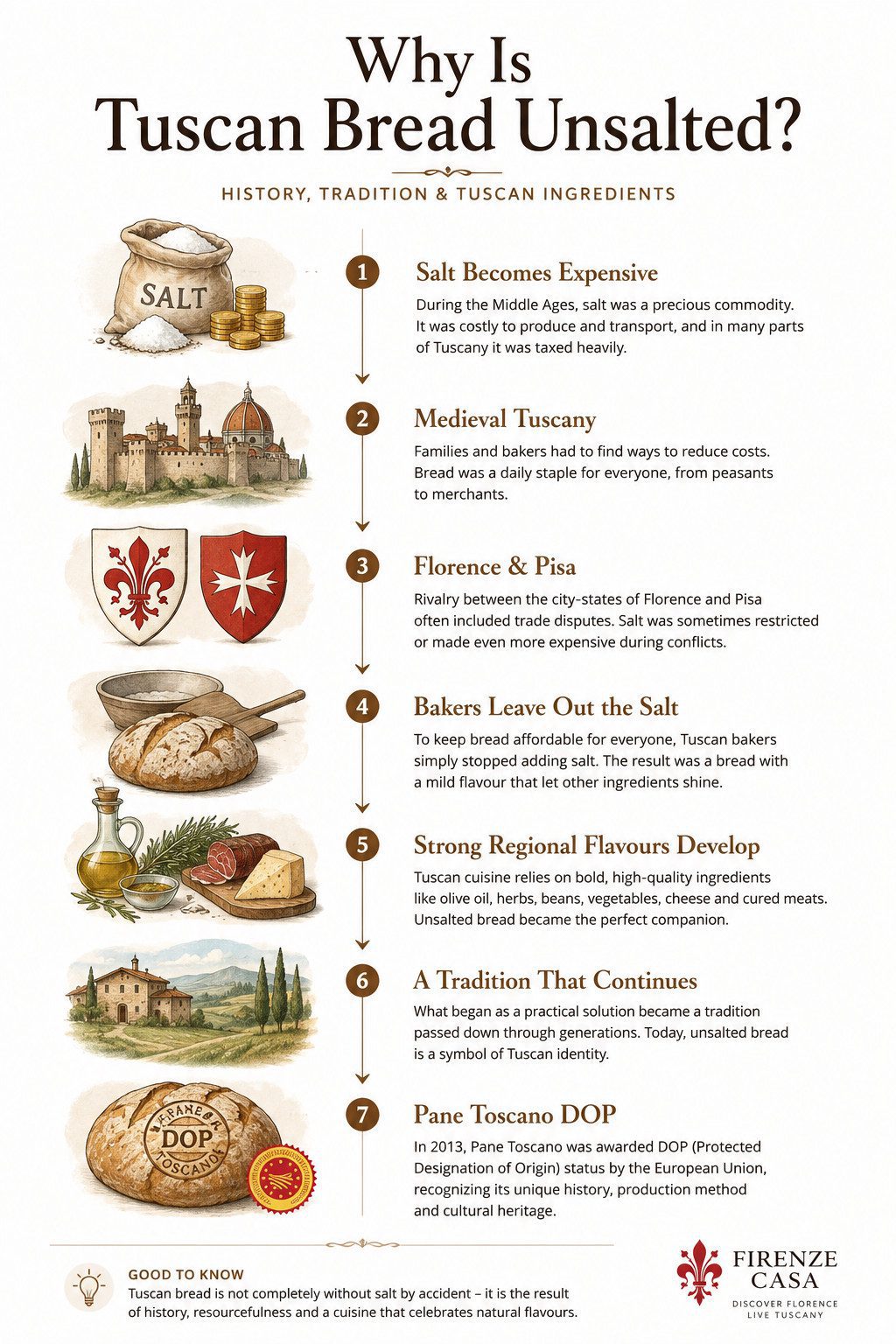
Why Is Tuscan Bread Unsalted?
The short answer is that nobody can identify one single proven historical reason. Instead, several explanations surround Tuscany’s long tradition of baking bread without salt.
The most famous story concerns medieval rivalry between Florence and Pisa. According to popular tradition, Pisa controlled access to salt through its maritime trade and either restricted supplies or made salt prohibitively expensive during periods of conflict. Florentines supposedly responded by baking bread without it.
It is a memorable explanation, but the story is difficult to establish as historical fact. Salt was certainly valuable and frequently taxed, yet Tuscany’s unsalted bread probably developed through a more complex combination of economics, local baking customs and changing food habits.
Whatever its precise origin, the practice became deeply established. Over time, the mild bread also fitted naturally with a cuisine rich in salty cured meats, cheese and strongly flavoured accompaniments.
The story that Florence began baking saltless bread because of a dispute with Pisa is part of Tuscan culinary folklore. It is best enjoyed as a traditional explanation rather than treated as a securely documented historical event.
The History of Tuscan Bread
Bread has been fundamental to Tuscan food for centuries, particularly because grain-based foods provided an essential source of everyday nourishment. Salt, meanwhile, was valuable both as a seasoning and as a means of preserving food.
By the later medieval and early modern periods, bread without salt had become sufficiently characteristic of central Italian food culture to attract comment. One famous literary reference appears in Dante’s Divine Comedy, where exile is described through the bitterness of eating another person’s “salty bread”. The passage does not explain the origin of Tuscan bread, but it is often cited as evidence of the cultural contrast between Tuscan saltless bread and bread elsewhere.
As generations became accustomed to the flavour, unsalted bread developed from a practical regional custom into a defining feature of Tuscan cuisine.
What Is Pane Toscano DOP?
DOP stands for Denominazione di Origine Protetta, or Protected Designation of Origin. The European system protects foods whose characteristics and production are closely connected with a defined geographical area.
Pane Toscano received DOP protection in 2016. Its official specification regulates the ingredients, production area and preparation required for bread sold under the protected name.
The specification preserves more than the absence of salt. Authentic Pane Toscano DOP also depends on defined flour characteristics and natural leavening, helping maintain the identity of the traditional loaf.
Not every unsalted loaf sold in Tuscany is automatically Pane Toscano DOP. The protected name applies only to bread produced according to the official DOP specification.
How Tuscan Bread Is Made
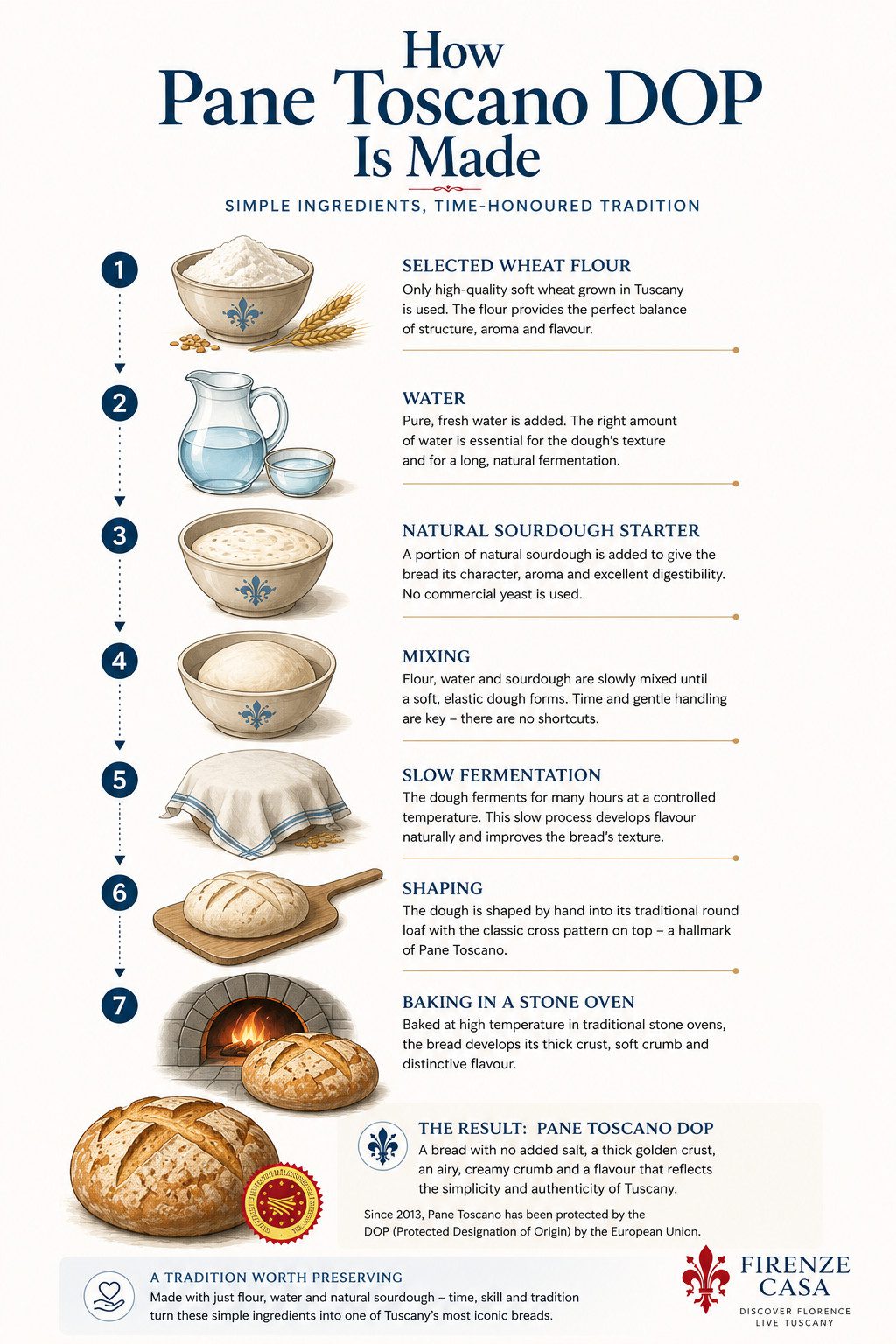
The ingredients are simple, but good bread depends heavily on fermentation, dough handling and baking. Traditional Pane Toscano uses natural leavening rather than relying on salt for flavour.
- Preparing the leaven – Natural starter provides fermentation and contributes aroma and structure.
- Mixing the dough – Flour and water are combined with the leaven, without adding salt.
- Fermentation – Time allows the dough to develop flavour and structure.
- Shaping – The dough is formed into the characteristic substantial loaves.
- Baking – Baking develops the crust while setting the structured crumb.
- Cooling – The loaf cools before slicing or sale.
The result is intentionally rustic rather than delicate. Moreover, the bread remains useful as it becomes firm, which has helped make older loaves an ingredient in their own right.
Why Tuscan Bread Works with Tuscan Food
The absence of salt becomes much easier to understand when the bread is eaten with traditional regional ingredients. Pecorino Toscano, prosciutto, finocchiona and other Tuscan salumi already provide plenty of seasoning.
Unsalted bread therefore offers contrast rather than competition. Similarly, its restrained flavour provides an excellent base for tasting Tuscan extra virgin olive oil, whose bitterness, fruitiness and peppery character remain clearly perceptible.
This relationship between bread and other ingredients is explored more broadly in our guide to The Role of Bread in Tuscan Cuisine.
From Stale Bread to Tuscan Classics
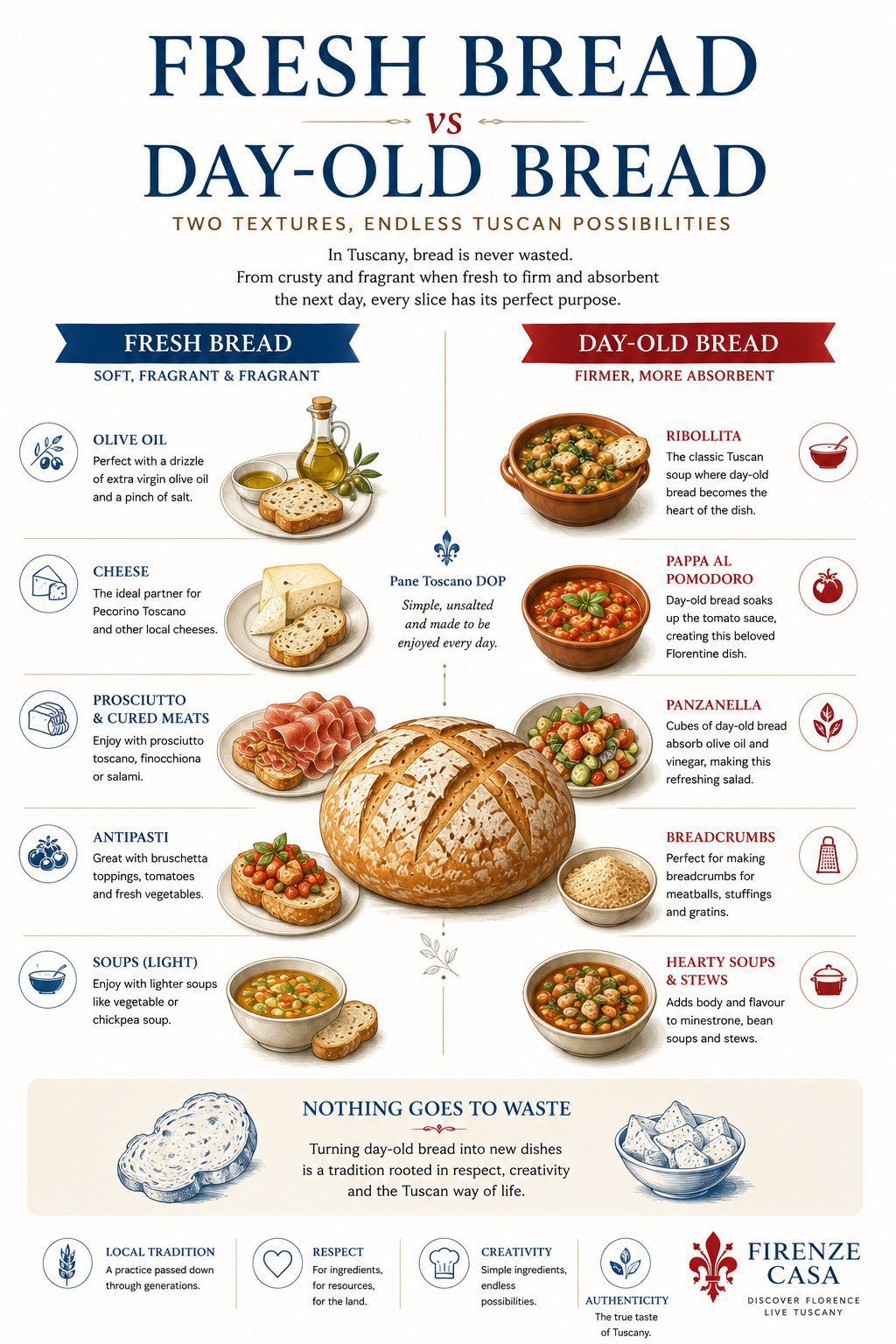
Historically, bread was too valuable to discard simply because it had become firm. Tuscan cooks instead developed dishes in which older bread could absorb broth, tomatoes, vegetables and olive oil.
This resourcefulness is closely connected with cucina povera: a culinary tradition built around using available ingredients intelligently and wasting as little as possible.
Ribollita
Ribollita combines bread with beans and vegetables, especially cavolo nero. Its name means “reboiled”, reflecting the tradition of reheating an already prepared vegetable soup.
Pappa al Pomodoro
Pappa al pomodoro transforms bread, tomatoes, garlic, basil and olive oil into a thick dish whose texture depends on the bread breaking down into the tomato mixture.
Panzanella
Panzanella gives old bread a summer identity. Tomatoes, onion, basil, olive oil and softened bread create a refreshing dish based on seasonal ingredients.
Crostini Toscani
Crostini Toscani use slices of bread as a base for savoury toppings. The classic Florentine version with chicken livers remains particularly associated with traditional Tuscan antipasti.

How to Enjoy Tuscan Bread
Fresh Tuscan bread is particularly good when combined with ingredients that provide salt, richness or aromatic intensity.
- With extra virgin olive oil: one of the simplest ways to appreciate both the bread and the oil.
- With Pecorino Toscano: the mild bread balances the cheese’s saltier, more concentrated flavour.
- With prosciutto or finocchiona: a natural combination for an informal snack or antipasto.
- With soups: the structured crumb absorbs liquid while adding body.
- As crostini: toasted slices provide a base for liver, vegetables, cheese or other toppings.
Butter is not the traditional default accompaniment. Instead, olive oil and other regional ingredients play the leading role.
Where to Buy Tuscan Bread in Florence
Neighbourhood bakeries, or forni, are the most obvious places to look for fresh Tuscan bread. However, visitors can also find regional breads in food markets, specialist shops and supermarkets.
Mercato Centrale provides a convenient introduction to Tuscan food products in the historic centre. Traditional neighbourhood markets can offer a more everyday perspective on how Florentines shop for bread and other ingredients.
If you specifically want Pane Toscano DOP, look for the protected name and DOP identification rather than assuming that every unsalted Tuscan-style loaf carries the certification.
Buy enough bread to try it twice: fresh with olive oil or salumi, then again a day or two later in a traditional bread-based dish. Its changing texture is part of what makes Tuscan bread so versatile.
Tuscan Bread at a Glance
| Characteristic | Pane Toscano |
|---|---|
| Salt | Traditionally none |
| Leavening | Natural fermentation |
| Flavour | Mild and deliberately neutral |
| Typical accompaniments | Olive oil, cheese and salumi |
| Traditional cooked uses | Ribollita, pappa al pomodoro and panzanella |
| Protected version | Pane Toscano DOP |
Frequently Asked Questions
Why is Tuscan bread made without salt?
No single explanation has been conclusively established. Medieval salt costs, taxation and the traditional story of conflict between Florence and Pisa are among the explanations associated with the custom.
What is Pane Toscano DOP?
Pane Toscano DOP is a protected Tuscan bread produced according to an official geographical and production specification. It received European DOP protection in 2016.
Does Tuscan bread taste bland?
On its own, it tastes noticeably mild. However, that neutrality works particularly well with olive oil, cheese, cured meats and strongly flavoured Tuscan dishes.
Is all unsalted bread in Tuscany Pane Toscano DOP?
No. Only bread complying with the official production specification can use the protected Pane Toscano DOP name.
Why does Tuscan cuisine use stale bread?
Older bread remains useful because it absorbs liquid well and adds texture and substance to dishes. Historically, reusing it also avoided wasting an important staple food.
Which Tuscan dishes use old bread?
Ribollita, pappa al pomodoro and panzanella are among the best-known examples. Bread also forms the base of traditional crostini.
Why Tuscan Bread Is Worth Trying
Tuscan bread makes the most sense when experienced as part of a meal rather than judged on its own. Its lack of salt creates space for olive oil, pecorino, salumi, soups and other strongly flavoured foods.
At the same time, its ability to move from fresh table bread to an ingredient in ribollita or panzanella reveals something fundamental about traditional Tuscan cooking: good food does not require waste.
What initially seems like an unusual omission therefore becomes one of the clearest expressions of Tuscany’s culinary identity.
Further Reading on Firenze Casa
- Florentine and Tuscan Food – Complete Guide
- The Role of Bread in Tuscan Cuisine
- Cucina Povera Explained: The Philosophy Behind Tuscan Cooking
- Tuscan Extra Virgin Olive Oil – A Guide to Tuscany’s Liquid Gold
- Tuscan Cheese: A Guide to Traditional Cheeses of Tuscany
- Tuscan Salumi: Traditional Cured Meats of Tuscany
- Tuscan Antipasti – The Perfect Start to Every Meal
- Mercato Centrale – Florence’s Historic Central Market
References
- Consorzio di Tutela del Pane Toscano DOP.
- European Commission – eAmbrosia Geographical Indications Register.
- Regione Toscana – Traditional Food Products.
- Accademia Italiana della Cucina.
- Ministero dell’Agricoltura, della Sovranità Alimentare e delle Foreste (MASAF).
- Dante Alighieri – Divine Comedy, Paradiso, Canto XVII.

