

Tuscan Extra Virgin Olive Oil is one of the defining ingredients of the region’s cuisine. Known for fresh aromas, characteristic bitterness and a peppery finish, high-quality Tuscan oil brings together agriculture, landscape and an exceptionally simple approach to cooking.
It appears everywhere from fettunta and bean dishes to soups, vegetables and grilled meat. Yet understanding Tuscan olive oil also means knowing how it is produced, what “extra virgin” actually means and why freshness matters so much. For the wider culinary context, see our Florentine and Tuscan Food – Complete Guide.
Product: Extra Virgin Olive Oil (EVOO)
Typical character: Fruity, bitter and peppery
Harvest: Mainly autumn, often October and November
Key principle: Healthy olives processed quickly after harvest
Protected origin: Toscano IGP and several Tuscan DOP oils
Classic tasting: Fresh oil on toasted Tuscan bread
Why Olive Oil Matters in Tuscan Cuisine
Olive oil is both a cooking ingredient and a finishing condiment in Tuscany. A drizzle added just before serving can transform beans, vegetables, soups or grilled meat while preserving the oil’s fresh aromas.
This fits naturally with a cuisine that often depends on relatively few ingredients. Rather than hiding them beneath elaborate sauces, traditional Tuscan cooking allows bread, vegetables, legumes, meat and herbs to retain their individual character.
Extra virgin olive oil connects these ingredients. It adds richness, aroma and sometimes a distinctly bitter or peppery contrast without requiring complicated preparation.
This simplicity is closely related to the philosophy explored in our guide to Cucina Povera.
Olive Growing in Tuscany
Olive cultivation has ancient roots in central Italy and developed over many centuries alongside other Mediterranean crops. The Tuscan landscape familiar today, however, is the result of a long and changing agricultural history rather than one uninterrupted tradition stretching unchanged from antiquity to the present.
Olive trees became particularly important because their fruit produced a valuable and versatile oil. Historically, olive oil served culinary purposes but could also be used for lighting and other practical needs.
Over time, olive groves became characteristic features of many parts of the Tuscan countryside. Today, they remain closely associated with landscapes around Florence, Chianti and other areas of the region.
Olive oil has a long history in Tuscany, but today’s production combines inherited agricultural knowledge with modern milling technology and strict contemporary quality standards.
How Tuscan Extra Virgin Olive Oil Is Made
Producing high-quality extra virgin olive oil depends on much more than simply pressing olives. Fruit condition, harvest timing, transport, milling and storage all influence the finished oil.
Harvesting the Olives
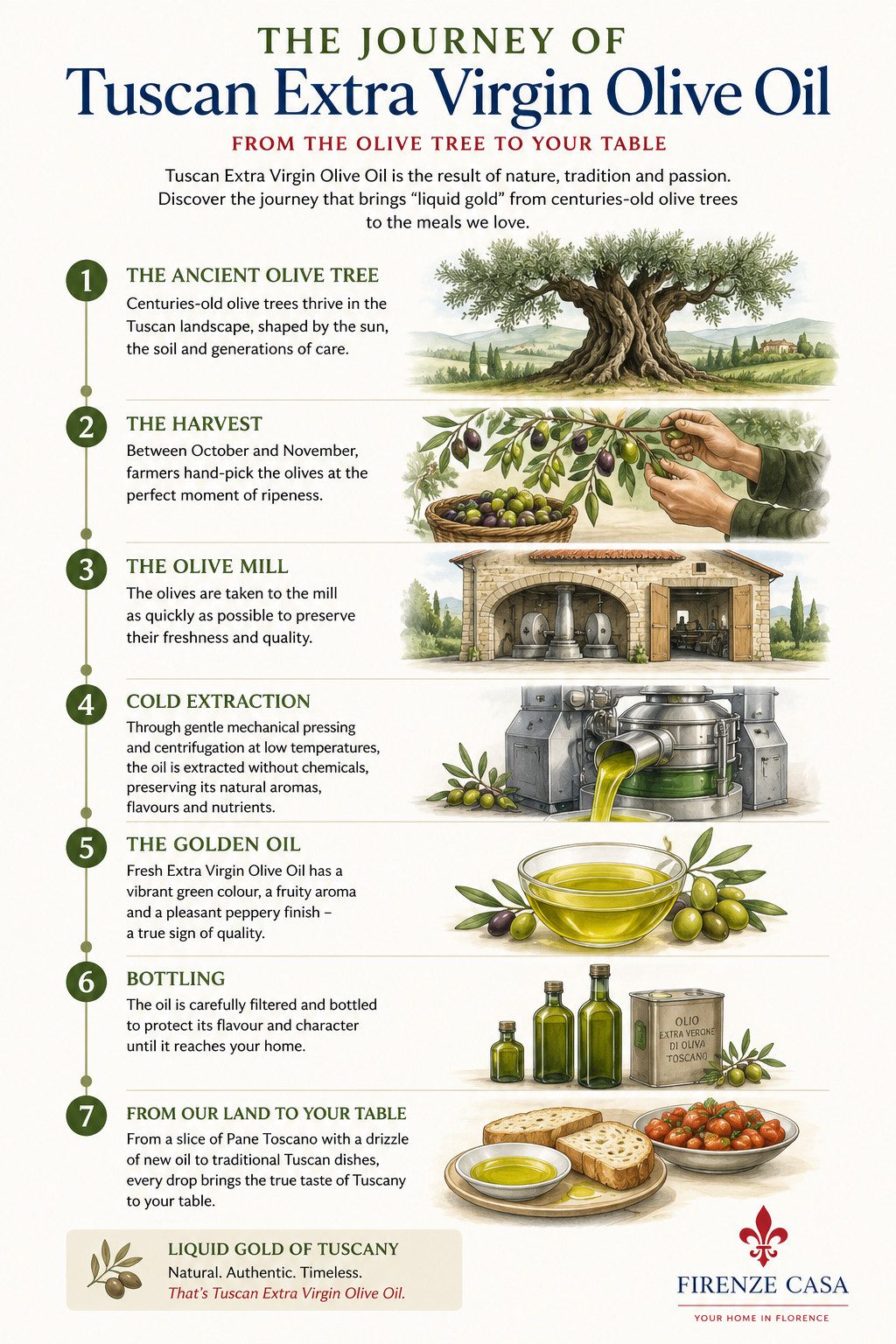
The Tuscan olive harvest generally takes place in autumn, often during October and November, although timing varies according to weather, location, cultivar and the style of oil a producer wants to achieve.
Olives intended for premium oils are frequently harvested before reaching complete ripeness. Earlier harvesting generally produces less oil, but it can contribute to fresher aromas, greater bitterness and pungency, and higher concentrations of certain phenolic compounds.
Hand harvesting and mechanical combs are both used. What matters particularly for quality is avoiding damaged fruit and transporting the olives promptly in suitable containers.
From Olive to Oil
At the mill, olives are cleaned and crushed into a paste containing the flesh, skin and stone. The paste then undergoes malaxation, during which small droplets of oil combine and become easier to separate.
Modern centrifuges separate the oil from water and solid material. Extra virgin olive oil must be obtained by mechanical or other physical means under conditions that do not alter the oil.
Rapid processing after harvest helps reduce deterioration and preserve desirable aromas and flavours.
What Does “Extra Virgin” Actually Mean?
Extra virgin is a regulated quality category, not simply a marketing expression. The oil must be obtained directly from olives through mechanical or physical processes and meet defined chemical and sensory requirements.
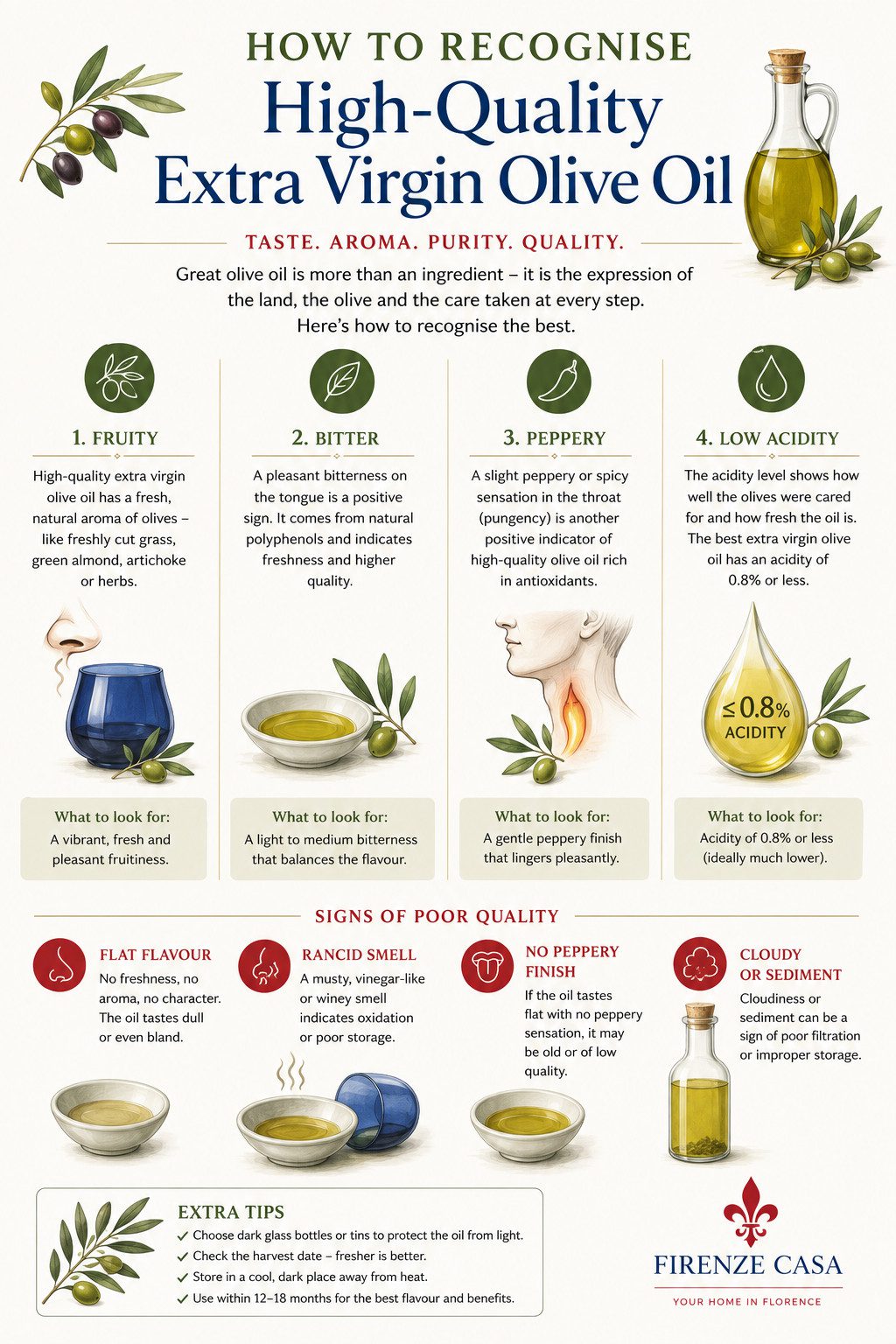
Among these requirements, free acidity must not exceed 0.8 grams per 100 grams, expressed as oleic acid. Extra virgin olive oil must also be free from sensory defects under the applicable assessment standards.
Acidity should not be confused with a sharp taste. It is a chemical measurement and cannot be determined simply by tasting the oil.
Fruitiness, Bitterness and Pungency
Three characteristics are particularly useful when learning to taste olive oil:
- Fruitiness: aromas and flavours associated with fresh, healthy olives.
- Bitterness: a characteristic taste particularly noticeable in oils made from greener olives.
- Pungency: the peppery sensation often felt towards the back of the throat.
Bitterness and pungency are not defects. In a balanced oil they are positive sensory characteristics and are often associated with phenolic compounds.
Toscano IGP and Tuscan DOP Olive Oils
Visitors shopping for olive oil in Tuscany often encounter the European geographical indications IGP and DOP. Both connect a product with a defined territory, but they operate under different specifications.
Toscano IGP
Olio Extra Vergine di Oliva Toscano IGP is a protected geographical indication covering Tuscan extra virgin olive oil produced according to its official specification.
The IGP label provides traceability and geographical protection. It is therefore useful for visitors who specifically want oil with a certified connection to Tuscany rather than relying only on Tuscan imagery or wording on a bottle.
Tuscan DOP Oils
Tuscany also has olive oils protected by DOP designations linked to more specific geographical areas. Their individual production specifications define where and how qualifying oils can be produced.
Neither DOP nor IGP should simply be interpreted as a universal ranking of taste. They primarily certify geographical origin and compliance with the rules of the particular designation.
When buying oil as a souvenir, read the actual geographical designation and harvest information rather than relying on a picturesque Tuscan label. “Bottled in Tuscany” and certified Tuscan origin are not necessarily the same thing.
Olive Oil, Tuscan Bread and Fettunta
One of the best ways to understand Tuscan olive oil is also one of the simplest: taste it on bread.
Traditional Tuscan bread contains no added salt, so its mild flavour provides an excellent background for a fresh, aromatic oil.
Fettunta takes this combination one step further. Bread is toasted, often rubbed with garlic, and dressed generously with olive oil. During harvest season, freshly produced olio nuovo makes the dish particularly distinctive.
The relationship between the two ingredients is explored further in our guide to The Role of Bread in Tuscan Cuisine.
How Olive Oil Is Used in Tuscan Cooking
Tuscan extra virgin olive oil appears in numerous dishes, but its function changes according to the preparation. Sometimes it contributes during cooking;

