

Cucina povera in Tuscany is a tradition built on simplicity, seasonality and respect for food. The expression literally means “poor cooking”, but it does not describe poor-quality cuisine. Instead, it refers to the resourceful way generations of families transformed bread, beans, vegetables, olive oil and economical cuts of meat into nourishing and deeply flavoured dishes.
Long before sustainability became a modern concern, Tuscan households reused stale bread, cooked according to the seasons and wasted as little as possible. Today, dishes once associated with rural necessity have become some of Tuscany’s most celebrated foods. For the wider culinary context, see our Florentine and Tuscan Food – Complete Guide.
Meaning: Resourceful traditional cooking based on modest ingredients
Core principles: Seasonality, minimal waste, simplicity and patience
Essential foods: Bread, beans, vegetables, olive oil and herbs
Classic dishes: Ribollita, pappa al pomodoro, panzanella and fettunta
Florentine example: Lampredotto
Modern relevance: Local sourcing and low-waste cooking
What Does Cucina Povera Really Mean?
The term cucina povera can be misleading when translated simply as “poor cuisine”. It refers instead to cooking shaped by limited resources, agricultural life and the practical need to make full use of available food.
Families in rural Tuscany depended strongly on what they could grow, preserve or obtain locally. Vegetables, bread, beans, herbs and olive oil therefore formed the basis of many meals, while meat was less frequent and valuable parts of an animal were rarely discarded.
The result was not a single collection of fixed recipes. It was a way of thinking about food: cook according to the season, waste little, use simple ingredients intelligently and allow time to create flavour.

🔍 Click to view the infographic in full size
A Brief History of Cucina Povera in Tuscany
| Period | Development |
|---|---|
| Middle Ages | Rural households rely strongly on bread, legumes, vegetables and locally produced food. |
| Renaissance | Elaborate elite dining develops alongside the much simpler everyday cooking of farmers, craftsmen and labourers. |
| 18th–19th centuries | Bread-based dishes, beans, vegetables and economical meat preparations remain central to ordinary Tuscan meals. |
| 20th century | Traditional household dishes become increasingly associated with trattorias and regional culinary identity. |
| Today | Seasonality, local ingredients and low-waste cooking give the principles of cucina povera renewed relevance. |
Life in Rural Tuscany
The origins of cucina povera lie largely in Tuscany’s agricultural landscape. Daily life followed the rhythm of fields, vegetable gardens, vineyards and olive groves, while the seasons determined what reached the table.
Spring brought fresh greens and herbs, summer tomatoes and other vegetables, while autumn provided olives, grapes and chestnuts. Winter relied more heavily on stored vegetables, dried legumes and preserved foods.
Because replacing food could be difficult or expensive, ingredients were treated as valuable resources. Leftovers became new dishes, stale bread found another use and slow cooking transformed inexpensive ingredients into satisfying meals.
Traditional Tuscan cooking was shaped less by written recipes than by season, availability and household experience. The same dish could therefore vary considerably from one family to another.
Florence and Everyday Cooking
Florence became one of Europe’s wealthiest cities during the Renaissance, but the everyday food of most residents remained far removed from aristocratic banquets. Craftsmen, market workers and labourers continued to eat bread, vegetables, beans and economical meat preparations.
The city’s markets connected urban consumers with the surrounding countryside. Produce, meat, grain, oil and other foods moved into Florence, allowing rural and urban traditions to influence one another.
This connection remains visible today in places such as Mercato Centrale and Sant’Ambrogio. Our Historic Food Markets of Florence – Complete Guide explores how markets became part of the city’s everyday food culture.
At the other end of Florentine society, the Medici court developed a much more elaborate dining culture. Our article How the Medici Shaped Florentine Cuisine examines this very different side of the city’s culinary history.
Bread: The Foundation of Tuscan Cooking
No ingredient illustrates cucina povera more clearly than bread. Traditional Tuscan bread is generally made without salt and played a role far beyond accompanying a meal.
Once bread became stale, households reused it rather than discarding it. Its firm texture could absorb broth, tomatoes, olive oil and vegetable juices, making yesterday’s loaf the foundation of an entirely new dish.
Ribollita, pappa al pomodoro, panzanella and fettunta all demonstrate this remarkable versatility. The history of the bread itself is explored in Tuscan Bread – Why Tuscany’s Bread Has No Salt, while The Role of Bread in Tuscan Cuisine looks more closely at its importance as an ingredient.
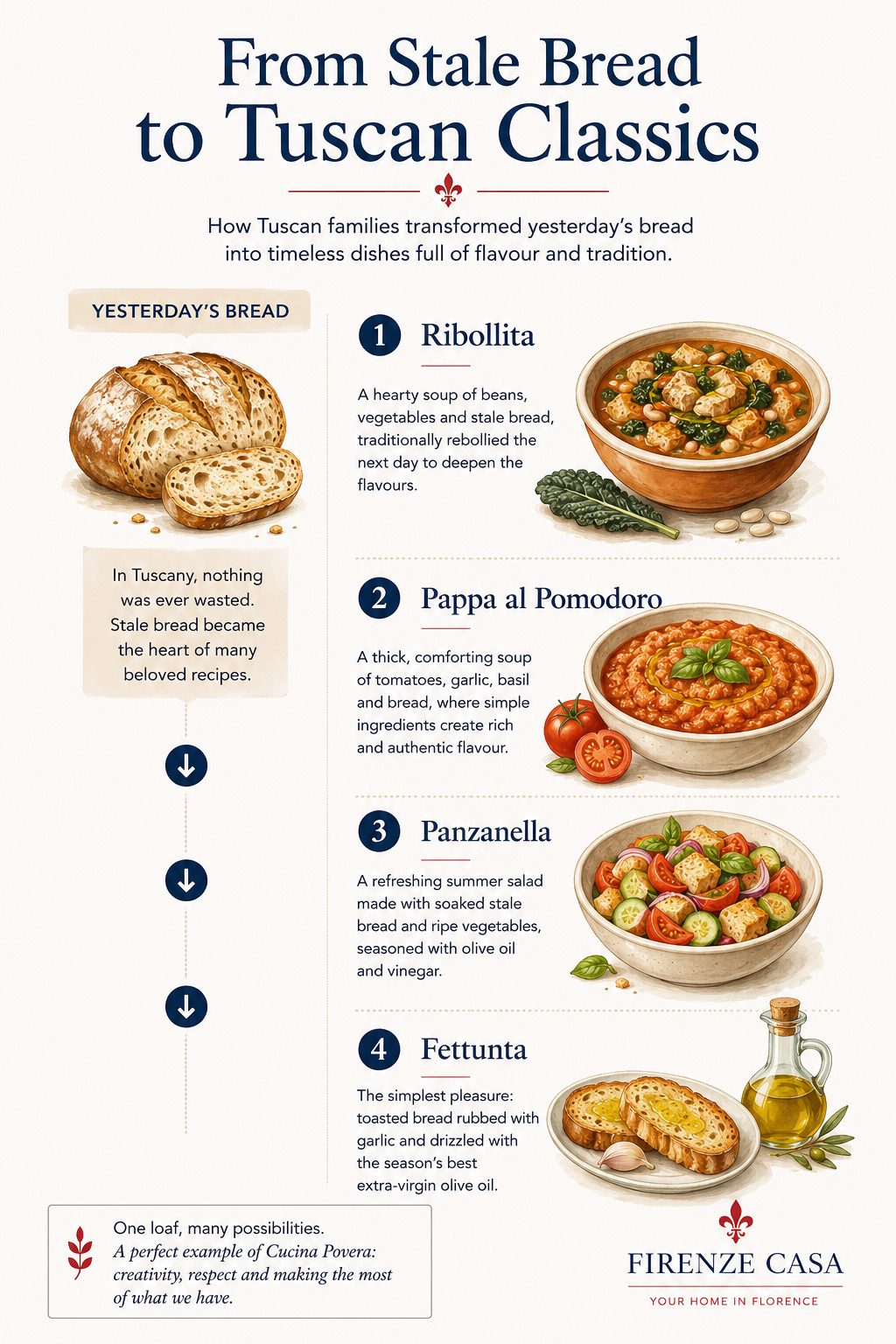
🔍 Click to view the infographic in full size
Classic Dishes of Cucina Povera
The philosophy becomes clearest through dishes that turn a small number of inexpensive ingredients into substantial food. Their recipes were traditionally flexible because cooks adapted them to season, household and availability.
Ribollita
Ribollita is one of Tuscany’s defining examples. Its name means “reboiled” and refers to the practice of reheating a vegetable-and-bean preparation enriched with stale bread.
Cannellini beans, cabbage, onions, carrots and cavolo nero commonly appear, although no single household formula defines the dish. The bread absorbs the cooking liquid and gives ribollita its characteristic substantial texture.
Pappa al Pomodoro
Pappa al pomodoro combines bread with tomatoes, garlic, basil and olive oil. The ingredients gradually merge into a thick preparation whose flavour depends heavily on the quality of the tomatoes and oil.
Its simplicity makes it an excellent demonstration of a central Tuscan principle: a short ingredient list leaves nowhere for poor ingredients to hide.
Panzanella
Panzanella offers a summer interpretation of the same no-waste philosophy. Stale bread is combined with ingredients such as tomatoes, onion, cucumber, basil, olive oil and vinegar.
Recipes vary considerably, reflecting the fact that panzanella developed as practical seasonal food rather than a precisely standardised restaurant recipe.
Fettunta
Fettunta is toasted bread rubbed with garlic and generously dressed with extra virgin olive oil. It becomes particularly important during the autumn olive harvest, when freshly pressed olio nuovo is available.
Few dishes demonstrate the Tuscan dependence on ingredient quality more clearly. Our guide to Tuscan Extra Virgin Olive Oil explains why fresh oil can taste so distinctive.
Crostini di Fegatini
Crostini di fegatini traditionally use chicken liver to create a deeply savoury spread for bread. Capers, anchovies, onion and other aromatics may appear depending on the recipe.
The dish demonstrates another recurring principle: ingredients considered inexpensive or secondary could become highly valued through careful preparation. Today, liver crostini remain a classic element of Tuscan antipasti.
Beans, Vegetables and the Tuscan Pantry
Bread was not the only foundation of economical Tuscan cooking. Beans provided an important and affordable source of nourishment, while vegetables changed according to the season.
Cannellini beans appear in soups, salads and dishes such as fagioli all’uccelletto. Cabbage, onions, tomatoes, greens and herbs likewise became central ingredients because they could be grown locally and incorporated into many different meals.
Tuscans are sometimes jokingly called mangiafagioli, or bean eaters. The nickname reflects just how deeply legumes became embedded in the region’s food culture.
Using the Whole Animal
The no-waste principle also applied to meat. When an animal was slaughtered, economical cuts and offal had real value and could not simply be discarded.
Slow cooking softened tougher pieces, while careful seasoning transformed organs and other less prestigious cuts into satisfying dishes. Several preparations that developed from this practicality later became important parts of Florentine culinary identity.
Lampredotto
Lampredotto is the most famous example. It comes from the fourth stomach of cattle and is slowly cooked in an aromatic broth before being chopped and commonly served inside bread.
Traditional trippai add green sauce, chilli or both, and some briefly dip the upper part of the bread into the cooking broth. What began as inexpensive food for workers has become one of Florence’s most distinctive street-food traditions.
Lampredotto makes most sense when eaten at a traditional street-food stand rather than approached as a novelty dish. It remains part of Florence’s everyday food history.
The Four Principles of Cucina Povera
Respect for Ingredients
Traditional cooks understood the labour required to grow vegetables, produce oil, bake bread and raise animals. Food therefore had value, even when the ingredients themselves were inexpensive.
This respect helps explain both the low-waste approach and the restrained seasoning typical of many Tuscan dishes.
Seasonality
Cooks followed the agricultural calendar rather than expecting every ingredient throughout the year. Winter soups naturally differed from summer salads because the available produce was different.
Patience
Many dishes depend on time rather than complicated technique. Beans simmer slowly, soups improve after resting and tougher cuts of meat become tender through long cooking.
Adaptability
Traditional recipes were rarely immutable formulas. Households adjusted ingredients according to what the garden, market or pantry provided, which explains why authentic versions of the same dish can differ considerably.
Is Cucina Povera the Same as Sustainable Cooking?
The historical motivation was necessity rather than environmental philosophy. Rural households reduced waste because food, labour and money were valuable resources.
Nevertheless, many practices now associated with sustainable cooking look remarkably familiar: seasonal ingredients, local sourcing, using leftovers and avoiding unnecessary waste.
The comparison is useful, but the historical distinction matters. Cucina povera was not an early lifestyle movement; it developed largely because ordinary households needed to make limited resources last.
From Necessity to Culinary Heritage
One of the most interesting aspects of cucina povera is the transformation of social status surrounding its dishes. Food once associated with poverty and agricultural labour can now appear in fashionable restaurants and sophisticated reinterpretations.
This change does not necessarily diminish the tradition. At its best, contemporary cooking preserves the underlying principles while using excellent modern ingredients and techniques.
The paradox is striking: recipes created because people had very little now help define the culinary identity of a region internationally famous for exceptional food.
Interesting Facts About Cucina Povera
- Cucina povera describes resourceful cooking rather than poor-quality food.
- Ribollita, pappa al pomodoro and panzanella all demonstrate traditional ways of reusing bread.
- Tuscans have long been jokingly called mangiafagioli, or “bean eaters”.
- Fettunta becomes especially important during the autumn olive harvest when olio nuovo appears.
- Lampredotto reflects the traditional practice of using edible parts of an animal that carried less commercial value.
- Traditional recipes frequently changed according to season and household availability.
- Many principles associated today with low-waste cooking were once ordinary economic necessities.
Frequently Asked Questions
What does cucina povera mean?
It describes a resourceful style of traditional cooking based on modest seasonal ingredients, minimal waste and practical preparation.
Why is cucina povera important in Tuscany?
Much of Tuscany historically depended on agriculture, so households developed dishes around bread, beans, vegetables, olive oil and whatever the season provided.
Which dishes best represent cucina povera?
Ribollita, pappa al pomodoro, panzanella and fettunta are classic examples. Lampredotto represents a related Florentine tradition of making valuable food from economical animal parts.
Why do so many Tuscan dishes use stale bread?
Bread was too valuable to waste. Once stale, it became an ingredient in soups, salads and other dishes rather than being discarded.
Is lampredotto part of cucina povera?
Yes, in the broader sense of economical, low-waste cooking. Its history reflects the practice of using edible parts of the animal carefully and turning them into satisfying food.
Is cucina povera still relevant today?
Yes. Its emphasis on seasonality, local ingredients and reducing waste feels remarkably contemporary, although its historical origins lay in necessity rather than lifestyle choice.
Where can visitors experience cucina povera in Florence?
Traditional trattorias, neighbourhood markets and historic street-food stands are good places to encounter dishes rooted in this tradition.
Why Cucina Povera Is Worth Discovering
Cucina povera reveals one of the most important ideas behind Tuscan food: memorable cooking does not require luxury. It requires good ingredients, practical knowledge and respect for what is available.
Ribollita turns bread and vegetables into a substantial meal, fettunta celebrates olive oil with almost nothing else, and lampredotto transforms an economical ingredient into a symbol of Florence.
Understanding this tradition makes Tuscan cuisine easier to appreciate. Its apparent simplicity is not an absence of culinary sophistication but the result of generations learning how to do more with less.
Further Reading on Firenze Casa
- Florentine and Tuscan Food – Complete Guide
- Tuscan Bread – Why Tuscany’s Bread Has No Salt
- The Role of Bread in Tuscan Cuisine
- Tuscan Extra Virgin Olive Oil – A Guide to Tuscany’s Liquid Gold
- Lampredotto Explained: Florence’s Most Iconic Street Food
- Tuscan Antipasti – The Perfect Start to Every Meal
- The Historic Food Markets of Florence – Complete Guide
- How the Medici Shaped Florentine Cuisine
References
- Davies, Emiko – Florentine: The True Cuisine of Florence.
- Artusi, Pellegrino – La scienza in cucina e l’arte di mangiar bene.
- Petroni, Paolo – Il grande libro della vera cucina toscana.
- Counihan, Carole M. – Around the Tuscan Table: Food, Family, and Gender in Twentieth-Century Florence.
- Righi Parenti, Giovanni – La cucina toscana.
- Accademia Italiana della Cucina.
- Slow Food Foundation for Biodiversity.

