
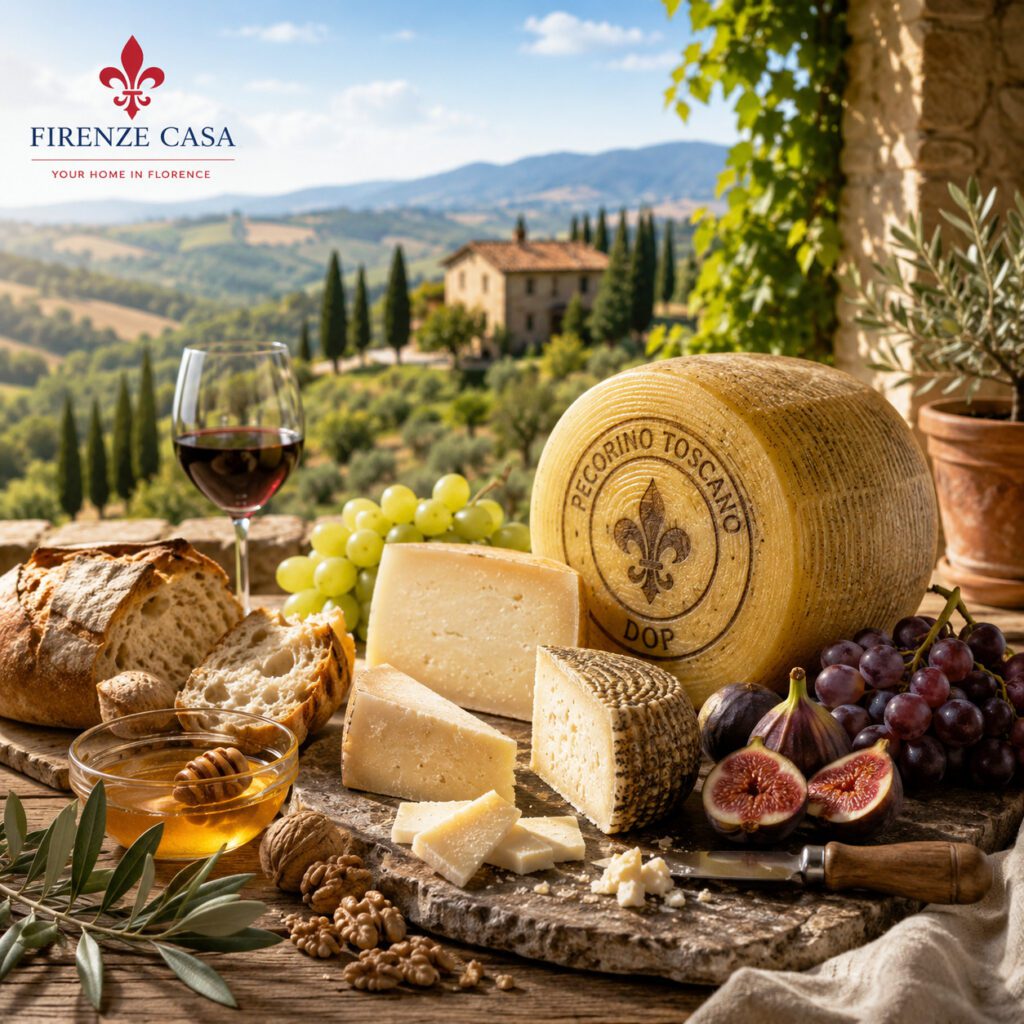
Tuscan cheese reflects the region’s long pastoral and farming traditions. Sheep’s milk plays the leading role, above all in Pecorino Toscano DOP, but Tuscany also produces fresh cheeses, goat’s milk varieties and distinctive local specialities.
From young, delicate pecorino to firm aged wheels served with honey or wine, cheese remains an important part of the Tuscan table. This guide introduces the principal varieties, explains how ageing changes them and offers practical advice for tasting and buying cheese in Tuscany. For the wider culinary context, see our Florentine and Tuscan Food – Complete Guide.
Best-known cheese: Pecorino Toscano DOP
Main milk: Sheep’s milk
Styles: Fresh, semi-aged and aged
Other speciality: Pecorino delle Balze Volterrane DOP
Classic pairings: Tuscan bread, honey, fruit, salumi and wine
Where to explore: Markets, alimentari, farm shops and artisan producers
A Long Tradition of Cheese Making in Tuscany
Ancient Roots
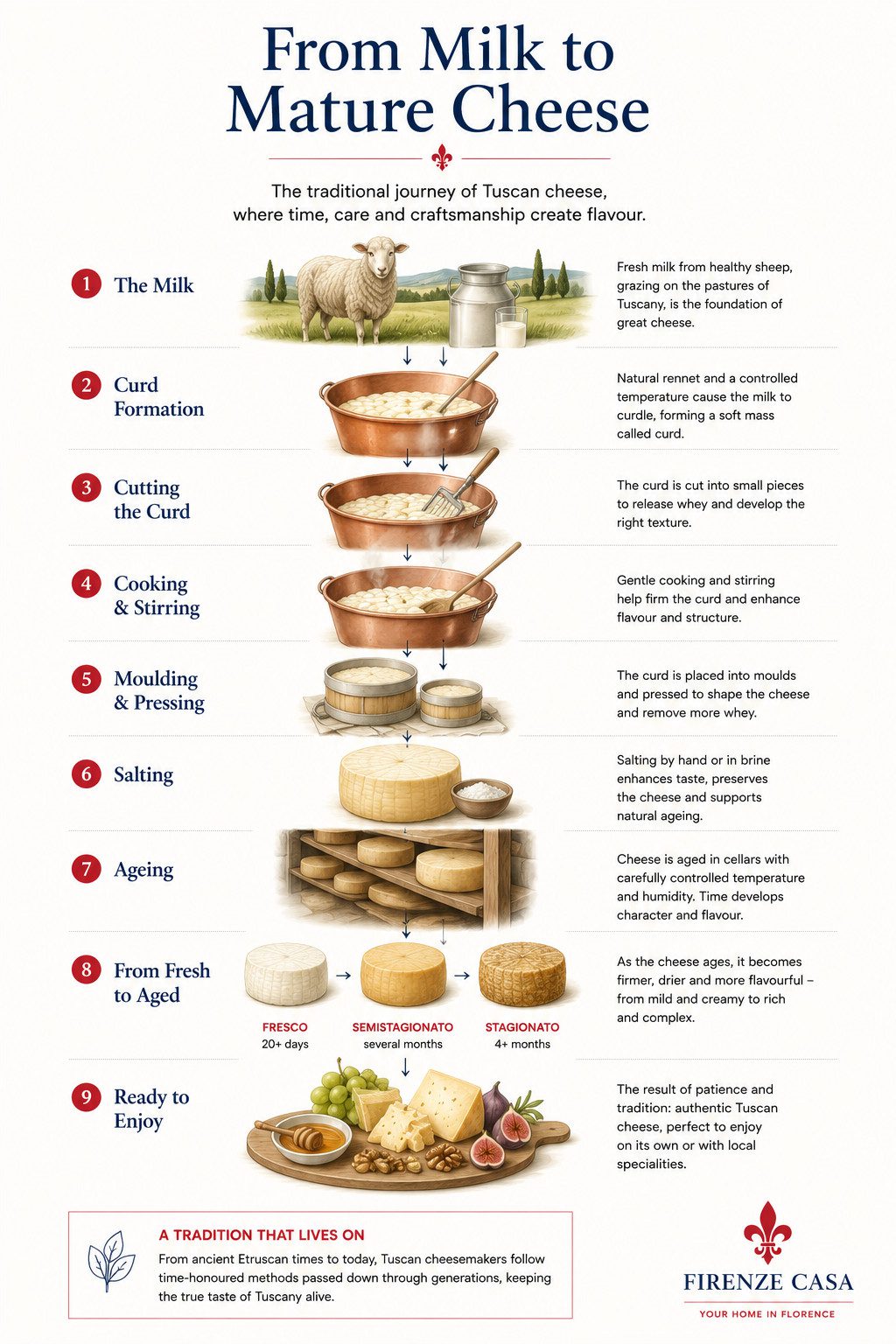
Sheep farming and cheese making have deep roots in central Italy. The Etruscans raised livestock in the region long before the rise of Roman Florence, while archaeological and written evidence shows that dairy products already formed part of ancient agricultural life.
Sheep were particularly well suited to the landscape. Moreover, turning milk into cheese provided a practical way to preserve a valuable source of nutrition.
Roman and Medieval Tuscany
Roman agricultural writers described methods for making and preserving cheese, including sheep’s milk varieties. Cheese was useful not only in rural households but also as portable food for travellers and soldiers.
During the medieval period, livestock farming remained an important part of the Tuscan countryside. Seasonal movement of flocks, known as transhumance, connected different grazing areas and helped shape pastoral traditions across central Italy.
From Renaissance Tuscany to Today
By the Renaissance, cheese appeared at different levels of Tuscan society, from rural households to wealthy tables. Florence’s markets connected the city with farms and producers throughout the surrounding countryside.
Modern cheesemakers combine this regional heritage with contemporary hygiene and production standards. Protected-origin systems now safeguard some of Tuscany’s most characteristic cheeses while numerous small producers continue to develop their own local styles.
The Most Important Tuscan Cheeses
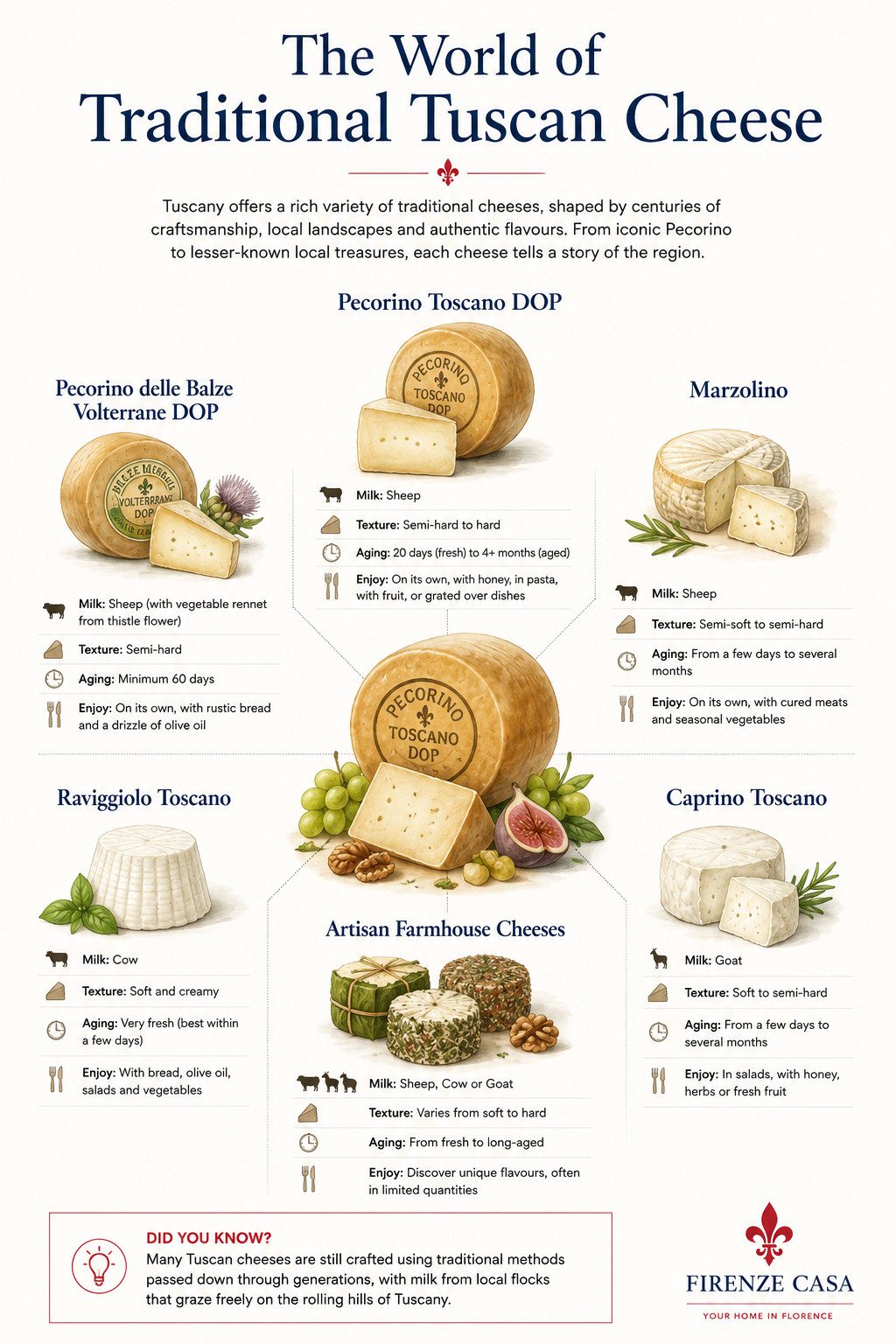
Tuscany produces cheeses from sheep’s, cow’s and goat’s milk. However, pecorino remains the category most closely associated with the region.
Pecorino Toscano DOP
Pecorino Toscano DOP is Tuscany’s best-known protected cheese. The word pecorino derives from pecora, the Italian word for sheep, and the cheese is made from sheep’s milk.
Pecorino Toscano received European Protected Designation of Origin status in 1996. Its production specification defines the geographical area, ingredients and methods required to use the protected name.
Two official categories are particularly important:
- Pecorino Toscano DOP: a softer cheese matured for at least 20 days.
- Pecorino Toscano DOP Stagionato: a firmer cheese matured for at least 120 days.
The younger version has a relatively delicate, sweet and milky character. With ageing, the texture becomes firmer and the flavour more pronounced.
“Semistagionato” is a useful term commonly encountered at cheese counters, but it is not one of the two principal ageing categories defined by the Pecorino Toscano DOP specification.
Pecorino delle Balze Volterrane DOP
Pecorino delle Balze Volterrane DOP comes from a defined area around Volterra in western Tuscany. One of its most distinctive features is the use of vegetable rennet obtained from wild cardoon.
This gives the cheese an unusual place among Tuscan pecorini and links its character closely to the landscape around Volterra.
Marzolino
Marzolino is a traditional Tuscan sheep’s milk cheese whose name refers to marzo, or March. Historically, spring milk was particularly valued when sheep returned to fresh grazing.
Styles vary according to producer and maturation. Younger examples are mild and tender, while ageing creates a firmer texture and more concentrated flavour.
Raviggiolo
Raviggiolo belongs to a very different cheese tradition. It is extremely fresh, soft and delicate and is particularly associated with the Tuscan-Romagnolo Apennines.
Because it is consumed fresh, Raviggiolo offers a striking contrast to aged pecorino. Production traditions and the milk used can vary locally, so it is better understood as a regional fresh-cheese tradition than as a single standardised Tuscan cheese.
Tuscan Goat’s Milk Cheeses
Artisan producers across Tuscany also make goat’s milk cheeses in both fresh and matured styles. These range from soft, lightly tangy cheeses to firmer wheels with more concentrated flavours.
Unlike Pecorino Toscano DOP, caprino toscano does not refer to one single protected cheese. Instead, visitors may encounter very different interpretations from individual farms and dairies.
Artisan Farmhouse Cheeses
Some of the most interesting discoveries have no famous name at all. Small producers make limited quantities of cheese that reflect local milk, pasture, season and individual maturation techniques.
Depending on the producer, wheels may be treated with herbs, leaves or grape pomace. Consequently, visiting a farm shop or specialist food store can reveal cheeses rarely found outside their immediate area.
What Does DOP Mean?
DOP stands for Denominazione di Origine Protetta, or Protected Designation of Origin. The European system protects foods whose production and characteristics are closely connected with a defined geographical area.
For a cheese carrying the DOP name, producers must follow an official specification covering factors such as origin, ingredients and production methods. Therefore, DOP is more than a general indication that a product comes from Tuscany.
For visitors, the familiar red-and-yellow DOP symbol provides a useful reference when shopping for protected regional products.
Fresh and Aged Pecorino Toscano
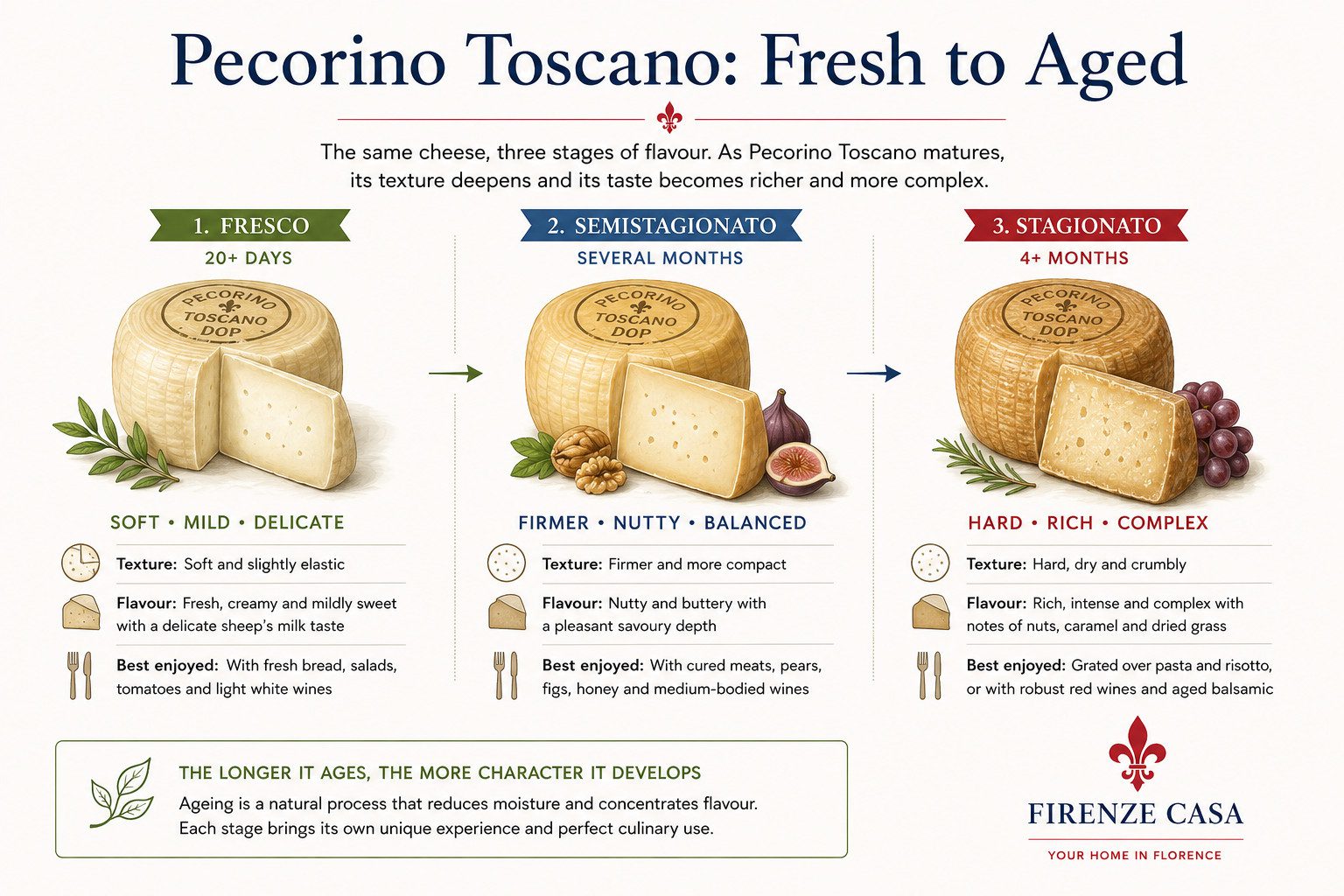
Ageing changes Pecorino Toscano considerably. Moisture gradually decreases, the texture becomes firmer and flavours grow more concentrated.
Young Pecorino Toscano
The younger DOP cheese matures for at least 20 days. It remains relatively soft and has a delicate flavour that can show sweet, milky notes.
Its gentle character makes it suitable for antipasti, sandwiches and simple combinations with seasonal vegetables. It can also be enjoyed with fresh fruit or a lighter wine.
Semi-Aged Pecorino
Between very young and fully aged cheeses, Tuscan counters commonly offer pecorino described as semistagionato. These cheeses provide a useful middle ground, with greater firmness and intensity while retaining some of the younger cheese’s softness.
They work particularly well with Tuscan salumi, pears, figs or honey.
Pecorino Toscano DOP Stagionato
The official aged version matures for at least 120 days. During this period, it becomes firmer and develops a stronger, more persistent flavour.
Aged pecorino works well on a cheese board and can also be grated or shaved over appropriate dishes. Its intensity makes it a natural partner for structured Tuscan wines.
How Tuscans Enjoy Cheese
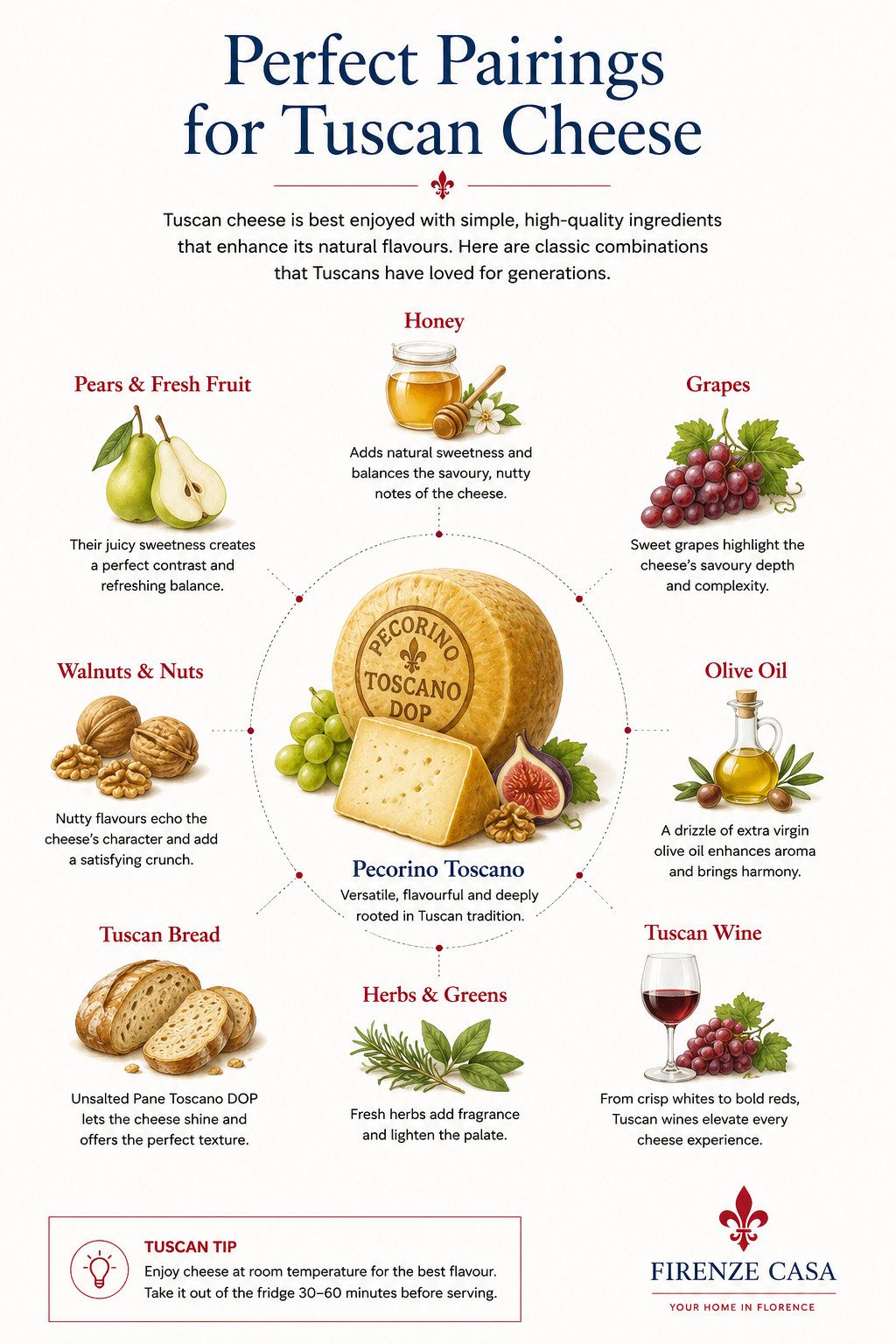
Tuscan cheese rarely needs elaborate presentation. Instead, a few well-chosen regional ingredients allow differences in milk, maturation and texture to remain noticeable.
With Honey and Fruit
Honey is a familiar partner for aged pecorino. Chestnut honey provides a darker, slightly bitter contrast, while delicate honeys offer a sweeter accompaniment.
Pears, figs and grapes also pair naturally with cheese. Meanwhile, walnuts or almonds add texture to a simple platter.
With Tuscan Bread
Unsalted Tuscan bread provides a neutral accompaniment to salty or mature cheese. Its restrained flavour allows the pecorino itself to remain prominent.
With Extra Virgin Olive Oil
A little Tuscan extra virgin olive oil can accompany young cheese, bread and vegetables. The combination illustrates the simplicity at the heart of much Tuscan cooking.
With Wine
Wine pairing depends primarily on the intensity of the cheese. Young pecorino can work with fresh whites or lighter wines, while mature examples can accompany more structured reds.
Chianti and Chianti Classico are natural regional choices, while mature cheeses can also stand alongside wines from Montalcino or Montepulciano. Our Wines of Tuscany – The Complete Guide provides a broader introduction to the region’s wines.
Tuscan Cheese on the Antipasto Table
Cheese frequently appears alongside cured meats, crostini, vegetables and other small dishes at the beginning of a meal. Different textures and maturation levels make it easy to create variety without complicated preparation.
A simple combination of pecorino, finocchiona, bread and seasonal accompaniments already captures much of the character of a Tuscan antipasto. Our guide to Tuscan Antipasti explains how these ingredients traditionally come together.
Where to Buy Tuscan Cheese in Florence
Florence offers many opportunities to compare regional cheeses, from neighbourhood food shops to the city’s historic markets.
Mercato Centrale is one of the most convenient places for visitors to explore Tuscan food products in the historic centre. Traditional alimentari and specialist shops can also be excellent sources, particularly when staff can explain the producer and maturation.
For a more local market experience, Mercato di Sant’Ambrogio combines food stalls with the everyday rhythm of a neighbourhood market. Beyond Florence, farm shops and direct purchases from dairies offer another opportunity to discover small producers.
Ask how long a pecorino has matured rather than choosing only by appearance. Tasting a young and an aged version side by side is one of the easiest ways to understand how dramatically maturation changes the cheese.
Buying Cheese to Take Home
Many specialist shops can vacuum-pack cheese for travel. This makes transport easier and helps preserve the product, although it does not override customs or food-import regulations.
Within the European Union, personal transport is generally straightforward. Travellers returning to countries outside the EU should check their destination’s current rules for dairy products before buying cheese for the journey home.
Tuscan Cheese at a Glance
| Cheese | Milk / Style | Character |
|---|---|---|
| Pecorino Toscano DOP | Sheep / young | Soft, delicate and mildly sweet |
| Pecorino Toscano DOP Stagionato | Sheep / aged | Firm and more intense |
| Pecorino delle Balze Volterrane DOP | Sheep / vegetable rennet | Distinctive regional pecorino |
| Marzolino | Sheep / traditional | Mild when young, stronger with age |
| Raviggiolo | Fresh cheese | Soft, delicate and highly perishable |
| Artisan goat’s cheese | Goat / various styles | From fresh and mild to mature and tangy |
Frequently Asked Questions
What is the most famous cheese in Tuscany?
Pecorino Toscano DOP is the region’s best-known protected cheese. It is made from sheep’s milk and sold in younger and aged forms.
Is Pecorino Toscano made from cow’s milk?
No. Authentic Pecorino Toscano DOP is made from sheep’s milk.
What does DOP mean?
DOP means Denominazione di Origine Protetta. It protects foods whose characteristics and production are closely connected with a defined geographical area.
Is all Tuscan pecorino Pecorino Toscano DOP?
No. Tuscany has many sheep’s milk cheeses, but only products that meet the official specification can use the protected Pecorino Toscano DOP name.
What should I eat with Tuscan cheese?
Bread, honey, pears, figs, walnuts and Tuscan salumi are classic companions. Wine can be matched according to the age and intensity of the cheese.
Where can I buy Tuscan cheese in Florence?
Historic markets, traditional alimentari and specialist food shops are good choices. Mercato Centrale and Sant’Ambrogio are particularly convenient for visitors.
Can I take Tuscan cheese home?
Often yes, and many shops offer vacuum packing. However, travellers outside the EU should check their destination country’s current dairy-import regulations.
Why Tuscan Cheese Is Worth Discovering
Tuscan cheese offers a direct connection with the region’s rural landscape. Sheep farming, seasonal grazing, local milk and generations of practical knowledge have produced cheeses with distinctly regional identities.
Pecorino Toscano DOP provides the obvious starting point, especially when tasted at different stages of maturation. Yet local markets and small producers reveal a much broader world of fresh, aged and artisan cheeses.
For visitors interested in Tuscan food, tasting cheese alongside bread, olive oil, salumi and wine is therefore not simply another gastronomic experience. It is one of the easiest ways to understand how the region’s landscape and agricultural traditions still shape its table.
Further Reading on Firenze Casa
- Florentine and Tuscan Food – Complete Guide
- Tuscan Antipasti – The Perfect Start to Every Meal
- Tuscan Salumi: Traditional Cured Meats of Tuscany
- Tuscan Bread – Why Tuscany’s Bread Has No Salt
- Tuscan Extra Virgin Olive Oil – A Guide to Tuscany’s Liquid Gold
- The Wines of Tuscany – The Complete Guide
- Mercato Centrale – Florence’s Historic Central Market
- Mercato di Sant’Ambrogio – Florence’s Authentic Food Market
References
- Consorzio di Tutela del Pecorino Toscano DOP.
- European Commission – eAmbrosia: Geographical Indications Register.
- Regione Toscana – Agriculture and Traditional Food Products.
- Accademia Italiana della Cucina.
- Slow Food Foundation for Biodiversity.

