
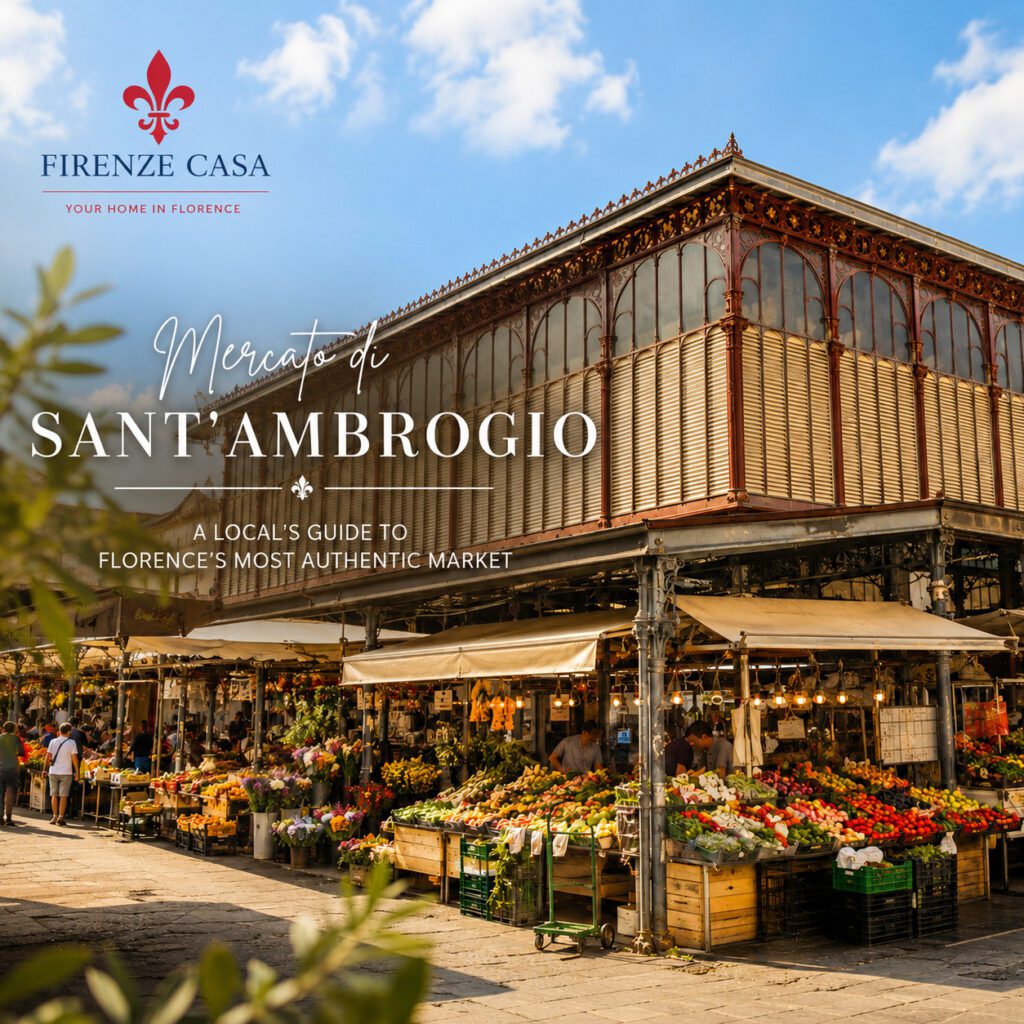
Mercato di Sant’Ambrogio is one of the best places in Florence to experience a traditional neighbourhood food market. Every morning, residents come here for vegetables, cheese, meat, fish, bread and other ingredients that form part of everyday Florentine cooking.
Located east of the historic centre, close to Santa Croce, the market dates from the nineteenth century and remains closely connected with the surrounding neighbourhood. For the wider history and comparison of the city’s markets, see our Historic Food Markets of Florence – Complete Guide.
Established: 1873
Location: Sant’Ambrogio, near Santa Croce
Character: Traditional neighbourhood market
Market areas: Covered hall and outdoor stalls
Best time to visit: Morning
Look for: Seasonal produce, pecorino, salumi, meat, fish and bread
Best for: Food shopping and everyday Florentine atmosphere
A Historic Food Market in Florence
Mercato di Sant’Ambrogio opened in 1873, during a period of enormous change in Florence. The city had recently served as capital of the Kingdom of Italy, a role that accelerated major programmes of urban expansion and modernisation.
Growing populations required better infrastructure, including more organised systems for food distribution. Covered markets offered permanent spaces where meat, fish and other perishable products could be sold under more controlled conditions.
Sant’Ambrogio emerged from the same nineteenth-century transformation that produced Florence’s other purpose-built market halls. Outdoor stalls complemented the covered section and became an important part of its character.
Sant’Ambrogio belongs to Florence’s nineteenth-century transformation into a modern European city. Its history is therefore closely connected with new infrastructure, changing ideas about public health and the reorganisation of urban food markets.
Why Sant’Ambrogio Feels Different
Florence has several historic markets, but Sant’Ambrogio has retained a particularly strong relationship with its surrounding neighbourhood.
Residents arrive with shopping bags, compare vegetables, speak with familiar traders and choose ingredients for lunch or dinner. Visitors are part of the scene, but everyday food shopping remains central to the market’s identity.
This distinguishes Sant’Ambrogio from market areas where tourism has become the dominant commercial force.
Inside Mercato di Sant’Ambrogio
The covered hall contains specialist food traders including butchers, fishmongers and cheese sellers. Its compact scale makes the market relatively easy to explore.
Outside, fruit and vegetable stalls add colour and seasonal variety. The combination of indoor specialists and outdoor produce sellers creates the characteristic rhythm of Sant’Ambrogio in the morning.
Do not only look at the products. Conversations between traders and regular customers reveal how strongly Sant’Ambrogio still functions as a neighbourhood market rather than simply as a visitor attraction.
What to Buy at Sant’Ambrogio Market
One of the pleasures of Sant’Ambrogio is seeing many of the ingredients associated with Tuscan cooking gathered in one place. The precise selection changes with the seasons.
Tuscan Cheese
Pecorino is one of the classic products to look for. Younger versions tend to be softer and milder, while longer ageing produces firmer textures and more pronounced flavours.
Fresh ricotta provides a very different experience. For a broader introduction to regional varieties, see our guide to Tuscan Cheese.
Fresh Fruit and Vegetables
The outdoor produce stalls are particularly useful for understanding Tuscan seasonality. Tomatoes, herbs and summer vegetables give way to mushrooms, pumpkins, leafy greens, artichokes and other products as the year progresses.
Instead of arriving with a fixed shopping list, notice which ingredients appear repeatedly across different stalls. They often reveal what is currently at its best.
Meat and Tuscan Salumi
Traditional butcher counters remain an important part of the covered market. Regional cured meats may include Prosciutto Toscano, Finocchiona and other products explored in our guide to Tuscan Salumi.
Fish and Seafood
Fishmongers contribute another traditional element to the hall. Like many Italian food markets, Sant’Ambrogio preserves the model of specialist traders concentrating on particular types of food rather than one retailer selling everything.
Bread, Pasta and Pantry Ingredients
Bread, pasta, olive oil and other staples make it possible to assemble most of a meal within the market. Traditional Tuscan bread, famously prepared without added salt, is particularly well suited to regional cheeses, salumi and olive oil.
Sant’Ambrogio and Tuscan Food Culture
Traditional markets once formed an essential link between Florence and the surrounding countryside. Farmers, producers and merchants supplied city households according to season and availability.
This relationship helps explain the character of Tuscan cooking. Bread, beans, vegetables, olive oil, cheese and relatively simple preparations depend heavily on the quality of their ingredients.
The philosophy is closely related to cucina povera: resourceful cooking based on seasonal ingredients and careful use of what was available rather than elaborate preparation.
Our Florentine and Tuscan Food – Complete Guide places these ingredients within the wider regional cuisine.
The Sant’Ambrogio Neighbourhood
The market is also an excellent starting point for exploring eastern central Florence. Sant’Ambrogio lies close to Santa Croce but outside some of the city’s most concentrated tourist routes.
Residential streets, small shops, cafés and restaurants coexist with major historic buildings. Within only a few minutes, visitors can move between everyday neighbourhood life and some of Florence’s most important monuments.
This makes a morning at the market easy to combine with the Santa Croce area rather than treating Sant’Ambrogio as an isolated destination.
Visit Sant’Ambrogio first in the morning and explore Santa Croce afterwards. The sequence works particularly well because the market is most active before lunch.
When to Visit Sant’Ambrogio Market
The traditional food market is primarily a morning experience. Arriving before lunch gives you the best chance to see well-stocked stalls and the regular shopping routine.
Weekday and Saturday mornings are generally the most useful times to plan a visit. Individual opening hours and holiday schedules can change, so check current information before making a special journey.
There is no need to arrive at dawn. A mid-morning visit usually provides plenty of activity while leaving time to explore the surrounding neighbourhood afterwards.
Breakfast Around Sant’Ambrogio
A market visit can easily become part of a relaxed Florentine morning. The cafés around Sant’Ambrogio provide opportunities for an espresso or cappuccino with a cornetto before exploring the stalls.
This is also a good way to experience the neighbourhood without turning the market into another attraction to hurry through. Coffee first, market second and Santa Croce afterwards make a natural morning route.
For more on the habits surrounding espresso, cappuccino and the Italian bar, see our guide to Italian Coffee Culture in Florence.
Sant’Ambrogio or Mercato Centrale?
Visitors often compare Sant’Ambrogio with Mercato Centrale, but the two markets now provide quite different experiences.
| Sant’Ambrogio | Mercato Centrale |
|---|---|
| Smaller and neighbourhood-oriented | Larger and internationally better known |
| Strong everyday food-shopping function | Traditional market plus contemporary food hall |
| Indoor and outdoor stalls | Monumental covered market hall |
| Near Santa Croce | In San Lorenzo |
| Best for local market atmosphere | Best for architecture and broad variety |
There is little reason to choose only one if you enjoy markets. Visiting both demonstrates how differently two nineteenth-century Florentine markets have evolved.
Practical Tips for Visiting
- Visit in the morning while the traditional food market is active.
- Bring a reusable bag if you plan to buy produce.
- Keep some cash available even when card payment is possible.
- Look for seasonal products rather than following a rigid shopping list.
- Ask traders for advice when choosing cheese, salumi or produce.
- Leave time to explore the surrounding Sant’Ambrogio and Santa Croce area.
Sant’Ambrogio is especially enjoyable when you can actually use what you buy. Fresh vegetables, pecorino, bread, pasta and olive oil are enough to turn a market visit into a simple Tuscan meal at home.
Frequently Asked Questions
Is Sant’Ambrogio Market worth visiting?
Yes. It is particularly rewarding for travellers interested in food, neighbourhood life and traditional Florence beyond the major monuments.
What can you buy at Sant’Ambrogio Market?
Typical products include fruit, vegetables, meat, fish, cheese, salumi, bread, pasta and other ingredients used in Tuscan cooking.
What is the best time to visit Sant’Ambrogio Market?
Morning is best because the traditional food stalls are active and residents are still doing their regular shopping.
Is Sant’Ambrogio Market mainly for tourists?
No. Visitors are welcome, but the market continues to serve residents of the surrounding neighbourhood.
Is Sant’Ambrogio better than Mercato Centrale?
They offer different experiences. Sant’Ambrogio feels more neighbourhood-oriented, while Mercato Centrale is larger and architecturally more monumental.
Can I buy ingredients to cook at my apartment?
Yes. Vegetables, cheese, meat, fish, bread, pasta and other staples make Sant’Ambrogio particularly useful for self-catering visitors.
Why Sant’Ambrogio Market Is Worth Visiting
Sant’Ambrogio offers something increasingly valuable in a heavily visited city: a market that still makes sense as part of its neighbourhood.
Its appeal lies not in one spectacular building or famous speciality but in the combination of seasonal produce, specialist traders and ordinary morning shopping.
Visit for pecorino, vegetables or fresh bread, but also pay attention to the people around you. Sant’Ambrogio shows how food markets continue to connect contemporary Florence with habits that long predate modern tourism.
Further Reading on Firenze Casa
- The Historic Food Markets of Florence – Complete Guide
- Mercato Centrale – Florence’s Historic Central Market
- Florentine and Tuscan Food – Complete Guide
- Cucina Povera Explained: The Philosophy Behind Tuscan Cooking
- Tuscan Cheese: A Guide to Traditional Cheeses of Tuscany
- Tuscan Salumi: Traditional Cured Meats of Tuscany
- Tuscan Bread – Why Tuscany’s Bread Has No Salt
References
- Comune di Firenze – Information on municipal markets and the Sant’Ambrogio market area.
- Mercati di Firenze – Historical and practical information on Florence’s food markets.
- Comune di Firenze – Historical material on nineteenth-century urban development.
- Historical studies on Florence’s nineteenth-century market architecture and food distribution.

