
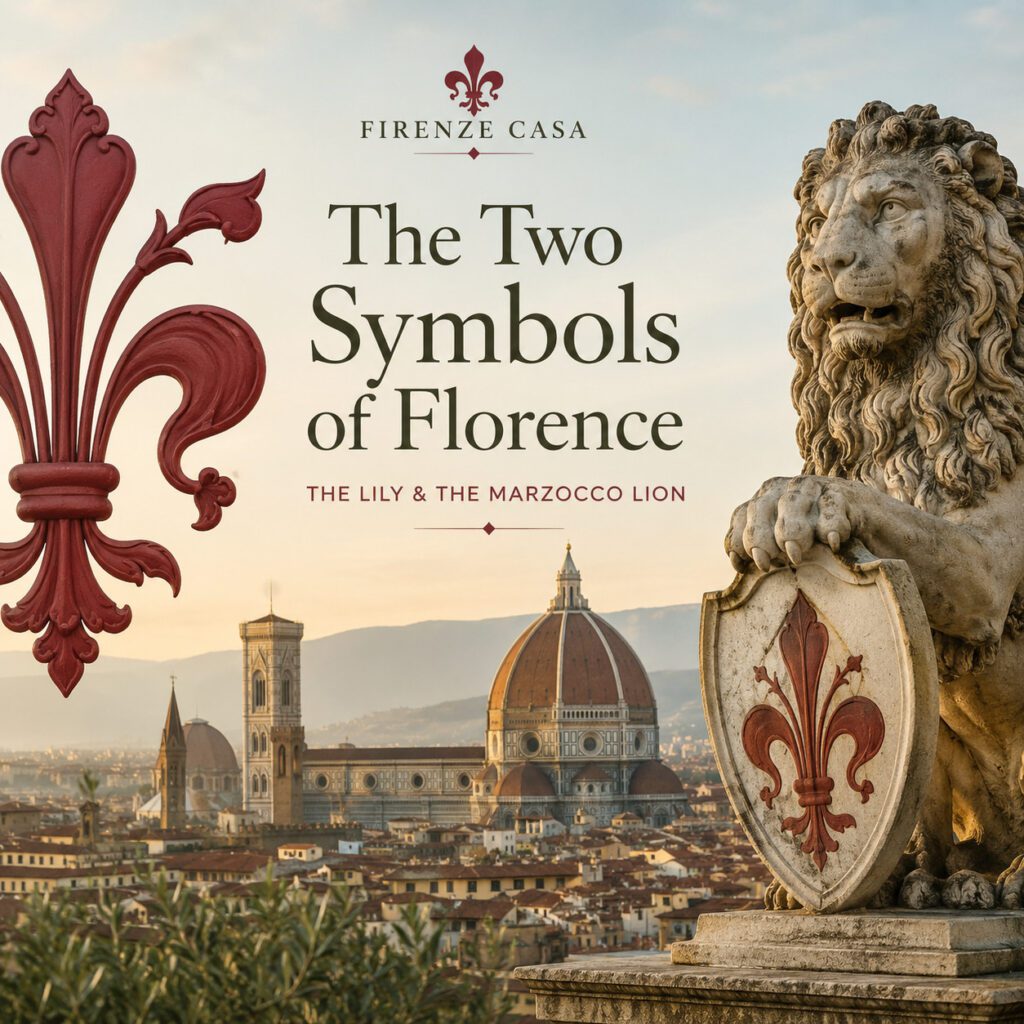
The Two Symbols of Florence: The Lily and the Marzocco Lion
Every great city has its symbols. Paris has the Eiffel Tower, Rome has the Colosseum, and Venice has the Winged Lion of Saint Mark.
Florence is different. Instead of being represented by a famous monument, the city’s identity has been shaped for centuries by two remarkable symbols: the Florentine Lily (Giglio di Firenze) and the Marzocco Lion.
You will discover them almost everywhere during your visit. They decorate churches, palaces, fountains, flags, official buildings and even manhole covers. Yet many visitors admire them without ever learning what they represent.
Understanding these two symbols offers a fascinating insight into Florence’s history, pride and identity. Their stories are closely connected with the development of the Medieval Republic of Florence and the civic culture that made Florence unlike almost any other European city.
At Firenze Casa, we chose the Florentine Lily as part of our own visual identity because it perfectly reflects the city’s elegance, artistic heritage and timeless beauty.
Why Does Florence Have Two Symbols?
Unlike many European cities that developed a single coat of arms, Florence gradually adopted two complementary symbols.
- The Lily represents the city itself, its beauty, prosperity and cultural identity.
- The Marzocco Lion represents strength, freedom and the protection of the Florentine Republic.
Together they tell the story of one of Europe’s most influential Renaissance cities and provide a visual introduction to the wider history of Florence.
| Symbol | Meaning | Represents |
|---|---|---|
| 🌺 Florentine Lily | Beauty, identity, culture | The City of Florence |
| 🦁 Marzocco Lion | Strength, liberty, protection | The Florentine Republic |
The Florentine Lily (Giglio di Firenze)
The Florentine Lily is undoubtedly the best-known symbol of Florence. For more than eight centuries it has appeared on the city’s coat of arms, public buildings and official documents.
Although it is commonly called a lily, the emblem is generally associated botanically with the iris. The connection remains particularly visible at Florence’s Giardino dell’Iris, where thousands of irises flower on the hillside beside Piazzale Michelangelo during the short spring opening season.
During spring, these elegant flowers bring the ancient connection between Florence and the iris vividly to life.
The Story Behind the Lily
The origins of the Florentine Lily date back to the medieval Republic of Florence.
Originally, the city used a white flower on a red background. Following the political conflicts between the Guelphs and Ghibellines during the thirteenth century, the colours were reversed, creating the famous red flower on a white background that survives today.
Those conflicts were far more than a dispute over heraldic colours. The Guelphs and Ghibellines in Florence divided families, caused repeated exiles and profoundly influenced the political development of the medieval city.
The red Florentine emblem became a powerful expression of civic pride and gradually evolved into one of Italy’s most recognisable city symbols.
What Does the Lily Symbolise?
Unlike military emblems used by many medieval cities, the Florentine Lily became associated with qualities closely connected with Florence itself:
- Beauty
- Art
- Prosperity
- Creativity
- Cultural excellence
- Civic pride
These qualities became especially closely associated with the city during the Renaissance and continue to shape the image of Florence today.
Where Can You Find the Florentine Lily?
One of the pleasures of walking through Florence is spotting the Lily in unexpected places.
Keep an eye out for it at:
- Palazzo Vecchio
- Piazza della Signoria
- Historic palaces
- Church façades
- Decorative fountains
- Street furniture and manhole covers
- Official city flags
- Museums
- Souvenir shops
Once you recognise the symbol, you will begin to notice it throughout the historic centre. Exploring Florence’s historic squares is particularly rewarding because civic symbols appear repeatedly on palaces, monuments and public decorations.
The Lily Today
Even after more than 700 years, the Florentine Lily remains an essential part of the city’s identity.
It appears in municipal branding, cultural events, sports, tourism and local businesses. For many Florentines, it represents much more than a historic emblem—it is a symbol of belonging.
The symbol traditionally known as the Florentine Lily is generally associated botanically with the iris. Florence even has a garden dedicated to these flowers beside Piazzale Michelangelo, where thousands of varieties bloom each spring.
Why We Chose the Lily for Firenze Casa
At Firenze Casa, we wanted a logo that immediately reflects the spirit of Florence.
The Florentine Lily represents everything we hope our guests experience during their stay: elegance, authenticity, history and a genuine connection with the city.
When you see the Lily on our website, you are not only looking at a beautiful symbol—you are looking at more than eight centuries of Florentine history.
The Marzocco Lion: Guardian of the Florentine Republic
If the Florentine Lily represents the beauty and identity of Florence, the Marzocco Lion represents its strength, independence and determination.
For centuries, the Marzocco served as one of the great civic emblems of republican Florence. The majestic lion rests one paw on a shield displaying the Florentine Lily, visually combining the guardian with the city it protects.
Its meaning becomes much clearer when seen within the political world of the Florentine Republic, whose guilds, magistrates and civic institutions developed an unusually strong sense of communal identity.
The Fascinating Legend Behind the Name
One of the most intriguing stories surrounding the Marzocco concerns the origin of its name.
In Roman times, Mars was regarded in Florentine tradition as an ancient protector of the city. Medieval chronicles describe a statue of Mars that once stood near the Ponte Vecchio.
According to the legend, the ancient statue was swept away during the catastrophic flood of the Arno in 1333. Over time, the Marzocco Lion inherited the symbolic role of protector of Florence, replacing the ancient pagan guardian with a new civic emblem of the Florentine Republic.
Whether entirely historical or partly legendary, the story beautifully illustrates how Florence transformed memories of its ancient past into the powerful civic identity of the medieval republic.
Before the Marzocco became Florence’s guardian, local tradition associated the city with Mars, the Roman god of war. The legendary disappearance of the ancient statue during the flood of 1333 became part of the story explaining Florence’s changing civic identity.
Donatello’s Marzocco
The most famous representation of the Marzocco was created around 1418–1420 by the Renaissance master Donatello.
The sculpture portrays a calm yet powerful lion resting one paw upon the shield of Florence. Rather than expressing aggression, Donatello’s lion conveys quiet confidence, authority and vigilance—qualities well suited to the civic ideals of republican Florence.
Today, visitors can see a replica beside Palazzo Vecchio in Piazza della Signoria. Donatello’s original masterpiece is preserved in the Museo Nazionale del Bargello, whose exceptional collection places the Marzocco within the wider development of Renaissance sculpture.
Where Can You See the Marzocco?
The best-known outdoor Marzocco stands beside the entrance to Palazzo Vecchio in Piazza della Signoria, the historic political heart of Florence. The statue displayed there today is a replica.
Donatello’s original Marzocco, created around 1418–1420, is preserved in the Bargello Museum. The museum is particularly rewarding because the Marzocco can be seen alongside other works by Donatello and masterpieces of Florentine Renaissance sculpture.
You will also discover lions and related civic imagery in many other places throughout Florence, including:
- Historic civic buildings
- Medieval coats of arms
- Museums dedicated to Florentine history
- Traditional Florentine sculptures and paintings
- Official decorations celebrating the city’s heritage
The relationship between these symbols and political power is especially easy to understand around Palazzo Vecchio and Piazza della Signoria, where sculpture, architecture and republican history remain concentrated within a remarkably small area.
The Lily and the Marzocco: A Perfect Pair
Although they represent different ideas, the Lily and the Marzocco complement one another perfectly.
| Florentine Lily 🌺 | Marzocco Lion 🦁 |
|---|---|
| Represents Florence | Protects Florence |
| Beauty | Strength |
| Art and Culture | Freedom and Independence |
| Civic Identity | Political Power |
| City Emblem | Guardian of the Republic |
Together, these symbols tell the story of a city whose extraordinary civic culture helped transform Florence into one of Europe’s great centres of art, commerce and humanism.
Did You Know?
- The Florentine Lily appears throughout the historic centre on civic buildings, monuments, street furniture and official decorations.
- Donatello’s Marzocco is one of the great examples of early Renaissance civic sculpture.
- The lion rests one paw on a shield displaying the Florentine Lily, combining Florence’s two symbols in a single image.
- Many visitors photograph the Marzocco beside Palazzo Vecchio without realising its historical significance.
- The Florentine Lily remains the official emblem of the City of Florence today.
Discover Both Symbols During Your Stay
One of the pleasures of exploring Florence on foot is recognising these historic symbols throughout the city.
During your stay at Firenze Casa, take time to look beyond the famous monuments. Spot the Lily decorating historic buildings, then walk to Piazza della Signoria to meet the Marzocco beside Palazzo Vecchio. Continue to the Bargello if you want to see Donatello’s original sculpture.
In spring, there is another particularly beautiful connection: visit the Iris Garden beside Piazzale Michelangelo and see the flower so closely associated with Florence growing above the city itself.
Once you know their stories, you will never look at Florence in quite the same way again.
Frequently Asked Questions
Why is the Lily the symbol of Florence?
The Florentine Lily has represented the city since the Middle Ages and became one of its most recognisable expressions of civic identity and pride.
Is the Florentine Lily actually a lily?
The emblem traditionally called the giglio is generally associated botanically with an iris rather than a true lily. Florence’s Giardino dell’Iris provides a particularly beautiful modern connection with this tradition.
What does the Marzocco Lion represent?
The Marzocco symbolises the strength, independence and civic authority of the historic Florentine Republic.
Where can I see the original Marzocco?
Donatello’s original Marzocco is preserved in the Museo Nazionale del Bargello. A replica stands beside Palazzo Vecchio in Piazza della Signoria.
Who created the famous Marzocco?
The best-known Marzocco was created by Donatello around 1418–1420. It is an important example of the relationship between Renaissance sculpture and Florentine civic identity.
Why does Firenze Casa use the Florentine Lily?
We chose the Florentine Lily because it reflects Florence’s elegance, history and artistic heritage—the same qualities we hope our guests experience during their stay.
Why Florence’s Two Symbols Still Matter
The Florentine Lily and the Marzocco Lion are much more than decorative emblems. Together they tell the remarkable story of a city that developed an unusually powerful sense of civic identity.
The Lily became the emblem of Florence itself, while the Marzocco embodied the strength and independence of its republic. Their stories lead directly into the conflicts between Guelphs and Ghibellines, the institutions of medieval Florence, Renaissance sculpture and the political world centred on Palazzo Vecchio and Piazza della Signoria.
As you stroll through Florence, keep an eye out for these two timeless symbols. Understanding their meaning transforms seemingly small decorative details into reminders of the city’s history.
At Firenze Casa, we invite you not only to visit Florence—but to discover the stories that make it truly unforgettable.
Further Reading on Firenze Casa
Continue exploring the history, art and civic identity behind Florence’s most enduring symbols:
- The Medieval Republic of Florence – Guilds, Power and Civic Life
- Guelphs and Ghibellines in Florence – Medieval Rivalry
- Palazzo Vecchio – Florence’s Historic Seat of Government
- Donatello – The Sculptor Who Changed Renaissance Art
- The Iris Garden in Florence – Giardino dell’Iris
References
- Brucker, Gene. Renaissance Florence. University of California Press.
- Najemy, John M. A History of Florence 1200–1575. Blackwell Publishing.
- Museo Nazionale del Bargello – historical and art-historical documentation concerning Donatello and the Marzocco.
- Musei Civici Fiorentini – historical documentation concerning Florence’s civic heritage.
- Comune di Firenze – historical and heraldic information concerning the City of Florence.
- Historical studies concerning the Florentine Republic, civic symbolism and Renaissance sculpture.

