
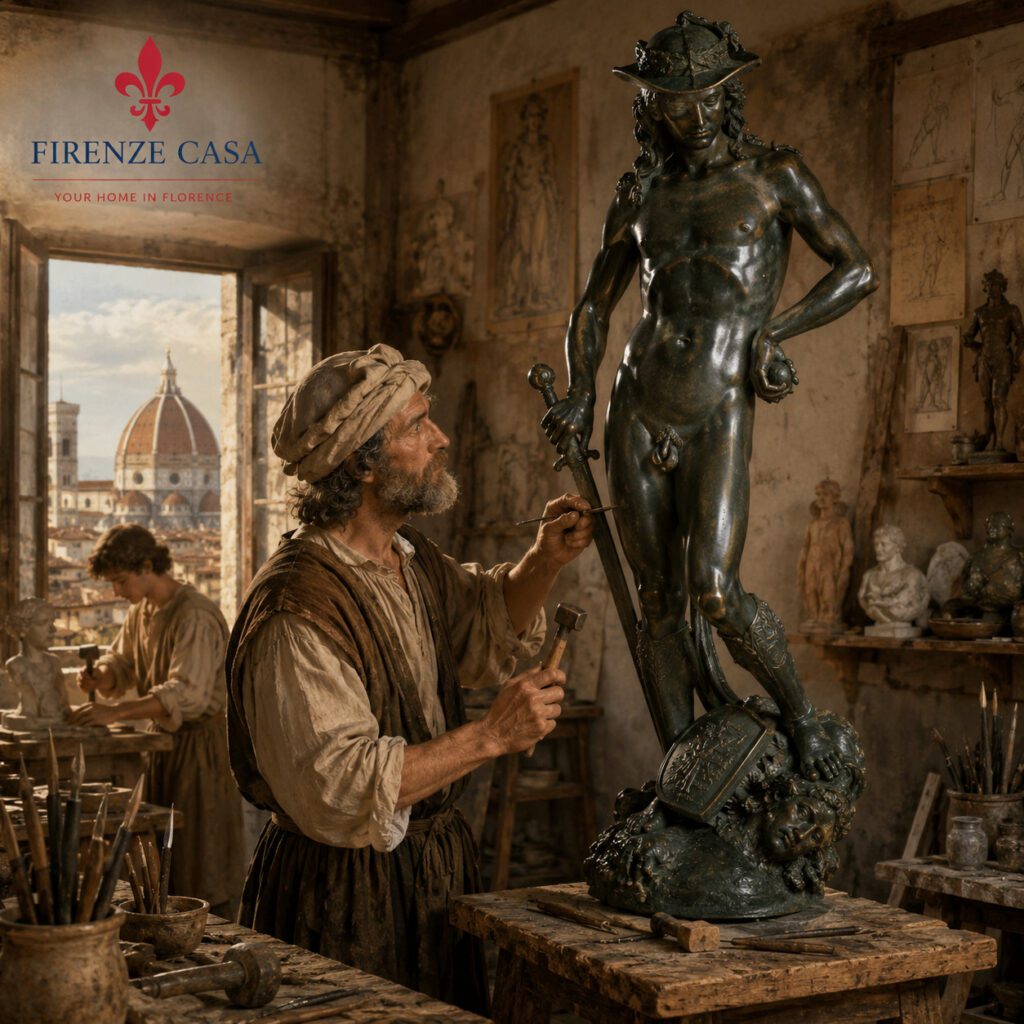
Donatello Renaissance Florence tells the story of one of the most revolutionary artists the city ever produced. Long before Michelangelo carved his monumental David, Donatello transformed sculpture through realism, movement and psychological intensity.
Born in Florence around 1386, he worked during the crucial decades when the early Renaissance began to reshape European art. His experiments with classical forms, perspective, bronze, marble and expressive portraiture helped establish a new sculptural language and make him one of the central figures in our The Great Artists of Florence – Complete Guide.
Born: around 1386, Florence
Full name: Donato di Niccolò di Betto Bardi
Main medium: marble, bronze and wood sculpture
Key works: bronze David, Saint George, Zuccone, Penitent Magdalene
Important Florentine sites: Bargello, Orsanmichele, San Lorenzo and the Cathedral complex
Important patron: Cosimo de’ Medici
Why he matters: one of the principal creators of Renaissance sculpture
Who Was Donatello?
Donatello was born Donato di Niccolò di Betto Bardi in Florence, probably around 1386. His father worked as a wool comber, placing the family within Florence’s artisan world rather than among the city’s wealthy elite.
Little is known with certainty about his earliest training, but Donatello became associated with Lorenzo Ghiberti’s workshop while Ghiberti was working on the bronze doors of the Baptistery. This exposed the young sculptor to one of Florence’s most prestigious artistic enterprises.
Donatello also developed a close relationship with Filippo Brunelleschi. Later accounts describe the two studying ancient monuments in Rome. Some details remain uncertain, but Donatello’s sculptures clearly demonstrate an intense engagement with classical antiquity.
Donatello did not simply revive classical sculpture. He combined ancient ideas with close observation of real people and created figures with a psychological and physical presence that was radically new.
Donatello and the Birth of Renaissance Sculpture
Florentine sculpture was already changing when Donatello began his career, but he accelerated that transformation dramatically.
He studied how people actually stood and explored facial expression, age, clothing and physical weight. His figures therefore gained an extraordinary sense of individual presence rather than functioning only as symbolic religious images.
Classical sculpture offered inspiration, particularly through contrapposto, in which the body rests primarily on one leg and the resulting shift of hips and shoulders creates a natural sense of balance.
Donatello did not simply copy ancient statues. He transformed classical principles into a new visual language suited to fifteenth-century Florence.
Saint Mark at Orsanmichele
One of Donatello’s early masterpieces was Saint Mark, commissioned by the linen workers’ guild for Orsanmichele.
The saint stands firmly on one leg while the other remains relaxed. Heavy fabric falls around his body, yet the anatomy underneath feels convincing.
His head turns slightly and his expression suggests intelligence and concentration. Rather than appearing as a distant religious symbol, Saint Mark seems capable of stepping forward into the street.
Orsanmichele is particularly important for understanding Florentine sculpture because its guild niches brought artists including Donatello, Ghiberti and Verrocchio directly into the public and commercial life of the city.
Saint George – A Hero Ready to Act
Donatello pushed this psychological presence even further with Saint George, another Orsanmichele commission, this time for the armourers and sword makers’ guild.
The young warrior stands upright with his feet firmly planted. His body appears alert, while his face communicates controlled determination rather than exaggerated heroism.
Donatello also designed the figure for its architectural setting. Florentines originally saw the sculpture from street level, so posture and expression were calculated for a viewpoint from below.
Concentrate on Saint George’s face. The slightly tense expression gives the impression that he has noticed something approaching – an excellent example of Donatello’s ability to create psychological presence.
Donatello and the Discovery of Perspective
Donatello revolutionised not only freestanding sculpture but also relief. His technique known as stiacciato, or flattened relief, allowed him to create remarkable spatial depth with extremely shallow carving.
Some parts of the surface project only slightly from the background. Tiny variations in depth respond to light and create atmospheric space, while perspective draws the viewer into the scene.
The result can resemble drawing in marble. Architecture, landscape and distant figures appear without requiring the deep carving associated with traditional relief sculpture.
The Feast of Herod
One of the most celebrated examples of Donatello’s approach to relief is The Feast of Herod, created for the baptismal font of Siena Cathedral.
The scene depicts the moment when the severed head of John the Baptist is presented during Herod’s banquet. Figures recoil from the sight, and their reactions turn the scene into an intense psychological drama.
Architectural lines lead the eye deep into the background, transforming a relatively small bronze relief into a surprisingly expansive theatrical space.
The work demonstrates how perspective, narrative and human emotion could reinforce one another within early Renaissance art.
Donatello’s Bronze David
No discussion of Donatello Renaissance Florence can avoid his bronze David, now one of the defining masterpieces of the Bargello Museum.
David stands after defeating Goliath. Instead of presenting him as a powerful warrior, Donatello created a slender youthful figure wearing little more than boots and a hat, with one foot resting on Goliath’s severed head.
The relaxed contrapposto recalls ancient sculpture, but the work went considerably further. It became one of the earliest celebrated monumental freestanding nude sculptures created in Europe since antiquity.
Its appearance within fifteenth-century Florence was therefore extraordinary.
Donatello’s bronze David reintroduced the monumental freestanding nude into European sculpture and demonstrated just how radically Florentine artists were reinterpreting antiquity.
Donatello’s David and Michelangelo’s David
Visitors familiar with Michelangelo often find Donatello’s version surprising. The two sculptures interpret the same biblical hero in completely different ways.
Michelangelo presents David before the battle: enormous, concentrated and physically powerful. Donatello shows the aftermath, with a youthful victor whose delicate body seems almost incapable of defeating Goliath through strength alone.
This contrast reinforces the biblical idea that David succeeds through divine favour rather than superior physical power.
The two sculptures also demonstrate how dramatically Florentine art developed across only a few generations. Donatello reopened possibilities that Michelangelo would later transform again.
Donatello and the Medici
Donatello developed important connections with the Medici family, particularly Cosimo de’ Medici.
The bronze David became closely associated with the Medici palace. Displayed within a private but politically significant setting, the biblical hero could communicate meanings extending beyond religion.
David had already become an important Florentine civic symbol: the relatively small republic could identify with the young hero who defeated a more powerful opponent.
Donatello’s sculpture could therefore combine biblical narrative, Medici patronage and Florentine political identity.
The Zuccone – Beauty Without Idealisation
One of Donatello’s most extraordinary sculptures stands far removed from the youthful elegance of David. The prophet traditionally known as the Zuccone presents an older, bald man with an intensely individual face.
The nickname means “pumpkin head” and refers to the figure’s bald skull. Donatello carved the statue for Giotto’s Campanile, where it originally stood high above street level.
Rather than idealising the prophet, he emphasised age, bone structure and a penetrating expression. The result feels almost like a portrait of an actual Florentine.
Giorgio Vasari later recorded the famous story that Donatello found the sculpture so lifelike he supposedly commanded it to speak. Whether or not the anecdote is true, it captures the realism later generations associated with his work.
Donatello did not always seek conventional beauty. Wrinkles, baldness, age and strong facial features could become sources of artistic power rather than imperfections to hide.
Donatello in Padua
Although Florence shaped Donatello’s career, his extended stay in Padua during the 1440s and early 1450s became especially important.
There he created the monumental equestrian statue known as the Gattamelata, honouring the military commander Erasmo da Narni outside the Basilica of Saint Anthony.
Ancient Roman equestrian monuments clearly influenced the composition, but Donatello transformed the classical model into a Renaissance statement about individual authority and memory.
His years in Padua also helped spread Florentine sculptural innovations through northern Italy.
Donatello Returns to Florence
After his years in Padua, Donatello returned to Florence. His later works became increasingly expressive and sometimes deliberately rough.
Instead of pursuing smooth classical perfection, he often emphasised emotional intensity. Surfaces could appear restless, bodies thin and faces marked by grief or age.
This development reveals an artist who continued experimenting rather than simply repeating the successful formulas of his youth.
The Penitent Magdalene
Donatello’s wooden Penitent Magdalene ranks among his most unforgettable works.
Mary Magdalene appears thin, aged and physically exhausted after years of penitence. Long hair falls around her body, while her hands come together in prayer.
Almost nothing remains of the idealised beauty associated with many Renaissance figures. Yet the sculpture possesses extraordinary emotional force because Donatello asks the viewer to confront suffering, devotion and mortality directly.
The use of wood strengthens the effect, contributing to the fragile appearance of the body.
Visitors who know Donatello mainly through the elegant bronze David are often surprised by the Penitent Magdalene. Seeing both reveals the extraordinary emotional range of his sculpture.
Donatello at San Lorenzo
The Basilica of San Lorenzo became another important setting for Donatello’s work and connects him closely with his Medici patrons.
Among his major contributions are the bronze pulpits created during the final phase of his career. Their reliefs depict episodes from the Passion of Christ with intense movement and emotional urgency.
Figures overlap, gestures become dramatic and surfaces appear restless. Rather than calm classical harmony, Donatello created scenes charged with suffering and human emotion.
He was ultimately buried at San Lorenzo in 1466, giving the church an especially personal connection with the sculptor.
Donatello and Brunelleschi
Donatello and Brunelleschi belonged to the generation that established much of the artistic language of the early Renaissance.
Brunelleschi revolutionised architecture and explored mathematical perspective, while Donatello transformed sculpture and applied new spatial ideas to relief.
Their careers reveal how closely different disciplines interacted in Florence. Innovations in architecture, perspective and sculpture did not develop in isolation but circulated through a relatively compact artistic community.
Donatello and Verrocchio
Donatello’s influence continued through later generations. Andrea del Verrocchio, born roughly half a century after Donatello, inherited a Florentine sculptural culture that Donatello had fundamentally changed.
Verrocchio also created a bronze David, offering visitors a particularly revealing comparison with Donatello’s earlier interpretation.
The Bargello allows both works to be considered within the same broader tradition, while Verrocchio’s later workshop would train Leonardo da Vinci.
This chain of influence is one reason Florence became such a powerful artistic centre: discoveries moved from one generation to another rather than ending with a single master.
Where to See Donatello in Florence
Florence remains the best city in which to explore Donatello’s career. His sculptures survive in museums, churches and buildings directly connected with Renaissance history.
Bargello Museum
The Bargello is essential. Its collection includes Donatello’s celebrated bronze David, an earlier marble David and the original Saint George.
Because the museum specialises strongly in sculpture, visitors can also compare Donatello with Verrocchio, Michelangelo and later Florentine masters.
Orsanmichele
Orsanmichele connects Donatello directly with Florence’s guild culture. Saint Mark and Saint George demonstrate how art, commerce, religion and civic identity came together in one remarkable building.
Florence Cathedral Complex
Several sculptures originally created for the Cathedral and Campanile survive in the Museo dell’Opera del Duomo, including the Zuccone and Penitent Magdalene.
San Lorenzo
San Lorenzo reveals Donatello’s late style through the bronze pulpits and also preserves his tomb.
Do not try to understand Donatello through one museum alone. The Bargello, Orsanmichele, Cathedral complex and San Lorenzo reveal different stages of his career and different relationships with Florence.
A Donatello Walk Through Florence
A rewarding Donatello itinerary can be completed largely on foot.
Begin at Orsanmichele, where his early public sculptures belonged to the world of the Florentine guilds. Continue to the Bargello and encounter the bronze David, a very different Donatello: experimental, classical and closely connected with Medici Florence.
Next, walk towards the Cathedral complex to see the Zuccone and Penitent Magdalene. Finally, continue to San Lorenzo, where his late works bring the story close to both the Medici and the end of his life.
The route demonstrates something important about Renaissance Florence: Donatello’s art did not originally belong to isolated museums. His sculptures formed part of streets, churches, guild buildings and political spaces throughout the city.
Donatello and Florence’s Artistic Revolution
The extraordinary generation surrounding Donatello transformed Florence during the early fifteenth century.
Brunelleschi reinvented architecture and perspective. Ghiberti transformed bronze relief, while Masaccio introduced new spatial and physical power into painting. Within this environment, Donatello reinvented sculpture.
Later artists built on those achievements. Verrocchio developed one of Florence’s most influential workshops, Leonardo explored nature and perception, and Michelangelo brought monumental sculpture to another level.
Donatello came before them. His willingness to experiment helped establish the artistic language that made Florence one of the centres of the Renaissance.
Frequently Asked Questions
Was Donatello born in Florence?
Yes. Donatello was born in Florence around 1386 and spent much of his career working for Florentine churches, guilds and patrons.
Where can I see Donatello’s bronze David?
The sculpture is displayed in the Bargello Museum, which contains one of the world’s most important collections of Donatello and Renaissance sculpture.
What is stiacciato?
Stiacciato is an extremely shallow relief technique in which tiny variations in carving create surprisingly deep spatial effects through light and perspective.
What is Donatello’s connection with Orsanmichele?
He created major guild sculptures including Saint Mark and Saint George for niches on the building’s exterior.
How is Donatello’s David different from Michelangelo’s?
Donatello shows the youthful hero after his victory over Goliath, while Michelangelo presents a monumental David preparing for the confrontation.
Where is Donatello buried?
Donatello was buried in the Basilica of San Lorenzo, a church closely connected with his Medici patrons and his late work.
Which places should I visit to understand Donatello?
The Bargello, Orsanmichele, the Cathedral complex and San Lorenzo together provide the strongest overview of his Florentine career.
Why Donatello Is Worth Discovering Across Florence
Donatello changed what sculpture could achieve. He revived ideas from antiquity without simply copying ancient art and gave biblical and historical figures physical weight, individuality and convincing emotions.
His shallow reliefs created extraordinary illusions of space, while the bronze David reintroduced the freestanding monumental nude into European art. The Zuccone and Penitent Magdalene demonstrated that realism did not depend on ideal beauty.
His influence becomes clearest when his sculptures are followed through Florence itself. Orsanmichele reveals the young public sculptor, the Bargello displays his revolutionary experiments, and San Lorenzo preserves both his late works and his burial place.
Florence was transformed by Donatello’s generation – and Donatello was one of the artists who made that transformation possible.
Further Reading on Firenze Casa
- The Great Artists of Florence – Complete Guide
- Bargello Museum – Renaissance Sculpture in Florence
- Orsanmichele – Florence’s Church of Art and Guilds
- Filippo Brunelleschi – The Architect Who Changed Florence
- Andrea del Verrocchio – The Master Who Trained Renaissance Florence
- Michelangelo – Florence and the Making of a Renaissance Genius
- The Medici Family – The Dynasty That Shaped Florence
- Basilica of San Lorenzo – The Medici Church of Florence
References
- Charles Avery – Donatello: An Introduction.
- John Pope-Hennessy – Donatello: Sculptor.
- Giorgio Vasari – Lives of the Most Excellent Painters, Sculptors, and Architects.
- Museo Nazionale del Bargello – collection information on Donatello and Renaissance sculpture.
- Museo dell’Opera del Duomo, Florence – collection information on Donatello’s works for the Cathedral complex.
- Victoria and Albert Museum – research and collection material on Donatello and Renaissance sculpture.

