
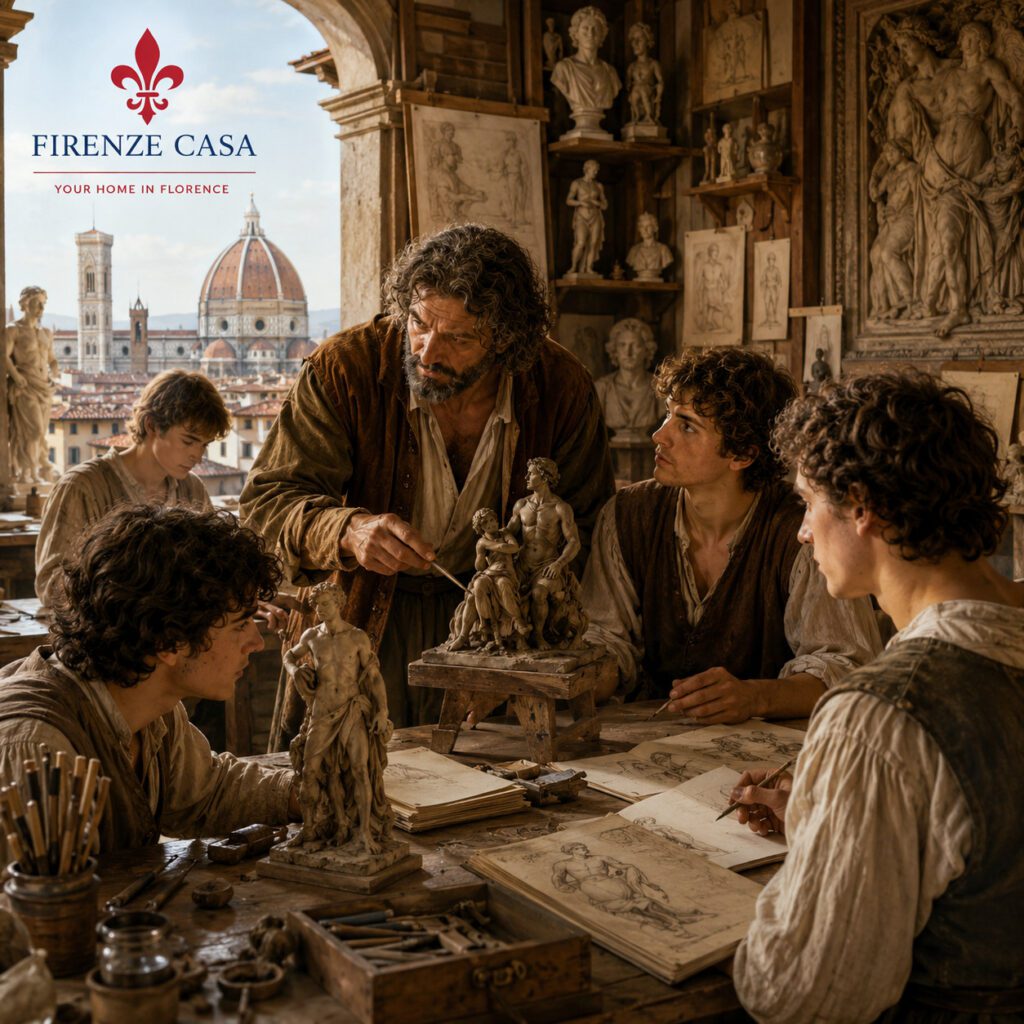
Andrea del Verrocchio Florence tells the story of one of the most influential masters of the Florentine Renaissance. Today, Leonardo da Vinci is far more famous than his teacher, yet before Leonardo became one of history’s great artists, he learned his craft inside Verrocchio’s remarkable Florentine workshop.
Verrocchio was much more than Leonardo’s master. He worked as a sculptor, painter, goldsmith and designer, while his workshop brought together different artistic disciplines and helped train a new generation. Understanding Verrocchio therefore also means understanding how Renaissance Florence produced so many exceptional artists. His career forms an essential chapter in our The Great Artists of Florence – Complete Guide.
Born: around 1435, Florence
Full name: Andrea di Michele di Francesco de’ Cioni
Professions: sculptor, painter, goldsmith and designer
Most famous pupil: Leonardo da Vinci
Major Florentine works: bronze David, Christ and St Thomas, Putto with a Dolphin
Important patrons: the Medici family and Florentine civic institutions
Key sites: Bargello, Uffizi, Orsanmichele, Palazzo Vecchio and San Lorenzo
Why he matters: his multidisciplinary workshop helped transmit Florentine Renaissance skills to another generation
Who Was Andrea del Verrocchio?
Andrea del Verrocchio was born in Florence around 1435. The name Verrocchio probably derived from Francesco di Luca Verrocchio, a goldsmith with whom Andrea may have had an early professional connection.
Like many Renaissance masters, Verrocchio did not restrict himself to one medium. He worked in bronze and marble, painted, designed decorative objects and understood the technical demands of metalwork.
This versatility became central to his later workshop. Florence offered ideal conditions for such a career because wealthy families, religious institutions, guilds and civic authorities continually commissioned ambitious works.
Renaissance Florence depended not only on individual geniuses but also on workshops where knowledge passed between masters, apprentices and specialised craftsmen. Verrocchio ran one of the most important of these creative centres.
Verrocchio and Renaissance Florence
By the middle decades of the fifteenth century, Florence had already experienced an artistic revolution. Brunelleschi had transformed architecture, while Donatello had redefined sculpture and Masaccio had demonstrated new possibilities in painting.
Verrocchio inherited these achievements but did not simply repeat them. His own sculpture combined technical refinement, movement and careful attention to how figures occupied architectural space.
His career also coincided with the expanding cultural influence of the Medici family. Lorenzo de’ Medici and the wider elite supported artists, poets and scholars, while other patrons competed through prestigious commissions. :contentReference[oaicite:0]{index=0}
The Workshop of Andrea del Verrocchio
The Verrocchio workshop in Florence became one of the most important artistic training grounds of the Renaissance. A fifteenth-century workshop, however, differed considerably from the modern idea of an artist’s private studio.
It functioned as a working business. Apprentices and assistants prepared materials, copied drawings and contributed to commissions, gradually taking responsibility for more demanding tasks as their abilities developed.
Painting, sculpture, metalwork and decorative design could exist side by side. For a naturally curious young artist, this multidisciplinary environment offered an extraordinary education.
Leonardo da Vinci entered precisely this world.
Verrocchio’s workshop combined imagination with practical craftsmanship. Young artists learned by drawing, modelling, preparing materials and contributing to real commissions across several disciplines.
Verrocchio and the Young Leonardo da Vinci
Leonardo da Vinci entered Verrocchio’s workshop as a young man and encountered an environment perfectly suited to his unusually broad curiosity.
Because Verrocchio worked across several disciplines, Leonardo could observe sculpture, metalworking, painting and technical craftsmanship while learning how complex commissions were organised.
This connection matters when considering Leonardo’s later career. His interests eventually expanded into anatomy, engineering, architecture, hydraulics and numerous other subjects. His curiosity was his own, but Verrocchio’s workshop offered fertile ground in which artistic and technical thinking could develop together.
Was Verrocchio Simply Leonardo’s Teacher?
Describing Verrocchio only as Leonardo’s teacher does him a disservice. Their relationship is fundamental to Leonardo’s biography, but Verrocchio already possessed considerable artistic standing.
His sculptures rank among the major achievements of fifteenth-century Florence, and his workshop itself became an important institution of artistic transmission.
Leonardo is therefore part of Verrocchio’s legacy, not its entire definition.
The Baptism of Christ
No work illustrates the relationship between Verrocchio and Leonardo more clearly than the Baptism of Christ, created in Verrocchio’s workshop during the 1470s and now preserved in the Uffizi Gallery.
Leonardo contributed to the painting, most famously to one of the angels, while scholars have also associated other passages with his participation.
The work offers an unusually revealing example of collaboration within a Renaissance workshop. Visitors can study how a master and younger assistants contributed to a single composition.
Giorgio Vasari later claimed that Verrocchio was so astonished by Leonardo’s superior painting that he abandoned painting altogether. Modern historians treat the anecdote cautiously, but it reflects Leonardo’s rapidly growing reputation.
Our guide to the Uffizi Gallery – History and Medici Legacy places the painting within the wider development of Florentine Renaissance art.
Compare the figures, landscape and treatment of light in the Baptism of Christ. The painting provides an exceptional opportunity to study collaboration inside a Renaissance workshop.
Verrocchio’s Bronze David
Among Verrocchio’s best-known Florentine sculptures is his bronze David, now preserved in the Bargello Museum. :contentReference[oaicite:1]{index=1}
The biblical hero appears youthful, elegant and self-assured after his victory over Goliath. The figure possesses a graceful movement that changes as the viewer walks around it.
Verrocchio’s interpretation is especially revealing when compared with Donatello’s earlier bronze David and Michelangelo’s monumental marble version from the following generation.
The Bargello allows visitors to follow this evolution of Florentine sculpture particularly well, placing Verrocchio directly within the tradition between Donatello and Michelangelo.
Verrocchio and the Medici
Medici patronage played an important role in Verrocchio’s career and connected him with several prestigious Florentine commissions.
One particularly important work was the tomb of Piero and Giovanni de’ Medici at San Lorenzo. The basilica was the religious centre most closely associated with the dynasty and brought together Brunelleschi, Donatello, Michelangelo and generations of Medici patronage. :contentReference[oaicite:2]{index=2}
Rather than relying primarily on monumental figures, Verrocchio created an elegant composition using bronze, stone and sophisticated decorative forms.
The commission reveals his sensitivity to materials and his ability to integrate sculpture with architecture and dynastic memory.
Christ and St Thomas at Orsanmichele
Another masterpiece remains closely tied to the urban heart of Florence. Verrocchio created Christ and St Thomas for Orsanmichele, the remarkable building where commerce, religion and guild patronage came together. :contentReference[oaicite:3]{index=3}
The commission presented a difficult problem because two life-size figures had to occupy a niche originally designed for one. Verrocchio responded ingeniously.
Christ stands further inside the niche while Thomas moves forward towards the viewer, transforming the architectural opening into a small theatrical stage.
The work demonstrates Verrocchio’s ability to combine technical problem-solving with dramatic narrative and helps explain why Orsanmichele is one of Florence’s most important places for studying public Renaissance sculpture.
Orsanmichele is easy to pass while walking between Piazza della Signoria and the Duomo. Its guild sculptures reveal how closely art, commerce and civic prestige were connected in Renaissance Florence.
The Putto with a Dolphin
Verrocchio could also create sculpture filled with movement and playful energy. His bronze Putto with a Dolphin offers one of the best examples.
The winged child twists around while holding a dolphin, producing a sense of continuous movement. Water originally formed part of the effect when the sculpture functioned as a fountain figure.
The work was commissioned for a Medici villa and later entered the Palazzo Vecchio environment. Today, the original is preserved inside the museum while a copy appears in the courtyard fountain.
The sculpture shows that Verrocchio’s ability to animate bronze was not limited to monumental religious or heroic figures.
Verrocchio the Sculptor
Modern visitors sometimes approach Verrocchio primarily through Leonardo, yet sculpture stood at the centre of his artistic reputation.
His figures combine physical presence with elegant surface treatment, while movement and gesture often create active relationships between sculpture and surrounding space.
These qualities helped bridge the period between Donatello’s innovations and Michelangelo’s monumental achievements.
The Bargello is therefore especially valuable because it places Verrocchio beside both earlier and later Florentine sculptors rather than treating him only as Leonardo’s teacher. :contentReference[oaicite:4]{index=4}
Verrocchio’s Workshop and a Generation of Artists
Leonardo remains the most famous artist associated with Verrocchio’s workshop, but he was not alone. Lorenzo di Credi had particularly close ties to the master and later continued aspects of the workshop tradition.
Pietro Perugino is also traditionally linked with Verrocchio’s artistic circle, although the exact nature of such workshop relationships is not always easy to reconstruct.
This uncertainty is important. Renaissance training rarely followed the simple modern model of one teacher and one pupil. Artists collaborated, moved between workshops and learned from one another’s works.
Leonardo’s apprenticeship with Verrocchio is central to the story, but not every important Florentine artist of the period can securely be described as his pupil. Workshop networks were complex and interconnected.
From Florence to Venice
Verrocchio’s final great project took him beyond Florence. The Republic of Venice commissioned him to create an equestrian monument to the military commander Bartolomeo Colleoni.
The resulting sculpture became one of the masterpieces of Renaissance bronze. Horse and rider project extraordinary authority, while the composition remains powerful from multiple viewpoints.
Verrocchio died in Venice in 1488 before the monument was completely finished, although his design determined the character of the final work.
The commission demonstrates how far the reputation of this Florentine master had travelled by the end of his career.
Where to See Verrocchio in Florence Today
Florence remains the best city in which to understand Verrocchio because important works survive across museums, churches and civic buildings within a compact area.
- Uffizi Gallery: Verrocchio’s Baptism of Christ and the essential connection with Leonardo.
- Bargello Museum: the bronze David and a wider comparison with Donatello and Michelangelo.
- Orsanmichele: Christ and St Thomas and Florence’s guild culture.
- Palazzo Vecchio: the original Putto with a Dolphin.
- San Lorenzo: the tomb of Piero and Giovanni de’ Medici and Verrocchio’s relationship with Medici patronage.
These sites also demonstrate how Renaissance artworks originally belonged to very different settings: private dynastic spaces, guild monuments, civic palaces and churches.
For a broader overview of the city’s collections, our Florence Museums – Complete Guide includes the Uffizi and Bargello among the essential museums for understanding Renaissance art. :contentReference[oaicite:5]{index=5}
A Verrocchio Walk Through Florence
A rewarding Verrocchio itinerary can be completed almost entirely on foot.
Begin at the Uffizi with the Baptism of Christ, where the story of master and pupil becomes visible in one painting. Continue to nearby Orsanmichele and study how Christ and St Thomas interacts with its architectural setting.
From there, walk to the Bargello to see the bronze David. Palazzo Vecchio adds the lighter, playful Putto with a Dolphin, while San Lorenzo introduces Verrocchio’s work for the Medici dynasty.
The route transforms Verrocchio from a name in Leonardo’s biography into a distinctly Florentine artist whose works still occupy the city that shaped his career.
The Master Behind the Genius
The relationship between Verrocchio and Leonardo raises a fascinating question: what does it take to educate an extraordinary artist?
No teacher could create Leonardo’s remarkable mind, but a master could provide technical discipline, challenges and opportunities. Verrocchio offered precisely that kind of environment.
His workshop encouraged mastery of materials, observation and work across disciplinary boundaries. Those characteristics must have been particularly stimulating for a young artist whose curiosity refused to remain inside one field.
Yet Verrocchio deserves recognition beyond the achievements of his greatest pupil. His own sculptures reveal exceptional technical intelligence and imagination.
Frequently Asked Questions
Who was Andrea del Verrocchio?
Andrea del Verrocchio was a Florentine sculptor, painter, goldsmith and workshop master active during the fifteenth century. He is especially famous as Leonardo da Vinci’s teacher.
Was Leonardo really Verrocchio’s pupil?
Yes. Leonardo trained in Verrocchio’s Florentine workshop, where he encountered painting, sculpture, metalwork and other technical disciplines.
Where can I see Verrocchio’s David?
The bronze David is preserved in the Bargello Museum, where it can be compared with works by Donatello and Michelangelo.
What is Verrocchio’s connection with the Uffizi?
The Uffizi preserves the Baptism of Christ, created in Verrocchio’s workshop and famous for Leonardo’s contribution to the painting.
What did Verrocchio create for Orsanmichele?
He created Christ and St Thomas, an innovative two-figure group that uses the architectural niche as part of the dramatic composition.
Did Verrocchio work for the Medici?
Yes. Important Medici commissions included the tomb of Piero and Giovanni de’ Medici at San Lorenzo and the Putto with a Dolphin.
Why is Verrocchio important beyond Leonardo?
His sculptures were major Renaissance achievements in their own right, and his multidisciplinary workshop helped transmit artistic and technical knowledge to a new generation.
Why Andrea del Verrocchio Still Matters
Andrea del Verrocchio reveals how Renaissance Florence actually worked. Its artistic achievements did not emerge only from isolated geniuses but from workshops, guilds, patrons and networks in which practical skills and ideas circulated continuously.
Verrocchio stood at the centre of that world. His sculpture developed the Florentine tradition after Donatello, while his workshop provided Leonardo with one of the richest artistic educations imaginable.
The Uffizi, Bargello, Orsanmichele, Palazzo Vecchio and San Lorenzo each reveal a different aspect of his career. Together they show a master capable of moving between painting, sculpture, metalwork, religious commissions and courtly patronage.
For this reason, Andrea del Verrocchio Florence is more than the story of the man who trained Leonardo da Vinci. It is the story of a master who helped create the artistic environment from which the High Renaissance emerged.
Further Reading on Firenze Casa
- The Great Artists of Florence – Complete Guide
- Leonardo da Vinci – The Young Artist in Florence
- Bargello Museum – Renaissance Sculpture in Florence
- Orsanmichele – Florence’s Church of Art and Guilds
- The Medici Family – The Dynasty That Shaped Florence
- Basilica of San Lorenzo – The Medici Church of Florence
- Uffizi Gallery – History and Medici Legacy
- Florence Museums – Complete Guide
References
- Andrew Butterfield – The Sculptures of Andrea del Verrocchio.
- Günter Passavant – Verrocchio: Sculptures, Paintings and Drawings.
- Gallerie degli Uffizi – collection information on Andrea del Verrocchio and the Baptism of Christ.
- Musei del Bargello – collection information on Verrocchio’s David.
- Musei Civici Fiorentini – historical information on Palazzo Vecchio and Verrocchio’s Putto with a Dolphin.
- National Gallery of Art – Verrocchio: Sculptor and Painter of Renaissance Florence.

