
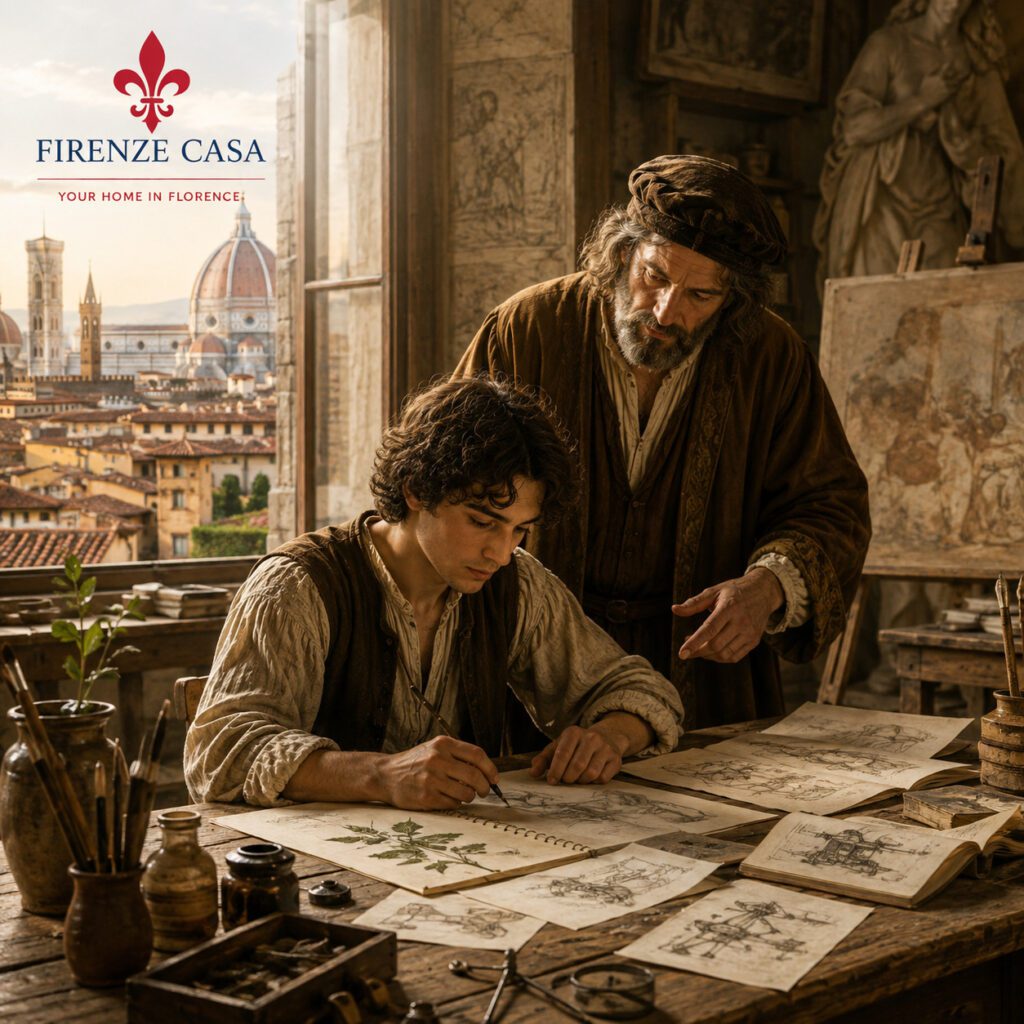
Leonardo da Vinci in Florence is the story of a young artist discovering what he was capable of becoming. Long before the Mona Lisa made him one of the most famous figures in art history, Leonardo entered the extraordinary creative world of Renaissance Florence.
Here he learned to paint, draw and work across different materials, while developing the habit of observing nature with unusual intensity. Florence did not simply educate Leonardo as a painter; its workshops, patrons and culture of experimentation helped shape the way he investigated the world. His Florentine years are therefore an essential chapter in our The Great Artists of Florence – Complete Guide.
Born: 15 April 1452, near Vinci
Florentine master: Andrea del Verrocchio
Early works in Florence: Annunciation, Adoration of the Magi and contribution to Verrocchio’s Baptism of Christ
Major later Florentine project: Battle of Anghiari for Palazzo Vecchio
Famous contemporary: Michelangelo
Main museum: Uffizi Gallery
Why Florence matters: the city provided Leonardo’s decisive artistic and technical education
Leonardo da Vinci Before Florence
Leonardo was born on 15 April 1452 near Vinci, a small Tuscan town west of Florence. He was the illegitimate son of Ser Piero da Vinci, a notary, and a woman named Caterina.
His childhood began far from the sophisticated workshops of Florence, but the Tuscan countryside offered another kind of education. Plants, water, rocks, birds and changing landscapes fascinated him, and his later notebooks reveal an almost relentless desire to understand natural processes.
As a young man, Leonardo entered the orbit of Florence. The move was decisive because it brought him into one of Europe’s most creative cities at precisely the moment when painting, sculpture, architecture and engineering were changing rapidly.
Leonardo was born in Vinci, but Florence provided his decisive artistic education. Understanding these years helps explain how the young apprentice developed into one of the defining figures of the Renaissance.
Florence When Leonardo Arrived
Fifteenth-century Florence was an extraordinary place for an ambitious young artist. Wealth from banking, commerce and textile production supported a constant stream of commissions from churches, guilds, civic institutions and powerful families.
Artists competed for prestigious projects while learning from one another. Sculptors studied anatomy, painters explored perspective and architects reinterpreted principles drawn from classical antiquity.
Brunelleschi, Donatello and Masaccio had already transformed Florentine art. A younger generation including Botticelli, Ghirlandaio and Verrocchio was developing their discoveries further.
The wider cultural environment was strongly influenced by the Medici family, whose patronage helped make Florence one of Europe’s most important centres of Renaissance culture.
Leonardo in the Workshop of Andrea del Verrocchio
Leonardo’s most important early artistic education took place in the workshop of Andrea del Verrocchio.
Verrocchio was much more than a painter. He was also a sculptor, goldsmith and designer and operated one of the leading workshops in fifteenth-century Florence.
This multidisciplinary environment suited Leonardo perfectly. A Renaissance workshop did not resemble a modern artist’s private studio. Masters, assistants and apprentices worked together on commissions, while younger members learned through observation and practical participation.
Leonardo therefore encountered painting, sculpture, metalworking, drawing and technical craftsmanship within the same environment. This broad training encouraged him to move naturally between disciplines throughout his later career.
Verrocchio’s workshop was ideal for Leonardo because artistic creation and skilled craftsmanship existed side by side. It helped establish the multidisciplinary approach that became one of Leonardo’s defining characteristics.
Florence’s Workshop Culture
Leonardo’s training illustrates why workshops were so important to Renaissance Florence. Artistic knowledge did not pass through formal academies in the modern sense but through practical work alongside experienced masters.
Apprentices prepared panels, pigments and materials before taking on increasingly demanding tasks. They studied drawing, perspective, anatomy and the technical behaviour of paint, metal and stone.
Workshops could also collaborate with specialised craftsmen, allowing an artist to encounter engineering, metalwork and decorative techniques far beyond painting alone.
Florence’s guild culture provides an excellent surviving context for this world. At Orsanmichele, the city’s powerful guilds commissioned major sculptures from artists including Donatello, Ghiberti and Verrocchio, demonstrating how commerce, craftsmanship and artistic ambition were closely connected. :contentReference[oaicite:0]{index=0}
What Leonardo Learned in Florence
Leonardo’s Florentine education went far beyond learning how to apply paint. He learned to prepare surfaces, mix pigments, draw figures, study drapery and understand how light creates volume.
Drawing became especially important because it allowed him to investigate ideas rapidly and repeatedly. A hand could be studied from several angles, a face could change expression from one sketch to another and a fold of fabric could become an experiment in light and shadow.
Over time, drawing became more than preparation for paintings. It became one of Leonardo’s principal tools for thinking.
Learning to Observe
One of Leonardo’s greatest abilities was careful observation. Rather than simply accepting conventional artistic formulas, he increasingly examined how things actually behaved.
How does light fall across a face? What happens to a shoulder when an arm rises? How does water move around an obstacle?
Questions like these connected artistic representation with physical investigation. Florence gave Leonardo the practical skills required to transform such observations into images while its intensely competitive culture encouraged constant experimentation.
Leonardo and Verrocchio’s Baptism of Christ
One of the most famous works associated with Leonardo’s apprenticeship is Verrocchio’s Baptism of Christ, produced by the workshop during the 1470s and now preserved in the Uffizi.
Leonardo contributed to the painting, most famously to one of the angels. The work therefore provides a rare opportunity to see the young artist functioning within the collaborative environment that trained him.
It also reveals a changing artistic language. Leonardo increasingly explored softer modelling, atmospheric effects and careful observation of natural details – qualities that would later become characteristic of his mature work.
The Uffizi Gallery remains the most important place in Florence for following this early development.
When visiting the Uffizi, compare Leonardo’s contribution to Verrocchio’s Baptism of Christ with his independent early works. Together they reveal how quickly his visual language developed.
Leonardo Becomes an Independent Artist
By 1472, Leonardo had entered the Compagnia di San Luca, the Florentine association connected with painters. He was no longer simply an apprentice and was beginning to establish an independent artistic identity.
Independence did not reduce his appetite for experimentation. His drawings and unfinished projects reveal an artist constantly searching for new solutions.
Several works from his Florentine period document this development particularly well, including the Annunciation and the unfinished Adoration of the Magi.
The Annunciation and the Young Leonardo
The Annunciation, today displayed in the Uffizi, belongs to Leonardo’s early career. Although it follows a traditional religious subject, the work already demonstrates his fascination with landscape, perspective and natural detail.
The garden, architecture, clothing and distant landscape all contribute to the composition, while nature receives an attention that goes far beyond simple decoration.
The painting therefore shows Leonardo absorbing Florentine traditions while beginning to develop his own distinctive way of observing and representing the visible world.
The Adoration of the Magi
In 1481, Leonardo received a commission for the Adoration of the Magi for the monastery of San Donato a Scopeto near Florence. He never completed the painting.
Its unfinished state has made it extraordinarily valuable for understanding his creative process. Figures emerge from layers of preparatory drawing and modelling, while gestures and faces develop across the surface.
A completed painting normally conceals much of the artist’s working process. The Adoration exposes it, allowing viewers to follow Leonardo as he searches for the final composition.
The Adoration of the Magi is valuable precisely because it remains unfinished. It reveals stages of Leonardo’s thinking that a polished final painting would normally hide.
Leonardo, Art and Science
Leonardo’s interests eventually extended far beyond painting. Anatomy, optics, mechanics, water, geology, engineering and flight all entered his notebooks.
The division between artist and scientist that feels natural today would have made less sense in the workshop culture that formed him. Understanding materials, geometry, perspective and mechanics could all serve artistic practice.
Florence therefore helped create an environment in which practical craftsmanship and intellectual investigation reinforced one another.
This wider relationship between art and observation is one reason Leonardo remains so important: he treated drawing not merely as representation but as a method for analysing the world.
Why Leonardo Left Florence
Leonardo left Florence for Milan in the early 1480s. Professional ambition and the opportunities offered by Ludovico Sforza’s court probably both played important roles.
Milan opened a new phase in his career, allowing him to work across painting, engineering, architecture, court entertainment and technical projects.
Yet he carried his Florentine education with him. Observation, drawing, craftsmanship and experimentation remained fundamental to everything he did.
Leonardo Returns to Florence
Leonardo’s relationship with Florence did not end when he moved to Milan. Around the beginning of the sixteenth century, political changes brought him back to the city.
He returned not as an unknown apprentice but as a celebrated master with an international reputation.
Florence had changed as well. A new generation had emerged, and among its most extraordinary figures was Michelangelo Buonarroti.
The simultaneous presence of Leonardo and Michelangelo created one of the most remarkable episodes in Renaissance art.
Leonardo, Michelangelo and Palazzo Vecchio
In the early sixteenth century, Leonardo received a major commission for Palazzo Vecchio. The Florentine authorities asked him to create a monumental battle scene for the Salone dei Cinquecento.
His subject became the Battle of Anghiari. At the same time, Michelangelo developed the Battle of Cascina for the same hall.
Neither monumental composition survives as originally intended, but their preparatory designs became famous and were intensively studied by other artists.
The episode also reveals the political world behind Renaissance art. Palazzo Vecchio was the heart of the Florentine Republic, and artists of Leonardo and Michelangelo’s stature were being employed to create imagery for one of its most important civic spaces.
Imagine Leonardo and Michelangelo developing competing monumental projects for the same hall in Palazzo Vecchio. Few episodes capture the creative intensity of Renaissance Florence more vividly.
Leonardo and Florentine Politics
Leonardo’s return to Florence coincided with a politically turbulent period. The Medici had been expelled in 1494, and the city was again governed as a republic.
Artists therefore worked within a society where commissions could have strongly civic and political meanings. The Battle of Anghiari was not simply a historical scene but part of the visual identity the republic was creating for itself.
This political environment also formed the world of Niccolò Machiavelli, who worked for the Florentine Republic during Leonardo’s second major Florentine period. Machiavelli’s career provides an illuminating parallel perspective on the unstable alliances, wars and republican ambitions behind the city’s artistic achievements. :contentReference[oaicite:1]{index=1}
Leonardo and the Mona Lisa
Leonardo’s second Florentine period also overlaps with the origins of his most famous painting: the Mona Lisa.
The sitter is traditionally identified as Lisa Gherardini, wife of the Florentine merchant Francesco del Giocondo, which explains the Italian title La Gioconda.
Leonardo continued working on the portrait over a long period and eventually took it with him when he left Italy.
The painting itself is now in Paris, but its story has deep Florentine roots.
Leonardo and the Medici World
Leonardo’s relationship with the Medici was less direct than Michelangelo’s celebrated connection with Lorenzo the Magnificent, yet his career unfolded within a city profoundly shaped by Medici political and cultural influence.
The family’s patronage of artists, architects and intellectuals helped create the competitive environment in which Leonardo trained and worked. Even when the Medici were absent from power, the artistic culture they had helped foster remained deeply embedded in Florence.
Understanding the Medici family therefore provides valuable context for Leonardo’s Florence as a whole. :contentReference[oaicite:2]{index=2}
Where to Discover Leonardo da Vinci in Florence Today
Visitors can still encounter important traces of Leonardo da Vinci in Florence, although no single monument tells his entire story.
Uffizi Gallery
The Uffizi provides the clearest introduction to Leonardo’s Florentine years. The Annunciation, Adoration of the Magi and Verrocchio’s Baptism of Christ allow visitors to follow his development from workshop collaborator to independent master.
The gallery also places Leonardo beside artists from several Florentine generations, making it easier to understand the artistic culture from which he emerged. The Uffizi is accordingly one of the central museums in our Florence Museums – Complete Guide. :contentReference[oaicite:3]{index=3}
Palazzo Vecchio
Palazzo Vecchio recalls Leonardo’s lost Battle of Anghiari and the extraordinary moment when he and Michelangelo were both commissioned to decorate the Salone dei Cinquecento.
Verrocchio and the Bargello
To understand the workshop tradition that trained Leonardo, the Bargello Museum is particularly useful. Its collection includes major sculpture by Verrocchio alongside Donatello, Michelangelo and other Florentine masters. :contentReference[oaicite:4]{index=4}
Vinci
Leonardo’s birthplace lies outside Florence and offers a different perspective on his origins and the Tuscan landscape that fascinated him throughout his life.
Do not search for one single “Leonardo monument” in Florence. His story is distributed across the Uffizi, Palazzo Vecchio, Verrocchio’s artistic world and the broader Renaissance city that trained him.
Leonardo and Florence’s Great Artists
Leonardo becomes easier to understand when seen beside the artists who came before and after him.
Brunelleschi had transformed architecture and perspective. Donatello had revolutionised sculpture. Verrocchio transmitted practical skills through one of Florence’s most important workshops.
Botticelli worked within the same broader late fifteenth-century environment, while Michelangelo represented the younger generation whose presence eventually turned Florence into a stage for one of art history’s great rivalries.
Leonardo’s genius was extraordinary, but Florence helps explain how such talent could develop. He emerged from a city where artistic knowledge accumulated across generations.
Florence and the Making of Leonardo
The popular image of Leonardo often focuses on the universal genius: painter, engineer, anatomist, inventor and observer of nature. This can make his achievements appear detached from any particular place.
Yet Leonardo’s development had a geography, and Florence stands at its centre.
The city gave him access to workshops where art and craftsmanship existed side by side. It exposed him to advances in perspective, sculpture and architecture and placed him among ambitious artists who continually competed, collaborated and experimented.
Most importantly, Florence provided an environment where artistic skill and intellectual curiosity could reinforce one another.
Why Leonardo’s Florentine Years Still Matter
Leonardo eventually travelled far beyond Florence. Milan became central to his mature career, and his final years took him to France.
Nevertheless, the foundations of that extraordinary life were laid in Tuscany. The young man who entered Verrocchio’s workshop learned how to transform observation into art and how to use drawing as a tool for investigating the world.
That restless curiosity eventually led Leonardo from painting to anatomy, mechanics, water, flight and countless other subjects.
Leonardo da Vinci in Florence therefore represents much more than one chapter in the biography of a famous artist. It reveals how Renaissance Florence could nurture extraordinary talent and create the conditions in which curiosity became innovation.
Leonardo’s Florence becomes most interesting when you stop searching for one famous monument. His story belongs to an entire creative ecosystem of workshops, patrons, artists, guilds and civic institutions.
Frequently Asked Questions
Was Leonardo da Vinci born in Florence?
No. Leonardo was born near Vinci in 1452, but Florence provided his decisive artistic training and became one of the most important cities of his career.
Who trained Leonardo in Florence?
Leonardo trained in the workshop of Andrea del Verrocchio, a major Florentine sculptor, painter and goldsmith.
Which Leonardo paintings can I see in Florence?
The Uffizi preserves major works from his early career, including the Annunciation and unfinished Adoration of the Magi, as well as Verrocchio’s Baptism of Christ, to which Leonardo contributed.
Did Leonardo and Michelangelo work together?
Not in the sense of collaborating. They received rival monumental commissions for the Salone dei Cinquecento in Palazzo Vecchio, creating one of the most famous artistic confrontations of the Renaissance.
What was the Battle of Anghiari?
It was Leonardo’s planned monumental battle scene for Palazzo Vecchio. The project was never completed in its intended form and the original work does not survive.
Is the Mona Lisa connected with Florence?
Yes. The sitter is traditionally identified as Lisa Gherardini, wife of the Florentine merchant Francesco del Giocondo, and Leonardo probably began the portrait during his second Florentine period.
Which museum is best for understanding Leonardo’s early career?
The Uffizi is the essential starting point because several works connected with his Florentine development can be seen together.
Why Leonardo da Vinci Is Worth Discovering Through Florence
Leonardo’s Florence is not the story of a fully formed genius arriving in a city. It is the story of how a remarkable young man learned within one of the most creative environments in Europe.
Verrocchio’s workshop taught him practical craftsmanship. Florentine painting and sculpture gave him artistic models to study and challenge. Guilds, patrons and civic institutions created commissions, while the rivalry with Michelangelo later placed him at the centre of the city’s artistic and political life.
The Uffizi preserves the clearest evidence of those formative years, but Leonardo’s real Florentine legacy is broader. It lies in the culture of observation, technical skill and experimentation that he carried with him for the rest of his life.
Florence did not create Leonardo’s curiosity, but it gave that curiosity the tools with which to become art.
Further Reading on Firenze Casa
- The Great Artists of Florence – Complete Guide
- Andrea del Verrocchio – The Master Who Trained Renaissance Florence
- Michelangelo – Florence and the Making of a Renaissance Genius
- Uffizi Gallery – History and Medici Legacy
- The Medici Family – The Dynasty That Shaped Florence
- Bargello Museum – Renaissance Sculpture in Florence
- Orsanmichele – Florence’s Church of Art and Guilds
- Florence Museums – Complete Guide
References
- Martin Kemp – Leonardo da Vinci: The Marvellous Works of Nature and Man.
- Walter Isaacson – Leonardo da Vinci.
- Frank Zöllner – Leonardo da Vinci: The Complete Paintings and Drawings.
- Kenneth Clark – Leonardo da Vinci: An Account of His Development as an Artist.
- Carlo Pedretti – studies on Leonardo da Vinci and his artistic development.
- Gallerie degli Uffizi – collection and historical information on Leonardo da Vinci.

