
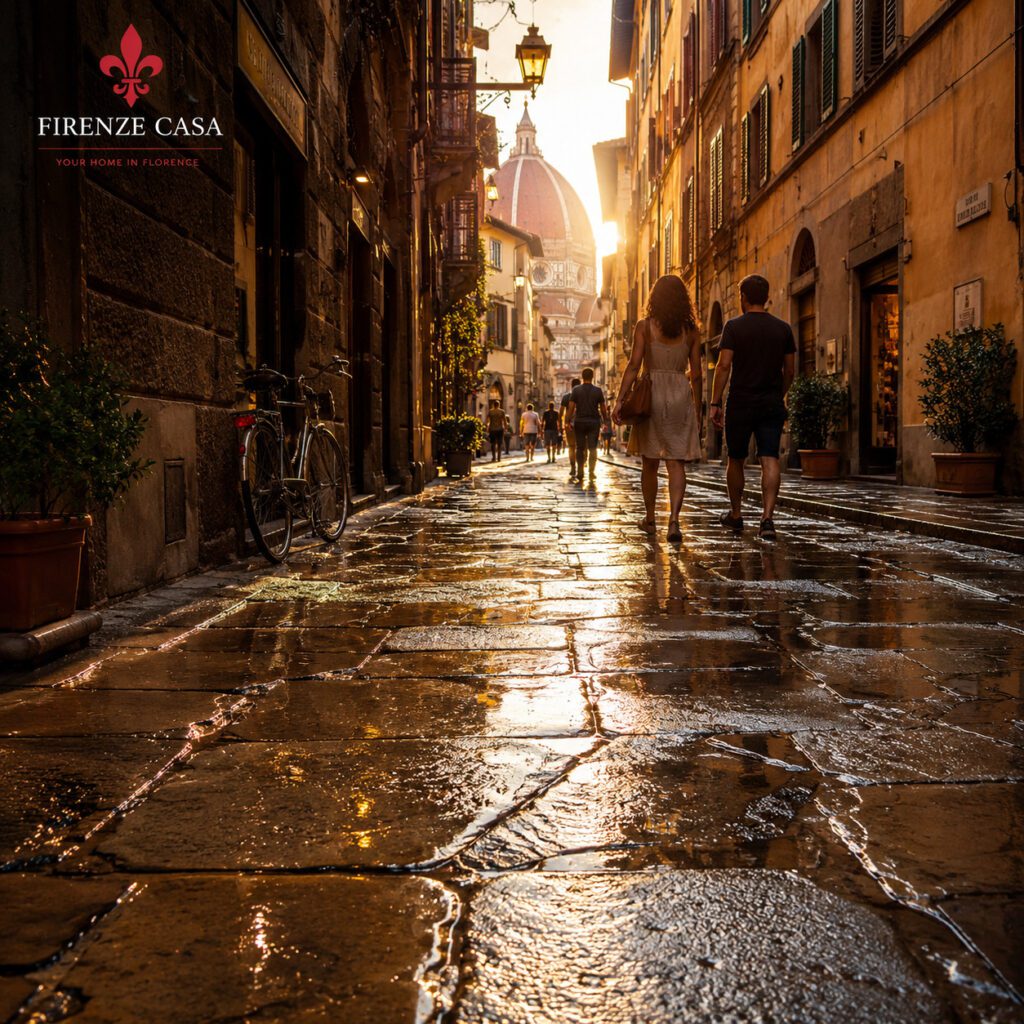
As you stroll through Florence, one detail quickly catches your attention. Almost every street in the historic centre is paved with large natural stone slabs instead of asphalt. Whether you’re wandering through narrow medieval alleys or crossing one of the city’s famous piazzas, these distinctive streets are everywhere. They are beautiful, timeless and unmistakably Florentine—but why has the city preserved them for centuries?
The answer goes far beyond aesthetics. Florence’s stone streets reflect more than 2,000 years of urban history, combining Roman engineering traditions, medieval craftsmanship and modern conservation. They are an essential part of the city’s identity and one of the reasons why walking through Florence feels like stepping back in time.
Unlike many historic cities that replaced their original paving with asphalt during the twentieth century, Florence chose a different path. The historic centre remains remarkably authentic, allowing residents and visitors to experience streets that still preserve much of their original character.
In this article, you’ll discover why Florence’s streets are paved with stone, which materials were traditionally used, how these historic roads are maintained today and why they continue to define the city’s unique atmosphere.
A Walk Through History
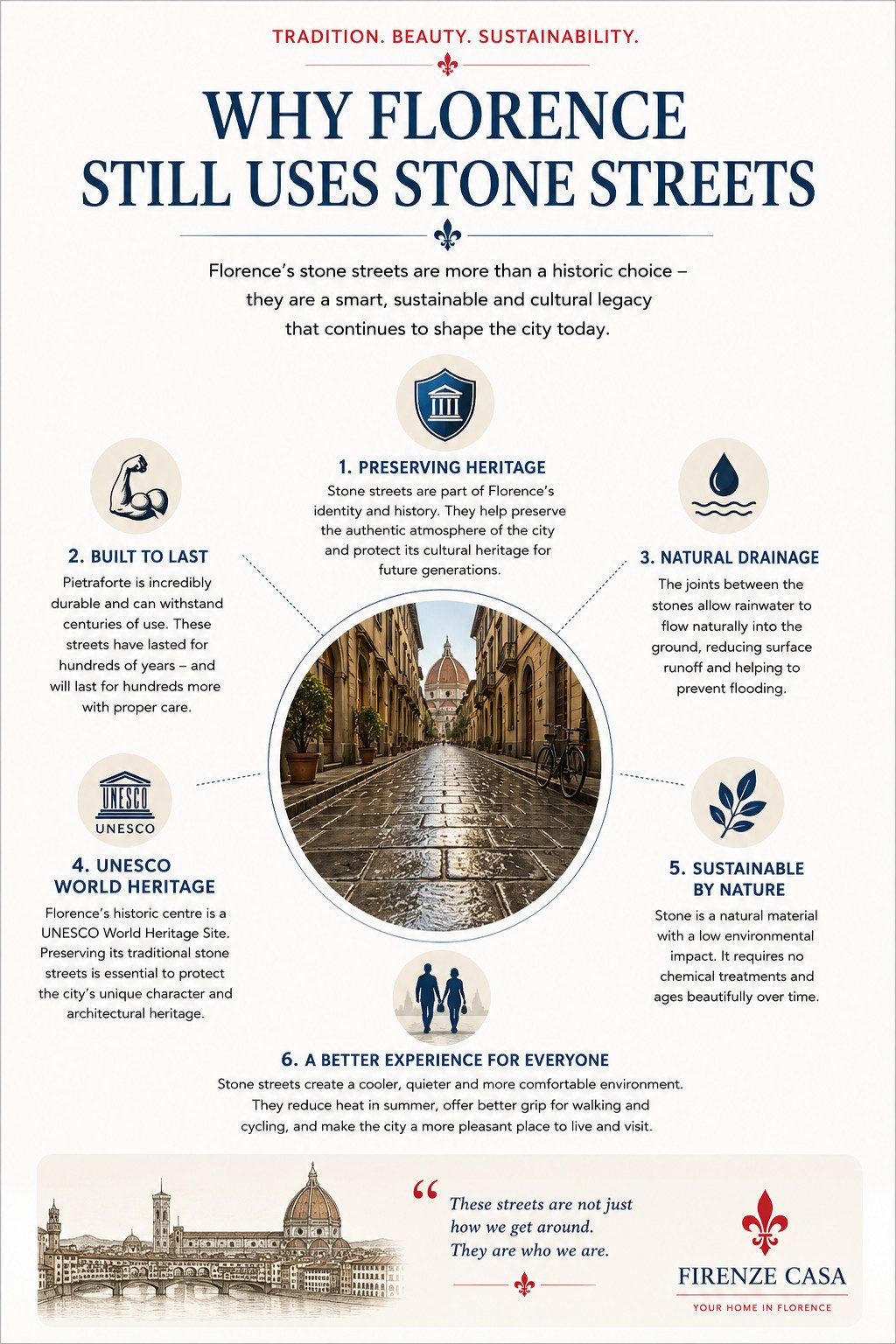
The story of Florence’s stone streets begins long before the Renaissance. When the Romans founded Florentia in 59 BC, they created a carefully planned city with straight streets, drainage systems and durable stone paving. Although much of the Roman street network disappeared beneath later construction, the idea of building long-lasting roads remained an important tradition.
During the Middle Ages, Florence expanded rapidly beyond its original Roman boundaries. New neighbourhoods developed around churches, monasteries and markets, while narrow streets connected homes, workshops and public squares. Stone quickly became the preferred paving material because it could withstand heavy traffic, frequent repairs and changing weather far better than dirt roads.
As Florence grew into one of Europe’s wealthiest cities during the Renaissance, its streets became an integral part of the urban landscape. Merchants, artists, pilgrims and political leaders all travelled across the same stone pavements that visitors still walk on today. These streets witnessed the rise of the Medici family, the construction of magnificent palaces and churches, and the flourishing of Renaissance art and architecture.
What Stone Was Used?
Florence is built with stone, so it is only natural that its streets reflect the same materials used for many of the city’s most famous buildings. The two stones most closely associated with Florence are pietraforte and pietra serena, both quarried in the surrounding Tuscan hills for centuries.
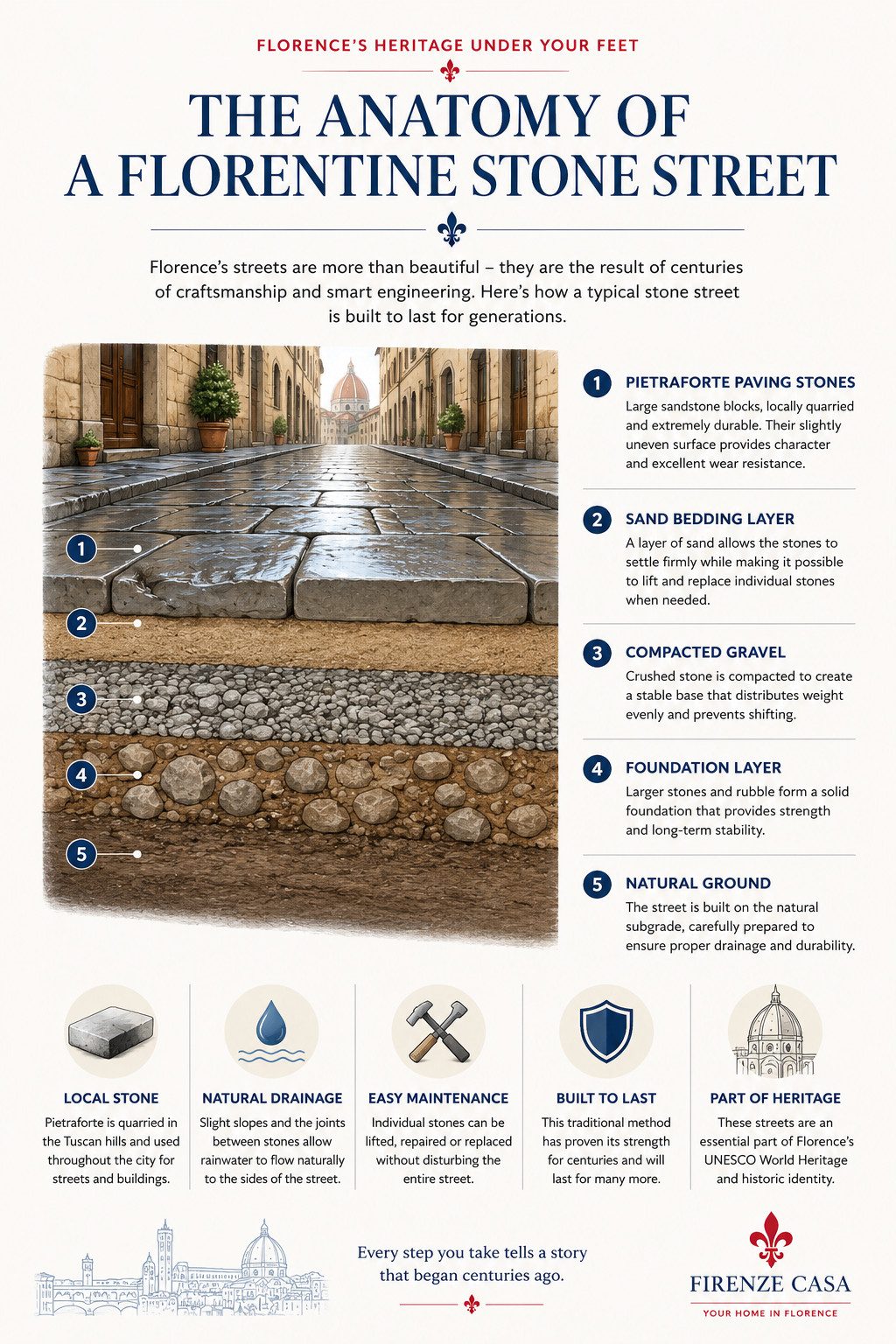
Pietraforte, a warm brown sandstone, is exceptionally strong and resistant to wear. It was traditionally used for streets, city walls and the lower sections of important buildings because it could withstand heavy traffic from horses, carts and later motor vehicles. Many of the paving stones found in Florence’s historic centre are made from this durable material.
Pietra serena, recognisable by its elegant blue-grey colour, is easier to carve and became one of the defining materials of Renaissance architecture. Filippo Brunelleschi used it extensively for columns, arches and decorative architectural details. While it appears less frequently as street paving, it contributes significantly to the city’s distinctive architectural character.
Walking through Florence therefore means experiencing the very materials that helped shape the city for centuries. Streets, churches, palaces and bridges often share the same local stone, creating a remarkable visual harmony throughout the historic centre.
| Stone | Colour | Main Use |
|---|---|---|
| Pietraforte | Warm brown | Street paving, city walls, building façades |
| Pietra Serena | Blue-grey | Architectural details, columns, staircases and interiors |
Why Not Asphalt?
For many visitors, the obvious question is why Florence has never simply replaced its historic paving with modern asphalt. The answer lies in the city’s commitment to preserving one of the world’s most remarkable historic centres.
Florence was designated a UNESCO World Heritage Site in 1982 because of its exceptional artistic, architectural and cultural significance. Preserving the original appearance of its streets is an essential part of protecting this heritage. Replacing centuries-old stone paving with asphalt would fundamentally alter the character of the city and diminish the unique atmosphere that attracts millions of visitors every year.
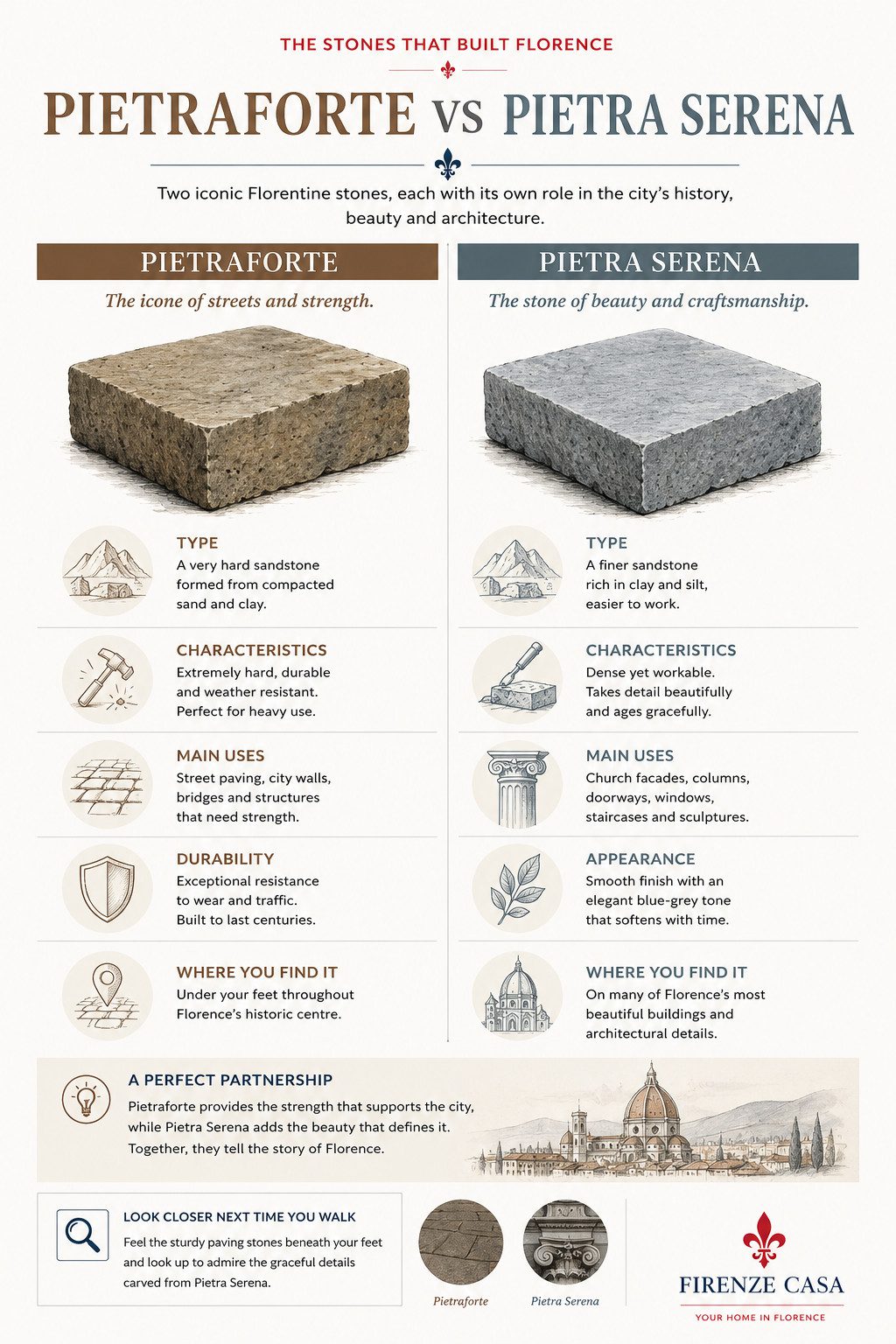
Stone also offers practical advantages. Individual paving blocks can be lifted whenever underground utilities need repair and then carefully reinstalled without permanently changing the historic streetscape. Asphalt, by contrast, often requires larger sections to be removed and replaced, making repairs far more visible.
Although maintaining stone streets is more expensive and labour-intensive, Florence considers this an investment in its cultural identity. Skilled craftsmen continue to repair damaged sections using traditional techniques, ensuring that the historic streets remain both functional and authentic for future generations.
How Are the Streets Maintained Today?
Maintaining Florence’s historic streets is a continuous task that requires specialised knowledge and traditional craftsmanship. Heavy traffic, changing weather and millions of visitors each year gradually wear down even the most durable paving stones.
Rather than replacing entire streets, restoration teams usually remove only the damaged stones, repair the underlying foundation if necessary and carefully reinstall the original paving. When individual stones can no longer be reused, they are replaced with matching local materials to preserve the historic appearance as closely as possible.
Modern infrastructure presents another challenge. Water pipes, electricity cables, fibre-optic networks and drainage systems all run beneath streets that are centuries old. Every repair must balance modern urban needs with the careful preservation of Florence’s unique historic character.
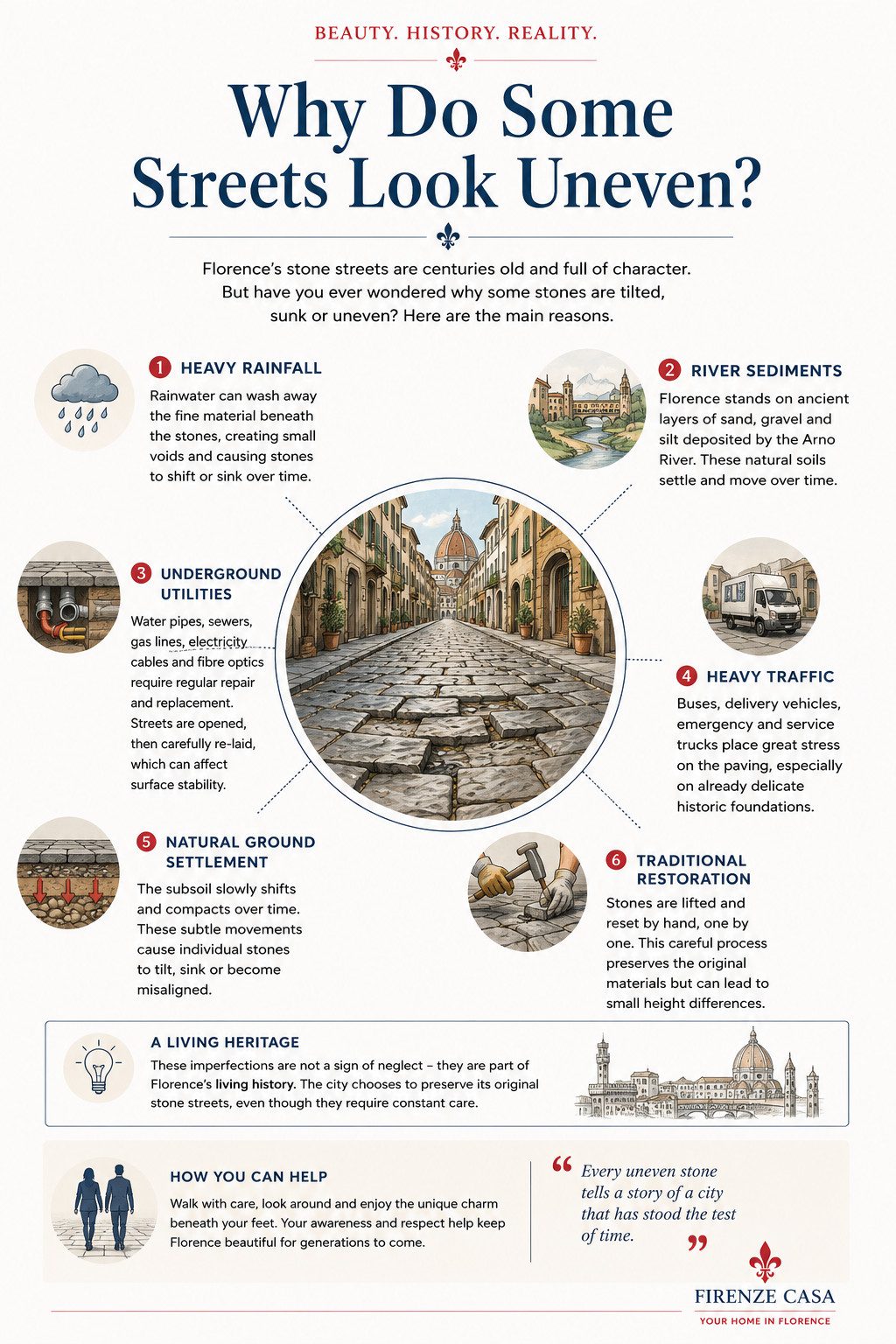
Why Do Some Streets Look Uneven?
Many visitors notice that some of Florence’s historic streets are not perfectly level. Individual paving stones may tilt slightly, sink over time or appear uneven after restoration work. At first glance, this might look like poor maintenance, but the reality is far more complex.
Florence stands on centuries of accumulated history. Beneath today’s streets lie Roman remains, medieval foundations, archaeological layers and an extensive network of modern water pipes, sewers, gas lines, electricity cables and fibre-optic infrastructure. Whenever repairs are needed, sections of the historic paving must be carefully lifted and later reassembled by hand.
The city’s location in the Arno Valley adds another challenge. The ground consists largely of ancient river sediments, including sand, gravel and silt, which can settle gradually over time. Changes in groundwater levels, heavy rainfall and constant traffic all contribute to small movements beneath the surface. As a result, even expertly restored streets may develop slight irregularities after a number of years.
Rather than replacing the historic paving with asphalt, Florence deliberately accepts these imperfections as part of preserving its cultural heritage. Individual stones can be lifted, adjusted and reused without destroying the original streetscape—a traditional approach that has helped protect the character of the city for centuries.
The Challenges of Stone Streets
Historic stone streets are undeniably beautiful, but they also present practical challenges for both residents and visitors. What gives Florence its timeless character can occasionally make everyday movement a little less convenient.
Many visitors notice the streets the moment they begin pulling a suitcase through the historic centre. Large paving stones and uneven surfaces can make wheeled luggage noisier and more difficult to handle than on modern pavements. Cyclists and scooter riders also need extra care, particularly after rain, when some polished stones become slippery.
Accessibility is another important consideration. While the city has introduced ramps and other improvements wherever possible, preserving centuries-old streets while making them accessible for everyone remains an ongoing challenge. Restoration projects must carefully balance historical authenticity with modern urban needs.
Despite these inconveniences, most visitors quickly discover that the stone streets are part of Florence’s unique charm. Their irregular surfaces, subtle colours and centuries of wear create an atmosphere that simply cannot be recreated with modern materials.
Interesting Details You Might Miss
As you explore Florence, take a closer look at the streets beneath your feet. You’ll soon notice details that many visitors walk past without ever seeing.
- 🪨 Many paving stones have been worn smooth by centuries of footsteps, horses and carts.
- 🏛️ Different neighbourhoods often use slightly different paving patterns and stone sizes.
- 💧 Historic drainage channels are still visible along the edges of many streets.
- 🔨 Individual stones can often be identified as recent replacements during restoration work.
- 🚶 Walking through Florence means following routes that have connected the city for hundreds of years.
Frequently Asked Questions
Why are the streets of Florence paved with stone?
Stone is durable, locally available and has been used in Florence since Roman times. It also preserves the city’s unique historic appearance.
What type of stone is used in Florence?
The most common materials are pietraforte for paving and structural elements, and pietra serena for architectural details.
Why doesn’t Florence replace the streets with asphalt?
Maintaining the historic stone paving helps preserve the character of Florence’s UNESCO-listed historic centre and protects its architectural heritage.
Are Florence’s stone streets original?
Many sections contain historic paving that has been repaired and restored over the centuries, although individual stones have been replaced when necessary.
Are the streets difficult to walk on?
Most visitors have no difficulty walking through Florence, although uneven surfaces can make wheeled luggage, bicycles and high heels slightly less practical.
Further Reading from Firenze Casa
- 📖 The History of Florence
- 📖 Why Is Florence a UNESCO World Heritage Site? (Coming Soon)
- 📖 The Most Beautiful Squares in Florence
- 📖 The History of Piazza del Duomo
- 📖 Hidden Gems in Florence – The Complete Guide
- 📖 Secret Courtyards of Florence
- 📖 Florence Cathedral (Santa Maria del Fiore) (Coming Soon)
- 📖 Brunelleschi’s Dome (Coming Soon)
References
- UNESCO World Heritage Centre. Historic Centre of Florence.
- Comune di Firenze. Public Works and Historic Street Maintenance.
- Opera di Santa Maria del Fiore. Official Historical Resources.
- John M. Najemy. A History of Florence 1200–1575. Blackwell Publishing.
- Christopher Hibbert. Florence: The Biography of a City. Penguin Books.
- Richard A. Goldthwaite. The Building of Renaissance Florence. Johns Hopkins University Press.

