
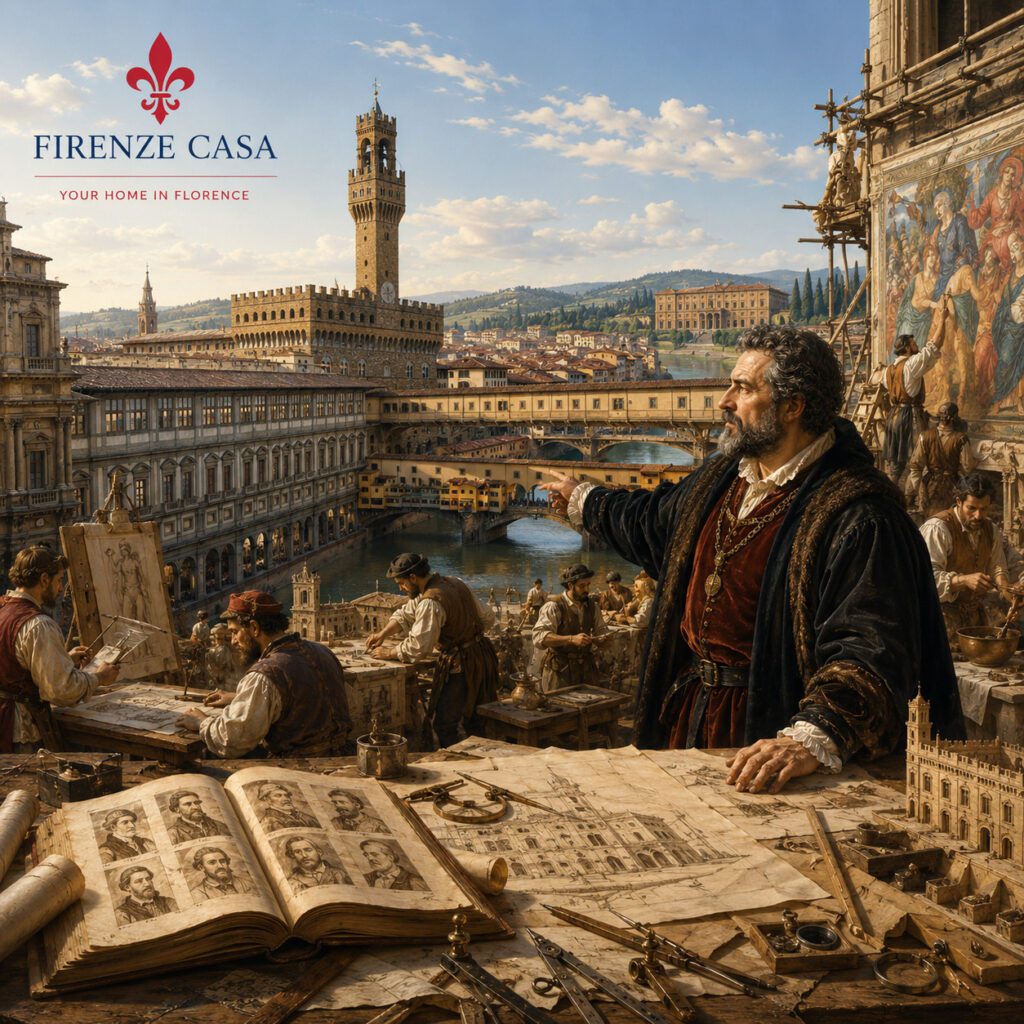
Giorgio Vasari Florence tells a story that reaches far beyond the career of a single Renaissance artist. Vasari painted monumental works, designed some of the city’s most recognisable architecture and served the Medici court. Yet he also did something even more influential: he wrote the stories of the artists who created the Renaissance.
Walk through Florence today and Vasari seems to appear everywhere. The Uffizi transformed the urban landscape beside Palazzo Vecchio, while the Vasari Corridor crosses the Arno above the Ponte Vecchio towards Palazzo Pitti. At the same time, his biographies shaped the reputations of Giotto, Brunelleschi, Botticelli, Leonardo and Michelangelo. His career therefore forms an essential part of our The Great Artists of Florence – Complete Guide.
Born: 30 July 1511, Arezzo
Died: 27 June 1574, Florence
Professions: painter, architect and writer
Major patron: Cosimo I de’ Medici
Major Florentine works: Uffizi, Vasari Corridor and decoration of Palazzo Vecchio
Important publication: Lives of the Most Excellent Painters, Sculptors, and Architects
Why he matters: he helped shape both Renaissance Florence and the later history of Renaissance art
Who Was Giorgio Vasari?
Giorgio Vasari was born in Arezzo in 1511. Although he was not Florentine by birth, Florence became central to his career and historical importance.
He trained as an artist and entered the cultural world surrounding the Medici. Over the following decades, he worked as a painter, architect, organiser of major artistic projects and trusted court artist.
His career eventually became closely connected with Cosimo I de’ Medici, Duke of Florence and later Grand Duke of Tuscany. This relationship gave Vasari access to some of the most prestigious commissions in the city.
Yet his ambitions extended beyond creating individual works. Vasari also wanted to understand, organise and explain the extraordinary artistic transformation that had taken place in Italy.
Vasari was born in Arezzo rather than Florence, but his work for the Medici made him one of the most influential figures in sixteenth-century Florentine culture.
Giorgio Vasari and Medici Florence
By Vasari’s time, Florence had changed dramatically from the republican city associated with earlier Renaissance masters. The Medici had consolidated political control, and Cosimo I wanted architecture and art to express the strength of his government.
Vasari became one of the duke’s most useful collaborators. He could design buildings, organise large teams and create decorative programmes that linked art with political symbolism.
This made him ideally suited to the transformation of ducal Florence. His work belongs closely to the story of the Medici family, whose patronage reshaped the city’s palaces, museums, churches and public spaces.
The Uffizi – Vasari’s Architectural Masterpiece
Among the greatest architectural legacies of Giorgio Vasari in Florence is the Uffizi complex.
Cosimo I commissioned Vasari in 1560 to create new administrative offices for the Florentine state. The Italian word uffizi means “offices”, reminding visitors that the building was not originally conceived as an art museum.
Vasari designed two long wings extending from the area beside Palazzo Vecchio towards the Arno. Between them, a narrow courtyard creates a powerful visual axis towards the river.
The architecture transformed a dense medieval area into a monumental administrative centre and expressed the order and authority of Medici government.
Today, the building houses one of the world’s most important art collections. Our guide to the Uffizi Gallery – History and Medici Legacy explores how Vasari’s government offices gradually became a museum. :contentReference[oaicite:0]{index=0}
When walking through the Uffizi courtyard, turn back towards Palazzo Vecchio. Vasari used the long, narrow space to frame the political heart of Medici Florence.
The Vasari Corridor
Only a few years after beginning the Uffizi, Vasari received another extraordinary commission.
In 1565, Cosimo I ordered the construction of an elevated passage linking Palazzo Vecchio with Palazzo Pitti. The project was associated with the marriage celebrations of Francesco de’ Medici and Joanna of Austria.
The corridor begins near the political centre of Florence, passes through the Uffizi, crosses above the shops of the Ponte Vecchio and continues towards the Oltrarno.
Its purpose was practical as well as symbolic. The Medici court could move between government and residence without using the crowded streets below.
The complete route and its history are explored in our Vasari Corridor – The Secret Passage of the Medici.
Crossing the Ponte Vecchio Above the City
The most famous section of the corridor passes directly over the Ponte Vecchio, creating one of Florence’s most unusual architectural compositions.
Shops occupy the bridge below while the enclosed Medici passage runs above them. The route then turns around the Torre dei Mannelli rather than cutting straight through it, demonstrating how Vasari adapted his design to the complicated medieval urban fabric.
This detail makes the corridor particularly revealing. Even a powerful ducal project had to negotiate the physical reality of an older city.
The Vasari Corridor is best understood from outside as well as inside. From the riverbanks, you can follow much of its route from the Uffizi across Ponte Vecchio towards the Oltrarno.
Vasari Inside Palazzo Vecchio
Vasari also played a major role in transforming Palazzo Vecchio for Cosimo I. The medieval civic palace had become a ducal residence, and its interiors now needed to reflect a new political reality.
Vasari supervised extensive artistic programmes throughout the building. Teams of painters and craftsmen worked under his direction, creating rooms filled with historical, mythological and political imagery.
The palace itself is included in our guide to The Most Beautiful Palaces in Florence, which places Palazzo Vecchio within the broader development of Florentine civic and family architecture. :contentReference[oaicite:1]{index=1}
The Salone dei Cinquecento
The most spectacular example is the Salone dei Cinquecento. The enormous hall had originally belonged to Florence’s republican political system, but under Cosimo I its meaning changed.
Vasari redesigned and decorated the space on a monumental scale. Large battle paintings cover the walls, while the elaborate ceiling celebrates the ruler and his achievements.
The transformation demonstrates how effectively Vasari combined architecture, painting and political storytelling.
The Salone dei Cinquecento shows how a space created for republican government could be visually transformed into a celebration of Medici power.
The Cerca Trova Mystery
One tiny detail in Vasari’s battle paintings has attracted extraordinary modern attention: the words Cerca Trova, meaning roughly “seek, find”, appear on a small green banner in the Salone dei Cinquecento.
The inscription is real, although its meaning remains debated. It became especially famous through theories suggesting that traces of Leonardo da Vinci’s lost Battle of Anghiari might survive behind Vasari’s later decoration.
The mystery later entered popular culture through Dan Brown’s Inferno. Our Dan Brown’s Inferno – Florence Through the Novel article explores how Vasari, Palazzo Vecchio and Cerca Trova became part of the modern literary mythology of Florence. :contentReference[oaicite:2]{index=2}
Was Vasari a Great Painter?
Vasari considered himself an artist first, and painting occupied much of his professional life. He produced altarpieces, frescoes and enormous decorative cycles, often working with large teams of assistants.
Nevertheless, his reputation as a painter has never equalled that of Michelangelo, Raphael or Leonardo.
This does not make his artistic career unimportant. Vasari represents the sophisticated court culture of the later Renaissance, when vast decorative projects required speed, organisation and coordination between many specialists.
His greatest strength may have been precisely this ability to bring architecture, painting and historical narrative together.
Vasari and Michelangelo
Among all Renaissance artists, Michelangelo occupied a special place in Vasari’s imagination.
Vasari admired him enormously and regarded his achievements as the culmination of the artistic development that had begun generations earlier. The two men also knew one another personally.
When Michelangelo died in Rome in 1564, Florence organised elaborate commemorations. Vasari later designed Michelangelo’s monumental tomb in Santa Croce, where allegorical figures representing Painting, Sculpture and Architecture mourn the artist. :contentReference[oaicite:3]{index=3}
Michelangelo’s privileged position within Vasari’s historical narrative would influence his reputation for centuries.
The Lives of the Artists
Despite Vasari’s buildings and paintings, his most influential creation may be a book.
In 1550, he published the first edition of Le vite de’ più eccellenti pittori, scultori e architettori, usually known in English as Lives of the Most Excellent Painters, Sculptors, and Architects. A greatly expanded second edition appeared in 1568.
The work assembled biographies of generations of Italian artists and discussed their careers, personalities, techniques, rivalries and major works.
Nothing comparable had previously attempted to construct such a broad historical narrative of Italian art. For that reason, Vasari is often regarded as one of the founders of modern art history.
Much of what later generations believed about Renaissance artists came through Vasari. His Lives preserve invaluable information, but they also contain anecdotes and judgements that modern historians continue to examine critically.
Vasari’s Story of the Renaissance
Vasari did not simply collect biographies. He created a theory of artistic progress.
In his narrative, Italian art recovered from a long period of decline and gradually moved towards greater naturalism, technical mastery and beauty. Florence occupied a privileged position within this story.
Giotto represented a decisive early breakthrough. Later generations introduced increasingly sophisticated innovations, while Brunelleschi, Donatello and other fifteenth-century masters pushed art forward again.
For Vasari, Michelangelo represented the culmination of this development.
This interpretation proved enormously influential and helped establish Florence as one of the central cities in the conventional history of Renaissance art.
Can We Trust Vasari?
Vasari remains an indispensable historical source, but his stories require careful reading.
He wrote decades or even centuries after some of the artists he described and relied on documents, oral traditions, personal memories and stories circulating among artists.
Some accounts contain invaluable information. Others include anecdotes that cannot be independently confirmed.
Vasari also had strong preferences. His admiration for Tuscan artists, particularly Florentines, shaped his interpretation of Italian art.
Modern historians therefore use the Lives critically rather than treating every sentence as literal fact.
Vasari and the Birth of the Renaissance Myth
One of Vasari’s greatest achievements was transforming individual artistic careers into a coherent historical story.
He presented generations of painters, sculptors and architects as participants in a continuing development. Artists learned from predecessors, competed with contemporaries and improved techniques inherited from earlier masters.
He also strengthened the idea of the artist as an exceptional individual. Personality, ambition, intelligence and genius became central parts of his biographies.
The Renaissance artist was no longer presented merely as an anonymous craftsman but as a historical personality.
The Accademia del Disegno
Vasari also contributed to an important change in the professional status of artists.
In 1563, the Accademia delle Arti del Disegno was founded in Florence under Medici patronage, and Vasari played an important role in its establishment.
The institution promoted the intellectual importance of disegno, a concept encompassing both drawing and artistic design.
This represented a significant move beyond the medieval guild tradition. Painters, sculptors and architects increasingly presented themselves not merely as craftsmen but as practitioners of intellectual disciplines requiring knowledge, invention and judgement.
Vasari’s Lasting Mark on Florence
Few Renaissance figures influenced Florence in as many different ways as Giorgio Vasari.
As an architect, he reshaped the centre of the city. As a painter and organiser, he transformed major Medici interiors. As a writer, he created a narrative that influenced how generations understood Renaissance art.
These achievements remain remarkably visible. Walk from Palazzo Vecchio through the Uffizi towards the Arno and Vasari’s architecture surrounds you. Look towards the Ponte Vecchio and his corridor continues across the river.
Then open almost any history of Renaissance art, and many of the artists Vasari wrote about appear again.
Where to Discover Giorgio Vasari in Florence
Visitors interested in Giorgio Vasari Florence can follow his legacy through several major sites.
- Uffizi: Vasari’s great administrative complex for Cosimo I, later transformed into one of the world’s most famous museums.
- Palazzo Vecchio: extensive decorative projects, especially the Salone dei Cinquecento.
- Vasari Corridor: the elevated Medici route linking Palazzo Vecchio with Palazzo Pitti.
- Ponte Vecchio: the most visible section of the corridor above the historic bridge.
- Santa Croce: Michelangelo’s monumental tomb, designed by Vasari.
The route between Palazzo Vecchio, Uffizi, Ponte Vecchio and Palazzo Pitti is especially revealing because it shows how architecture could physically connect government, court and private residence.
Start at Palazzo Vecchio, continue through the Uffizi and follow the exterior route of the Vasari Corridor across Ponte Vecchio towards Palazzo Pitti. Few walks reveal the relationship between architecture and Medici power so clearly.
Frequently Asked Questions
Who was Giorgio Vasari?
Giorgio Vasari was a sixteenth-century painter, architect and writer from Arezzo who became one of Cosimo I de’ Medici’s most important artistic collaborators in Florence.
Did Vasari design the Uffizi?
Yes. Cosimo I commissioned Vasari in 1560 to design administrative offices for the Florentine state, which later evolved into the Uffizi Gallery.
Why was the Vasari Corridor built?
It connected Palazzo Vecchio with Palazzo Pitti, allowing the Medici court to move privately between government and residence above the streets of Florence.
What is Vasari’s most important book?
Lives of the Most Excellent Painters, Sculptors, and Architects, first published in 1550 and expanded in 1568, is his most influential written work.
Can Vasari’s biographies be trusted completely?
No. They are indispensable historical sources but contain biases, literary anecdotes and information that modern historians sometimes cannot independently verify.
What did Vasari do in Palazzo Vecchio?
He supervised major decorative programmes under Cosimo I, including the monumental transformation of the Salone dei Cinquecento.
Where is Giorgio Vasari buried?
Vasari died in Florence in 1574 but was buried in his native Arezzo.
Why Giorgio Vasari Is Worth Discovering Across Florence
Giorgio Vasari did more than create individual works of art. He helped reshape the political centre of Florence, connected major Medici buildings through architecture and created one of the most influential histories of Renaissance art.
The Uffizi demonstrates his architectural ambition. Palazzo Vecchio reveals his ability to organise monumental political imagery, while the Vasari Corridor shows how architecture could serve power, movement and security.
His Lives added another dimension entirely. Through writing, Vasari transformed generations of painters, sculptors and architects into a historical narrative that still influences the way Renaissance Florence is understood.
Vasari therefore helped build Florence, decorate Florence and explain to later generations why its artists mattered.
Further Reading on Firenze Casa
- The Great Artists of Florence – Complete Guide
- Uffizi Gallery – History and Medici Legacy
- Vasari Corridor – The Secret Passage of the Medici
- The Medici Family – The Dynasty That Shaped Florence
- Michelangelo – Florence and the Making of a Renaissance Genius
- Palazzo Pitti – History, Architecture & Museums
- The Most Beautiful Palaces in Florence
- Dan Brown’s Inferno – Florence Through the Novel
References
- Giorgio Vasari – Lives of the Most Excellent Painters, Sculptors, and Architects.
- Patricia Lee Rubin – Giorgio Vasari: Art and History.
- Liana De Girolami Cheney – Giorgio Vasari’s Artistic and Emblematic Manifestations.
- Gallerie degli Uffizi – historical information on Giorgio Vasari, the Uffizi and the Vasari Corridor.
- Musei Civici Fiorentini – historical information on Palazzo Vecchio and the Salone dei Cinquecento.

