
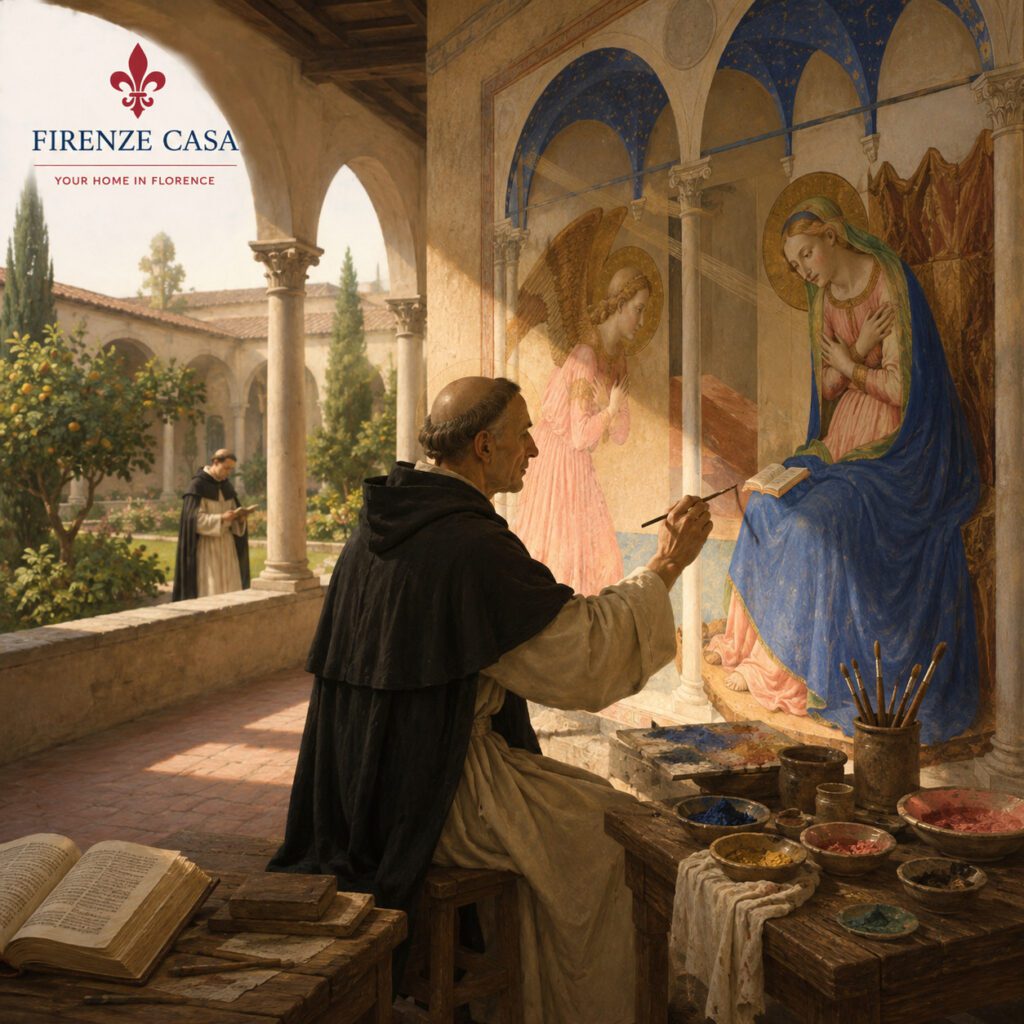
Fra Angelico Florence tells the story of an artist whose paintings seem to belong simultaneously to two worlds. His work grew from medieval religious traditions, yet its light, space and humanity helped shape the visual language of the Renaissance.
Few places reveal this combination as beautifully as San Marco. Inside the former Dominican convent, Fra Angelico created frescoes for corridors, communal spaces and individual monks’ cells, allowing art and architecture to become part of daily spiritual life. His distinctive contribution to Florentine painting makes him an essential figure in our The Great Artists of Florence – Complete Guide.
Born: around 1395, probably in the Mugello
Original name: Guido di Pietro
Religious name: Fra Giovanni da Fiesole
Order: Dominican
Florentine masterpiece: frescoes of San Marco
Famous work: Annunciation at San Marco
Key patronage: Cosimo de’ Medici and the Dominican community
Why he matters: he united Renaissance space and naturalism with profound religious contemplation
Who Was Fra Angelico?
Fra Angelico was born around 1395, probably in the Mugello region north of Florence. His original name was Guido di Pietro, and after entering the Dominican order he became known as Fra Giovanni da Fiesole.
The name by which the world remembers him came later. “Fra Angelico” reflects the extraordinary spiritual character that later generations associated with both the painter and his work.
His career unfolded during one of the most important transitions in European art. Medieval traditions remained powerful, while Florentine artists increasingly explored perspective, architecture, natural space and human emotion.
Fra Angelico stood directly at this crossroads.
Fra Angelico was both a professional painter and a Dominican friar. Religious painting was therefore not simply a subject for him but part of the spiritual world in which he lived.
Fra Angelico and Renaissance Florence
Florence in the early fifteenth century was becoming an extraordinary laboratory for artistic innovation. Brunelleschi was transforming architecture, while Donatello was redefining sculpture and Masaccio was introducing unprecedented physical presence and spatial coherence into painting.
Fra Angelico participated in this transformation in his own distinctive way. He did not abandon the beauty and spirituality of earlier religious art but combined them with the emerging language of the Renaissance.
His figures gained greater volume, architectural spaces became increasingly convincing and gestures acquired emotional meaning. Yet his paintings retained an unmistakable serenity.
This balance helps explain why Fra Angelico occupies such an important place between the world of Giotto and the mature Renaissance.
San Marco and Fra Angelico
The place most closely associated with Fra Angelico in Florence is the Dominican convent of San Marco, now one of the highlights described in our Florence Museums – Complete Guide.
During the 1430s, the Dominican community took possession of the complex. Cosimo de’ Medici financed an extensive reconstruction, while Michelozzo helped transform the monastery into one of the most important religious buildings of Renaissance Florence.
Fra Angelico and members of his workshop decorated the convent with frescoes. Rather than creating one monumental cycle designed primarily for public display, they placed images throughout corridors, communal spaces and individual cells.
Architecture and painting consequently became part of the same spiritual environment.
San Marco is best explored slowly. The frescoes are often restrained and intimate, and much of their impact comes from encountering them within the quiet spaces for which they were created.
The Annunciation at San Marco
Among Fra Angelico’s most celebrated works is the Annunciation at the top of the staircase leading to the monks’ cells.
The Virgin Mary and the Archangel Gabriel face one another beneath an elegant Renaissance loggia. Slender columns define the space, while a small garden opens beside them.
The composition appears simple, yet the simplicity is carefully constructed. Architecture creates order and perspective, while light produces calm rather than theatrical drama.
Neither figure dominates through exaggerated gesture. The painting seems almost to invite silence.
The Monks’ Cells
The individual cells on the upper floor of San Marco provide an even more unusual experience.
Fra Angelico and his workshop decorated many of these small rooms with scenes including the Crucifixion, Resurrection, Annunciation and other episodes from the life of Christ.
These images were not simply decorations. They supported prayer and contemplation, and a friar living in one of the cells would repeatedly encounter the same image as part of his daily routine.
Many compositions therefore avoid unnecessary detail. Figures, essential gestures and religious events dominate the scenes.
Notice how little some of the cell frescoes contain. Their apparent simplicity is deliberate: Fra Angelico used empty space, gesture and silence as carefully as other painters used elaborate decoration.
Fra Angelico and Cosimo de’ Medici
San Marco also connects Fra Angelico with one of the most influential figures in Florentine history: Cosimo de’ Medici.
Cosimo provided substantial financial support for the rebuilding of the monastery and maintained a cell there for periods of retreat. His involvement illustrates how religion, politics, architecture and patronage could overlap in Renaissance Florence.
The broader role of the Medici family in shaping Florence extended far beyond palaces and famous paintings. Their wealth also supported churches, monasteries, libraries and other institutions.
This relationship between finance and cultural patronage is explored further in How Banking Financed the Renaissance in Florence, where San Marco provides one of the clearest examples of banking wealth supporting religious architecture and art.
San Marco shows that Renaissance patronage was not limited to spectacular public monuments. Wealth could also finance spaces intended for prayer, study and religious community life.
Light and Colour in Fra Angelico’s Paintings
Colour is one of the most recognisable qualities of Fra Angelico’s art. Blues, reds, pinks and golds can appear extraordinarily luminous, yet colour rarely functions merely as decoration.
Instead, it contributes to the clarity and spiritual stillness of the compositions. Light performs a similar role.
Rather than relying primarily on dramatic contrasts, Fra Angelico often uses illumination to unify architecture, clothing and faces within a calm atmosphere.
These qualities give his paintings an unmistakable visual identity.
Medieval Tradition Meets Renaissance Innovation
Fra Angelico is sometimes described primarily as a deeply religious painter. Although true, that description alone can obscure his artistic importance.
He understood the innovations transforming Florentine painting. Perspective helped him organise architecture, figures occupy increasingly believable spaces and bodies possess greater weight and volume.
At the same time, Fra Angelico never abandoned the transcendent character of religious imagery.
This combination demonstrates that the Renaissance did not simply replace medieval culture. In many cases, the new artistic language grew directly from older religious traditions.
Fra Angelico and Giotto
The comparison with Giotto is particularly revealing. More than a century earlier, Giotto had introduced greater physical presence and emotional immediacy into religious painting.
Fra Angelico inherited a Florentine tradition already transformed by those developments. Yet the world around him had changed again: Brunelleschi’s architecture and new experiments with perspective offered artists more systematic ways to construct space.
Fra Angelico therefore represents another stage in the long evolution from medieval painting towards the Renaissance rather than a complete break with what came before.
Fra Angelico Beyond San Marco
Although San Marco provides the strongest connection between Fra Angelico and Florence, his career extended far beyond the convent.
He worked for important religious institutions and patrons and eventually received prestigious commissions in Rome. Pope Nicholas V employed him to decorate the private papal chapel now known as the Niccoline Chapel in the Vatican.
Florence nevertheless remained fundamental to his artistic identity. It provided the environment in which he encountered the innovations of the early Renaissance, while San Marco preserves his work in a setting that few museums can equal.
Fra Angelico in Florence’s Museums
The Museo di San Marco is the essential destination for anyone interested in Fra Angelico. Visitors can encounter the famous Annunciation, the frescoes of the monks’ cells and numerous other works associated with the artist and his workshop.
The architecture adds enormously to the experience. Michelozzo’s cloisters, corridors and former monastic rooms preserve the relationship between artworks and their original environment.
Fra Angelico is also represented in other Florentine collections, but San Marco remains exceptional because the building itself explains how much of his art was intended to function.
For visitors planning several museums, our Florence Museums – Complete Guide places San Marco within the wider network of Florentine collections and helps distinguish its quieter, contemplative character from the Uffizi or Accademia.
Fra Angelico and Florence’s Religious Landscape
Fra Angelico’s work is easier to understand when placed within Florence’s wider religious culture. Churches, monasteries and convents were among the city’s most important patrons and provided artists with spaces for frescoes, altarpieces and devotional images.
Our The Most Beautiful Churches in Florence guide explores this broader relationship between faith, architecture and art.
Nearby Santissima Annunziata provides another revealing example of the importance of religious imagery in Florentine life. The Basilica della Santissima Annunziata developed around one of the city’s most venerated images of the Virgin and demonstrates how devotion could shape both architecture and urban space.
San Marco, Fra Angelico and Savonarola
San Marco later became closely associated with Girolamo Savonarola, the Dominican preacher who dominated Florentine political and religious life during the 1490s.
Savonarola arrived after Fra Angelico’s lifetime, so the two should not be treated as contemporaries. Yet their connection with the same Dominican convent demonstrates how San Marco remained an important spiritual and political institution across generations.
The turbulent Florence of Savonarola belongs to the wider historical context explored in our History of Florence.
Fra Angelico’s San Marco and Savonarola’s San Marco belong to different periods. The same convent, however, became central to both the artistic and political history of Renaissance Florence.
Why Fra Angelico Still Matters
Florence celebrates artists who transformed the visible world. Brunelleschi changed architecture, Donatello changed sculpture and Masaccio transformed the representation of space and the human figure.
Fra Angelico’s achievement was subtler but no less important.
He demonstrated that the new visual language of Renaissance Florence could express profound spirituality. Perspective and naturalism did not have to eliminate mystery, while stronger human emotion did not have to replace religious meaning.
Instead, these elements could reinforce one another.
A Different Kind of Renaissance Master
Fra Angelico does not fit neatly into the modern image of the Renaissance artist as a fiercely ambitious individual genius.
His identity as a Dominican friar was fundamental to his life and work, yet he was also a highly accomplished professional artist who responded intelligently to some of the most important developments of his age.
That apparent contradiction is precisely what makes him so interesting.
Fra Angelico Florence reveals a Renaissance in which faith and innovation were not opposing forces. At San Marco, they became part of the same artistic language.
San Marco is particularly rewarding after visiting a large gallery. Its small cells, restrained frescoes and monastic architecture provide a completely different way to experience Renaissance art.
Frequently Asked Questions
Who was Fra Angelico?
Fra Angelico was an early Renaissance painter and Dominican friar whose work combined religious devotion with developments in perspective, space and naturalistic representation.
Where can I see Fra Angelico in Florence?
The Museo di San Marco is the essential destination. Many frescoes remain in the corridors and cells for which they were originally created.
What is Fra Angelico’s most famous work in Florence?
The Annunciation at San Marco is among his most celebrated Florentine works and one of the defining images of early Renaissance religious painting.
Was Fra Angelico supported by the Medici?
Cosimo de’ Medici financed the rebuilding of San Marco, creating the architectural and institutional environment in which Fra Angelico and his workshop produced many of the convent’s frescoes.
Was Fra Angelico a medieval or Renaissance artist?
He belongs to the early Renaissance but retained strong connections with medieval religious traditions. His art is especially fascinating because it combines elements of both worlds.
Did Fra Angelico know Savonarola?
No. Fra Angelico died decades before Savonarola became associated with San Marco. Their connection is the Dominican convent itself, which remained important across different generations.
How long should I allow for San Marco?
Allow roughly one to one and a half hours if Fra Angelico is your main interest, with enough time to explore the upper-floor cells slowly.
Why Fra Angelico Is Worth Discovering in Florence
Fra Angelico offers one of Florence’s most intimate Renaissance experiences. His art is not dominated by monumental scale or theatrical display but by light, restraint and carefully controlled emotion.
San Marco makes that experience especially powerful because so many frescoes remain close to their original architectural context. Corridors, cells and cloisters explain why the paintings were created and how they were intended to be encountered.
His work also provides an important bridge between artistic periods. Giotto’s earlier innovations, Brunelleschi’s new spatial language and Fra Angelico’s religious sensibility all belong to the longer evolution of Florentine art.
In a city filled with monumental masterpieces, Fra Angelico reminds us that some of Florence’s greatest artistic achievements were created for silence and contemplation.
Further Reading on Firenze Casa
- The Great Artists of Florence – Complete Guide
- Florence Museums – Complete Guide
- The Medici Family – The Dynasty That Shaped Florence
- How Banking Financed the Renaissance in Florence
- Giotto – The Artist Who Transformed Medieval Florence
- Filippo Brunelleschi – The Architect Who Changed Florence
- The Most Beautiful Churches in Florence
- Basilica della Santissima Annunziata – Florence’s Marian Sanctuary
References
- William Hood – Fra Angelico at San Marco.
- John Pope-Hennessy – Fra Angelico.
- Museo di San Marco, Florence – collection and historical information on Fra Angelico and the Dominican convent.
- National Gallery, London – biographical and collection information on Fra Angelico.
- Encyclopaedia Britannica – Fra Angelico: biography and artistic career.

