
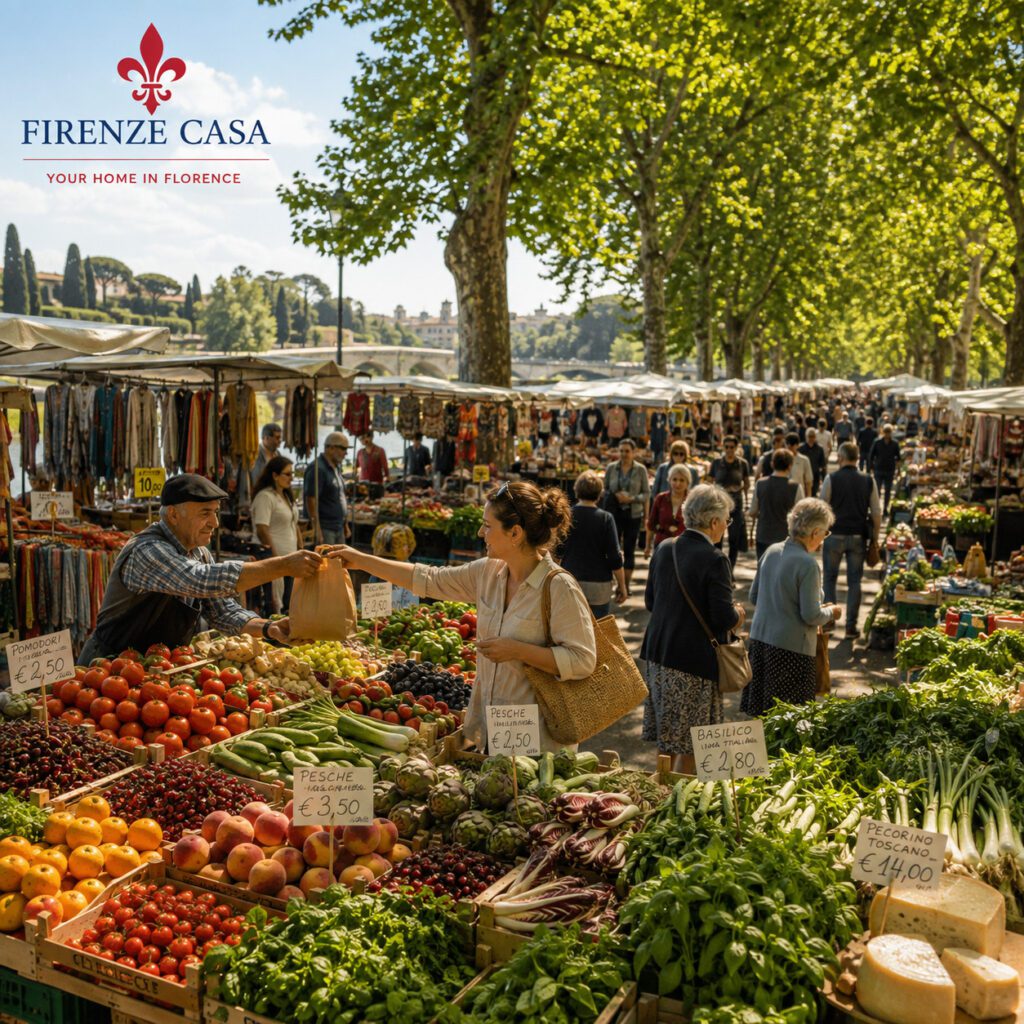
Mercato delle Cascine is Florence’s largest traditional open-air market. Every Tuesday morning, a long stretch beside the Arno fills with stalls selling food, clothing, shoes, household goods and countless everyday products.
Its setting beside the Parco delle Cascine makes the market unlike Florence’s historic covered markets. Instead of Renaissance squares and narrow streets, visitors find broad avenues, trees and open space. For an overview of the city’s different market traditions, see our Historic Food Markets of Florence – Complete Guide.
Market day: Tuesday morning
Location: Parco delle Cascine, beside the Arno
Type: Large weekly open-air market
Products: Food, clothing, shoes and household goods
Best time to visit: Morning
Best for: Local atmosphere and traditional weekly-market culture
Combine with: A walk through the Parco delle Cascine
What Is Mercato delle Cascine?
Unlike Mercato Centrale or Mercato di Sant’Ambrogio, Mercato delle Cascine does not occupy a permanent nineteenth-century market hall. Instead, traders create a temporary commercial street along the Cascine area once a week.
The range of goods is enormous. Fruit and vegetables appear alongside cheese and other foods, while extensive sections are devoted to clothing, shoes, textiles, accessories and household products.
Food therefore forms only one part of the Cascine experience. Its real character comes from the scale and variety of a traditional weekly market.
The History of the Cascine
To understand the market, it helps to know something about its unusual setting. The Parco delle Cascine extends westwards along the northern bank of the Arno and has a history stretching back centuries.
The Medici developed the Cascine estate during the sixteenth century for agricultural and recreational purposes. Its name is associated with cascine, agricultural buildings traditionally connected with livestock and dairy production.
The landscape therefore had links with agriculture and food production long before the modern weekly market appeared.
Over time, the former Medici estate evolved into an important recreational landscape and eventually Florence’s largest public park.
The Cascine were once part of a Medici agricultural estate. Their transformation into a public park reflects the gradual opening of former aristocratic landscapes to the wider city.
From Medici Estate to Public Park
The transformation of the Cascine mirrors broader changes in Florence. Land once associated with the ruling Medici gradually became part of the city’s public life.
Broad avenues, meadows and tree-lined spaces made the Cascine suitable for promenades, recreation and large gatherings. The open landscape also provided something scarce within Florence’s dense historic centre: space.
A large weekly market fits naturally into this environment. On Tuesday mornings, part of the park edge becomes one of the city’s busiest temporary commercial spaces.
A Tuesday Tradition in Florence
The traditional Mercato delle Cascine takes place on Tuesday morning. Traders set up early, and shoppers arrive from different parts of Florence to browse the long succession of stalls.
The scale immediately distinguishes it from smaller neighbourhood markets. Exploring the entire market takes time, particularly if you stop to compare vendors or browse both food and non-food sections.
For many shoppers, the attraction is practical: variety, competitive prices and the opportunity to buy very different products in one place.
Do not plan the Cascine as a quick stop between monuments. Give the market a morning of its own and combine it with a walk through the park afterwards.
Food at Mercato delle Cascine
Although the Cascine is not exclusively a food market, its food stalls provide another window onto Tuscan ingredients and seasonal shopping.
Fresh Fruit and Vegetables
Seasonal produce creates some of the most colourful displays. Tomatoes, peppers, courgettes and summer fruit give way to artichokes, leafy vegetables, citrus fruit and other products as the seasons change.
As at Sant’Ambrogio, the repeated appearance of particular ingredients across several stalls often provides the best indication of what is currently abundant.
Cheese and Tuscan Specialities
Pecorino and other regional cheeses are worth looking for, alongside olives, preserved products and sometimes cured meats. Our guide to Tuscan Cheese explains the regional varieties in greater detail.
When salumi are available, products such as prosciutto and finocchiona offer another introduction to the flavours explored in our guide to Tuscan Salumi.
Other Food Products
The precise selection depends on the traders present. Meat, poultry and other fresh or prepared foods may appear alongside pantry products and ingredients for a simple meal.
Rather than searching only for familiar ingredients, notice what appears repeatedly at different stalls. Traditional markets are among the easiest places to see Tuscan seasonality in practice.
Much More Than a Food Market
What most clearly distinguishes Mercato delle Cascine from Florence’s other markets is the enormous variety of non-food goods.
Clothing occupies a substantial part of the market, alongside shoes, accessories, textiles, kitchenware and inexpensive household products. This makes the Cascine feel less like a specialised food destination and more like the traditional weekly markets found throughout Italy.
That practical character is central to its identity. People come not simply to browse but to shop for ordinary things they need.
The Market and Parco delle Cascine
The setting changes the entire experience. Central Florence usually surrounds visitors with stone façades, churches, palaces and narrow streets. At the Cascine, trees, broad paths and the open landscape beside the Arno dominate instead.
A market visit can therefore become part of a longer morning outdoors. After exploring the stalls, continue through the park or walk along the river.
The contrast is particularly welcome for travellers who have already spent several days exploring Florence’s densely built historic centre.
The Cascine demonstrates that Florence is more than its monumental centre. A Tuesday morning here reveals a greener, more spacious and distinctly everyday side of the city.
Mercato delle Cascine and Tuscan Food Culture
The market also illustrates an important characteristic of traditional Tuscan cooking: its dependence on seasonal ingredients rather than elaborate preparation.
Vegetables, cheese, cured meats, bread and olive oil form the basis of many dishes associated with the region. These ingredients are explored more broadly in our Florentine and Tuscan Food – Complete Guide.
The emphasis on using what is locally available also reflects the philosophy of cucina povera, in which resourcefulness and good ingredients matter more than luxury.
When to Visit Mercato delle Cascine
The traditional weekly market is associated with Tuesday morning. Arriving reasonably early gives you more time to browse while the market is fully active.
Morning visits are particularly pleasant during warmer months, before temperatures rise and while the park still offers comfortable conditions for walking.
Market arrangements can change on public holidays or because of special events, so checking current information before making a special journey is advisable.
How Much Time Should You Allow?
You can see part of the market in less than an hour, but anyone who enjoys browsing should allow considerably longer. Its length is easy to underestimate.
For a relaxed visit that includes both the market and a walk through the park, around two to three hours is reasonable.
Practical Tips for Visiting
- Visit on Tuesday morning for the traditional weekly market.
- Arrive earlier if you want plenty of time to browse.
- Wear comfortable shoes because the market extends over a large area.
- Bring a reusable shopping bag if you plan to buy food or other goods.
- Keep some cash available even when individual traders accept cards.
- Pay normal attention to personal belongings in crowded areas.
- Combine the market with a walk through the Parco delle Cascine.
How the Cascine Compares with Florence’s Other Markets
Florence’s historic markets developed in different ways, and comparing them helps explain why each is worth visiting.
| Market | Character | Best For |
|---|---|---|
| Mercato delle Cascine | Large weekly open-air market | Local shopping, variety and open-air atmosphere |
| Sant’Ambrogio | Neighbourhood food market | Traditional food shopping and seasonal produce |
| Mercato Centrale | Historic covered market and modern food hall | Architecture, food and nineteenth-century market history |
Sant’Ambrogio provides the most concentrated neighbourhood food-market experience, while Mercato Centrale combines traditional stalls with monumental nineteenth-century architecture and a contemporary food hall.
The Cascine is fundamentally different from both. Its defining features are its weekly rhythm, enormous range of goods and open-air setting.
Frequently Asked Questions
What day is Mercato delle Cascine held?
The traditional weekly market takes place on Tuesday morning. Check current arrangements when visiting around public holidays.
Is Mercato delle Cascine a food market?
Food is an important part of the market, but it also has extensive sections selling clothing, shoes, household goods and other products.
Is Mercato delle Cascine worth visiting?
Yes, especially if you want to experience a less tourist-oriented side of Florence and enjoy traditional open-air markets.
What should I buy at the Cascine market?
Seasonal fruit and vegetables, cheese and other regional foods are worth exploring, but browsing the enormous variety of stalls is part of the experience.
How long should I spend at the market?
Allow at least an hour for the market itself. Two to three hours works well if you also want to walk through the Parco delle Cascine.
Can I combine the market with the park?
Yes. The park is an important part of the experience and makes an excellent continuation of a Tuesday morning market visit.
Why Mercato delle Cascine Is Worth Visiting
Mercato delle Cascine reveals a side of Florence that many short-term visitors never encounter. Once a week, part of the city’s largest green space becomes a long temporary marketplace filled with traders, shoppers and everyday goods.
Its appeal lies less in individual landmarks than in the experience as a whole: seasonal produce, clothing stalls, local shoppers, the Arno and the open landscape of the Cascine.
Visit the market in the morning, then continue through the park. Together they provide a refreshing contrast to Florence’s museums, churches and Renaissance streets.
Further Reading on Firenze Casa
- The Historic Food Markets of Florence – Complete Guide
- Mercato di Sant’Ambrogio – Florence’s Authentic Food Market
- Mercato Centrale – Florence’s Historic Central Market
- Florentine and Tuscan Food – Complete Guide
- Cucina Povera Explained: The Philosophy Behind Tuscan Cooking
- Tuscan Cheese: A Guide to Traditional Cheeses of Tuscany
- Tuscan Salumi: Traditional Cured Meats of Tuscany
References
- Comune di Firenze – Information on markets, commerce and the Parco delle Cascine.
- Comune di Firenze – Historical information on the Parco delle Cascine.
- Destination Florence – Information on Florence’s markets and neighbourhoods.
- Historical studies on the Cascine estate and the development of Florence’s public spaces.

