
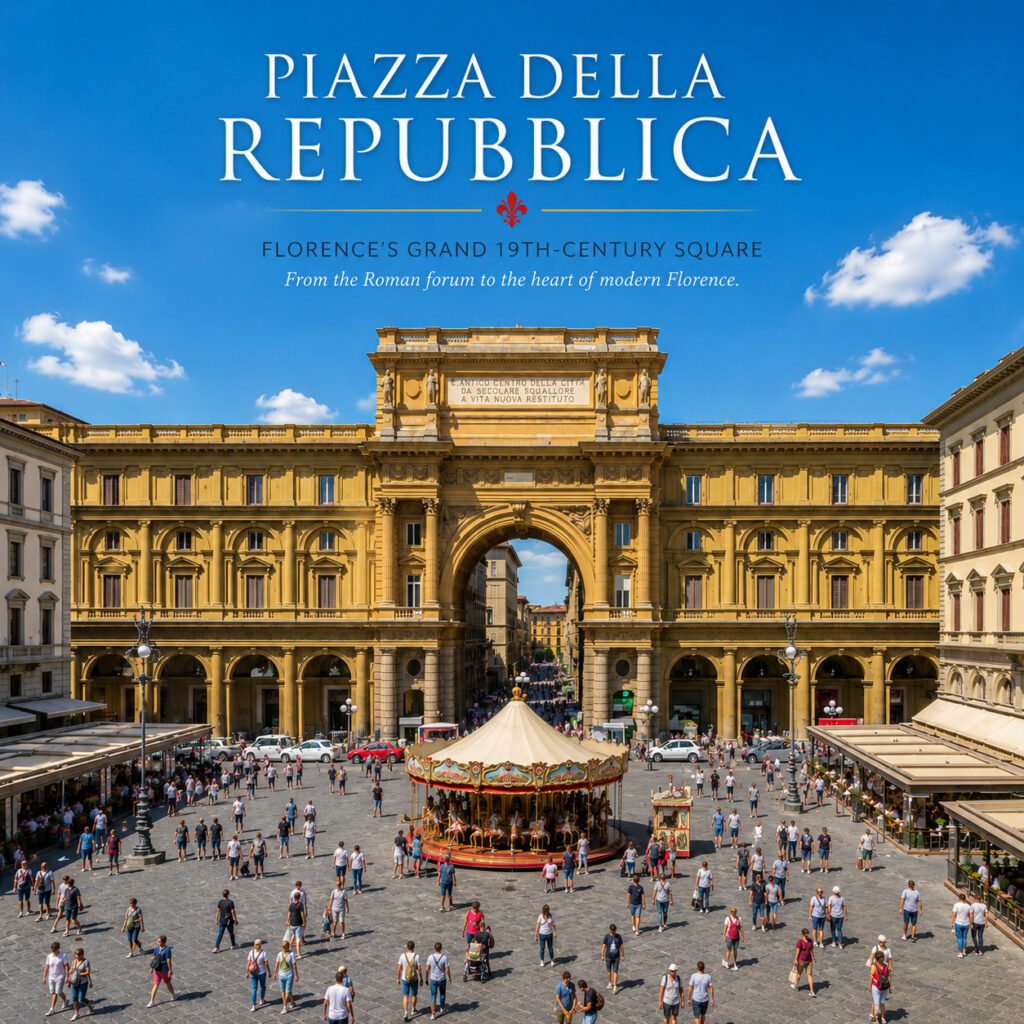
Piazza della Repubblica Florence stands on one of the oldest and most continuously important sites in the city. Long before its elegant cafés, monumental façades and famous carousel appeared, this area formed the centre of Roman Florentia and later became the crowded commercial heart of medieval Florence.
Today, the square looks surprisingly different from the Renaissance streets surrounding it. Its broad open space and imposing 19th-century buildings tell the story of a period when Florence wanted to transform itself into a modern European city. Few places reveal the different layers of Florentine history quite so clearly.
Location: Historic centre of Florence
Best known for: Roman origins, historic cafés, Arcone and carousel
Character: Elegant, lively and distinctly 19th-century
Admission: The piazza is free to visit
Best time: Early morning or evening
Don’t miss: Colonna dell’Abbondanza and the inscription on the Arcone
From Roman Florentia to Piazza della Repubblica
The history of Piazza della Repubblica begins almost two thousand years before the square acquired its present appearance. Roman Florentia was founded in the first century BC, and its street plan followed the typical Roman grid formed by the cardo and decumanus.
The forum occupied the central area where Piazza della Repubblica stands today. Public buildings, commercial activities and civic life concentrated around this important space. Although almost nothing of the Roman forum is visible above ground, its position helps explain why this part of Florence remained important for centuries.
The Roman city beneath modern Florence is easy to overlook. Exploring the surviving traces described in our guide to Roman Florence helps place Piazza della Repubblica within this much older urban landscape.
When you cross Piazza della Repubblica, you are walking across the approximate centre of ancient Roman Florentia. The site has therefore been central to Florentine life for nearly two millennia.
The Mercato Vecchio – Florence’s Lost Market
During the Middle Ages, the district developed into one of Florence’s busiest commercial areas. At its centre stood the Mercato Vecchio, or Old Market, surrounded by shops, workshops, houses, taverns and narrow streets.
This was not the monumental Florence of grand palaces and ceremonial squares. Instead, it was dense, noisy and intensely commercial. Merchants sold food and everyday goods, while residents lived and worked in buildings packed closely together.
The district grew organically over centuries. Its irregular streets and crowded buildings created a completely different urban landscape from the orderly piazza visitors see today.
The Colonna dell’Abbondanza
One landmark still recalls the ancient importance of the site: the Colonna dell’Abbondanza, or Column of Abundance. Standing near the centre of Piazza della Repubblica, the column marks the traditional centre of Florence at the intersection of the ancient Roman street axes.
Over the centuries, different columns and sculptures occupied the site, while the figure of Abundance connected the monument with the market that later surrounded it.
Amid the 19th-century architecture of the present square, the column provides an important visual reminder that the history of this place reaches far beyond the buildings visible today.
Look for the Colonna dell’Abbondanza near the centre of the square. Its position helps visitors imagine the much older city hidden beneath modern Florence.
The Jewish Ghetto of Florence
Another important chapter in the history of the area began in the 16th century. Under Cosimo I de’ Medici, a Jewish ghetto was established close to the Mercato Vecchio. For centuries, the district contained homes, businesses and synagogues within a restricted urban area.
The ghetto became part of the dense network of streets surrounding the market. Its history is essential to understanding the communities that once occupied this part of Florence, even though almost all physical traces disappeared during later redevelopment.
The destruction of the neighbourhood therefore removed not only old buildings but also an important part of the city’s social history. Our article on Florence’s Lost Jewish Quarter explores this vanished district in greater detail.
Florence Becomes the Capital of Italy
The decisive transformation began after Florence became capital of the Kingdom of Italy in 1865. The city suddenly had to accommodate ministries, government officials, diplomats and the institutions of a modern national capital.
Large urban projects followed. New avenues appeared, sections of the medieval walls disappeared and entire neighbourhoods changed as planners attempted to modernise Florence.
Although the national capital moved to Rome in 1871, the transformation continued. The story of Firenze Capitale explains why these few years had such a lasting effect on the appearance of the city.
Much of modern Florence still reflects decisions made during and after Firenze Capitale, when the city served as capital of Italy from 1865 to 1871.
The Risanamento and the Destruction of the Old Quarter
During the late 19th century, the old market district was demolished as part of the urban redevelopment known as the Risanamento. Narrow streets, medieval houses, market structures and much of the former Jewish ghetto disappeared.
The changes remain controversial. Supporters regarded the redevelopment as necessary sanitation and modernisation, while critics saw it as the destruction of an irreplaceable part of medieval Florence.
The transformation belonged to a wider reshaping of the city that also included the demolition of large sections of the medieval city walls and the creation of new boulevards. Piazza della Repubblica is perhaps the most dramatic surviving expression of that period in the historic centre.
A New Square for Modern Florence
The cleared district was replaced by a broad rectangular piazza surrounded by imposing buildings. Initially associated with King Vittorio Emanuele II, the square reflected the ambitions of post-unification Italy rather than the intimate scale of medieval Florence.
Large façades, arcades and commercial premises created an environment more reminiscent of 19th-century European boulevards. Hotels, restaurants, shops and cafés gradually transformed the area into a fashionable meeting place.
The contrast remains striking today. Walk into Piazza della Repubblica from one of the surrounding medieval streets and the scale of central Florence suddenly changes.
The Great Arch of Piazza della Repubblica
The most monumental feature of the square is the large triumphal arch on its western side. Known as the Arcone, it was created as part of the 19th-century reconstruction and forms a dramatic entrance towards Via degli Strozzi.
Its inscription famously declares: “L’antico centro della città da secolare squallore a vita nuova restituito.” It can be translated approximately as: “The ancient centre of the city, restored from centuries of squalor to new life.”
The words perfectly capture the confidence of the planners responsible for the transformation. From a modern perspective, however, they can also sound provocative: what was celebrated as renewal involved the disappearance of an extraordinary part of historic Florence.
The inscription on the Arcone is one of the most revealing details on Piazza della Repubblica. It expresses how 19th-century Florence viewed the radical transformation of its historic centre.
The Historic Cafés of Piazza della Repubblica
As the new square developed, cafés became an important part of its identity. During the late 19th and early 20th centuries, Piazza della Repubblica evolved into one of Florence’s most fashionable social and intellectual meeting places.
Historic names such as Caffè Gilli, Paszkowski and Giubbe Rosse became associated with the piazza. Writers, artists, musicians and intellectuals gathered here, creating a café culture very different from the medieval commercial world that had occupied the same site.
The square became particularly important to Florence’s literary and artistic life in the early 20th century. Writers, journalists and artists used its cafés to exchange ideas and debate new cultural movements, including Futurism.
This modern intellectual history provides an interesting contrast with the Renaissance image normally associated with Florence and connects the piazza with the wider story of Florence in literature.
The Carousel of Piazza della Repubblica
For many visitors today, one of the most recognisable features of Piazza della Repubblica is its colourful carousel. Its painted horses, decorative panels and lights create an unexpectedly playful contrast with the monumental architecture surrounding the square.
The carousel is not a surviving feature of 19th-century Florence despite its nostalgic appearance. Nevertheless, it has become part of the contemporary identity of the piazza and is particularly popular with families.
After dark, its lights and the illuminated façades give Piazza della Repubblica a noticeably different atmosphere from the daytime square.
What to Look for Around the Square
Start with the Colonna dell’Abbondanza and consider how it marks the ancient centre of Florence. Then compare its scale with the monumental 19th-century buildings surrounding it.
Look towards the Arcone and its inscription before turning towards the historic cafés. In only a few minutes, these elements allow you to read several different chapters of the city’s history within the same urban space.
This is what makes Piazza della Repubblica particularly interesting. Almost nothing visible belongs to its oldest periods, yet Roman, medieval, Jewish and modern Florence all contribute to the meaning of the square.
Piazza della Repubblica is best understood as a historical palimpsest. The buildings are comparatively modern, but the site itself preserves memories reaching back to Roman Florentia.
Piazza della Repubblica Today
Modern Piazza della Repubblica Florence is one of the busiest pedestrian spaces in the historic centre. Shoppers cross between Via Roma, Via degli Speziali and Via degli Strozzi, while visitors pause at café tables or around the carousel.
Early morning is best for appreciating the architecture and taking photographs with fewer people around. Later in the day the square becomes livelier, while evening brings illuminated façades, café tables and the lights of the carousel.
Because of its central location, there is little reason to make a special journey here. Piazza della Repubblica naturally forms part of almost any walk through central Florence.
What to See Near Piazza della Repubblica
Piazza del Duomo lies only a few minutes to the north-east, while Via dei Calzaiuoli leads directly towards Piazza della Signoria and Palazzo Vecchio.
Along the same route stands Orsanmichele, whose history as both grain market and church provides another fascinating example of the close relationship between commerce, religion and civic life in Florence.
To the west, Via degli Strozzi leads towards Palazzo Strozzi and Via de’ Tornabuoni. The monumental Renaissance palace recalls the wealth and ambition of the Strozzi family, one of the great rivals of the Medici.
Continue south and the Arno, Ponte Vecchio and Ponte Santa Trinita are also within easy walking distance.
A walk from Piazza del Duomo through Piazza della Repubblica and Via dei Calzaiuoli to Piazza della Signoria connects three remarkably different chapters of Florence’s urban history.
Frequently Asked Questions About Piazza della Repubblica Florence
Why is Piazza della Repubblica important?
It occupies the approximate site of the Roman forum of ancient Florentia. The area later became the Mercato Vecchio before being radically transformed in the late 19th century.
Was Piazza della Repubblica part of Roman Florence?
Yes. The area stood at the centre of Roman Florentia, close to the intersection of the principal Roman streets and the city’s forum.
What happened to the Mercato Vecchio?
The old market and many surrounding medieval streets were demolished during the late 19th-century Risanamento. The present square emerged from this redevelopment.
Was the Jewish ghetto located here?
Yes. Florence’s historic Jewish ghetto stood beside the Mercato Vecchio. Most physical traces disappeared when the district was demolished during the Risanamento.
What is the Colonna dell’Abbondanza?
The Column of Abundance marks a historically important point near the centre of ancient Florence. It also recalls the market district that later occupied the area.
What is the large arch on Piazza della Repubblica?
The Arcone was constructed during the 19th-century redevelopment. Its inscription celebrates what contemporary planners regarded as the renewal of Florence’s ancient centre.
Why does Piazza della Repubblica look different from Renaissance Florence?
Most of its present architecture dates from the late 19th century. The medieval neighbourhood was demolished to create a modern square after Italian unification.
Is Piazza della Repubblica worth visiting?
Yes. It is one of the best places to understand how Florence evolved from a Roman and medieval city into the modern urban centre created after Italian unification.
Why Piazza della Repubblica Is Worth Visiting
Piazza della Repubblica is worth visiting because few places in Florence contain so many historical layers within one space. Beneath its 19th-century appearance lies the centre of Roman Florentia, the memory of the Mercato Vecchio and the vanished Jewish ghetto.
The Arcone and monumental façades reveal the ambitions of post-unification Florence, while historic cafés and the carousel represent later chapters in the life of the square.
Understanding Piazza della Repubblica therefore means looking beyond what is immediately visible. The architecture may be comparatively modern, but the ground beneath it has been at the heart of Florence for almost two thousand years.
Further Reading on Firenze Casa
- The Most Beautiful Squares in Florence – Complete Guide
- The Lost Mercato Vecchio of Florence
- Florence’s Lost Jewish Quarter
- Firenze Capitale – Florence as Capital of Italy
- Orsanmichele – Florence’s Church of Art and Guilds
- Piazza della Signoria – Florence’s Political Heart
- Piazza del Duomo – Florence’s Cathedral Square
References
- Comune di Firenze – Historical material on Piazza della Repubblica and the historic centre
- Archivio Storico del Comune di Firenze – Documentation relating to 19th-century urban redevelopment
- Historical studies on the Mercato Vecchio and the Risanamento of Florence
- Historical studies on Roman Florentia and the development of the city’s urban centre
- Historical literature on the Jewish ghetto of Florence
- Historical studies on Florence during the period of Firenze Capitale, 1865–1871

