
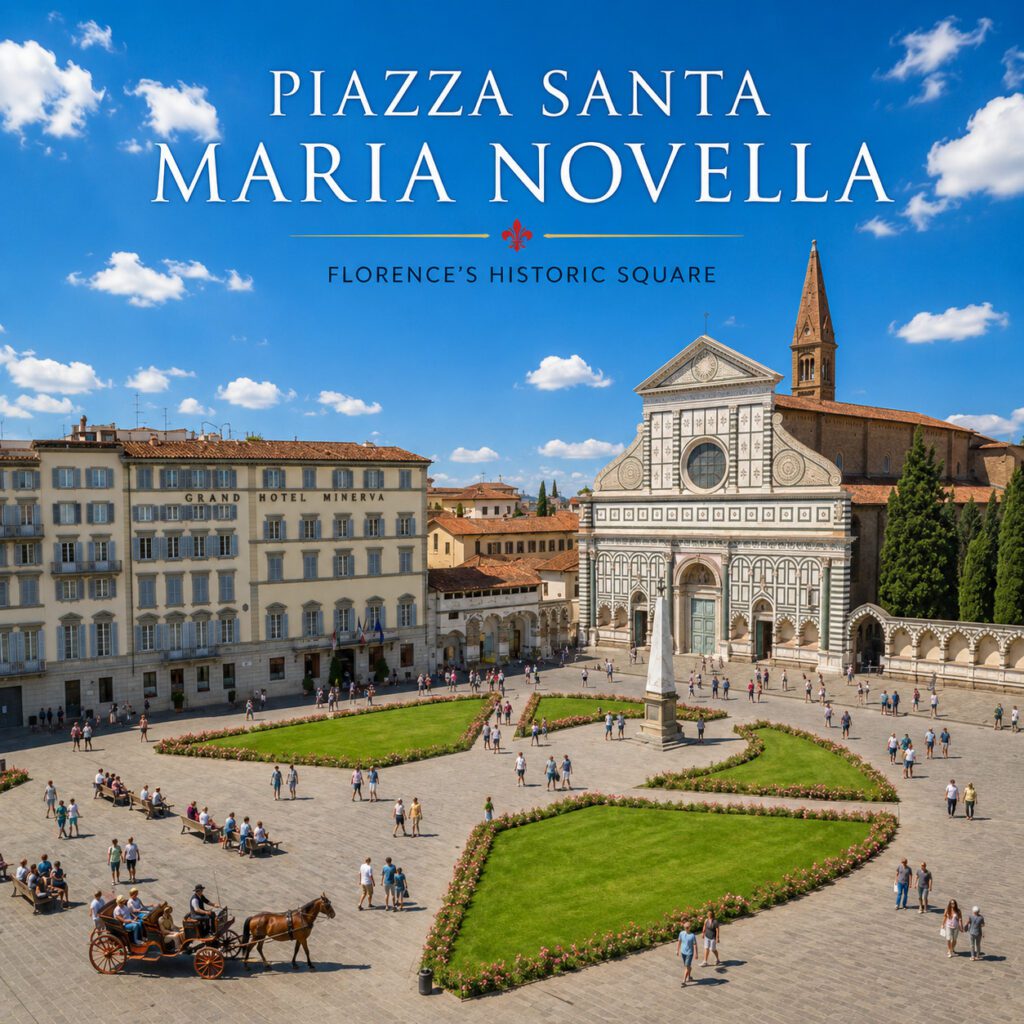
Piazza Santa Maria Novella is one of Florence’s most elegant historic squares. Framed by the celebrated façade of the Basilica di Santa Maria Novella, the piazza has been shaped by centuries of religious ceremonies, public festivals and everyday city life.
For many visitors, Piazza Santa Maria Novella is one of the first major spaces they encounter after arriving in Florence. The city’s main railway station lies only a few minutes away, yet stepping into the piazza immediately introduces another Florence: Renaissance architecture, historic buildings and broad pedestrian spaces replace the movement of trains and traffic.
Although the basilica naturally dominates the setting, the story of Piazza Santa Maria Novella extends far beyond the church itself. Its distinctive obelisks recall spectacular Renaissance chariot races, while the Loggia di San Paolo preserves the memory of Florence’s historic charitable institutions.
Location: Western side of Florence’s historic centre
Best known for: Basilica di Santa Maria Novella and the two obelisks
Character: Elegant, spacious and historic
Admission: The piazza itself is free to visit
Best time: Early morning or evening
Don’t miss: Alberti’s façade and the Loggia di San Paolo
A Piazza Shaped by the Dominican Presence
The history of Piazza Santa Maria Novella is closely connected with the Dominican friars who established themselves in this part of Florence during the 13th century. As their religious complex expanded, the open area in front of the church gradually developed into an important public space.
Unlike some Florentine squares that grew within densely built medieval neighbourhoods, Santa Maria Novella offered a relatively broad area in front of the Dominican complex. Religious gatherings and public events could take place here, while the piazza provided an impressive approach to the church.
Over time, buildings belonging to wealthy families, charitable institutions and religious organisations helped define its perimeter. The area therefore developed into much more than a forecourt for the basilica and acquired its own civic identity.
Florence’s great squares developed around different centres of city life. Piazza della Signoria represented political power, Piazza del Duomo the religious heart of the city, while Santa Maria Novella grew around one of Florence’s most influential monastic communities.
The Basilica as the Architectural Backdrop
The Basilica of Santa Maria Novella provides the unmistakable architectural focus of the piazza. Its famous marble façade, completed by Leon Battista Alberti during the 15th century, creates one of the most harmonious Renaissance compositions in Florence.
From the opposite side of the square, visitors can appreciate the façade particularly well because the distance reveals its carefully balanced geometry and the relationship between the medieval lower section and Alberti’s Renaissance additions.
The church itself contains major works by Masaccio, Giotto and Domenico Ghirlandaio. From the perspective of the piazza, however, its importance is also urban: the façade acts almost like a monumental backdrop and determines the visual identity of the entire square.
Walk to the opposite side of the piazza before photographing Santa Maria Novella. From here, Alberti’s façade can be appreciated as a complete architectural composition rather than simply as the entrance to the church.
The Two Obelisks of Piazza Santa Maria Novella
Among the most distinctive features of Piazza Santa Maria Novella are the two marble obelisks standing opposite one another across the square. Resting on bronze tortoises, they immediately distinguish the piazza from other historic spaces in Florence.
Their presence is connected with one of the square’s most unusual traditions: the Palio dei Cocchi, a spectacular race involving horse-drawn chariots. The obelisks marked the turning points of the racing course, around which competitors raced while spectators watched from the piazza and surrounding buildings.
What appears today as elegant urban decoration therefore preserves the memory of a much louder and more energetic Florence.
The obelisks were not created simply as decorative monuments. They helped define the course of the historic Palio dei Cocchi, when horse-drawn chariots raced around Piazza Santa Maria Novella.
The Palio dei Cocchi
Public spectacles formed an important part of life in Renaissance Florence. While Piazza Santa Croce became famous for games associated with Calcio Storico, Piazza Santa Maria Novella developed its own racing tradition.
The Palio dei Cocchi was introduced during the 16th century and became associated with Cosimo I de’ Medici. Horse-drawn chariots raced around the two obelisks, temporarily transforming the elegant piazza into an urban racecourse.
Such events were more than entertainment. Festivals, processions and competitions allowed Florence’s rulers to demonstrate power and generosity while creating shared spectacles for the population. The Palio therefore belonged to the broader culture of public display under the Medici.
The Loggia di San Paolo
On the western side of Piazza Santa Maria Novella stands the elegant Loggia di San Paolo, another important element of the square’s architectural character. Its Renaissance arcade creates a quieter counterpart to the monumental church façade opposite.
The loggia formed part of the Hospital of San Paolo dei Convalescenti, one of the institutions that provided assistance to the sick, poor and travellers in historic Florence.
This charitable function connects Santa Maria Novella with a broader Florentine tradition represented by institutions such as Santa Maria Nuova and the Misericordia. Hospitals, confraternities and religious foundations formed an important part of the social infrastructure of the medieval and Renaissance city.
The open arches of the Loggia di San Paolo created a transition between a charitable institution and the public piazza – a characteristic example of the close relationship between architecture and civic life in Florence.
Architecture Around the Square
One of the pleasures of Piazza Santa Maria Novella is that no single architectural period completely dominates it. Although Alberti’s façade naturally attracts attention, the surrounding buildings reveal different layers of Florentine history.
Historic residences and former religious or charitable institutions line the perimeter, while their relatively restrained façades allow the basilica to remain the principal visual landmark.
This makes Santa Maria Novella quite different from Piazza del Duomo, where monumental religious architecture dominates almost everything around it. Here, the relationship between church, loggia, surrounding buildings and open space feels more balanced.
From Ceremonial Space to Modern Piazza
Piazza Santa Maria Novella changed repeatedly as Florence itself evolved. Religious processions and Renaissance spectacles gradually gave way to new forms of urban life, while improvements in transportation transformed the surrounding district.
The arrival of the railway was particularly important. Florence’s principal station eventually developed immediately behind the basilica, turning the Santa Maria Novella district into one of the city’s main points of arrival.
The present Firenze Santa Maria Novella station belongs to a much later architectural chapter. Designed by the Gruppo Toscano and opened in the 1930s, its modernist architecture creates a striking contrast with the medieval and Renaissance monuments only a short distance away.
This juxtaposition makes the neighbourhood particularly interesting: within a few minutes, visitors move between medieval Florence, Renaissance architecture and one of the city’s most important examples of 20th-century design.
Piazza Santa Maria Novella Today
Modern Piazza Santa Maria Novella has a surprisingly relaxed atmosphere despite its proximity to one of Florence’s busiest transport hubs. Travellers cross the square with luggage, residents pass through on their daily routes and visitors sit facing the basilica.
Traffic that once occupied much of the area has been reduced, allowing pedestrians to reclaim a larger part of the piazza. Broad paved areas, benches and landscaped sections encourage visitors to stop rather than simply pass through.
Morning brings commuters and newly arrived visitors, while the piazza becomes livelier during the main sightseeing hours. In the evening, when the façade is illuminated and the crowds diminish, the square becomes considerably calmer.
Take a slow walk around the perimeter rather than viewing the basilica from only one position. The spacious character of the piazza makes it particularly good for understanding how individual buildings relate to one another.
What to See on Piazza Santa Maria Novella
The piazza does not require a rigid itinerary, but several features are particularly useful for understanding its history and character.
- Basilica di Santa Maria Novella – the architectural landmark that dominates the square.
- The two obelisks – reminders of the historic Palio dei Cocchi.
- Loggia di San Paolo – an elegant Renaissance arcade connected with a historic charitable institution.
- Historic buildings – forming the architectural frame around the open space.
- The view towards the basilica – one of the best opportunities to appreciate Alberti’s façade from a distance.
Piazza Santa Maria Novella is a public square and can be visited freely. The Basilica di Santa Maria Novella has separate opening hours and admission arrangements.
A Gateway to Historic Florence
For travellers arriving by train, Piazza Santa Maria Novella provides an excellent introduction to Florence. From here, the historic centre unfolds naturally towards Piazza della Repubblica, Piazza del Duomo and Piazza della Signoria.
The Duomo is only a short walk away, yet taking a slower route through the surrounding streets reveals historic buildings, cafés, smaller churches and details that are easily missed when heading directly towards the major monuments.
Another worthwhile route leads south towards Piazza Ognissanti and the Arno, connecting two historic squares with very different characters.
Santa Maria Novella therefore works particularly well as a starting point for exploring Florence on foot. Within minutes of leaving the station, visitors can move from modern transportation infrastructure into streets shaped over many centuries.
How Piazza Santa Maria Novella Compares with Other Florentine Squares
Each of Florence’s great squares developed around a different function. Piazza della Signoria became the centre of civic government, Piazza del Duomo grew around the cathedral complex and Piazza Santa Croce provided space for religious gatherings and large public spectacles.
Across the Arno, Piazza Santo Spirito retains a more informal neighbourhood atmosphere. Santa Maria Novella occupies a position somewhere between these different models: monumental enough to frame an important basilica, yet spacious and balanced enough to remain a comfortable everyday urban space.
These contrasts are explored in our Complete Guide to the Most Beautiful Squares in Florence.
Frequently Asked Questions About Piazza Santa Maria Novella
Where is Piazza Santa Maria Novella?
The piazza lies on the western side of Florence’s historic centre, only a short walk from Firenze Santa Maria Novella railway station and around ten minutes on foot from Piazza del Duomo.
Why are there two obelisks in the square?
The obelisks marked the turning points of the historic Palio dei Cocchi. Horse-drawn chariots once raced around them during public spectacles.
Is Piazza Santa Maria Novella free to visit?
Yes. The piazza is a public space and is freely accessible. The Basilica di Santa Maria Novella has separate admission arrangements.
Who designed the façade of Santa Maria Novella?
Leon Battista Alberti completed the celebrated Renaissance façade in the 15th century, incorporating the earlier medieval lower section into his design.
What was the Loggia di San Paolo used for?
It belonged to a charitable complex associated with the Hospital of San Paolo dei Convalescenti. The institution assisted people including the sick and convalescent.
What is the best time to visit?
Early morning is particularly pleasant before sightseeing activity increases. Evening is also attractive when the square becomes quieter and the basilica is illuminated.
Is Piazza Santa Maria Novella worth visiting without entering the church?
Yes. The obelisks, Renaissance loggia, surrounding architecture and history of public spectacles make the square worth exploring in its own right.
Why Piazza Santa Maria Novella Is Worth Visiting
Piazza Santa Maria Novella is worth visiting because architecture, history and everyday Florentine life coexist here unusually well. Alberti’s basilica façade provides an extraordinary Renaissance backdrop, while the obelisks preserve the memory of chariot races and public celebrations.
The Loggia di San Paolo recalls Florence’s tradition of charitable institutions, and the nearby railway station continues the district’s long association with travellers and arrivals.
For visitors exploring the historic squares of Florence, Piazza Santa Maria Novella therefore offers something distinctive: an elegant public space that has continuously adapted to the changing city while retaining visible traces of its past.
Further Reading on Firenze Casa
- The Most Beautiful Squares in Florence – Complete Guide
- Basilica of Santa Maria Novella – Art and Architecture in Florence
- Piazza del Duomo – Florence’s Cathedral Square
- Piazza della Repubblica – Florence’s Historic Central Square
- Piazza Santa Croce – Florence’s Monumental Square
- Piazza Ognissanti – Florence’s Elegant Riverside Square
- The Medici Family and Florence
References
- Comune di Firenze – Historical and cultural information on Piazza Santa Maria Novella
- Museo Novecento – Historical information on the former Hospital of San Paolo and the Loggia di San Paolo
- Santa Maria Novella – Historical information on the basilica and Dominican complex
- UNESCO World Heritage Centre – Historic Centre of Florence
- Hibbert, Christopher – Florence: The Biography of a City

