
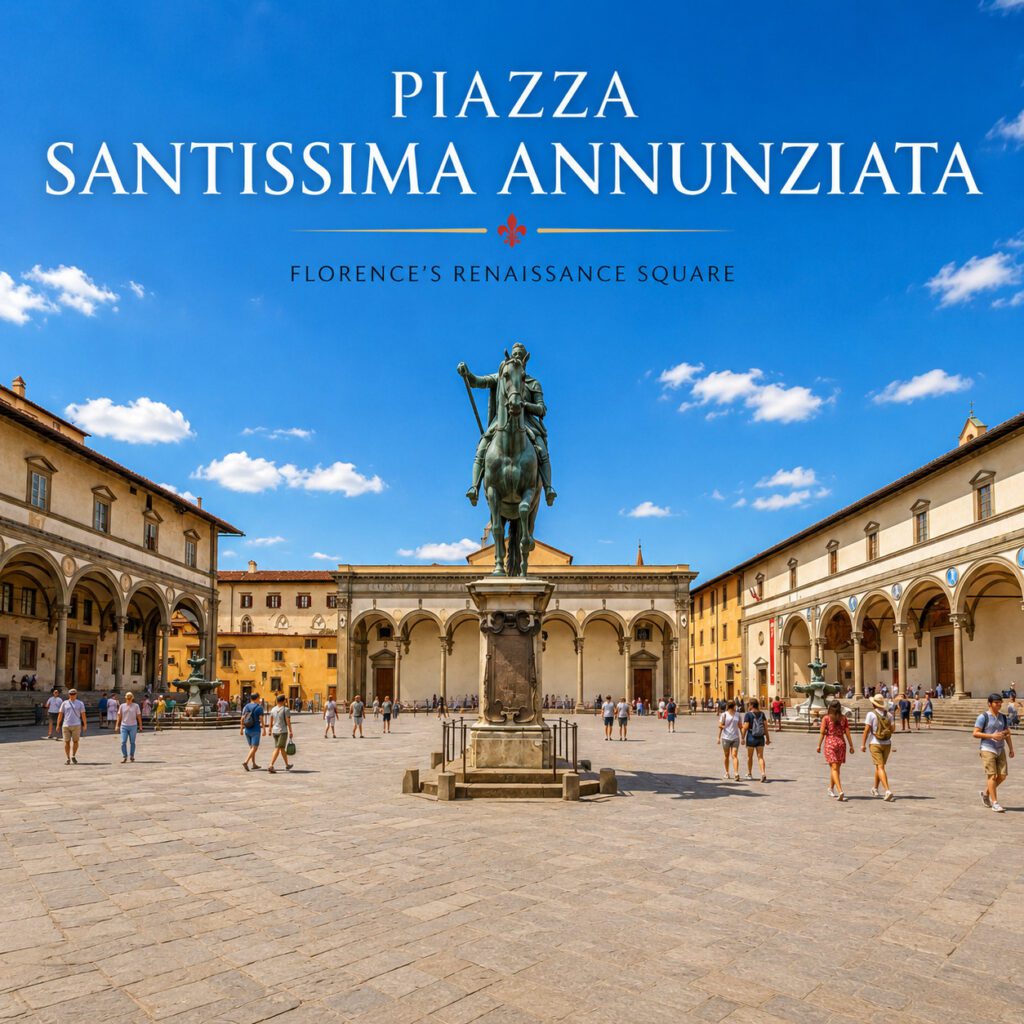
Piazza Santissima Annunziata is one of Florence’s most harmonious Renaissance squares. Elegant arcades frame the open space, the Basilica della Santissima Annunziata closes its northern side, and a remarkable view along Via dei Servi connects the piazza directly with Brunelleschi’s Dome.
Unlike Piazza della Signoria or Piazza del Duomo, this square does not overwhelm visitors with monumental architecture. Its beauty comes from proportion, repetition and the relationship between buildings created over several centuries.
Filippo Brunelleschi’s Ospedale degli Innocenti established the architectural language that later buildings around the piazza followed. At the centre stands the equestrian monument to Grand Duke Ferdinando I de’ Medici, while two extraordinary bronze fountains by Pietro Tacca complete the composition.
Location: North of Piazza del Duomo in Florence’s historic centre
Best known for: Renaissance architecture and Brunelleschi’s Ospedale degli Innocenti
Character: Harmonious, elegant and usually quieter than Florence’s major central squares
Admission: The piazza itself is free to visit
Best view: Along Via dei Servi towards Brunelleschi’s Dome
Don’t miss: The bronze bees on the Ferdinando I monument
A Renaissance Square Built Over Centuries
Piazza Santissima Annunziata did not emerge from a single master plan. Instead, its remarkable harmony developed gradually as successive architects responded to buildings that already existed.
The decisive moment came during the early 15th century with construction of the Ospedale degli Innocenti on the eastern side of the square. Brunelleschi’s elegant loggia introduced slender columns, rounded arches and carefully measured proportions.
Later architects responded to this design rather than ignoring it. Buildings created at different times therefore appear to participate in the same composition, making Piazza Santissima Annunziata one of the clearest places to understand the principles of the Renaissance in Florence.
The harmony of Piazza Santissima Annunziata was created gradually. Later architects deliberately responded to Brunelleschi’s earlier design, giving buildings from different periods a remarkably unified appearance.
Brunelleschi and the Ospedale degli Innocenti
The Ospedale degli Innocenti is fundamental to understanding the square. Designed by Filippo Brunelleschi and begun in 1419, the institution was created to care for abandoned children and became one of the landmarks of early Renaissance architecture.
The famous loggia appears deceptively simple. Rounded arches rest on slender Corinthian columns, while the spacing between architectural elements follows a clear proportional system. Grey pietra serena contrasts with pale walls, making the structure of the façade immediately legible.
Brunelleschi created beauty through order, repetition and balance rather than elaborate decoration. These principles became central to Renaissance architecture throughout Florence and far beyond the city.
The building also demonstrates how architecture in Florence could combine artistic innovation with a social purpose. The institution behind the elegant façade was dedicated to the care and protection of children.
Stand near the centre of the piazza and compare the arcades on opposite sides. The repetition of arches and columns helps explain why the square feels so unusually balanced.
How the Piazza Became So Symmetrical
The western side of Piazza Santissima Annunziata was eventually given an arcade that responds directly to Brunelleschi’s earlier design opposite. The Loggia dei Servi di Maria repeats the rhythm of arches and columns established by the Ospedale degli Innocenti.
Although the two sides were not created simultaneously, their visual relationship makes the piazza appear far more unified than its long construction history might suggest.
The arcaded entrance in front of the Basilica della Santissima Annunziata adds another element to this architectural dialogue. Together, the three sides create the impression of a carefully proportioned outdoor room.
The Basilica della Santissima Annunziata
The Basilica della Santissima Annunziata closes the northern end of the piazza and gives the square its name. The church developed from a medieval sanctuary founded by the Servite Order and became one of Florence’s most important centres of Marian devotion.
Its relatively restrained exterior gives little indication of the artistic richness inside. The basilica is associated with a revered image of the Annunciation and contains architecture and artworks spanning several centuries.
From the perspective of the piazza, however, the basilica performs another role. It anchors the northern side and completes the composition created by the arcades opposite and alongside it.
Do not look only at individual monuments. Walk slowly around the perimeter and repeatedly look back across the square. Its architectural logic becomes clearer from changing perspectives.
Ferdinando I de’ Medici at the Centre
At the centre of the square stands the equestrian monument to Grand Duke Ferdinando I de’ Medici. The bronze statue was designed by Giambologna and completed by his pupil Pietro Tacca, linking the piazza with two of the most important sculptors working for the Medici court.
The monument introduces a strong central focus without disturbing the architectural balance around it. Horse and rider rise above the open space, while the surrounding arcades provide an ordered backdrop.
Like many monuments connected with the Medici family, the statue also carried a political message. It placed grand-ducal authority prominently within a public space and reminded viewers of the ruling dynasty’s presence in Florence.
The Mysterious Bees of Florence
The monument contains one of the square’s most charming details. On its pedestal is a bronze composition featuring a queen bee surrounded by numerous smaller bees arranged in concentric patterns.
The arrangement inspired a traditional Florentine challenge: try to count the bees without losing your place. What initially appears simple becomes surprisingly difficult because of the way the insects are positioned.
The bees carried symbolism connected with the grand duke and his subjects. Over time, however, they also became part of Florentine popular tradition and one of those small details that reward visitors who look beyond the obvious monuments.
One of Florence’s best-known small challenges is hidden on the pedestal of Ferdinando I’s monument. Before searching for the answer, try counting the bronze bees yourself.
Pietro Tacca’s Bronze Fountains
Two remarkable bronze fountains stand on either side of the square. Created by Pietro Tacca, they introduce a more playful sculptural element into the otherwise disciplined architectural setting.
The fountains feature marine creatures and elaborate forms that contrast with the geometric clarity of the surrounding Renaissance arcades. Their dark bronze surfaces also stand out dramatically against the pale stone and plaster of the buildings.
Seen together with the equestrian monument, the fountains demonstrate how sculpture gradually enriched a piazza originally defined primarily by architecture.
The Extraordinary View Along Via dei Servi
One of the most beautiful features of Piazza Santissima Annunziata is not actually located within the square. Standing near the basilica and looking south, visitors see directly along Via dei Servi towards Piazza del Duomo.
Brunelleschi’s enormous dome appears at the end of the street, creating one of Florence’s finest urban perspectives. The view also connects two places closely associated with the architect: the Ospedale degli Innocenti beside the piazza and the cathedral dome dominating the city beyond.
Walking along Via dei Servi between the two squares makes the relationship particularly clear. The dome repeatedly disappears and reappears between the surrounding buildings, turning the street itself into part of the architectural experience.
Stand towards the northern side of the piazza and look down Via dei Servi. The street frames Brunelleschi’s Dome and creates one of Florence’s classic architectural views.
A Square Connected with Florence’s Children
The presence of the Ospedale degli Innocenti gives Piazza Santissima Annunziata a social history that distinguishes it from many other Florentine squares. For centuries, the institution cared for abandoned infants and children.
The famous glazed terracotta medallions of swaddled infants on the façade became symbols of the institution and remain among the most recognisable details of the building.
This humanitarian role adds another dimension to Brunelleschi’s architecture. The loggia was not designed simply to express the prestige of a ruler or wealthy family; it provided a monumental setting for one of Florence’s most important charitable institutions.
The Festa della Rificolona
Piazza Santissima Annunziata also plays an important role in one of Florence’s most distinctive popular traditions. Each September, the Festa della Rificolona brings colourful paper lanterns into the streets and is closely associated with the piazza and the feast of the Nativity of the Virgin.
The tradition has evolved over centuries, but lanterns remain its most recognisable feature. Families and children gather with brightly coloured creations, giving the historic square a very different atmosphere from its usual architectural calm.
Events such as the Rificolona demonstrate that Florence’s historic piazzas are not simply preserved monuments. They continue to function as places where traditions and community life become part of the modern city.
A Piazza Made for Walking Slowly
Despite its architectural importance, Piazza Santissima Annunziata often feels calmer than Florence’s most famous central squares. Its position slightly north of the principal route between the Duomo, Piazza della Signoria and Ponte Vecchio means that many visitors pass nearby without spending much time here.
That relative quiet is part of its appeal. There is space to stand back from the buildings, compare the arcades and notice details that would easily disappear in a more crowded setting.
For anyone interested in Renaissance architecture, this is precisely the kind of place that rewards a slower visit.
Piazza Santissima Annunziata is best experienced as a complete composition. Spend less time searching for a single spectacular monument and more time observing how architecture, sculpture and open space work together.
What to See on Piazza Santissima Annunziata
- Ospedale degli Innocenti – Brunelleschi’s landmark of early Renaissance architecture.
- Basilica della Santissima Annunziata – the historic Marian sanctuary that gives the square its name.
- Loggia dei Servi di Maria – the arcade that responds to the architectural rhythm of the Ospedale degli Innocenti.
- Monument to Ferdinando I de’ Medici – the equestrian statue designed by Giambologna and completed by Pietro Tacca.
- Pietro Tacca’s fountains – two distinctive bronze fountains decorating the square.
- The bronze bees – a famous hidden detail on the pedestal of the Medici monument.
- View along Via dei Servi – one of the most beautiful perspectives towards Brunelleschi’s Dome.
Piazza Santissima Annunziata is a public square and can be visited freely. The basilica and museums around the piazza have their own opening hours and admission arrangements.
Exploring Florence from Piazza Santissima Annunziata
The most natural route from the square follows Via dei Servi directly towards Piazza del Duomo. This short walk connects Brunelleschi’s early Renaissance architecture at the Innocenti with his greatest engineering achievement at Florence Cathedral.
Nearby, Piazza San Lorenzo provides another connection with Brunelleschi and the Medici, while heading south through the historic centre eventually leads towards Piazza della Signoria.
Comparing these spaces reveals how differently Florence’s piazzas developed. Santissima Annunziata is particularly unusual because its identity depends less on size or political importance than on architectural harmony.
For a broader comparison, see our Complete Guide to the Most Beautiful Squares in Florence.
Frequently Asked Questions About Piazza Santissima Annunziata
Where is Piazza Santissima Annunziata?
The square lies north of Piazza del Duomo in Florence’s historic centre. Via dei Servi provides a direct walking route between the cathedral and the piazza.
Why is Piazza Santissima Annunziata famous?
It is particularly famous for its harmonious Renaissance architecture. Brunelleschi’s Ospedale degli Innocenti established the architectural rhythm later echoed by other buildings around the square.
What is the Ospedale degli Innocenti?
It is a historic institution founded to care for abandoned children. Its Brunelleschi-designed loggia became a landmark of early Renaissance architecture.
What is in the centre of the piazza?
The centre is dominated by the equestrian monument to Grand Duke Ferdinando I de’ Medici, designed by Giambologna and completed by Pietro Tacca.
Where are the famous bronze bees?
The bees are located on the pedestal of the Ferdinando I monument. Their unusual arrangement inspired a traditional Florentine counting challenge.
Can you see the Duomo from Piazza Santissima Annunziata?
Yes. Looking south along Via dei Servi provides an impressive view of Florence Cathedral and Brunelleschi’s Dome.
Is Piazza Santissima Annunziata free to visit?
Yes. The piazza itself is freely accessible. Individual museums and attractions around the square have their own admission arrangements.
Why Piazza Santissima Annunziata Is Worth Visiting
Piazza Santissima Annunziata is worth visiting because it demonstrates Renaissance urban design with exceptional clarity. Brunelleschi’s Ospedale degli Innocenti established a language of arches, columns and measured proportions that later buildings continued, creating an extraordinary sense of harmony.
The Ferdinando I monument and Pietro Tacca’s fountains add Medici history and sculpture, while the Basilica della Santissima Annunziata contributes centuries of religious tradition. The Innocenti, meanwhile, connects architectural beauty with an important chapter in Florence’s social history.
Then there is the view along Via dei Servi towards Brunelleschi’s Dome. Few places demonstrate more clearly how architecture, sculpture, streets and public space combine to shape the experience of Florence.
Further Reading on Firenze Casa
- The Most Beautiful Squares in Florence – Complete Guide
- Basilica della Santissima Annunziata – Florence’s Marian Sanctuary
- Piazza del Duomo – Florence’s Cathedral Square
- Piazza San Lorenzo – The Medici Square of Florence
- Piazza della Signoria – Florence’s Political Heart
- The Medici Family – The Dynasty That Shaped Florence
- The Renaissance in Florence
References
- Comune di Firenze – Historical and cultural information on Piazza Santissima Annunziata
- Museo degli Innocenti – History and architecture of the Ospedale degli Innocenti
- Basilica della Santissima Annunziata – Historical information on the basilica and Servite complex
- UNESCO World Heritage Centre – Historic Centre of Florence
- Hibbert, Christopher – Florence: The Biography of a City
- Zöllner, Frank – Florence: The Complete Guide to the City of the Renaissance

