
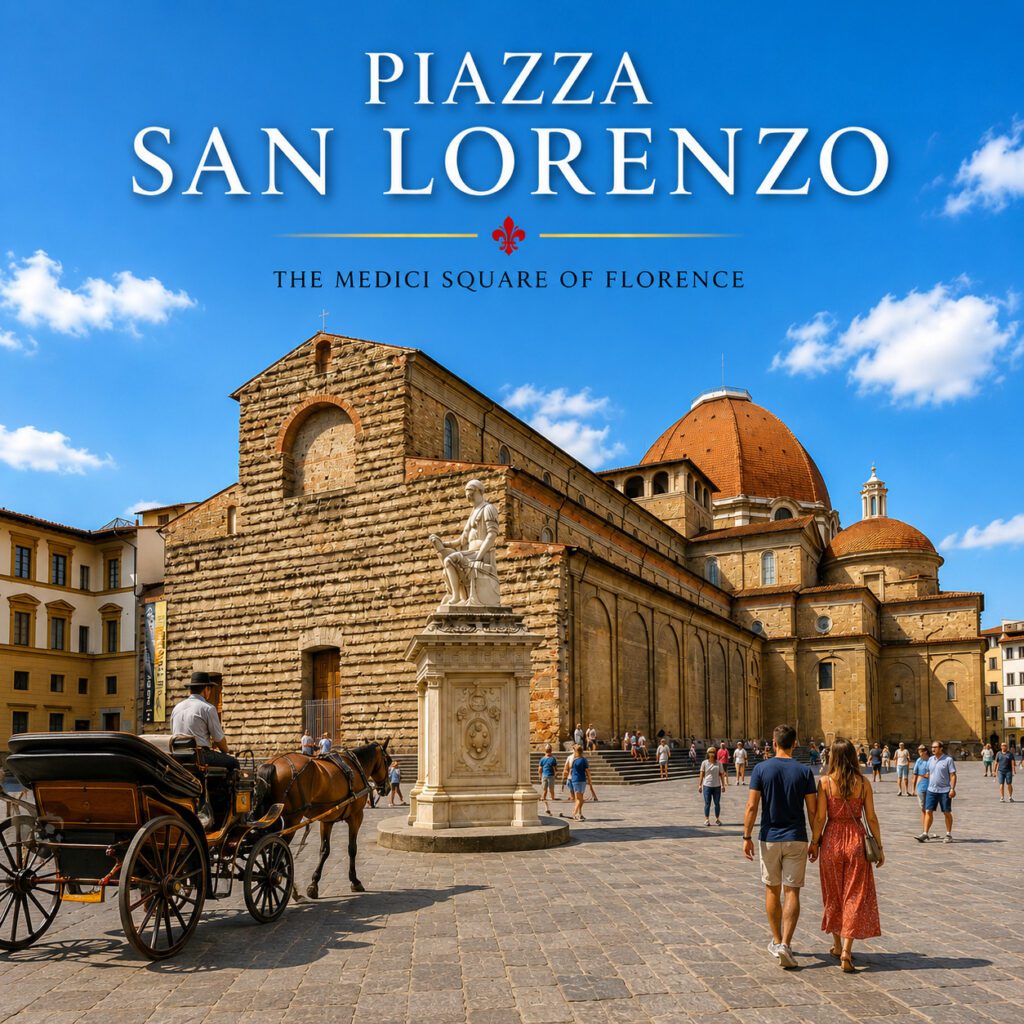
Piazza San Lorenzo lies at the heart of one of Florence’s most historically layered neighbourhoods. The unfinished façade of the Basilica of San Lorenzo dominates the square, while centuries of Medici history, Renaissance architecture, monuments and everyday street life surround it.
At first sight, the piazza can appear less spectacular than Piazza della Signoria or Piazza Santa Croce. Yet this informality is precisely what makes it interesting. Piazza San Lorenzo was never designed as a perfectly symmetrical Renaissance stage; instead, it developed organically around one of Florence’s oldest churches and within a district that became closely connected with the Medici family.
Location: Northern historic centre of Florence
Best known for: Basilica of San Lorenzo and Medici history
Character: Historic, informal and lively
Admission: The piazza itself is free to visit
Best time: Morning
Nearby: Medici Chapels, Palazzo Medici Riccardi and Mercato Centrale
A Piazza at the Heart of Old Florence
The history of Piazza San Lorenzo reaches far beyond the Renaissance. The church of San Lorenzo has ancient origins, and the surrounding district developed within one of the oldest inhabited parts of Florence.
Long before the Medici transformed the neighbourhood, religious buildings, houses, workshops and commerce already shaped daily life here. The character of the area changed dramatically during the 15th century, when the Medici family became increasingly influential and San Lorenzo developed into one of the geographical centres of their world.
The family palace stood nearby, while the church became closely associated with Medici patronage and burial. This proximity between home, church and public space is important: early Medici power developed within the streets and institutions of republican Florence rather than behind the walls of a royal court.
The Basilica That Defines Piazza San Lorenzo
The most prominent building on Piazza San Lorenzo is the Basilica of San Lorenzo. Its rough, unfinished façade creates one of the most unusual church fronts in central Florence.
Instead of coloured marble or elaborate sculptural decoration, visitors encounter exposed stone and masonry. Behind this restrained exterior, however, lies one of the key architectural complexes of Renaissance Florence, shaped by Filippo Brunelleschi and closely connected with generations of Medici patrons.
Michelangelo later produced plans for a monumental façade, but the project was never realised. The unfinished exterior has since acquired a character of its own and gives Piazza San Lorenzo its unmistakable appearance.
The façade may appear incomplete, but it has become one of San Lorenzo’s defining features. Try imagining the piazza with the monumental marble façade Michelangelo once planned.
A Square Shaped by the Medici
Few areas of Florence are as closely associated with the Medici as San Lorenzo. Giovanni di Bicci de’ Medici supported the reconstruction of the church, and subsequent generations continued to invest in the religious complex.
Just a short walk from the piazza stands Palazzo Medici Riccardi, commissioned by Cosimo de’ Medici from Michelozzo. Family residence, church, burial spaces and patronage projects were therefore concentrated within a remarkably small area.
Later additions strengthened the connection. The Medici Chapels became one of the dynasty’s principal burial sites, while the Laurentian Library expressed both the family’s intellectual ambitions and Michelangelo’s extraordinary architectural imagination.
For visitors interested in the broader development of the city, this concentration of architecture and patronage is one of the clearest examples of the relationships explored in our guide to the Renaissance in Florence.
Giovanni delle Bande Nere
One of the most distinctive monuments on Piazza San Lorenzo is dedicated to Giovanni delle Bande Nere, the celebrated 16th-century military commander and father of Cosimo I de’ Medici.
Baccio Bandinelli created the monument, combining an imposing seated figure with a massive stone base decorated with reliefs. Giovanni appears not simply as an individual soldier but as an idealised military hero, reflecting the political imagery of 16th-century Florence.
The monument was originally conceived for another setting and remained incomplete for a long period. Only later did it acquire its present position beside San Lorenzo, where it now forms part of the identity of the piazza.
Giovanni delle Bande Nere was the father of Cosimo I de’ Medici, who became Duke of Florence and later the first Grand Duke of Tuscany. The monument therefore connects the square with the transition to the grand-ducal Medici era.
The Laurentian Library
Another remarkable element of the San Lorenzo complex is the Biblioteca Medicea Laurenziana, or Laurentian Library. Commissioned by the Medici and designed largely by Michelangelo, it preserves one of Italy’s most important collections of historic manuscripts.
The library does not dominate Piazza San Lorenzo in the way the church façade does, yet it belongs to the extraordinary concentration of Renaissance architecture around the square.
Its famous vestibule and staircase reveal how far Florentine architectural ideas had developed since Brunelleschi worked on the basilica. Within one compact complex, visitors can therefore encounter two very different generations of Renaissance design.
From Piazza San Lorenzo to Palazzo Medici Riccardi
The short walk between Piazza San Lorenzo and Palazzo Medici Riccardi helps explain the historical geography of the neighbourhood. The palace stands only a few minutes from the church and was commissioned by Cosimo the Elder during the 15th century.
Walking between palace and piazza makes early Medici power surprisingly easy to understand. Private wealth, religious patronage and public streets existed side by side rather than in separate districts.
Combine Piazza San Lorenzo with Palazzo Medici Riccardi. The short walk between them reveals how closely family residence, religious patronage and political influence were connected.
A Piazza Between Monument and Market
Piazza San Lorenzo has never existed only as a monumental space. Commerce has long formed part of the surrounding neighbourhood, and the nearby streets remain associated with the San Lorenzo market and Mercato Centrale.
This commercial character gives the square an atmosphere quite different from more formally composed Florentine piazzas. Visitors, residents, vendors and people moving between the Duomo, market and railway station constantly pass through the area.
The result is a square where Renaissance history remains embedded in everyday city life rather than isolated from it.
Why Piazza San Lorenzo Feels Different
Many of Florence’s famous squares are defined by strong visual order. Piazza Santissima Annunziata is celebrated for architectural harmony, while Piazza Santa Croce gains much of its impact from its broad open space and monumental church façade.
Piazza San Lorenzo is different. Its irregular form, unfinished church façade and constant pedestrian movement give it a more spontaneous character.
Instead of presenting Renaissance Florence as a carefully composed image, the square reveals a city that has accumulated different functions over centuries. Medieval origins, Medici patronage and modern commerce occupy the same urban space.
This contrast is one reason Piazza San Lorenzo belongs naturally in our Complete Guide to the Most Beautiful Squares in Florence.
What to See Around Piazza San Lorenzo
Few squares in Florence offer such a concentration of important sights within such a small area. Rather than treating each monument as an isolated destination, explore the neighbourhood on foot.
- Basilica of San Lorenzo – one of the defining churches of Renaissance Florence.
- Medici Chapels – the monumental burial complex of the Medici dynasty.
- Laurentian Library – Michelangelo’s remarkable architectural setting for the Medici manuscript collection.
- Monument to Giovanni delle Bande Nere – Baccio Bandinelli’s imposing Medici military monument.
- Palazzo Medici Riccardi – the Renaissance palace of Cosimo the Elder and his family.
- Mercato Centrale – Florence’s historic covered market.
- San Lorenzo street market – the commercial streets surrounding the district.
Piazza San Lorenzo is a public square and can be visited freely. The basilica, Medici Chapels, Laurentian Library and Palazzo Medici Riccardi have their own opening hours and ticket arrangements.
A Short Walk from the Duomo
Piazza San Lorenzo lies only a few minutes on foot from Piazza del Duomo. The atmosphere changes noticeably as you approach the San Lorenzo district: monumental cathedral architecture gives way to narrower streets, market activity and the historic Medici quarter.
From San Lorenzo, visitors can continue towards Palazzo Medici Riccardi and Mercato Centrale or walk west towards Piazza Santa Maria Novella.
To the south, Piazza della Repubblica lies within easy walking distance and offers a striking contrast with the older, more irregular character of San Lorenzo.
Morning works particularly well. You can see the square before the busiest part of the day and then continue to the basilica, Medici Chapels or Mercato Centrale.
Frequently Asked Questions About Piazza San Lorenzo
Where is Piazza San Lorenzo in Florence?
The square lies in the historic centre, only a few minutes north of Piazza del Duomo. Mercato Centrale and Palazzo Medici Riccardi are also nearby.
Why is Piazza San Lorenzo famous?
It is famous for the Basilica of San Lorenzo and its strong connections with the Medici family. Several major Renaissance and Medici sites are concentrated around the square.
Why is the façade of San Lorenzo unfinished?
The planned monumental exterior was never completed. Michelangelo later designed a marble façade for the church, but the project was not realised.
What is the monument beside San Lorenzo?
It represents Giovanni delle Bande Nere, the military commander and father of Cosimo I de’ Medici. The monument was created by Baccio Bandinelli.
Is Piazza San Lorenzo the same as San Lorenzo Market?
No. Piazza San Lorenzo is the historic square beside the basilica, while the street market occupies nearby streets within the wider district.
What can you visit near Piazza San Lorenzo?
The Basilica of San Lorenzo, Medici Chapels, Laurentian Library, Palazzo Medici Riccardi and Mercato Centrale are all within a short walk.
Is Piazza San Lorenzo free to visit?
Yes. The piazza itself is freely accessible. Individual churches, museums and monuments around it may require tickets.
How far is Piazza San Lorenzo from the Duomo?
It is only a few minutes’ walk from Piazza del Duomo, making the two areas very easy to combine.
Why Piazza San Lorenzo Is Worth Visiting
Piazza San Lorenzo is worth visiting because few places bring together Medici history, Renaissance architecture and everyday Florence so naturally. The unfinished basilica recalls Brunelleschi, Michelangelo and centuries of family patronage, while Giovanni delle Bande Nere represents another generation of the dynasty.
Nearby, the Medici palace, chapels and library reveal how deeply the family shaped this part of Florence. At the same time, Mercato Centrale and constant pedestrian activity prevent the district from becoming frozen in its Renaissance past.
For visitors trying to understand Florence rather than simply photograph its most famous monuments, San Lorenzo is particularly rewarding. Here, Renaissance history and ordinary urban life continue to occupy the same streets.
Further Reading on Firenze Casa
- The Most Beautiful Squares in Florence – Complete Guide
- Basilica of San Lorenzo – The Medici Church of Florence
- The Medici Family – The Dynasty That Shaped Florence
- Mercato Centrale – Florence’s Historic Food Market
- Piazza del Duomo – Florence’s Cathedral Square
- Piazza Santissima Annunziata – Florence’s Renaissance Square
- The Renaissance in Florence
References
- Comune di Firenze – Historical information on the San Lorenzo district and its monuments
- Opera Medicea Laurenziana – Basilica di San Lorenzo and the Laurentian complex
- Musei del Bargello – Cappelle Medicee and Medici heritage in Florence
- Biblioteca Medicea Laurenziana – History and architecture of the Laurentian Library
- Palazzo Medici Riccardi – Historical information on the Medici palace and surrounding district
- Touring Club Italiano – Florence and the historic San Lorenzo neighbourhood

