
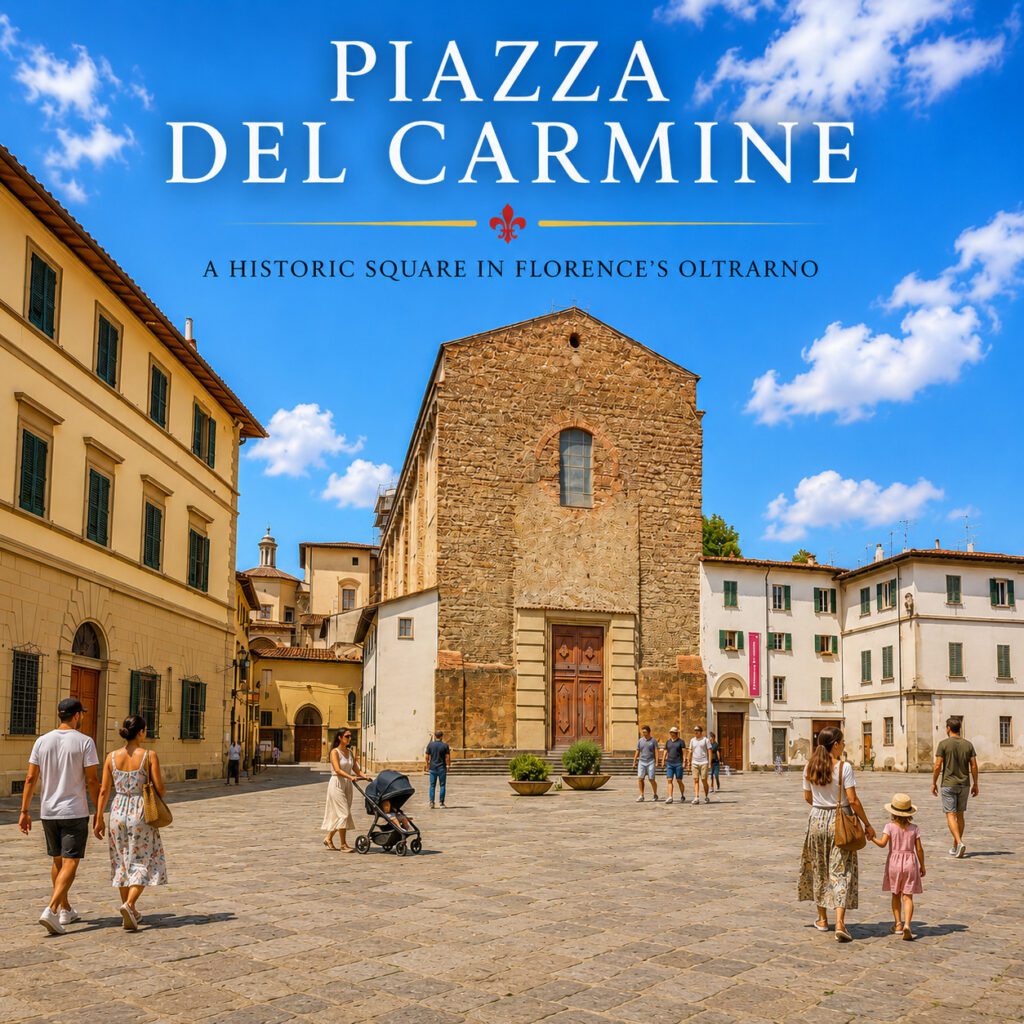
Piazza del Carmine is one of the historic neighbourhood squares of Florence’s Oltrarno. Shaped by the Church of Santa Maria del Carmine and centuries of everyday city life, it offers a quieter and more local experience than Florence’s great ceremonial piazzas.
The square lies west of Santo Spirito, away from the busiest routes around the Duomo and Piazza della Signoria. Its appearance is comparatively restrained, yet its history is remarkable. Religious institutions, residential streets and the changing life of the Oltrarno have all left their mark here.
Most visitors come because Santa Maria del Carmine contains the famous Brancacci Chapel. Yet spending some time in the piazza itself reveals another side of Florence: a historic public space that still feels closely connected with its surrounding neighbourhood.
Location: Oltrarno, west of Piazza Santo Spirito
Best known for: Santa Maria del Carmine and the Brancacci Chapel
Character: Historic, residential and understated
Admission: The piazza itself is free to visit
Best time: Morning or late afternoon
Nearby: Santo Spirito and San Frediano
A Historic Square in the Oltrarno
The story of Piazza del Carmine is inseparable from the development of the Oltrarno. Florence expanded considerably during the Middle Ages, and communities south of the Arno grew around churches, monasteries, workshops and important routes through the city.
The arrival of the Carmelites during the 13th century gave this part of Florence a religious centre that eventually shaped the identity of the square. Unlike piazzas created through highly formal architectural planning, Piazza del Carmine developed more organically around the church and surrounding streets.
This history helps explain its atmosphere today. The piazza feels integrated into its neighbourhood rather than separated from it as a monumental stage.
Florence’s piazzas served very different purposes. Some represented political or religious power, while smaller neighbourhood squares such as Piazza del Carmine helped organise everyday life within individual districts.
Santa Maria del Carmine and the Identity of the Square
The Church of Santa Maria del Carmine and the Brancacci Chapel form the historical and architectural focus of the piazza. The unfinished façade has a surprisingly austere appearance, especially when compared with the decorated marble fronts of churches such as Santa Maria Novella or Santa Croce.
Behind this restrained exterior lies a church shaped by medieval foundations, later alterations and extensive reconstruction following a devastating fire in 1771. Most famously, the complex contains the Brancacci Chapel, whose frescoes by Masolino, Masaccio and Filippino Lippi became landmarks in the development of Renaissance painting.
Seen from the piazza, however, Santa Maria del Carmine also demonstrates how religious institutions once served as anchors for entire Florentine neighbourhoods. The church belonged not only to the history of art but also to the everyday social fabric of the Oltrarno.
The unfinished façade of Santa Maria del Carmine gives little indication of the extraordinary Renaissance art preserved inside. The contrast between exterior and interior is one of the surprises of visiting the church.
The Brancacci Chapel and Renaissance Florence
The Brancacci Chapel is the principal reason many visitors come to Piazza del Carmine. Its fresco cycle became one of the most influential achievements of early Renaissance painting.
Masolino and the young Masaccio began work on the chapel during the 1420s. Masaccio’s figures, use of perspective and convincing treatment of light helped introduce a new sense of physical presence and spatial depth into Florentine painting. Filippino Lippi later completed unfinished sections of the cycle.
The chapel therefore connects this relatively modest Oltrarno square with the much broader story of the Renaissance in Florence. It is a good example of how some of the city’s most important artistic developments occurred away from its grandest public spaces.
The 1771 Fire and a Changing Church
A devastating fire in 1771 destroyed much of the interior of Santa Maria del Carmine. The subsequent reconstruction substantially changed the appearance of the church, creating the combination of different historical periods visitors encounter today.
Remarkably, the Brancacci Chapel survived. Its preservation allows visitors to experience one of the great artistic achievements of 15th-century Florence within a church whose wider interior largely reflects later reconstruction.
The fire of 1771 destroyed much of Santa Maria del Carmine, but the Brancacci Chapel survived. The church therefore combines important elements from very different periods of Florentine history.
A Piazza Shaped by Neighbourhood Life
One of the most appealing aspects of Piazza del Carmine is that it does not feel like a square created primarily for visitors. Residential streets, workshops and local businesses have long existed beside the historic monuments of this part of the Oltrarno.
This distinguishes the piazza from Florence’s more ceremonial spaces. Piazza della Signoria developed around political power, while Piazza Santa Croce became an important setting for religious ceremonies and major public events.
Piazza del Carmine instead retains the character of a neighbourhood square. People cross it on their way through the district, residents use the surrounding streets and visitors arrive for the church before continuing deeper into the Oltrarno.
This mixture of history and ordinary urban life is one of the characteristics that makes Florence particularly rewarding to explore beyond its most famous monuments.
How Piazza del Carmine Differs from Santo Spirito
Piazza Santo Spirito lies only a short walk away, yet the two squares have noticeably different personalities. Santo Spirito is larger and generally more animated, with cafés, restaurants and considerable activity throughout the day and evening.
Piazza del Carmine feels more contained and understated. Both spaces developed around important religious institutions, but their urban roles evolved differently. Santo Spirito became one of the Oltrarno’s principal social gathering places, while Piazza del Carmine retained a quieter relationship with its church and surrounding residential streets.
Visiting both on the same walk is therefore particularly worthwhile. Together they demonstrate that the Oltrarno is not a single homogeneous neighbourhood but a collection of historic spaces with distinct identities.
Combine Piazza del Carmine with Piazza Santo Spirito. The short walk between them provides an excellent introduction to two very different sides of the historic Oltrarno.
The Architecture Around Piazza del Carmine
The architectural interest of Piazza del Carmine does not depend on a perfectly unified Renaissance composition. Instead, its attraction comes from the interaction between buildings of different periods and functions.
Santa Maria del Carmine provides the monumental focus, while the surrounding façades create a more intimate urban enclosure. Medieval origins, later architectural interventions and subsequent alterations coexist without a later redesign completely erasing the accumulated history of the square.
The result is less theatrical than Piazza Santissima Annunziata, where architectural harmony defines the experience. Piazza del Carmine instead derives much of its character from irregularity and historical layering.
Exploring San Frediano and the Oltrarno
Piazza del Carmine is an excellent starting point for exploring the western Oltrarno. From here, visitors can walk into San Frediano, continue towards Piazza Santo Spirito or wander through streets traditionally associated with Florentine craftsmen and workshops.
The Oltrarno historically developed differently from the densely monumental centre north of the river. Craftspeople, religious communities and working families lived alongside aristocratic residences and important churches. Although the district has changed considerably, this mixture remains part of its identity.
Continuing east brings visitors towards the Basilica of Santo Spirito and eventually Palazzo Pitti. Alternatively, walking north towards the Arno reconnects the district with the historic centre across the river.
Piazza del Carmine → San Frediano → Piazza Santo Spirito → Via Maggio → Ponte Santa Trinita. This route combines neighbourhood Florence with important churches, streets and historic architecture.
What to See Around Piazza del Carmine
- Santa Maria del Carmine – the historic Carmelite church that gives the piazza its name.
- Brancacci Chapel – one of the landmarks of early Renaissance painting.
- Piazza Santo Spirito – the lively social heart of this part of the Oltrarno.
- Basilica of Santo Spirito – one of Brunelleschi’s most important architectural works.
- San Frediano – a historic neighbourhood known for its strong local identity.
- Via Maggio – an important historic street leading towards the Arno.
- Palazzo Pitti – the monumental Renaissance palace further east in the Oltrarno.
Piazza del Carmine itself is freely accessible. If you plan to visit the Brancacci Chapel, check current opening hours, reservation requirements and admission arrangements before your visit.
When to Visit Piazza del Carmine
Morning is particularly pleasant if you want to experience the neighbourhood before the surrounding streets become busier. Late afternoon also works well, especially if Piazza del Carmine forms part of a longer walk through San Frediano and Santo Spirito.
If the Brancacci Chapel is the main purpose of your visit, plan around its admission arrangements rather than simply arriving spontaneously. Even without entering the church, however, the piazza is worth including in an Oltrarno walk because much of its appeal comes from the surrounding neighbourhood.
Frequently Asked Questions About Piazza del Carmine
Where is Piazza del Carmine in Florence?
Piazza del Carmine is in the Oltrarno, south of the Arno and west of Piazza Santo Spirito. The historic San Frediano neighbourhood is nearby.
What is Piazza del Carmine famous for?
The square is best known for Santa Maria del Carmine and the Brancacci Chapel. The chapel contains celebrated Renaissance frescoes by Masolino, Masaccio and Filippino Lippi.
Is Piazza del Carmine worth visiting?
Yes. It combines important Renaissance art with the quieter neighbourhood character of the Oltrarno and works particularly well as part of a walk through San Frediano and Santo Spirito.
Is Piazza del Carmine free to visit?
Yes. The piazza itself is a public space and freely accessible. Separate admission arrangements apply to attractions such as the Brancacci Chapel.
How far is Piazza del Carmine from Piazza Santo Spirito?
The two squares are only a short walk apart. Visiting both provides an interesting comparison between two historic Oltrarno piazzas with very different atmospheres.
What happened to Santa Maria del Carmine in 1771?
A major fire destroyed much of the church interior. The Brancacci Chapel survived, preserving its important Renaissance fresco cycle.
What else can you see nearby?
Nearby sights include Piazza Santo Spirito, the Basilica of Santo Spirito, San Frediano, Via Maggio and Palazzo Pitti.
Why Piazza del Carmine Is Worth Visiting
Piazza del Carmine is worth visiting because it combines exceptional Renaissance art with the atmosphere of a historic Florentine neighbourhood. Santa Maria del Carmine and the Brancacci Chapel provide the artistic focus, while the surrounding streets reveal a quieter side of the Oltrarno.
The square also offers an instructive contrast with nearby Piazza Santo Spirito. One is lively and strongly associated with cafés and social life; the other feels more contained and closely connected with its church and residential surroundings.
For visitors who want to understand Florence beyond its most famous monuments, Piazza del Carmine is therefore particularly rewarding. It demonstrates how art, religion and everyday neighbourhood life have shared the same urban spaces for centuries.
Further Reading on Firenze Casa
- The Most Beautiful Squares in Florence – Complete Guide
- Santa Maria del Carmine & Brancacci Chapel
- Piazza Santo Spirito – The Heart of Florence’s Oltrarno
- Basilica of Santo Spirito – Brunelleschi’s Renaissance Church
- Palazzo Pitti – History, Architecture & Museums
- The Renaissance in Florence
- Quiet Florence – The Best Places We Never Queued For
References
- Comune di Firenze – Historical information on Piazza del Carmine and the Oltrarno
- Musei Civici Fiorentini – Cappella Brancacci
- Comune di Firenze – Santa Maria del Carmine and the Brancacci Chapel
- Treccani – Historical and artistic information on Santa Maria del Carmine and Florentine Renaissance art
- Touring Club Italiano – Firenze e dintorni

