
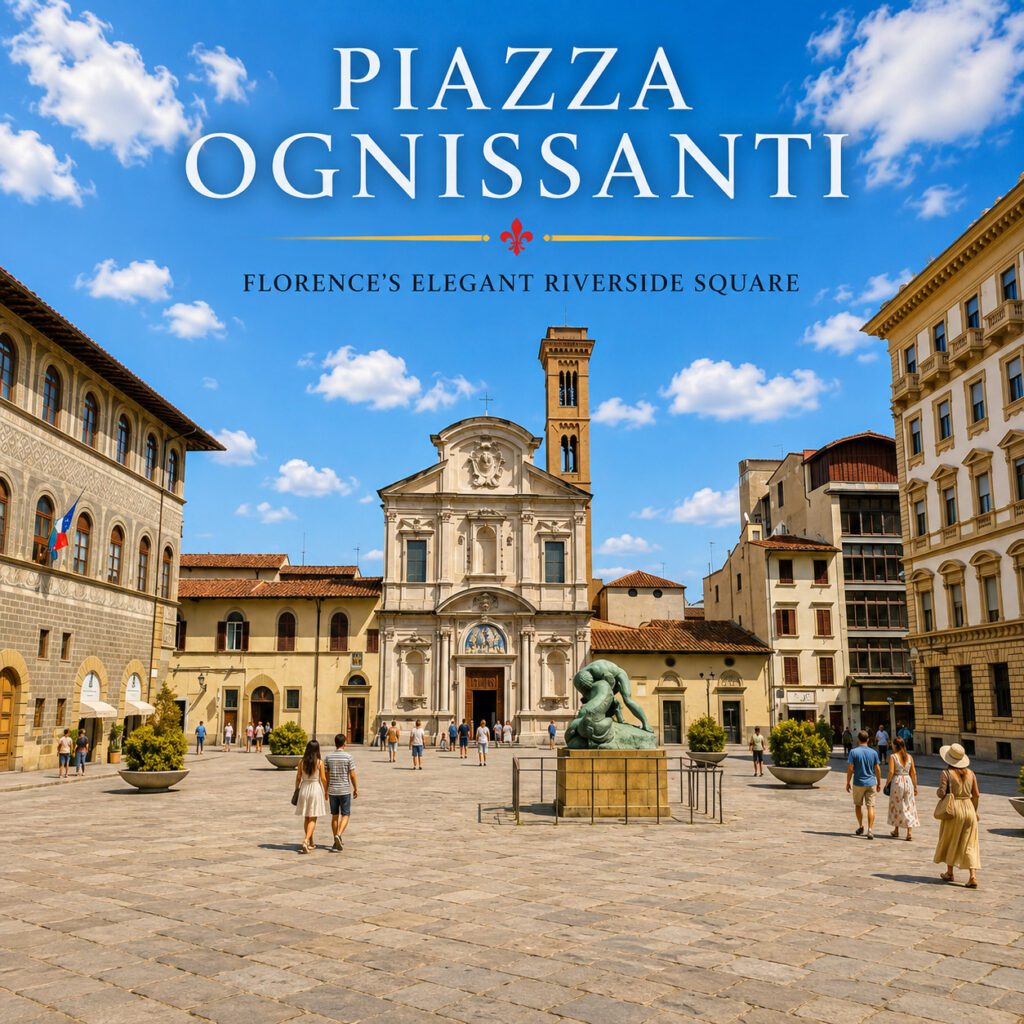
Piazza Ognissanti is one of Florence’s most elegant historic squares, only steps from the Arno and dominated by the Church of Ognissanti. Renaissance art, aristocratic architecture and connections with the Vespucci family give the piazza an importance that is easy to overlook when exploring the better-known monuments of the historic centre.
Unlike Piazza della Signoria or Piazza del Duomo, Piazza Ognissanti usually feels calmer and more open. Historic palaces frame the square, while its proximity to the river gives this part of Florence a distinctive atmosphere.
The stories surrounding the piazza are remarkably diverse. Botticelli and Ghirlandaio connect it with Renaissance painting, Amerigo Vespucci with the age of exploration, and the monument to Daniele Manin with the political world of 19th-century Italy.
Location: Northern bank of the Arno, west of Santa Maria Novella
Best known for: Church of Ognissanti, Botticelli and the Vespucci family
Character: Elegant, historic and comparatively quiet
Admission: The piazza itself is free to visit
Best time: Morning or late afternoon
Nearby: Lungarno Vespucci, Ponte alla Carraia and Santa Maria Novella
A Historic Piazza Beside the Arno
Piazza Ognissanti lies on the northern side of the Arno, west of Santa Maria Novella and within easy walking distance of the heart of historic Florence. Its riverside location helped shape the neighbourhood from an early period, as religious institutions developed alongside commercial activity and residences belonging to important Florentine families.
The square takes its name from the Church of Ognissanti, whose origins reach back to the 13th century. Renaissance patronage, later architectural alterations and the construction of substantial residences gradually created the urban setting visitors encounter today.
The Arno remains one of the piazza’s defining features. Only a few steps separate the square from the Lungarno, giving Ognissanti a sense of openness that distinguishes it from more enclosed squares deeper within the historic centre.
Piazza Ognissanti developed where religious life, commerce, important Florentine families and the Arno came together. This mixture explains why such a relatively quiet square contains so many different layers of history.
The Church of Ognissanti
The Church of Ognissanti forms the historical and visual focus of the square. Founded in the 13th century by the Umiliati, a religious order closely associated with textile production and commerce, the church became an important institution in medieval Florence.
The Umiliati were strongly connected with the wool industry, and the nearby Arno provided water essential to several stages of textile production. Religion, trade and the river were therefore closely linked in the development of the district.
The church visitors see today reflects several periods of Florentine history. Its medieval origins, Renaissance artistic heritage and later architectural transformations coexist within the same building.
The elegant exterior of Ognissanti gives little indication of the artistic treasures inside. The church is particularly associated with Sandro Botticelli and Domenico Ghirlandaio.
Botticelli and Ognissanti
Sandro Botticelli had close connections with the Ognissanti neighbourhood. His family lived in this part of Florence, and the church became associated with both his artistic career and his final resting place. Botticelli was buried here after his death in 1510.
His fresco Saint Augustine in His Study faces Domenico Ghirlandaio’s Saint Jerome in His Study. The two works create a fascinating dialogue between leading artists of 15th-century Florence.
This artistic heritage gives Piazza Ognissanti a significance that is not immediately obvious from the square itself. Visitors can step from a relatively peaceful piazza into a church connected with some of the most important developments of the Renaissance in Florence.
Sandro Botticelli was buried in the Church of Ognissanti in 1510. His connection with the neighbourhood adds a personal dimension to the church’s remarkable Renaissance heritage.
The Vespucci Family and Piazza Ognissanti
Another famous Florentine family closely associated with the district was the Vespucci. Their presence in the Ognissanti neighbourhood created lasting connections between the church, local patronage and the family whose most famous member would eventually give his name to two continents.
Amerigo Vespucci was born in Florence in 1454. His voyages and writings contributed to the growing European understanding that the lands encountered across the Atlantic represented a continent distinct from Asia.
The name America was subsequently derived from the Latin form of his first name, Americus. The Vespucci story therefore connects this relatively small Florentine neighbourhood with one of the great transformations in European geographical knowledge.
Yet the story begins locally, in the world of Florentine families, churches, commerce and patronage. This relationship between neighbourhood history and international influence is characteristic of Florence.
The Monument to Daniele Manin
At the centre of Piazza Ognissanti stands a monument to Daniele Manin, the Venetian patriot and statesman who became one of the important figures of the Italian Risorgimento.
Manin played a leading role in the revolutionary events of 1848 and the Republic of San Marco in Venice. His presence in a Florentine square reflects the national political culture that developed during the 19th century.
The connection is particularly appropriate because Florence served as capital of the Kingdom of Italy from 1865 to 1871. During and after the period known as Firenze Capitale, monuments commemorating figures associated with independence and national unification became part of the changing urban landscape.
Manin therefore introduces another historical layer into the piazza: medieval religious life, Renaissance art and 19th-century Italian nationalism all meet within the same space.
The monument at the centre of the square represents Daniele Manin, not a Florentine but a Venetian patriot. His presence connects Piazza Ognissanti with the wider history of Italian unification.
Elegant Palaces Around the Square
Piazza Ognissanti is distinguished by the substantial buildings surrounding it. Their architecture gives the square a more formal and elegant appearance than many smaller neighbourhood piazzas.
Among the most prominent is Palazzo Lenzi, an important Renaissance palace whose restrained façade reflects the architectural language of 15th-century Florence. Today, the building houses the Institut français Firenze, continuing the piazza’s long association with cultural life.
Other historic buildings around the square later became connected with hospitality as Florence developed into an important destination for international travellers. Together, these façades give Piazza Ognissanti an atmosphere that feels both Florentine and cosmopolitan.
From Piazza Ognissanti to the Arno
One of the pleasures of visiting Piazza Ognissanti is its immediate relationship with the river. A few steps lead to Lungarno Amerigo Vespucci, where the dense streets of the historic centre suddenly open towards the Arno.
From here, visitors can walk east towards Ponte Santa Trinita and Ponte Vecchio or cross the river via nearby Ponte alla Carraia into the Oltrarno.
The transition is particularly appealing. Within a few minutes, you can move from the enclosed streets around Santa Maria Novella to an elegant historic square and then into the open riverside landscape of Florence.
After visiting Ognissanti, walk east along the Arno towards Ponte Santa Trinita. The route combines a quieter historic square with one of the most attractive riverside walks in central Florence.
How Piazza Ognissanti Differs from Florence’s Other Squares
Each of Florence’s historic piazzas developed around a different combination of functions. Piazza della Signoria represents civic and political power, while Piazza del Duomo is dominated by the cathedral complex.
Across the Arno, Piazza Santo Spirito remains strongly associated with neighbourhood and social life. Piazza Ognissanti has another identity entirely.
No single monument overwhelms the space. Instead, the church, Renaissance palaces, Manin monument and nearby river work together to create its character. This layered composition makes Ognissanti particularly rewarding for visitors who already know Florence’s most famous squares.
The different roles and personalities of these spaces are explored further in our Complete Guide to the Most Beautiful Squares in Florence.
A Quieter Side of Central Florence
Despite its central location, Piazza Ognissanti generally feels calmer than Florence’s headline attractions. This relative tranquillity makes it easier to notice architectural details and understand the relationship between the buildings and the river.
The atmosphere also suits Ognissanti itself, where important Renaissance works can often be experienced in a setting very different from the city’s busiest museums and churches.
For travellers interested in this slower side of the city, our guide to Quiet Florence explores other places where history and everyday life can be enjoyed away from the busiest visitor routes.
What to See Around Piazza Ognissanti
- Church of Ognissanti – historic church associated with Botticelli, Ghirlandaio and the Vespucci family.
- Palazzo Lenzi – Renaissance palace overlooking the square.
- Monument to Daniele Manin – 19th-century monument recalling the Italian Risorgimento.
- Lungarno Amerigo Vespucci – elegant riverside promenade immediately beside the piazza.
- Ponte alla Carraia – nearby bridge connecting this part of central Florence with the Oltrarno.
- Santa Maria Novella – one of Florence’s major churches and historic squares, only a short walk away.
Piazza Ognissanti is a public square and can be visited freely. Opening hours for the Church of Ognissanti may vary, particularly during religious services and holidays.
A Walking Route Through Western Florence
Piazza Ognissanti fits naturally into a walk through western central Florence. Begin at Piazza Santa Maria Novella and continue west towards Ognissanti through the surrounding historic streets.
After visiting the piazza and church, walk down to the Arno. Ponte alla Carraia offers the option of crossing into the Oltrarno, while continuing east along the northern bank leads towards Ponte Santa Trinita and the heart of Renaissance Florence.
Because the distances are short, the route requires little planning while combining religious history, Renaissance architecture, riverside views and several very different parts of the city.
Piazza Santa Maria Novella → Piazza Ognissanti → Lungarno Amerigo Vespucci → Ponte alla Carraia → Oltrarno. It is a compact route through several different layers of Florence.
Frequently Asked Questions About Piazza Ognissanti
Where is Piazza Ognissanti in Florence?
Piazza Ognissanti lies on the northern side of the Arno, west of Santa Maria Novella. Lungarno Amerigo Vespucci is only a few steps away.
What is Piazza Ognissanti famous for?
The square is known for the Church of Ognissanti, its connections with Botticelli and the Vespucci family, and its elegant riverside setting.
Is Botticelli buried in Ognissanti?
Yes. Sandro Botticelli was buried in the Church of Ognissanti after his death in 1510. His family had strong connections with the neighbourhood.
What is the connection between Amerigo Vespucci and Ognissanti?
The Vespucci family was closely associated with the Ognissanti district and church. Amerigo Vespucci was born in Florence in 1454.
Who is the statue in Piazza Ognissanti?
The monument represents Daniele Manin, the Venetian patriot and statesman associated with the revolutionary events of 1848 and the Italian Risorgimento.
Is Piazza Ognissanti free to visit?
Yes. The piazza is freely accessible. The Church of Ognissanti has its own opening arrangements and may be affected by religious services.
Is Piazza Ognissanti worth visiting?
Yes. It combines Renaissance art, Florentine family history and elegant architecture with a quieter location beside the Arno.
Why Piazza Ognissanti Is Worth Visiting
Piazza Ognissanti is worth visiting because few Florentine squares combine Renaissance art, family history and a riverside setting so naturally. The Church of Ognissanti connects the piazza with Botticelli and Ghirlandaio, while the Vespucci family adds a story that reaches far beyond Florence.
The monument to Daniele Manin introduces the political world of 19th-century Italy, and the surrounding palaces give the square an elegant architectural frame. Just beyond them, the Arno opens the dense historic centre towards the river.
For visitors exploring Florence beyond its most obvious landmarks, Piazza Ognissanti is therefore particularly rewarding: central but comparatively peaceful, historically important without being monumental, and perfectly positioned for continuing a walk along the Arno.
Further Reading on Firenze Casa
- The Most Beautiful Squares in Florence – Complete Guide
- Chiesa di Ognissanti – Botticelli’s Church in Florence
- Amerigo Vespucci – The Florentine Explorer Behind the Name America
- Piazza Santa Maria Novella – Florence’s Historic Square
- Ponte alla Carraia – Florence’s Historic Arno Bridge
- Ponte Santa Trinita – Florence’s Renaissance Bridge
- Quiet Florence – The Best Places We Never Queued For
References
- Comune di Firenze – Historical information on Piazza Ognissanti and the surrounding district
- Chiesa di Ognissanti – History of the church and its artistic heritage
- Le Gallerie degli Uffizi – Sandro Botticelli and Florentine Renaissance art
- Treccani – Amerigo Vespucci, Daniele Manin and historical context
- Institut français Firenze – Palazzo Lenzi and its history
- Touring Club Italiano – Firenze e dintorni

