
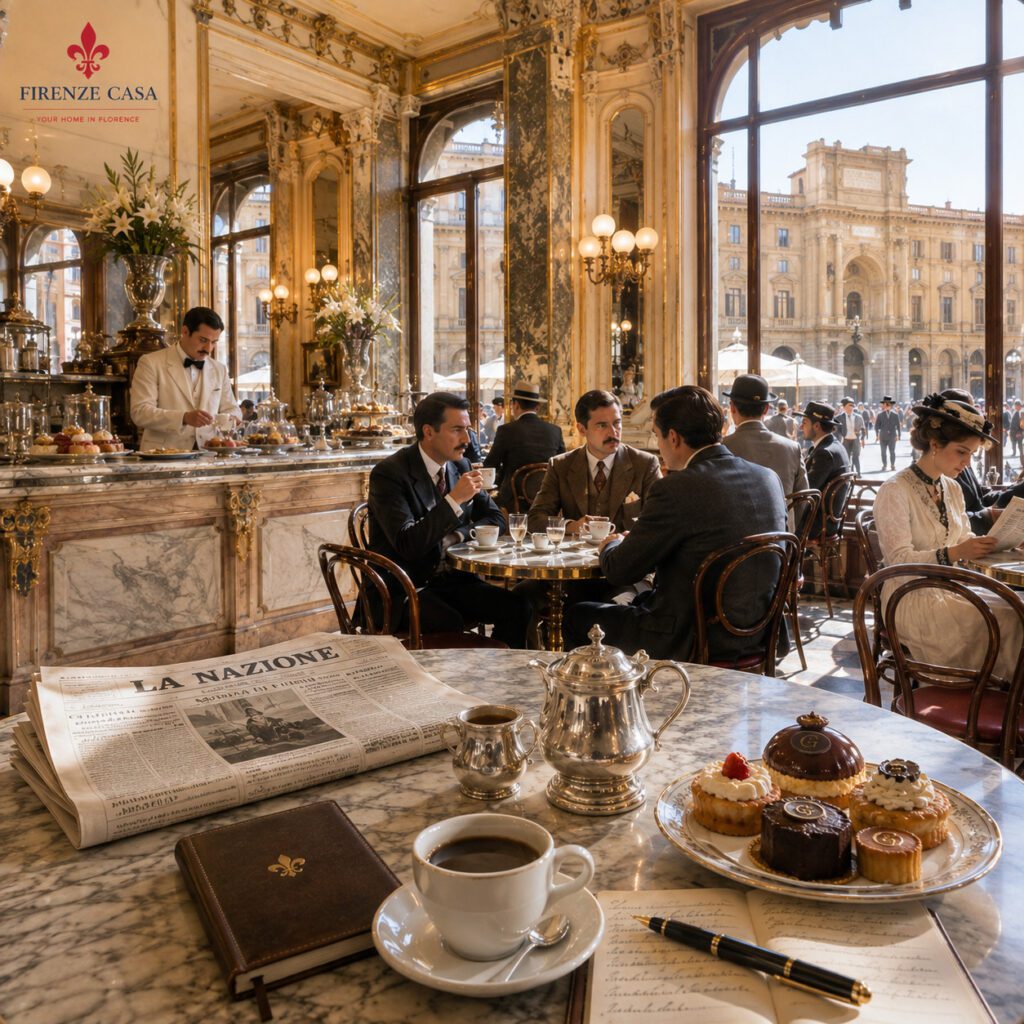
Caffè Gilli Florence combines almost three centuries of confectionery, café culture and Florentine history. Its origins date to 1733, when the Gilli family opened a confectionery in central Florence. After several moves, the business eventually settled on Piazza della Repubblica, where its elegant early twentieth-century interior still forms part of the experience.
Gilli is therefore more than a place for espresso. Its history connects pastry making, chocolate, Florence’s nineteenth-century transformation and the rise of the grand European café. For the wider cultural context, see our Historic Cafés of Florence – Complete Guide.
Origins: 1733
Original business: Confectionery and sweet breads
Current location: Piazza della Repubblica
Present premises: Since 1917
Known for: Coffee, pastries, chocolate and historic interiors
Architectural character: Early twentieth-century grand café
Best for: Historic atmosphere rather than the cheapest espresso
Combine with: Piazza della Repubblica and Florence’s other historic cafés
The Origins of Caffè Gilli
The story of Gilli begins in 1733. The Gilli family, originally from Switzerland, opened a confectionery in Via dei Calzaiuoli, the important street linking the Cathedral area with Florence’s civic centre.
The establishment became known as the Bottega dei Pani Dolci, a shop specialising in sweet breads and confectionery. Gilli was therefore not founded as the grand café familiar today; pastry and artisanal food came first.
This distinction matters because the business evolved gradually alongside Florence itself. The café tradition emerged from a much older gastronomic identity rather than replacing it.
Gilli’s history began with confectionery rather than espresso. Pastries and chocolate are not additions to its café identity; they belong to the foundation of the business.
From Confectionery to Florentine Institution
During the nineteenth century, Florence became increasingly cosmopolitan. Commercial streets grew busier, travellers arrived in greater numbers and cafés developed into important places for social life.
Gilli expanded its premises in 1843 and gradually evolved beyond a shop where customers simply purchased sweets. Like cafés elsewhere in Europe, it increasingly became somewhere to meet, linger and observe the city.
Coffee, chocolate and pastries fitted naturally into this changing environment, while newspapers and conversation helped transform cafés into public social spaces.
Florence as Capital and the Transformation of the Centre
The most dramatic changes came after Florence became capital of the Kingdom of Italy in 1865. Government, new residents and ambitious urban projects accelerated the transformation of the city.
Although the capital moved to Rome in 1871, redevelopment continued. Streets were widened, infrastructure changed and large parts of the historic centre were radically reorganised.
This wider period is explored in our article Florence as Capital of Italy. It provides the essential background for understanding how the modern Piazza della Repubblica and its café culture emerged.
The elegant Piazza della Repubblica surrounding Gilli today is largely the product of nineteenth-century urban redevelopment. It replaced a much denser historic quarter.
From Mercato Vecchio to Piazza della Repubblica
The area around today’s Piazza della Repubblica had occupied a central position in Florence since Roman times. For centuries, the Mercato Vecchio stood here among a dense network of streets, shops, houses and religious buildings.
During the late nineteenth-century Risanamento, much of this urban fabric disappeared. The old market was demolished and a monumental new square emerged in its place.
Gilli adapted to the changing city. In 1893, the business moved to Via degli Speziali beside the new square and expanded its role by obtaining a licence to serve alcoholic drinks.
The history of Gilli therefore mirrors the history of the district itself: an eighteenth-century confectionery gradually became part of the social world of modern Florence.
Gilli Moves to Piazza della Repubblica
In 1917, Gilli moved into the premises overlooking Piazza della Repubblica that it still occupies today.
By then, the establishment had become a fully developed grand café combining confectionery, coffee, drinks and table service within an elegant environment.
The square also supported other famous establishments. Caffè Paszkowski developed strong connections with music and literary life, while Le Giubbe Rosse became particularly associated with writers, magazines and Futurism.
Gilli occupied its own place within this remarkable concentration of café culture, distinguished especially by its elegance and long confectionery tradition.
The Historic Interior
One of the strongest reasons to visit Gilli is the surviving interior. Marble, mirrors, woodwork, chandeliers and ornamental details preserve the atmosphere of an early twentieth-century European café.
The counter is particularly noteworthy, while decorative ceiling elements and lighting reinforce the sense that the rooms were designed as more than a functional place to consume coffee.
A fashionable café acted almost like a public salon. Architecture helped create an environment in which customers could linger, meet acquaintances and participate in urban social life.
Before looking at the pastry counter, look up. The ceiling, lighting, mirrors and decorative surfaces are part of the reason Gilli remains important as a historic café.
Gilli and Florence’s Intellectual Café Culture
During the early twentieth century, Piazza della Repubblica became an important meeting place for Florence’s artistic and literary circles. Gilli participated in this environment, and artists and writers connected with the Italian avant-garde were associated with its social world.
However, the different cafés should not be treated as interchangeable. Le Giubbe Rosse developed the strongest reputation for Futurist debate and literary magazines, while Paszkowski cultivated its own relationship with music and intellectual life.
Gilli’s significance lies more broadly in being one of the elegant meeting places within this concentrated cultural landscape.
Piazza della Repubblica functioned almost like a small cultural district. Writers and artists could move between several cafés within the same square, each with its own clientele and character.
Pastry and Chocolate – The Older Gilli Tradition
It is easy to focus on writers and café interiors and forget that Gilli’s oldest tradition is gastronomic.
Pastry and confectionery connect the modern café directly with the Bottega dei Pani Dolci founded in 1733. Over time, elaborate pastries, chocolates and other sweets expanded the original range.
This continuity helps explain the success of the establishment. Gilli did not become famous simply because notable people visited it; generations of customers also came because of what its pastry and confectionery counters produced.
Morning Coffee at Gilli
Morning provides a particularly natural way to experience Gilli. An espresso or cappuccino with a pastry combines its historic confectionery identity with contemporary Italian coffee culture.
Visitors should understand the difference between standing at the counter and sitting at a table. Counter service is quicker and can cost less, while a table allows more time to appreciate the room and Piazza della Repubblica.
Both experiences are legitimate, but they serve different purposes. Our guide to Coffee in Florence – From Historic Cafés to the Italian Bar explains this contrast between the grand café and everyday Italian bar in more detail.
If you mainly want an espresso, the counter is the natural choice. If you want to experience Gilli as a historic café, a table gives you time to enjoy the interior and the square.
From Coffee to Aperitivo
Gilli’s role changes during the day. Morning emphasises coffee and pastries, while later hours bring lunch, wine, cocktails and aperitivo.
This flexibility is typical of the Italian café-bar tradition. One establishment can accompany customers from breakfast through the early evening without changing its basic identity.
At Gilli, this daily rhythm adds another layer to the historical experience: the café remains a functioning business rather than a preserved museum interior.
The View onto Piazza della Repubblica
Part of Gilli’s appeal lies outside its doors. Piazza della Repubblica is one of Florence’s busiest public spaces, surrounded by monumental nineteenth-century buildings and crossed by residents, shoppers and visitors throughout the day.
Yet the open square conceals a much older history. Roman Florence, the medieval Mercato Vecchio and the nineteenth-century redevelopment all occupy different layers of the same location.
A table at Gilli therefore provides more than a view. It offers a place from which to observe one of the most radically transformed spaces in central Florence.
Is Caffè Gilli Worth Visiting?
Yes, if you visit for the right reasons. Gilli is not the place to seek the cheapest espresso in Florence, and comparing its table-service prices with a simple neighbourhood bar misses the point.
The attraction lies in the combination of historic interior, pastry tradition, location and continuity. Even a short visit provides access to a surviving part of Florence’s grand café culture.
For someone interested purely in everyday espresso habits, a neighbourhood bar may be more appropriate. For someone interested in cultural history, Gilli offers something that an ordinary coffee counter cannot.
When to Visit Caffè Gilli
Morning highlights the relationship between coffee, pastry and Italian breakfast culture. It is also a good time to appreciate the interior before Piazza della Repubblica reaches its busiest period.
Late afternoon offers a livelier atmosphere as shopping and sightseeing give way towards the evening. At night, artificial light and chandeliers emphasise the elegance of the rooms.
There is therefore no single best time. Choose according to whether you prefer morning café culture, a busy piazza or a more formal evening atmosphere.
What to See Around Caffè Gilli
Gilli’s position makes it easy to include in a walk through central Florence. Piazza del Duomo lies only a few minutes away, while Via dei Calzaiuoli leads towards Piazza della Signoria and Palazzo Vecchio.
The easiest cluster of related stops is already on Piazza della Repubblica. Paszkowski and Giubbe Rosse allow visitors to compare three very different historic café traditions without leaving the square.
Via de’ Tornabuoni is also nearby, with its Renaissance palaces and Procacci 1885, another historic Florentine gastronomic institution.
A Living Historic Café
Historic establishments face a difficult balance. They must preserve enough continuity to retain their identity while still operating successfully in a city that has changed enormously around them.
Gilli has experienced political upheaval, urban reconstruction, wars, mass tourism and changing coffee habits since its eighteenth-century beginnings.
Yet its basic function remains recognisable. People still enter for pastries, coffee, conversation and a pause from the streets outside.
That continuity may be more interesting than any list of famous former customers. Caffè Gilli is historically important precisely because it remains a café rather than becoming a museum about cafés.
Frequently Asked Questions About Caffè Gilli Florence
When was Caffè Gilli founded?
Gilli traces its origins to 1733, when the Gilli family opened the Bottega dei Pani Dolci in central Florence.
Is Caffè Gilli the oldest café in Florence?
Gilli presents itself as Florence’s oldest historic café based on its origins in 1733. However, its history began as a confectionery before the business developed into a grand café.
When did Gilli move to Piazza della Repubblica?
After earlier locations, Gilli moved into its present premises overlooking Piazza della Repubblica in 1917.
Why is Caffè Gilli historically important?
Its significance combines a long confectionery tradition, an early twentieth-century interior, Piazza della Repubblica and participation in Florence’s historic café culture.
Is Gilli associated with the Futurists?
Artists and writers connected with the avant-garde frequented the cafés around Piazza della Repubblica, including Gilli. Le Giubbe Rosse, however, has the strongest specific association with Florentine Futurist and literary culture.
Is table service more expensive?
It can be. Historic cafés in prestigious central locations may charge different prices for counter and table service, so check the current price list.
Where is Caffè Gilli?
Gilli stands on Piazza della Repubblica in central Florence, between the Duomo and Piazza della Signoria.
Why Caffè Gilli Is Worth Visiting
Caffè Gilli is worth visiting because several layers of Florentine history survive in one functioning establishment. Its eighteenth-century origins belong to confectionery, its present location reflects the nineteenth-century redevelopment of central Florence and its interior recalls the grand café culture of the early twentieth century.
Pastries and chocolate connect the café with its oldest identity, while Piazza della Repubblica places it within the social history of modern Florence.
Whether you drink an espresso at the counter or sit down for a longer visit, Gilli offers something more interesting than simply an old name. It shows how a historic business can continue to adapt while remaining recognisably connected with its past.
Further Reading on Firenze Casa
- The Historic Cafés of Florence – Coffee, Culture and Literary Life
- Caffè Paszkowski – Music and Café Culture in Florence
- Le Giubbe Rosse – Florence’s Café of Writers and Futurists
- Coffee in Florence – From Historic Cafés to the Italian Bar
- Procacci 1885 – Truffles, Wine and a Florentine Institution
- Florence as Capital of Italy
References
- Caffè Gilli – Historical material on the origins and development of the establishment.
- Comune di Firenze – Historical resources on Piazza della Repubblica and nineteenth-century Florence.
- Visit Tuscany – Historical material on Florence’s historic cafés.
- Historical studies on the Risanamento and the transformation of central Florence.
- Historical literature on Florentine café culture and the Italian avant-garde.

