
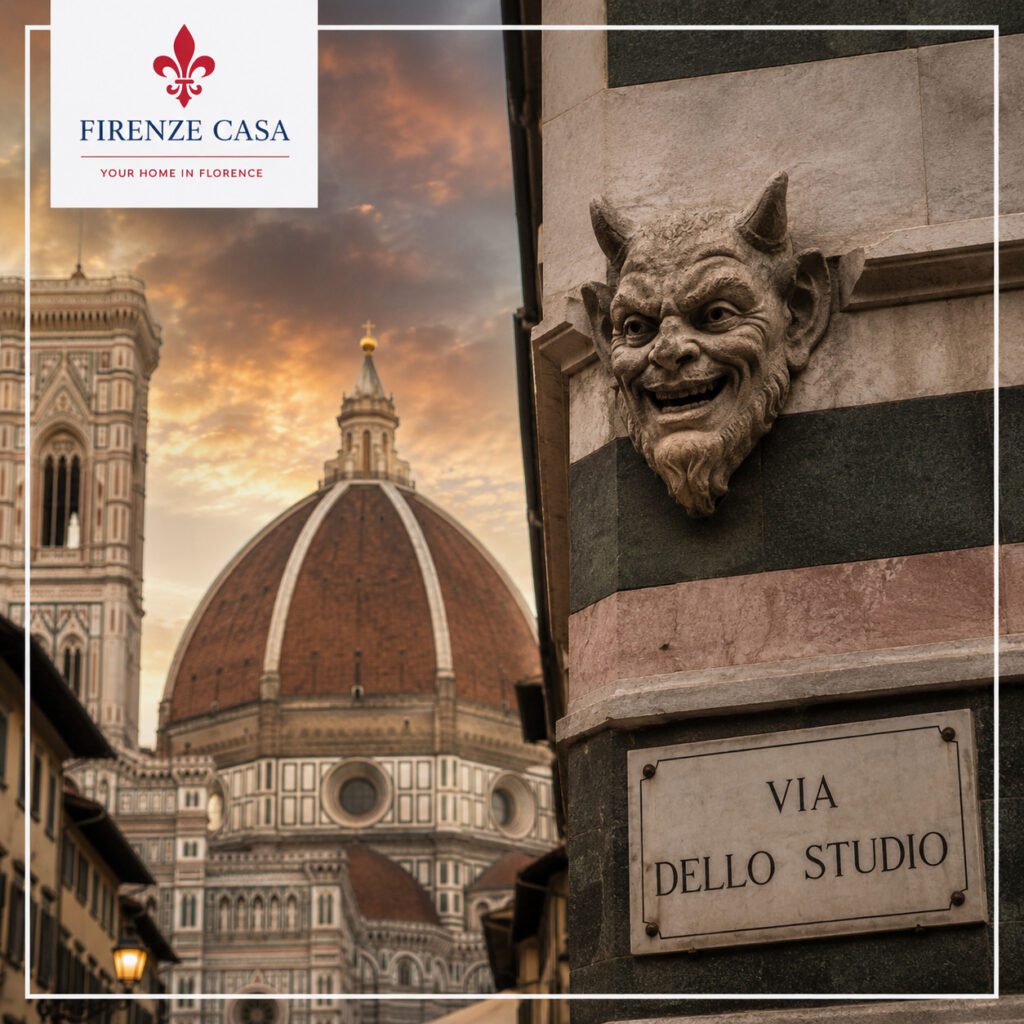
Devil on Florence Cathedral is one of Florence’s most fascinating legends. Hidden beside the Cattedrale di Santa Maria del Fiore, the mysterious story of Il Rifrullo del Diavolo explains why an unexpected whirlwind still surprises visitors near Via dello Studio.
Millions of visitors cross Piazza del Duomo every year. Their eyes naturally turn towards Brunelleschi’s magnificent dome, Giotto’s Bell Tower and the colourful marble façade of Florence Cathedral. Most never notice that one of the city’s oldest legends belongs to a spot only a few steps away.
On the southern side of the cathedral, Piazza del Duomo meets Via dello Studio. Here, Florence hides a mystery that visitors cannot see – they can only feel it.
Even when the rest of the square seems calm, an unexpected current can sweep around the cathedral corner. The air gathers strength between the surrounding buildings and catches visitors by surprise. In winter, it can feel remarkably cold, lifting hats and sending loose papers swirling through the narrow street.
Modern architects can explain the phenomenon through the cathedral’s immense walls and the surrounding medieval street layout. Florentines, however, prefer a more imaginative explanation. They call it Il Rifrullo del Diavolo – the Devil’s Whirlwind.
According to one of Florence’s best-loved legends, the wind is more than moving air. It is the impatient breath of the Devil himself. He has supposedly waited outside the cathedral for centuries, hoping that a clever priest will finally return.
The Legend of Il Rifrullo del Diavolo
The story begins in medieval Florence. A priest was walking through the city when he realised that someone was following him. His pursuer was neither a thief nor a political enemy, but the Devil himself – il Diavolo – who had come to claim the priest’s soul.
The priest hurried through Florence’s narrow streets. He passed workshops, market stalls and stone houses, hoping to lose his terrifying pursuer. Each time he glanced over his shoulder, however, the Devil had moved closer.
The chase finally reached Piazza del Duomo. Here, the priest found himself before the great Cathedral of Santa Maria del Fiore, known to Florentines simply as the Duomo di Firenze.
The Priest’s Clever Plan
The priest realised that he could never outrun the Devil. Instead, he relied on something more useful than physical strength: his intelligence.
He turned to his pursuer and asked for one final favour. Before surrendering his soul, he wanted to enter the cathedral and say one last prayer.
The request seemed harmless. Certain that his victim had nowhere to escape, the Devil agreed. He waited outside while the priest entered the cathedral.
Minutes passed. Then more minutes. The Devil grew restless. His impatient sighs became angry breaths, and the breaths turned into powerful gusts. Soon the air around the cathedral began to swirl.
The Escape Through Another Door
The Devil had overlooked one crucial detail: the cathedral had other exits.
While his pursuer waited outside, the priest quietly crossed the immense church. He slipped out through a different doorway on the opposite side. By the time the Devil understood the trick, the priest had disappeared into the streets of Florence.
Furious at having been outwitted, the Devil continued to breathe, blow and rage beside the cathedral. According to the legend, he never left.
The mysterious gusts that still surprise visitors near Via dello Studio are therefore said to be his angry breath. The Devil remains there, waiting in vain for the priest who never returned.
🌪️ What Does “Rifrullo” Mean?
The Italian word rifrullo describes a sudden swirling movement or gust of air. Il Rifrullo del Diavolo can therefore mean “the Devil’s Whirlwind”, “the Devil’s Gust” or, more freely, “the Devil’s Breath”. The Italian name remains the best expression to use when searching for the story locally.
The Cathedral Behind the Story
The setting of the legend is not accidental. Florence Cathedral, the Cattedrale di Santa Maria del Fiore, represents far more than an impressive religious building. Medieval Florence created it as an expression of faith, wealth, ambition and civic identity.
Workers laid the first stone of the new cathedral in 1296. Arnolfo di Cambio initially shaped the project, while later generations of architects expanded his plans.
Construction continued for generations. Filippo Brunelleschi began work on his revolutionary dome in 1420 and completed it in 1436.
For Florentines, the cathedral served as both sacred space and civic monument. It belonged to the religious life of the city while expressing the confidence of a republic determined to demonstrate its ingenuity.
This combination of sacred authority and human intelligence makes the Duomo an ideal setting for the legend. The priest defeats the Devil not through violence, but through cleverness.
Via dello Studio and the Porta dei Canonici
Florentines traditionally associate the legend with the southern side of the cathedral near Via dello Studio and the Porta dei Canonici, or Canons’ Door.
Via dello Studio takes its name from the former Studio Fiorentino. The Florentine Republic established this institution of higher learning during the fourteenth century.
Today, the street remains closely connected with the cathedral. The Bottega di restauro dell’Opera del Duomo stands only a short distance from the Porta dei Canonici. Florentine specialists continue the traditions of stone carving and conservation here.
Legend and Historical Reality
No historical evidence confirms that a particular priest escaped from the Devil by crossing Florence Cathedral. We do not know the supposed priest’s identity, the date of the event or the earliest version of the story.
Il Rifrullo del Diavolo belongs to Florentine oral tradition rather than documented history.
The wind itself, however, has a perfectly plausible explanation.
Why the Wind Can Be Stronger Here
Piazza del Duomo forms a large open space connected with a network of comparatively narrow streets. The enormous cathedral interrupts and redirects air moving through the square.
When wind reaches the walls of such a large structure, the building can divert it around corners. Narrow passages may then accelerate the moving air.
Via dello Studio forms one of these passages. Differences in width, orientation and temperature can create local currents that feel stronger than the air only a short distance away.
The phenomenon therefore requires no supernatural explanation. Yet physics alone cannot explain why generations of Florentines imagined an angry Devil waiting beside their cathedral.
| What Can Be Observed? | What Belongs to the Legend? |
|---|---|
| Visitors may feel unexpected currents near Via dello Studio and the southern side of the cathedral. | The impatient Devil creates the wind with his breath. |
| The cathedral has several entrances and exits on different sides. | A priest entered through one door and escaped through another. |
| Large buildings and narrow streets can redirect and accelerate air. | The Devil still waits beside the Duomo for the priest to return. |
| Florentine popular tradition has preserved the story. | The story records an identifiable event from medieval history. |
Why Is the Devil So Often Found Near a Church?
To modern readers, a humorous story about the Devil may seem an unusual companion to one of Florence’s most important churches.
Medieval Europeans, however, frequently encountered images and stories of evil in sacred settings. Churches displayed demons, monsters, scenes of punishment and visions of hell. Such images warned worshippers about temptation and showed that people could ultimately defeat evil.
Popular tradition also portrayed the Devil in surprisingly human ways. He could be vain, impatient and remarkably easy to deceive.
Folklore across Europe contains countless stories in which ordinary people escape him. They succeed through courage, faith, quick thinking or a carefully chosen technicality.
Such stories transformed abstract religious ideas into memorable encounters between recognisable personalities. One character possessed great power but suffered from arrogance. The other appeared vulnerable but proved more intelligent.
In Il Rifrullo del Diavolo, the priest does not overpower the Devil. He understands his weakness.
The Devil is so confident of victory that he becomes careless.
A Very Florentine Victory
There is something unmistakably Florentine about the priest’s escape.
Florence has long admired intelligence, verbal agility and unexpected solutions. Its history celebrates artists who solved architectural problems, merchants who negotiated across Europe and diplomats who survived unstable political alliances.
Writers also transformed everyday Tuscan speech into literature. Again and again, Florentine culture rewards ingenuity rather than brute strength.
Intelligence Instead of Strength
The Florentine ideal is not simply to be stronger than an opponent. It is to be quicker, more observant and more inventive.
Brunelleschi did not solve the problem of the cathedral dome by simply using more timber. He developed a revolutionary construction method that avoided the enormous wooden centring conventional techniques would have required.
The priest follows the same cultural logic on a much smaller and more humorous scale. Faced with an enemy he cannot defeat physically, he studies his surroundings and discovers another exit.
The Devil has supernatural power.
The Florentine has a better idea.
This contrast may explain why the story has endured. It transforms the square around Florence’s greatest monument into a stage where intelligence defeats brute force.
Faith, Cleverness and a Touch of Irreverence
The legend also reflects the distinctive relationship Florentines have often maintained with authority.
Religion stood at the centre of historical Florentine life. Yet popular devotion did not always express itself solemnly. Saints, priests, sacred figures and even the Devil could become characters in humorous stories filled with exaggeration and practical wisdom.
This humour did not necessarily weaken faith. Instead, it brought religious ideas into everyday life.
The Devil beside the Duomo creates enough danger to make the story exciting, but his foolishness makes the conclusion enjoyable. The priest is no distant theological hero. He behaves like a recognisable person who feels fear, thinks quickly and notices an open door.
The story combines several recurring Florentine values: respect for sacred space, suspicion of arrogance, admiration for intelligence and delight in a clever deception.
The Moral Behind the Humour
The legend also contains a subtle warning. Power without judgement is not enough.
Certainty can become a weakness. Those who believe they have already won may prove surprisingly easy to defeat.
Why the Legend Endures
Perhaps Il Rifrullo del Diavolo has survived because visitors can still experience the phenomenon behind the story.
A stone sculpture requires someone to point it out. A historical event may need a plaque or guidebook. The wind needs no introduction. It touches the skin, moves through clothing and immediately demands attention.
Once someone has heard the legend, every unexpected gust beside the cathedral becomes part of the story.
When Science and Legend Meet
The listener knows that streets, walls, temperature and architecture influence the movement of air. Yet for a moment, the scientific explanation and the legend can exist side by side.
That coexistence helps explain the enduring power of folklore.
Legends do not survive only because people believe every detail. They survive because they give character to places and transform ordinary experiences into shared memory.
A draught becomes impatience.
A street corner becomes a place of waiting.
A second doorway becomes the route by which intelligence escapes power.
The story also allows Florentines to laugh at the Devil without denying his symbolic importance. Evil appears strong, but neither wise nor invincible. Faith, observation and quick thinking can frustrate it.
Perhaps that is the real value preserved in the legend.
The Devil may control the wind.
But the Florentine knows where the other door is.
Firenze Casa Insider Tip
To experience the setting of the legend, walk to the southern side of the Cattedrale di Santa Maria del Fiore. Look for the point where the cathedral approaches Via dello Studio.
Do not search for a carved Devil on the marble façade. No sculpture represents this particular mystery. The story concerns the movement of air around the cathedral corner.
Pause near the beginning of Via dello Studio and notice whether the air changes. Weather conditions influence the effect, so you will not always encounter a dramatic gust.
On a windy or cool day, however, the current can feel noticeably stronger than in more sheltered parts of the square.
Then look at the doors and passages around the cathedral. The architecture makes the priest’s trick easy to imagine. He enters the immense church while the Devil waits outside, crosses the sacred interior and disappears through another exit.
🌬️ Experience the Story
Walk slowly from Piazza del Duomo towards Via dello Studio and notice whether the air changes. Florence’s smallest mysteries often become most memorable when visitors experience them rather than merely photograph them.
Where to Find Il Rifrullo del Diavolo
| Visitor Information | Details |
|---|---|
| Italian name | Il Rifrullo del Diavolo |
| English translation | The Devil’s Whirlwind or the Devil’s Gust |
| Location | Southern side of Florence Cathedral near Via dello Studio, Piazza del Duomo |
| Nearby cathedral door | Porta dei Canonici |
| What to look for | There is no specific Devil sculpture; notice the currents of air around the street corner |
| Admission | The location can be visited freely from the street |
| Best conditions | A cool or windy day, particularly outside the busiest hours |
Frequently Asked Questions
What is the Devil’s Whirlwind called in Italian?
It is called Il Rifrullo del Diavolo. The word rifrullo refers to a sudden swirl or gust of wind.
Is there a sculpture of the Devil on Florence Cathedral?
No particular sculpture represents the legend of Il Rifrullo del Diavolo. The story explains the currents of air traditionally noticed near Via dello Studio on the southern side of the Duomo.
What is the legend of the Devil at Florence Cathedral?
According to the story, the Devil chased a priest through Florence to claim his soul. The priest asked permission to enter the cathedral for one final prayer. Instead, he crossed the church and escaped through another door. The legend says that the Devil’s angry breath still creates the wind near Via dello Studio.
Did the event really happen?
No documentary evidence confirms the priest, the chase or the encounter with the Devil. The story belongs to Florentine folklore. The arrangement of the cathedral, square and surrounding streets can explain the local movement of air.
Where can I experience Il Rifrullo del Diavolo?
Walk along the southern side of the Cattedrale di Santa Maria del Fiore towards Via dello Studio. Florentines generally associate the legend with the entrance to the street and the nearby Porta dei Canonici.
Why did the Devil allow the priest to enter the cathedral?
The Devil believed that the priest had no way to escape. His confidence made him careless, and the priest took advantage of another doorway.
Why are there stories about demons around medieval churches?
Medieval Christian art and folklore frequently used demons to represent threats to the human soul. Popular stories also portrayed the Devil as arrogant and vulnerable to faith, courage or intelligence.
What does the legend tell us about Florentine culture?
The story reflects Florentine admiration for intelligence, resourcefulness and ironic humour. The priest survives because he observes his surroundings and finds a clever solution.
A Final Thought
Florence Cathedral inspires awe through its scale, geometry and extraordinary engineering. Il Rifrullo del Diavolo tells a much smaller story beside the same monumental walls.
The legend reminds us that Florentines have never regarded intelligence as the privilege of great architects, scholars or rulers. In popular imagination, even a frightened priest can become ingenious when circumstances demand it.
The story does not ask us to believe that the Devil literally stands beside Via dello Studio. Instead, it preserves a simple idea: arrogance can fail, sacred space can offer refuge and intelligence can succeed where strength cannot.
For centuries, an ordinary movement of air has allowed Florence to repeat that lesson. Perhaps this explains why the legend remains alive.
The wind disappears as quickly as it arrives, but the story continues to pass from one generation to another.
Every city has wind. Florence gave it a character, a grievance and a story worth remembering.
Further Reading on Firenze Casa
- The Stone Head of Berta
- The Mysterious Bees of Piazza Santissima Annunziata
- The Open Window of Piazza Santissima Annunziata
- The Mystery of the Porcellino
- Florence’s Symbols: The Lily and the Marzocco
References
Opera di Santa Maria del Fiore – Official historical and architectural information about the Cattedrale di Santa Maria del Fiore, its side doors and the Porta dei Canonici.
Feel Florence – Official tourism information about Via dello Studio and the restoration workshop of the Opera del Duomo.
Florentine oral traditions concerning Il Rifrullo del Diavolo and the currents of air near Via dello Studio.
Historical studies of medieval European folklore, popular representations of the Devil and the moral role of demonic figures in Christian storytelling.

