
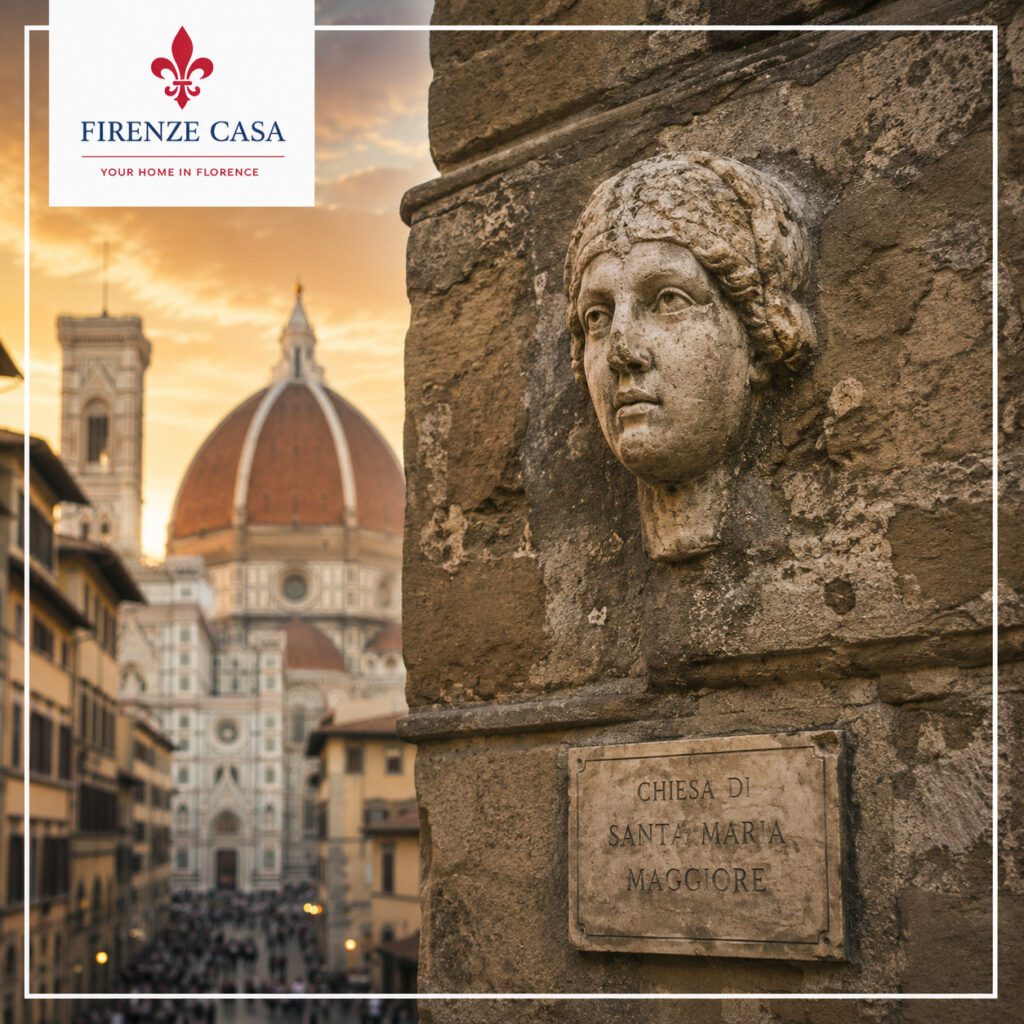
The Stone Head of Berta is one of Florence’s most curious hidden details. Every day, thousands of people walk along Via de’ Cerretani towards Florence Cathedral. Most naturally look towards Brunelleschi’s dome, Giotto’s Bell Tower and the marble façade of Santa Maria del Fiore.
Only a few notice the much quieter Church of Santa Maria Maggiore nearby. Its plain stone exterior cannot compete easily with the splendour of the Duomo. Yet an enigmatic face has watched the street from its ancient bell tower for centuries.
The pale marble head projects partly from the weathered masonry. From street level, its features are difficult to recognise at first. Once visitors discover the face, however, it becomes almost impossible to ignore.
Florentines call it La Berta or La Testa di Berta: the Stone Head of Berta.
Who was she? Why does her face appear so high on a church tower? And why have generations of Florentines continued to tell stories about her?
History offers only fragments. Legend supplies the rest.
La Berta is a mysterious marble head embedded high in the former bell tower of Santa Maria Maggiore on Via de’ Cerretani. Historians generally consider the sculpture ancient, probably Roman. Florentine tradition surrounds it with two very different legends.
The Legend of Berta and Cecco d’Ascoli
The best-known legend takes us back to medieval Florence and the final journey of a condemned man.
His name was Cecco d’Ascoli, born Francesco Stabili. He worked as a physician, poet, astrologer and university teacher. His fascination with the stars made him both respected and feared.
Medieval scholars did not separate astronomy, astrology, philosophy and medicine as clearly as we do today. Cecco explored subjects that repeatedly brought him into conflict with religious authorities.
In 1327, a Florentine tribunal condemned him for heresy. Over time, popular imagination transformed the historical scholar into something more mysterious. Stories described him as a magician who possessed supernatural knowledge and could even escape death.
The Final Procession Through Florence
According to the legend, guards led Cecco through Florence towards the place of execution. When the procession passed Santa Maria Maggiore, someone looked down from the tower and mocked him.
One version identifies the figure as a woman named Berta. Another describes a sacristan or bell-ringer. The details vary, but the crucial warning remains the same.
The figure allegedly shouted to the guards:
“Do not give him anything to drink, because if he drinks water, he will never die.”
The warning referred to Cecco’s supposed magical powers. According to the tale, one sip of water might have allowed him to escape his fate.
The Curse of Cecco d’Ascoli
Cecco looked towards the tower and realised that someone had revealed his final hope. He responded with a curse.
At that moment, the figure on the tower turned to stone.
Florentine tradition claims that Berta has remained there ever since. Her face still projects silently from the wall while generations of people pass beneath her.
Cecco d’Ascoli was a real historical figure. Authorities condemned him for heresy and burned him in Florence in 1327. No historical evidence suggests that he transformed anyone into stone. That part belongs entirely to Florentine folklore.
Who Was Cecco d’Ascoli?
Understanding the man at the centre of the legend helps explain why the story became so powerful.
Cecco d’Ascoli was born during the second half of the thirteenth century, probably near Ascoli Piceno. His name simply means “Cecco from Ascoli”. He studied medicine, philosophy and astrology and later taught at the University of Bologna.
Medieval scholars studied astrology alongside medicine, mathematics and natural philosophy. Many believed that movements in the heavens could influence the human body, political events and the natural world.
Cecco nevertheless crossed boundaries that Church authorities considered dangerous. Bologna first condemned him in 1324 and forced him to leave his university position.
He later moved to Florence and served at the court of Charles of Calabria, known in Italian as Carlo di Calabria.
In Florence, authorities accused him of heresy again. The Inquisition tried him and ordered his execution in September 1327.
His dramatic death changed how later generations remembered him. The physician became a magician, his scholarship became secret knowledge and his execution inspired stories about curses and supernatural powers.
The legend of La Berta grew from this mixture of history and imagination.
A Second Legend: Berta the Market Woman
Florence also preserves a completely different explanation for the mysterious stone head.
In this gentler version, Berta was not a cruel witness punished by a curse. She was a humble vegetable seller, sometimes described as a cavolaia, a woman who sold cabbages and other produce.
A Gift to Santa Maria Maggiore
According to the story, Berta worked hard throughout her life and saved a modest amount of money. Instead of keeping it, she donated her savings to Santa Maria Maggiore.
The church used the money to obtain a bell for its tower. Tradition calls this bell La Trecca.
The bell supposedly served a practical purpose. Farmers and market sellers travelled into Florence from the surrounding countryside. At the end of the trading day, the bell warned them that they should leave before nightfall and before the city gates closed.
In this version, people placed Berta’s likeness on the tower as an expression of gratitude. Her face commemorated an ordinary woman whose generosity helped other working people.
Two Completely Different Memories
The two legends could hardly differ more.
In one version, a curse transforms Berta into stone because she interferes with a condemned man’s fate. In the other, Florence remembers her because she gives away her savings to help rural workers.
One story presents her as a warning.
The other celebrates her kindness.
Florence has preserved both.
History and Facts About La Berta
The figure known as La Berta is a marble head embedded in the exterior wall of the former bell tower of the Chiesa di Santa Maria Maggiore on Via de’ Cerretani.
Historians generally consider the head to be Roman in origin. Its original identity and purpose remain uncertain.
The sculpture may once have belonged to an ancient funerary monument or another Roman work. Builders later incorporated it into the medieval structure.
Why Medieval Builders Reused Ancient Sculpture
Medieval builders frequently reused older architectural and sculptural fragments. Historians call such reused material spolia.
Ancient stone offered practical advantages because it was readily available. Roman fragments also carried the prestige and memory of antiquity.
Santa Maria Maggiore itself ranks among the oldest churches in Florence. An early religious building already occupied the site centuries ago, while the present structure preserves important medieval elements.
The Romanesque bell tower once stood considerably taller than it does today.
When History Falls Silent
By the time Florentines began telling stories about Berta, people had probably forgotten the marble head’s original identity.
That absence of documentation created space for imagination. An anonymous Roman face gradually acquired a medieval name.
The name gained a story.
The story became part of Florence’s collective memory.
| What Is Historically Supported? | What Belongs to Legend? |
|---|---|
| A marble head of probable Roman origin is embedded in the former bell tower of Santa Maria Maggiore. | The face represents a woman named Berta. |
| Florentines traditionally call the sculpture La Berta or La Testa di Berta. | Cecco d’Ascoli transformed Berta into stone. |
| Authorities tried Cecco d’Ascoli for heresy and executed him in Florence in 1327. | Cecco possessed magical powers or could escape death by drinking water. |
| The church tower contained bells and served the surrounding community. | A vegetable seller named Berta paid for the bell called La Trecca. |
Why the Legend Endures
There is something deeply human about an anonymous face.
If the sculpture carried the name of a Roman noblewoman or an inscription from an ancient tomb, perhaps there would be no mystery. Visitors could read the biography and continue walking.
Instead, Florence inherited a face without a life story.
Giving an Anonymous Face a Story
For centuries, people tried to bridge that silence. They gave the woman a name and imagined the events that might have left her suspended between the church and the street.
The two principal legends reveal very different ideas about memory.
The story of Cecco d’Ascoli turns Berta into a symbol of betrayal and punishment. The market-woman legend transforms her into an example of generosity and service.
Perhaps both versions survived because societies constantly decide which actions deserve remembrance.
Does one act of cruelty define a person? Or should people remember an act of kindness that benefits strangers?
Does memory preserve guilt, gratitude or simply the desire to explain what we no longer understand?
Why Florence Refused to Forget Her
The first storytellers probably knew no more about the marble head than we do today. Yet they felt that a face should belong to someone.
They also believed that a life, even an imagined one, should carry meaning.
That is why La Berta still watches over Via de’ Cerretani. The stone itself remains silent, while stories continue to move from one generation to the next.
History may never tell us who Berta was.
Legend refuses to accept that she was nobody.
Firenze Casa Insider Tip
Finding the Stone Head of Berta is part of the experience. Unlike Florence’s monumental sculptures, La Testa di Berta does not stand at eye level or dominate a square.
She remains high above Via de’ Cerretani, partly emerging from the masonry of the former bell tower of Santa Maria Maggiore.
Stand on the opposite side of Via de’ Cerretani and look carefully towards the upper part of the tower. The pale stone head is small compared with the surrounding wall.
Many visitors walk directly beneath her without noticing anything unusual.
Morning or late-afternoon light can make the face easier to distinguish. Step back far enough to see the upper tower rather than standing directly underneath it.
Florence often hides memorable stories above street level. After finding Berta, continue along Via de’ Cerretani and look towards façades, corners and rooftops. The city rewards visitors who slow down and raise their eyes.
Where to Find the Stone Head of Berta
The Stone Head of Berta, known as La Testa di Berta or simply La Berta, sits high in the former bell tower of the Chiesa di Santa Maria Maggiore.
| Visitor Information | Details |
|---|---|
| Italian name | La Testa di Berta or La Berta |
| Location | Chiesa di Santa Maria Maggiore, Via de’ Cerretani, Florence |
| Where to look | High on the former bell tower facing Via de’ Cerretani |
| Nearest landmarks | Piazza del Duomo and Piazza di Santa Maria Novella |
| Admission | The head can be viewed freely from the street |
| Best viewed | In daylight, preferably from the opposite side of the street |
Can You Find Berta?
Thousands of people walk along Via de’ Cerretani every day between Florence Cathedral and Santa Maria Novella. Most never realise that a mysterious face watches them from above.
When you visit, do not immediately search for a photograph showing Berta’s exact position. Walk slowly beside the church and try to discover her yourself.
Once you recognise the pale face emerging from the wall, it becomes difficult to understand how you ever missed it.
That moment of discovery forms part of the legend. Berta has remained in the same place for centuries, but she reveals herself only to those who remember to look up.
Questions & Answers About La Berta
What is the Stone Head of Berta called in Italian?
The sculpture is known as La Testa di Berta, meaning “the Head of Berta”. Florentines commonly call it simply La Berta.
Where is La Berta in Florence?
La Berta appears high in the former bell tower of the Church of Santa Maria Maggiore on Via de’ Cerretani. The church stands between Piazza del Duomo and Piazza di Santa Maria Novella.
Was Berta a real woman?
No historical document conclusively identifies the person represented by the stone head. Historians generally believe that the sculpture may be an ancient fragment, possibly from a Roman funerary monument.
What is the legend of Cecco d’Ascoli and Berta?
According to the best-known legend, guards led Cecco d’Ascoli through Florence towards his execution. Someone on the tower warned them not to give him water because his magical powers might allow him to escape death.
Cecco supposedly responded with a curse and turned the speaker into stone. Most versions call the figure Berta, although some traditions identify a priest, sacristan or bell-ringer instead.
Who was Cecco d’Ascoli?
Cecco d’Ascoli, whose real name was Francesco Stabili, was a medieval physician, astrologer, poet and university teacher. Authorities condemned him for heresy and executed him in Florence in 1327.
Later generations transformed memories of his scholarship and trial into stories of magic and supernatural powers.
Is there another explanation for the stone head?
Yes. Another Florentine tradition describes Berta as a vegetable seller or cavolaia. She supposedly donated her savings to Santa Maria Maggiore so that the church could obtain a bell.
According to this story, the bell known as La Trecca warned rural merchants when they should leave the city before the gates closed. Florentines supposedly placed Berta’s likeness on the tower to honour her generosity.
How old is the Stone Head of Berta?
The precise age and original purpose remain uncertain. Historians generally consider the marble head older than the legends surrounding it and possibly Roman in origin.
Can La Berta be seen without entering the church?
Yes. Visitors can see the head freely from Via de’ Cerretani. Because it sits high above the street, daylight and a position several metres away provide the best view.
Is Santa Maria Maggiore the same church as Santa Maria Novella?
No. Santa Maria Maggiore is a smaller historic church on Via de’ Cerretani. Santa Maria Novella stands closer to Florence’s main railway station and is a completely separate church.
A Final Thought
Perhaps the greatest mystery of La Berta is not whether she was a generous market woman, an unfortunate witness or simply an ancient fragment reused in a medieval tower.
The real mystery is why Florence refused to let her disappear.
When builders reduced the old bell tower, they preserved the head as part of its ancient memory. The city may have forgotten whom the face originally represented, but it remembered that the face itself mattered.
This is often how legends begin. A name survives after a biography disappears. A piece of stone remains after people forget its original purpose.
Stories then gather around it. Each generation tries to explain what the previous one could no longer remember.
One legend turns Berta into a warning. Another turns her into an example of generosity.
History cannot tell us with certainty which story is true.
Perhaps Florence preserved both because human beings are capable of cruelty and kindness alike. Every anonymous face may conceal a life that deserves remembrance.
History preserves the stone. Imagination gives it a voice.
Further Reading on Firenze Casa
- The Mysterious Bees of Piazza Santissima Annunziata
- The Open Window of Piazza Santissima Annunziata
- The Mystery of the Porcellino
- Florence’s Symbols: The Lily and the Marzocco
References
Church of Santa Maria Maggiore – Historical and architectural descriptions of the former Romanesque bell tower and the sculptural fragment known as La Berta.
Historical accounts of Cecco d’Ascoli, his condemnation for heresy and his execution in Florence.
Florentine oral traditions concerning La Berta, the bell known as La Trecca and merchants travelling between the countryside and Florence.
Studies of reused Roman and medieval sculptural fragments in Florentine architecture.

