
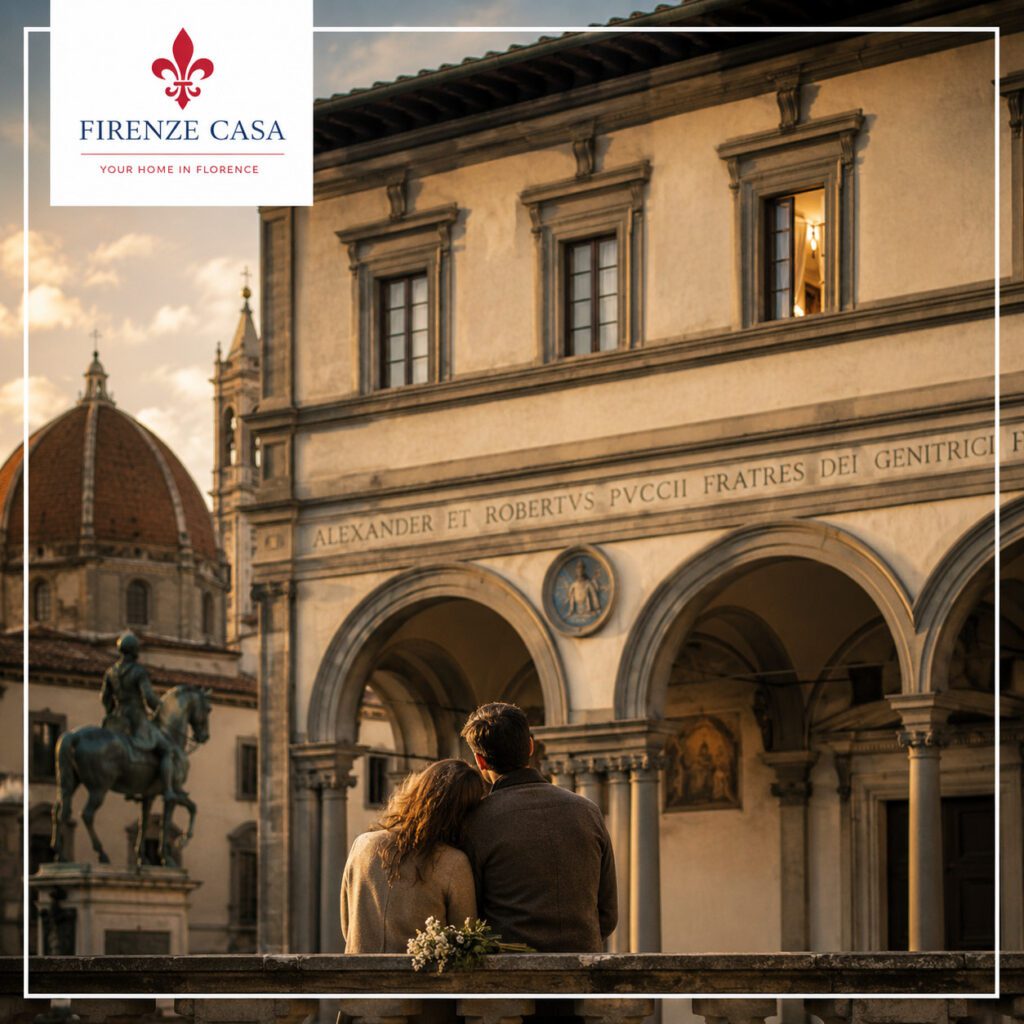
Arrive early in Piazza Santissima Annunziata, before the cafés have filled with conversation and before the footsteps of visitors echo beneath the elegant arcades. The morning light slowly warms the Renaissance façades designed centuries ago, and for a brief moment the square belongs only to Florence itself.
Everything appears perfectly balanced. Every column, every arch and every window reflects the harmony that made this piazza one of the architectural masterpieces of the Renaissance.
Then you notice something unexpected.
One window is open.
Not today. Not because someone forgot to close it. According to local tradition, it has remained open for centuries.
Most visitors never notice it. Those who do inevitably ask the same question.
Why?
The answer is neither written on a plaque nor found in most guidebooks. Instead, it survives as one of Florence’s most touching legends—a story about love, patience and a promise that perhaps was never meant to be broken.
The Story
Many generations ago, when Florence was still surrounded by its medieval walls and merchants carried their goods across Tuscany on horseback, a young couple lived near Piazza Santissima Annunziata.
He was not a nobleman or a famous artist. According to the legend, he was a young merchant whose work required him to travel far from Florence for several months.
On the morning of his departure, he embraced the woman he loved beneath the windows of their home.
“Keep the window open,” he told her with a smile. “When I return, I want to see it from the square and know that you are waiting for me.”
She promised.
Every evening she opened the window before sunset.
Every morning she looked across the piazza, hoping to recognise his familiar figure among the travellers arriving in the city.
Weeks became months.
Months slowly turned into years.
No letter ever arrived.
No messenger brought news.
Some believed he had fallen ill. Others whispered that bandits had attacked the caravan somewhere beyond the Apennines. Eventually, people stopped asking about him.
Only she continued to wait.
The open window became part of daily life in the neighbourhood. Children grew up seeing it every morning. Shopkeepers crossed the square beneath it. Seasons changed. Generations passed.
When the young woman eventually died, her neighbours quietly closed the shutters inside the house.
But not the window.
According to the legend, no one had the heart to close the opening through which she had waited so faithfully. Instead, each new family living in the building left it open in her memory.
Not because they expected the traveller to return.
But because some promises deserve to outlive those who made them.
❤️ A Story That Lives On
Whether the legend is true has never mattered to most Florentines. The open window became something larger than a love story. It reminds us that hope is sometimes stronger than certainty, and that faithfulness can leave a mark on a city just as surely as marble or stone.
History & Facts
Like many Florentine legends, the story of the Open Window cannot be confirmed by historical documents. Historians have never found evidence identifying the young couple or proving that the tradition began exactly as the legend describes.
What is certain, however, is that visitors have been pointing out the permanently open window for generations. It has become part of the folklore surrounding Piazza Santissima Annunziata and continues to inspire curiosity among locals and travellers alike.
Several alternative explanations have been suggested over the years. Some believe the open window symbolised eternal hospitality. Others connect it with religious devotion, suggesting that it remained open as a sign of respect for the nearby Basilica della Santissima Annunziata. Another theory proposes that the story simply grew from an ordinary household habit that gradually evolved into one of Florence’s favourite urban legends.
Whatever its true origin, the legend has become inseparable from the square itself.
Piazza Santissima Annunziata Through the Centuries
| Period | What Happened |
|---|---|
| 1250s | Construction of the Basilica della Santissima Annunziata expands the religious importance of the area. |
| 15th Century | Filippo Brunelleschi designs the famous Ospedale degli Innocenti, creating one of Europe’s first Renaissance squares. |
| 16th–17th Century | The legend of the permanently open window begins circulating among Florentine families. |
| Today | The mysterious window remains one of Florence’s best-kept local stories. |
Why It Matters Today
Florence is filled with extraordinary masterpieces, yet sometimes it is the smallest details that remain longest in our memories.
The Open Window reminds us that cities are not built only from stone and architecture. They are also built from the stories people choose to preserve and pass from one generation to the next.
Whether the young woman ever existed is ultimately impossible to know. But the emotions behind the legend—love, hope, patience and remembrance—are timeless. They resonate just as deeply today as they would have centuries ago.
Perhaps that is why visitors continue searching for the mysterious window. They are not simply looking for an architectural curiosity. They are looking for a story that transforms a beautiful square into something deeply human.
And perhaps that is Florence’s greatest gift. Here, history and legend rarely compete with one another. Instead, they quietly coexist, leaving every visitor free to decide which version they wish to believe.
Firenze Casa Insider Tip
💡 Look Up Before You Walk On
Most visitors cross Piazza Santissima Annunziata while admiring Brunelleschi’s elegant architecture, the Fountain of the Sea Monsters or the bronze equestrian statue in the centre of the square. Very few ever think to look upwards.
That is exactly why the Open Window remains one of Florence’s best-kept secrets.
Stand quietly in the middle of the piazza and let your eyes wander across the upper floors of the surrounding palaces. Suddenly, the open window reveals itself. There is nothing spectacular about it—no sign, no explanation, no crowd taking photographs.
Perhaps that is precisely what makes the experience so memorable. You have not discovered another monument. You have discovered a story.
Where to Find It
The legendary Open Window overlooks Piazza Santissima Annunziata, one of the most harmonious Renaissance squares in Europe. The piazza is located about a ten-minute walk from Florence Cathedral and can easily be combined with visits to the Accademia Gallery or the Basilica della Santissima Annunziata.
The square is beautiful throughout the day, but early morning offers a very special atmosphere. Before the cafés become busy and tour groups arrive, the silence allows you to appreciate the remarkable symmetry imagined by Brunelleschi almost six hundred years ago.
If you visit in the late afternoon, stay a little longer. As the warm Tuscan light slowly fades across the arcades, it becomes surprisingly easy to imagine the young woman from the legend still standing quietly at her window, waiting for footsteps that never came.
📍 Visitor Information
| Location | Piazza Santissima Annunziata, Florence |
| Nearest Landmark | Basilica della Santissima Annunziata |
| Admission | Free |
| Best Time to Visit | Early morning or late afternoon |
| Time Needed | 15–20 minutes |
Why Do Legends Like This Survive?
Historians often ask whether a legend is true. Human beings usually ask a different question: Why has it survived for so long?
Perhaps stories such as the Open Window endure because they express something that facts alone cannot explain. Every generation hopes that loyalty, love and devotion can overcome time, distance and even death. Reality often teaches us otherwise, yet we continue telling stories that remind us how life might be at its very best.
Literature is filled with characters who wait. Penelope waits for Odysseus. Countless lovers wait in novels, poems and songs. The details change, but the hope remains the same. Faithfulness has always fascinated humanity precisely because it is so rare.
Maybe that is why the Open Window still captures our imagination today. We do not admire it because we believe every detail of the legend happened exactly as described. We admire it because it represents an ideal that people have searched for throughout history: a promise kept, even when keeping it no longer seems reasonable.
Florence has always understood that cities are built not only with stone, marble and genius, but also with memory. Sometimes a single open window tells us more about the human heart than an entire palace filled with masterpieces.
Perhaps historians will one day discover the true origin of the window. Or perhaps they never will. Yet that uncertainty may be the greatest gift of all. A solved mystery becomes history. An unsolved mystery remains a story—and stories are often what we remember long after dates and names have been forgotten.
Frequently Asked Questions
Is the Open Window a true historical story?
No historical document has confirmed the legend. It belongs to Florence’s rich tradition of local folklore and has been passed down through generations.
Can visitors still see the window today?
Yes. Observant visitors can still identify the famous open window overlooking Piazza Santissima Annunziata.
Why has the window remained open?
No one knows with certainty. Various explanations exist, ranging from the romantic legend to religious symbolism and local tradition.
Is Piazza Santissima Annunziata worth visiting?
Absolutely. It is one of Florence’s finest Renaissance squares and remains surprisingly peaceful compared with many of the city’s better-known attractions.
How long should I spend here?
Allow at least twenty minutes to enjoy the architecture, visit the basilica and search for the famous window.
Further Reading from Firenze Casa
- The Mystery of the Porcellino: Florence’s Famous Lucky Boar
- Piazza della Signoria: A Complete Visitor’s Guide
- Florence’s Symbols: The Lily & the Marzocco
- Sant’Ambrogio Market: A Local’s Guide
Selected Literature
- Hibbert, Christopher. Florence: The Biography of a City.
- Zöllner, Frank. Florence – Portrait of a City.
- Brucker, Gene. Renaissance Florence.
- Comune di Firenze – Historical Publications.
- Local Florentine oral traditions and historical accounts relating to Piazza Santissima Annunziata.

