
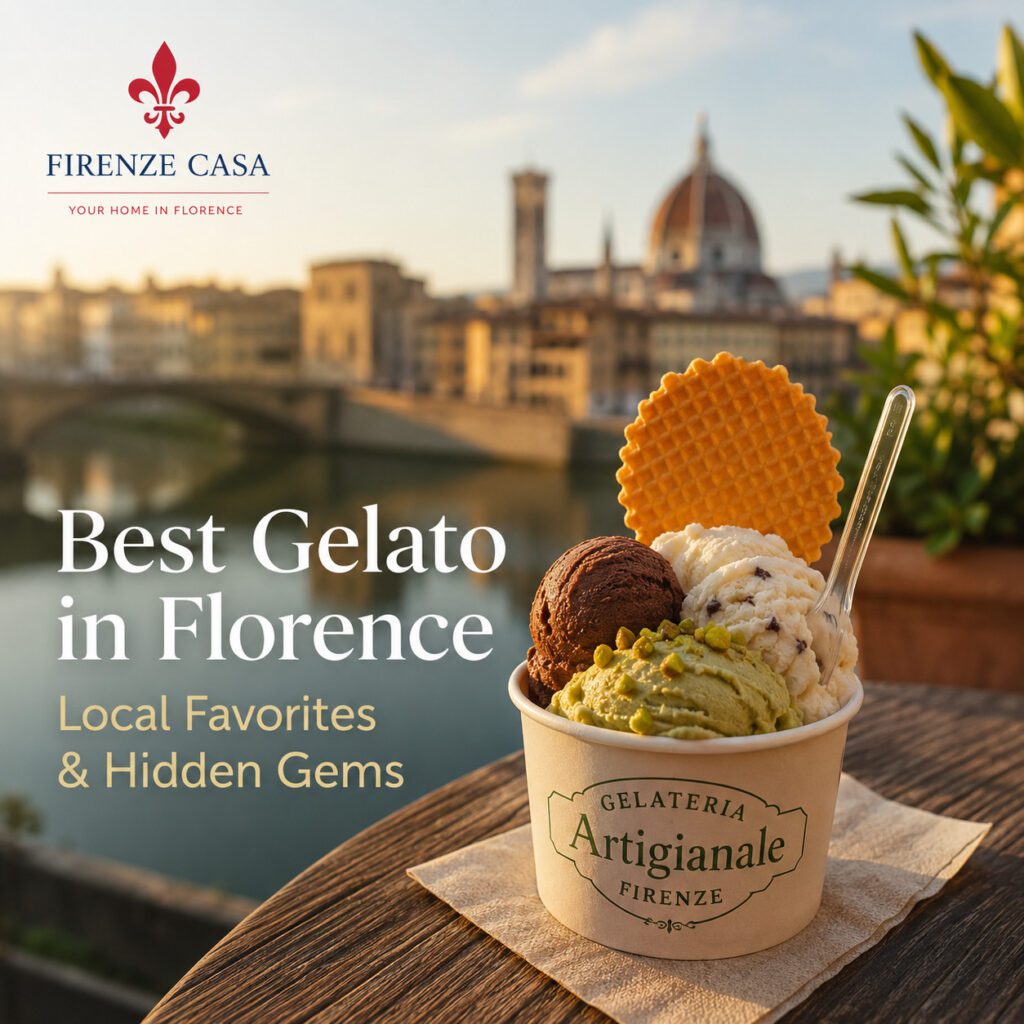
Finding excellent gelato in Florence is easy once you know what to look for. The historic centre has countless gelaterias, but quality varies considerably, and the longest queue or most spectacular display does not necessarily lead to the best experience.
This guide explains how to recognise good artisan gelato, which classic flavours are worth trying and how Florentines enjoy one of Italy’s favourite treats. Rather than attempting an endless ranking, we also highlight a small selection of established gelaterias that offer useful starting points for visitors.
Look for: Natural-looking colours, balanced displays and seasonal flavours
Classic choices: Pistacchio, nocciola, crema and stracciatella
Florentine connection: Bernardo Buontalenti and the Medici court
Good approach: Quality matters more than queues or elaborate displays
Local pleasure: Gelato during an afternoon or evening stroll
Florence and the History of Gelato
Florence has an important place in the history of Italian frozen desserts. The city’s best-known gelato story centres on Bernardo Buontalenti, the Florentine architect, engineer and theatrical designer who worked for the Medici court during the sixteenth century.
Buontalenti is traditionally associated with an elaborate frozen preparation made with ingredients such as milk, cream, eggs and sugar. However, describing him simply as the “inventor of gelato” makes a complicated culinary history sound much more certain than it really is.
Frozen desserts existed in different forms before Buontalenti, and modern gelato emerged through developments spanning different places and periods. Our True History of Italian Gelato explores this fascinating mixture of documented history and culinary legend in greater detail.
The Medici connection nevertheless remains important. Court culture, elaborate entertainments and access to ice created an environment in which sophisticated frozen preparations could develop. Our article on How the Medici Shaped Florentine Cuisine places these traditions within the wider food culture of Renaissance Florence.
Bernardo Buontalenti is strongly associated with Florence’s gelato tradition, but modern gelato cannot reliably be attributed to one inventor. The famous story is best understood as part of a much longer history of frozen desserts.
Why Gelato Is Different from Ice Cream
Gelato and conventional ice cream belong to the same broad family of frozen desserts, but their recipes and production methods often differ. Gelato typically contains less fat than many styles of ice cream and is generally churned with less incorporated air.
This contributes to the dense, smooth texture associated with good Italian gelato. It is also normally served at a somewhat higher temperature than hard-frozen ice cream, allowing aromas and flavours to become more noticeable.
However, there is no single recipe that defines every gelato. Milk-based flavours, fruit sorbets and individual artisan preparations naturally have different compositions.
What Makes Good Artisan Gelato?
Good gelato begins with ingredients and careful preparation. Milk, nuts, chocolate, fruit and other flavouring ingredients should remain recognisable rather than being overwhelmed by excessive sweetness or artificial aromas.
Freshness also matters. Artisan producers commonly prepare relatively small quantities and adjust their selection according to demand and season.
Natural-Looking Colours
Colour provides one useful clue, although it should never be treated as proof of quality. Pistachio is naturally much more muted than the brilliant green sometimes seen in tourist-oriented displays, while banana tends towards cream rather than bright yellow.
In general, extremely vivid colours deserve a little scepticism, particularly when they bear little resemblance to the ingredient they supposedly represent.
Moderate Displays
Huge sculpted mountains of gelato rising far above their containers are visually impressive but are not themselves evidence of craftsmanship. Many excellent gelaterias use relatively restrained displays or keep gelato in covered containers known as pozzetti.
Again, presentation alone cannot determine quality. It is simply one of several details worth observing.
Seasonal Flavours
A changing selection can be another encouraging sign. Strawberry, peach, fig and other fruit flavours make particular sense when the corresponding fruit is in season.
Not every year-round flavour is automatically inferior, since professional gelato makers can use high-quality preserved ingredients. Nevertheless, seasonality often provides an opportunity to taste particularly expressive fruit gelato.
Do not judge a gelateria by one feature alone. Natural colours, a thoughtful selection, clean flavours and seasonal ingredients together tell you much more than either a long queue or an impressive display.
Classic Gelato Flavours to Try in Florence
Creative flavours can be enjoyable, but traditional varieties are often the best way to judge a gelateria. Simple recipes leave less room to hide mediocre ingredients.
- Pistacchio: Nutty and creamy, with a naturally muted colour rather than fluorescent green.
- Nocciola: Hazelnut gelato with a rich but balanced flavour.
- Crema: A traditional custard-style flavour based on milk, sugar and egg.
- Stracciatella: Milk-based gelato with fine pieces or ribbons of chocolate.
- Cioccolato fondente: A darker and more intense chocolate option.
- Limone: A refreshing citrus choice, particularly appealing in warm weather.
- Seasonal fruit: Strawberry, peach, apricot and fig can be excellent when the fruit itself is at its best.
Rather than choosing five or six flavours at once, try one or two complementary varieties. This makes their individual character much easier to appreciate.
Common Mistakes When Choosing Gelato
One of the easiest mistakes is assuming that popularity automatically equals quality. Online recommendations can be useful, but Florence has enough good gelaterias that visitors rarely need to spend a large part of their afternoon waiting in a queue.
Location can also be misleading. A gelateria beside a famous monument may be excellent, mediocre or somewhere in between; the view outside tells you little about what is inside the display case.
Price is equally unreliable as a quality indicator. Premium ingredients such as pistachios or high-quality chocolate are expensive, but a higher selling price alone does not guarantee better gelato.
Finally, avoid treating rules such as “never buy brightly coloured gelato” as absolute tests. Choosing well is about combining several observations rather than following one supposedly infallible trick.
How Florentines Enjoy Gelato
Gelato is not reserved for the end of a restaurant meal. It can be an afternoon snack, an evening treat or part of a leisurely walk through the city.
This makes it a natural companion to the Italian tradition of the passeggiata. As temperatures become more pleasant towards evening, streets and piazzas fill with people walking, talking and meeting friends.
There is no complicated etiquette involved. Choose a cone or cup, select the flavours you genuinely want and enjoy the gelato before it begins to melt.
Gelato does not need to become another item on a sightseeing checklist. Buy one when you feel like taking a break, find a nearby piazza and enjoy Florence for twenty minutes without going anywhere.
Gelato, Coffee and Florentine Food Culture
Gelato fits naturally into Florence’s broader food culture, where relatively simple pleasures often matter more than elaborate presentation. It also overlaps with another great Italian ritual: coffee.
The classic affogato combines gelato with hot espresso, creating a contrast between cold sweetness and intense coffee. Our guide to Italian Coffee Culture in Florence explains the city’s everyday coffee traditions in more detail.
For other sweet regional specialities beyond gelato, see our guide to Traditional Tuscan Desserts. Together, these foods show that Tuscany’s culinary identity extends well beyond its famous savoury dishes.
Our Recommended Gelaterias in Florence
Florence has many good gelaterias, and personal preference inevitably plays a role. Rather than pretending that one establishment can objectively be declared “the best”, these three provide useful starting points with different histories and styles.
Gelateria dei Neri
Gelateria dei Neri, close to Santa Croce, has been a Firenze Casa favourite for many years. It combines traditional flavours with a broad selection and is particularly convenient for visitors exploring the eastern side of the historic centre.
Its popularity means it can become busy, but there is rarely any reason to treat a queue as part of the experience. Florence has plenty of alternatives if the wait becomes excessive.
Perché No!
Perché No! has been part of Florence’s gelato landscape since 1939. Its central location makes it easy to combine with a walk between Piazza della Signoria, the Duomo and Piazza della Repubblica.
The establishment is a useful example of how gelato has become embedded in the everyday commercial history of central Florence rather than existing purely as a recent visitor attraction.
Vivoli
Vivoli is another long-established Florentine name, located near Santa Croce. It is particularly well known for its affogato, combining gelato with espresso.
As with every recommendation, tastes differ. These three should therefore be treated as starting points rather than a definitive ranking.
Finding Your Own Favourite Gelateria
One advantage of spending several days in Florence is that you do not have to solve the question of the city’s “best gelato” in a single afternoon. Try different places and compare a familiar flavour such as pistachio, hazelnut or chocolate.
Neighbourhoods away from the busiest monuments can be particularly enjoyable for this kind of exploration. A gelateria does not need international fame to produce excellent work.
Ultimately, your favourite may simply be the place where the flavour, atmosphere and moment come together. That is a much more useful measure than trying to establish an objective city-wide ranking.
Frequently Asked Questions
What is the difference between gelato and ice cream?
Gelato generally contains less fat and less incorporated air than many conventional ice creams and is served somewhat warmer. This contributes to its dense texture and pronounced flavour.
How can I recognise good artisan gelato?
Look for natural-looking colours, balanced flavours, thoughtful presentation and seasonal ingredients. No single visual clue guarantees quality.
Did Florence invent gelato?
Florence played an important role in the history of frozen desserts, and Bernardo Buontalenti is famously associated with the tradition. However, modern gelato developed over time and cannot reliably be attributed to one inventor or city.
Which gelato flavours should I try first?
Pistachio, hazelnut, crema, stracciatella and chocolate are useful classics for judging a gelateria. Seasonal fruit flavours can also be excellent.
Is Gelateria dei Neri worth visiting?
We consider it a reliable Firenze Casa recommendation and have included it among our favourites. However, Florence has many excellent gelaterias, so there is no need to wait excessively if it is particularly crowded.
When do Italians eat gelato?
There is no strict time. Gelato is commonly enjoyed as an afternoon or evening treat and often accompanies a walk through the city.
Why Gelato in Florence Is Worth Discovering
Gelato combines culinary pleasure with a fascinating part of Florence’s history. Its connections with Renaissance court culture, artisan production and contemporary city life make it much more than a convenient dessert between museums.
The best approach is also the simplest: avoid chasing rankings, learn a few signs of good craftsmanship and try different gelaterias during your stay.
You may eventually find a favourite. But even if you do not, searching for it is one of the more enjoyable ways to explore Florence.
Further Reading on Firenze Casa
- Florentine and Tuscan Food – Complete Guide
- The True History of Italian Gelato
- How the Medici Shaped Florentine Cuisine
- Traditional Tuscan Desserts: Sweet Specialties
- Italian Coffee Culture – How Florence Enjoys Coffee
- Understanding the Traditional Italian Meal
- The Historic Cafés of Florence – Coffee, Culture and Literary Life
References
- Accademia Italiana della Cucina.
- Comune di Firenze – Historical resources on Florence and Bernardo Buontalenti.
- Capatti, Alberto & Montanari, Massimo – Italian Cuisine: A Cultural History.
- Montanari, Massimo – Italian Identity in the Kitchen.
- Historical material on Florentine gelato and artisan food traditions.

