
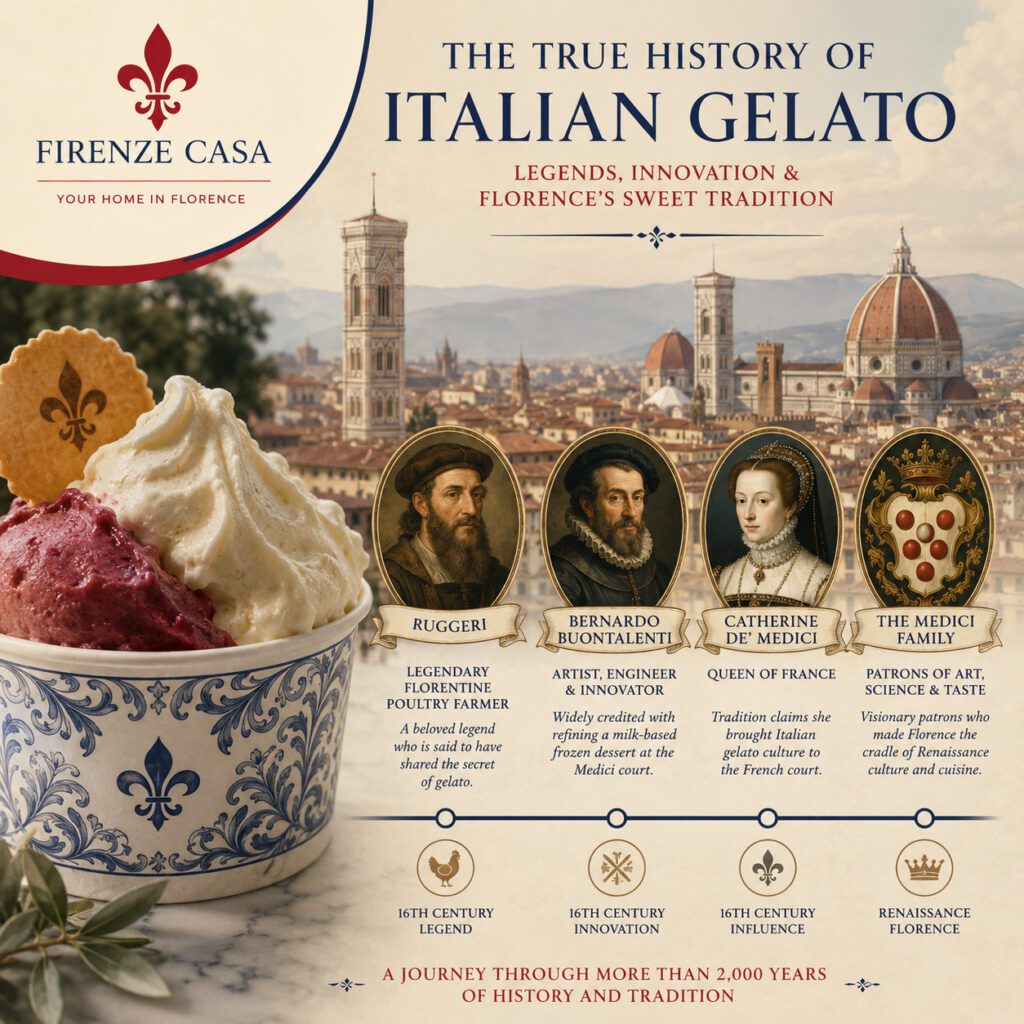
The history of Italian gelato is far more complex than the familiar story of one brilliant Florentine inventor. Frozen desserts developed over centuries through advances in ice storage, sugar production, cooling techniques and courtly cuisine across several cultures.
Florence nevertheless plays an important role in this story, especially through Renaissance court culture and the figure of Bernardo Buontalenti. This article separates documented history from culinary legend and explains how gelato gradually emerged from a much older tradition of frozen foods.
Ancient roots: Snow, ice and flavoured frozen refreshments existed long before modern gelato
Important influence: Persian and Arab cooling traditions
Italian development: Sicily and Renaissance courts played major roles
Florentine figure: Bernardo Buontalenti
Famous legend: Catherine de’ Medici introduced gelato to France
Historical conclusion: No single person invented modern gelato
Gelato and Ice Cream Are Related, but Not Identical
Modern gelato and conventional ice cream belong to the same broad family of frozen desserts, but their typical production styles differ.
Gelato usually contains less fat than many cream-heavy ice creams and often incorporates less air during freezing. It is also commonly served at a slightly warmer temperature, contributing to its dense texture and pronounced flavour.
However, no single recipe defines every gelato. Fruit sorbets, milk-based flavours and individual artisan preparations naturally vary in composition and technique.
| Gelato | Typical Conventional Ice Cream |
|---|---|
| Often lower in fat | Often higher in cream and fat |
| Usually less incorporated air | Often more aerated |
| Dense texture | Lighter texture |
| Served somewhat warmer | Usually served colder |
Frozen Desserts Before Italy
The history of frozen food does not begin in Florence or even in Europe. Long before mechanical refrigeration, different societies developed methods for collecting, storing and using snow and ice.
These early preparations were not gelato in the modern sense. Nevertheless, they established two essential ideas: cold itself could become a luxury, and frozen refreshments could be deliberately flavoured.
Ancient Persia and Ice Storage
Ancient Persian cultures developed sophisticated techniques for preserving ice in hot climates. Structures commonly known as yakhchals allowed winter ice to be stored for use during warmer months.
Cold drinks and frozen or semi-frozen refreshments flavoured with ingredients such as fruit and rose water belonged to this broader tradition.
These preparations were fundamentally different from milk-based gelato, but Persian expertise demonstrates that advanced ice storage and chilled desserts existed many centuries before Renaissance Italy.
The history of gelato begins with technologies for controlling temperature. Before modern refrigeration, storing ice itself required considerable engineering, labour and wealth.
What About Ancient China?
Popular histories of ice cream frequently claim that China produced frozen milk or fruit desserts many centuries before Europe. Ancient Chinese societies certainly knew sophisticated methods of storing ice and preparing chilled foods.
However, surviving evidence does not justify a simple statement that “China invented ice cream”. Accounts vary widely, and later retellings often combine genuine historical practices with much more speculative claims.
China therefore belongs to the wider global history of ice and frozen refreshments, but it cannot securely be identified as the single birthplace of modern gelato.
The Romans and Snow-Flavoured Desserts
Ancient Romans also valued snow and ice as luxury goods. Wealthy households could combine chilled snow or ice with sweeteners, fruit or other flavourings.
The Emperor Nero is often singled out in popular accounts, but stories crediting him personally with a specific proto-gelato recipe should be treated cautiously. Roman literature does support the broader use of snow and chilled foods among elites.
These preparations again differ fundamentally from modern gelato because they lacked the dairy base, controlled freezing and texture associated with later frozen desserts.
Arab Sicily and the Development of Frozen Sweets
One of the most important chapters in the development of Italian frozen desserts comes from medieval Sicily and the wider Arab Mediterranean world.
Arab agricultural and culinary influence helped spread sugar cultivation, citrus fruits, almonds and other ingredients that later became important in Sicilian sweets. Techniques for flavouring and chilling drinks also formed part of this exchange.
Sicily subsequently developed strong traditions of sorbetto and granita. These should not simply be called early gelato, but they represent a crucial stage in the evolution of Italian frozen desserts.
Modern gelato emerged from cultural exchange rather than from one isolated invention. Sicily’s position between Europe, North Africa and the eastern Mediterranean made it especially important in that long process.
Ice, Sugar and Renaissance Italy
By the late medieval and Renaissance periods, wealthy Italian courts had access to increasingly sophisticated methods of storing ice and preparing elaborate sweets.
Sugar also became more important within elite cuisine, although it remained an expensive ingredient for much of this period. Combining controlled cold with sugar, fruit, dairy products and flavourings opened new possibilities for frozen desserts.
Florence was particularly well placed to participate in these developments because of its wealthy court, commercial connections and culture of elaborate ceremonial entertainment.
Why Florence Became Important
Renaissance Florence provided an environment in which food could become part of courtly spectacle. Medici celebrations combined architecture, theatre, music, decoration and elaborate dining.
The family’s court employed artists, engineers and organisers capable of solving practical problems involving stage effects, water, cooling and temporary installations. Culinary experimentation therefore existed within a much wider culture of technical and artistic innovation.
This context is explored further in our article How the Medici Shaped Florentine Cuisine.
The Ruggeri Legend
One of Florence’s most colourful gelato stories concerns a man named Ruggeri, traditionally described as a poultry seller or poultry farmer who entered a culinary competition connected with the Medici court.
According to the legend, his frozen creation impressed the judges and brought him unexpected fame. Later versions even connect him with Catherine de’ Medici and the French court.
The problem is documentary evidence. Modern retellings provide many details, but reliable contemporary sources establishing Ruggeri’s identity, recipe and role in the development of gelato remain elusive.
The story therefore belongs more securely to Florentine culinary folklore than to firmly documented food history.
Ruggeri remains part of Florence’s gelato tradition, but the surviving evidence does not support presenting him as the documented inventor of gelato.
Bernardo Buontalenti and Florentine Gelato
Bernardo Buontalenti (1531–1608) is the historical figure most strongly associated with Florence’s gelato tradition.
Buontalenti was an architect, engineer, painter and theatrical designer who worked for the Medici court. His documented career demonstrates an extraordinary ability to combine artistic imagination with technical expertise.
Later culinary tradition associates him with a rich frozen preparation using dairy products, sugar and flavourings for Medici festivities. The precise original recipe and circumstances remain difficult to reconstruct securely.
What matters historically is less whether Buontalenti produced the first-ever gelato than that Renaissance Florence became strongly associated with increasingly sophisticated frozen desserts.
Did Buontalenti Invent Gelato?
Probably not in the simple sense suggested by tourist guidebooks. Frozen desserts already existed in several cultures, and Italian traditions had developed well before Buontalenti’s lifetime.
His place in the story is better understood as that of an important Florentine figure associated with the refinement of rich frozen preparations within Medici court culture.
That distinction preserves his significance without requiring the unsupported claim that one man suddenly invented modern gelato.
Buontalenti matters because he represents Renaissance Florence’s role in the development of sophisticated frozen desserts. Calling him the sole inventor of gelato turns a long cultural evolution into a much simpler story than the evidence allows.
The Buontalenti Flavour
Florence still celebrates Buontalenti through a gelato flavour bearing his name. Modern versions generally emphasise rich dairy and egg flavours.
The flavour should be understood as a later tribute rather than a direct survival of a precisely documented sixteenth-century recipe.
This distinction is useful because culinary traditions often preserve historical memory through names even when the modern product differs considerably from what people ate centuries earlier.
Catherine de’ Medici and France
Catherine de’ Medici provides another famous chapter in gelato mythology. Born in Florence in 1519, she married the future Henry II of France in 1533.
Later stories credit her with transporting Italian cooks, frozen desserts and numerous culinary innovations to the French court. Similar legends claim that she introduced forks, sauces and several other foods to France.
Modern historians treat these broad claims cautiously. French court cuisine already possessed sophisticated traditions of its own, while contemporary documentation supporting many of the specific Catherine stories is weak.
There is no convincing contemporary evidence that she personally introduced gelato to France. The story remains interesting as an example of how later generations used Catherine to explain cultural exchange between Renaissance Italy and France.
Our article on Medici cuisine examines this broader pattern of culinary myths surrounding the family.
So Who Invented Italian Gelato?
No single person can reasonably be identified as the inventor of Italian gelato.
The dessert emerged gradually from several developments: ancient and medieval ice storage, Mediterranean traditions of flavoured frozen refreshments, the increasing availability of sugar, Sicilian sorbet traditions and the sophisticated court culture of Renaissance Italy.
Florence contributed importantly to this development, particularly through the association between the Medici court and Bernardo Buontalenti. Sicily contributed another essential line of development through sorbetto and granita traditions.
Modern gelato therefore represents a long process of culinary exchange rather than one dramatic moment of invention.
| Claim | Assessment |
|---|---|
| Ancient China invented gelato. | Too simplistic; ancient frozen traditions existed, but direct continuity is unproven. |
| Emperor Nero invented ice cream. | Legendary exaggeration of Roman elite use of snow and ice. |
| Ruggeri invented gelato. | Florentine tradition with limited documentary support. |
| Buontalenti invented gelato. | Oversimplification; he remains an important figure in Florentine frozen-dessert history. |
| Catherine de’ Medici introduced gelato to France. | Popular legend without convincing contemporary documentation. |
| Florence influenced the development of gelato. | Yes, especially through Renaissance court culture and later Florentine tradition. |
From Court Dessert to Public Gelateria
Renaissance court preparations still differed considerably from the gelato sold in modern shops. The transformation into a widely available commercial food required later developments in refrigeration, freezing technology and professional production.
By the nineteenth and twentieth centuries, mechanical refrigeration made frozen desserts far easier to produce consistently and distribute beyond elite households.
Artisan gelaterias subsequently became part of everyday Italian urban life, turning what had once depended on expensive ice and courtly resources into an accessible popular food.
Gelato in Florence Today
Florence remains strongly identified with gelato, although historical reputation alone does not guarantee quality in every shop.
Modern artisan gelato depends on ingredients, formulation, temperature control and production technique rather than on claims of Renaissance authenticity.
Visitors interested in choosing a gelateria can find practical advice in our Best Gelato in Florence: Local Favorites & Hidden Gems.
Gelato also belongs within the wider world of Florentine and Tuscan food. Our Florentine and Tuscan Food – Complete Guide provides the broader culinary overview.
Frequently Asked Questions
Who invented Italian gelato?
No single inventor can be identified. Gelato developed gradually from older traditions of ice storage, frozen refreshments, sorbet and later milk-based desserts.
Did Bernardo Buontalenti invent gelato?
He is strongly associated with Florence’s gelato tradition, but calling him the sole inventor oversimplifies a much longer history.
Did Catherine de’ Medici bring gelato to France?
The story is popular but lacks convincing contemporary documentary evidence. Historians generally treat it cautiously.
Did ancient Romans eat ice cream?
Roman elites consumed snow or ice with sweet or flavoured ingredients, but these preparations differed substantially from modern gelato.
What role did Sicily play in gelato history?
Sicily developed important traditions of sorbetto and granita under strong Mediterranean and Arab influence, making it central to the history of Italian frozen desserts.
Why is Florence associated with gelato?
Renaissance court culture, Bernardo Buontalenti and later Florentine tradition created a particularly strong historical connection between the city and sophisticated frozen desserts.
Why the History of Italian Gelato Is Worth Understanding
The real history of gelato is more interesting than the search for one inventor. It connects ancient engineering, Mediterranean trade, Arab Sicily, Renaissance courts and later technological change.
Florence occupies an important place within that story, but not because one Florentine suddenly created gelato from nothing. Its significance lies in the way Renaissance court culture refined and celebrated frozen desserts within an exceptionally creative environment.
Understanding that longer history makes gelato more than a colourful souvenir. It becomes a small example of how food evolves through migration, technology, trade and cultural exchange.
Further Reading on Firenze Casa
- Best Gelato in Florence: Local Favorites & Hidden Gems
- Florentine and Tuscan Food – Complete Guide
- How the Medici Shaped Florentine Cuisine
- Traditional Tuscan Desserts: Sweet Specialties
- Italian Coffee Culture – How Florence Enjoys Coffee
References
- Albala, Ken – Food in Early Modern Europe.
- Capatti, Alberto & Montanari, Massimo – Italian Cuisine: A Cultural History.
- Davidson, Alan – The Oxford Companion to Food.
- Montanari, Massimo – Medieval Tastes: Food, Cooking and the Table.
- Toussaint-Samat, Maguelonne – A History of Food.
- Treccani – Bernardo Buontalenti.
- Treccani – Medici family.

